The best tool for rewriting headlines as questions depends on the job. A general AI assistant handles quick, bulk rewrites. A question research tool tells you which questions people actually ask. A content platform does both inside a full article workflow. No single product wins all three, and the mistake most teams make is using the first kind when they need the second.
That distinction matters because a grammatically correct question that nobody searches adds nothing. The sections below explain why question headings help in search and in AI answers, what a good rewriting tool must do, how the tool categories compare, a prompt and workflow you can run today, when to skip the format, and how to test whether a rewrite worked.
Why Question Headlines Help Both Search and AI Answers
People type conversational queries into Google, and they phrase prompts to ChatGPT, Claude, and Perplexity as full questions. A heading written as a question mirrors that phrasing and maps cleanly to a single intent. "How do you write email subject lines that get opened?" tells a reader, a crawler, and a language model exactly what the section answers.
The second benefit is extraction. A question followed by a direct answer is a self-contained unit. Google features such as People Also Ask, which shows expandable related questions beneath a result, pull from pages that answer a specific question concisely. AI systems that retrieve passages to build answers face the same task: find a chunk that cleanly resolves a query. A heading that states the query and a first sentence that answers it make that chunk easy to lift and cite.
This sits within what is now called GEO, or generative engine optimization: structuring content so AI-driven search tools can find, understand, and mention it. Question headings are one structural lever among many. Others include clear entity naming, factual specificity, authoritative sources, and crawlable, indexed pages. For a broader look at the tooling behind this, see our guide to the best tools for AI search optimization.
It is worth being plain about the limits. Changing a heading to a question does not guarantee a higher ranking, a People Also Ask placement, or an AI citation. Claims of a fixed click-through or citation lift should come with a named study and year, and none is cited here because the effect depends on the query, the page, and the competition. Treat the format as a hypothesis you test, not a trick that works by default.
What a Good Question-Rewriting Tool Must Actually Do
Whatever you choose, judge it against a short set of criteria:
- Keeps the primary keyword. The rewrite should still contain the term you want to rank for, or a close variant that matches how people search it.
- Preserves intent. An informational page should stay informational. A commercial comparison should not turn into a vague "what is" question.
- Sounds natural. Output should read like something a person would ask, not a forced "What is..." template stamped on every title.
- Grounds questions in demand. The best tools draw on search suggestions, People Also Ask data, or tracked AI prompts, so the question reflects real behavior rather than grammar alone.
- Lets you control constraints. Length, tone, and question type (how, why, which) should be adjustable.
The most common mistake is converting every headline mechanically. A listicle titled "12 Project Management Tools for Agencies" becomes "What Is the Best Project Management Tool for Agencies?", which now promises one answer and delivers twelve. The mismatch hurts the reader and muddies the page's intent.
Here is a short illustration. Start with "Email Subject Line Tips." A good rewrite is "How Do You Write Email Subject Lines That Get Opened?" It keeps the keyword phrase, stays informational, and sounds like a real query. A bad rewrite is "Why Are Emails Important?" It drops the keyword, shifts the topic, and matches no useful search. If a tool produces the second kind of output regularly, it is doing grammar conversion, not SEO work.
Tool Categories Compared: AI Assistants, Question Research Tools, and Content Platforms
Tools fall into three groups, and each is strong at a different part of the job. Feature sets and pricing change often, so confirm the details below on each vendor's site; they reflect general positioning as of November 2026.
General AI assistants
ChatGPT, Claude, and Gemini are fast and flexible. Given a list of headings and a well-built prompt, they can rewrite dozens in minutes and adjust tone on request. Their weakness is that they have no live demand data by default. They generate plausible questions, not verified ones, so a rewrite may sound right and still match nothing people search. If you want to compare options for this kind of work, our roundup of the best AI writing tools for SEO covers the field.
Question research tools
AlsoAsked, AnswerThePublic, Google's own People Also Ask and autocomplete, and the question filters in most keyword tools show questions real users ask. They do not rewrite your existing headlines. You use them to find the target wording, then apply it yourself or hand it to an assistant. Check each tool's current free limits and plans before committing.
SEO content platforms
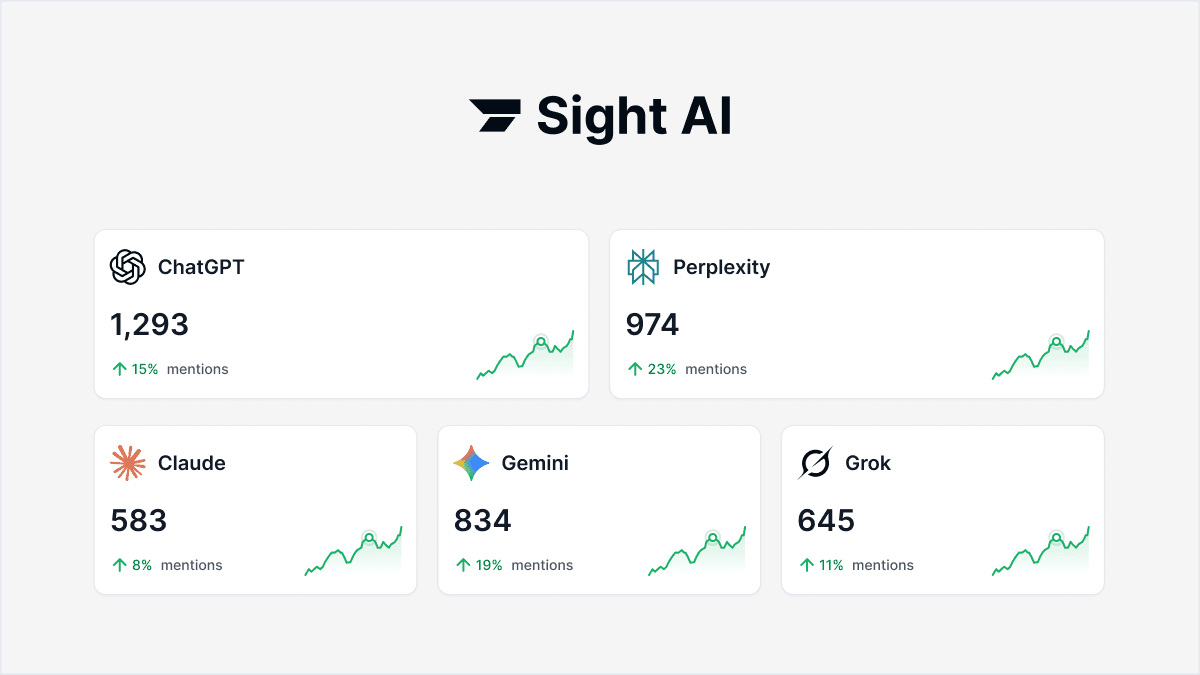
Platforms build question-style headings into a complete article rather than rewriting titles in isolation. Sight AI's AI Content Writer uses 13+ specialized agents to generate SEO and GEO-optimized articles, with heading structure decided in the context of the whole piece. Its AI Visibility tracking, which monitors brand mentions across 6+ AI platforms, shows which prompts mention your brand, so you can see where a question-led section might earn a place. Teams weighing platforms can start with the best SEO tools for content creation.
By use case:
- A handful of headings, no budget: an AI assistant plus Google's People Also Ask.
- Finding which questions deserve a heading: a question research tool.
- Producing and measuring content at scale: a content platform with visibility tracking.
A Prompt and Workflow You Can Use Today
This workflow uses free tools and takes under an hour for a single page.
- Collect current headings. Copy the H1 and every H2 from the page into a list.
- Pull real questions. Search your primary keyword, note the People Also Ask entries and autocomplete suggestions, and save the ones that fit each section's topic.
- Rewrite with constraints. Give an AI assistant the headings, the real questions, and a structured prompt.
- Choose by query match. Pick the variant whose wording is closest to the real query.
- Fix the answer. Make sure the first sentence or two under each heading answers it directly.
A reusable prompt template:
"Rewrite the heading below as a question. Primary keyword: [keyword]. Search intent: [informational / commercial]. Tone: [plain, professional]. Real queries to draw wording from: [pasted list]. Rules: keep the primary keyword or a close variant; titles under 70 characters; no yes/no questions unless the intent is a true yes/no decision; do not use 'What is' unless it is a definition; return 3 to 5 variants, each on its own line."
Generating several variants matters. The first output is rarely the best, and comparing three to five against the real query list lets you choose the phrasing users already use, rather than the one the model found most fluent. If you are stretching a limited budget, these free AI tools for blog optimization can help with the rewriting step.
One requirement is easy to miss: the rewritten heading needs an answer directly beneath it. If the section opens with background and buries the answer in paragraph four, the question format adds nothing. Lead with the answer, then explain.
When Not to Use a Question Headline
Some pages are better served by a direct statement. Navigational and branded pages, such as a pricing page or a product page, match searches where the visitor already knows what they want. "Pricing" or "Integrations" is clearer than a question. Transactional pages usually perform better when they state the offer plainly.
Listicles and comparisons generally keep their numbers and their plural framing, because the number sets an expectation of multiple options. Converting them to a single-answer question breaks that promise, as the earlier example showed.
Overuse is the other trap. If every H2 in an article is a question, the page reads as repetitive, and it can start to look like keyword stuffing rather than structure. A mix works better: questions where the section resolves a real query, statements elsewhere.
Finally, avoid questions that can be answered yes or no. "Is email marketing worth it?" invites a one-word reply and a thin section. Reframing it as "How much revenue can email marketing realistically generate?" or "When is email marketing worth the investment?" gives you room to deliver substance, and gives the reader a reason to stay.
How to Test Whether the Rewrite Worked
Measure in two places: traditional search and AI answers.
Traditional search
In Google Search Console, record impressions, click-through rate, and average position for the page before the change, then compare over a fixed window, typically four to eight weeks. Change one variable at a time. If you rewrite headings, update the intro, and add new links in the same week, you cannot tell which change mattered.
AI answers
Define a set of target prompts, the questions a buyer would ask an AI assistant, and check whether your brand or page is mentioned or cited across ChatGPT, Claude, and Perplexity. A tool like Sight AI's AI Visibility Score, with prompt tracking and sentiment analysis, automates that check and keeps a history, so you can see movement after an edit rather than relying on memory. For more options, see the best tools for tracking AI mentions.
Getting changes discovered
After editing, prompt re-crawling instead of waiting. Submitting through IndexNow, an open protocol that notifies participating search engines of updated URLs, or refreshing your sitemap speeds discovery. Support varies by engine, and Google has not adopted IndexNow as of this writing, so confirm current participants in the IndexNow documentation and keep sitemaps updated either way. Sight AI's indexing tools handle IndexNow submission and automated sitemap updates, and our guide to the best IndexNow tools for faster indexing compares the alternatives.
One caveat applies to all of this. AI responses are non-deterministic: the same prompt can return different answers on different runs. A single check proves nothing. Run each prompt many times, across several days, and look at the trend. Results also vary by site and niche, so a lift on one page does not guarantee the same on another.
Pick One Page and Run the Test This Week
The right tool follows from the job. Use an AI assistant for fast rewrites, a question research tool when you need real query data, and a content platform when you want research, writing, and measurement in one workflow. Whichever you choose, the rewrite only counts if it is grounded in questions people actually ask.
Choose one page, rewrite its headings using real queries, put the answer first under each one, and measure the result in both Search Console and AI visibility tracking. Stop guessing how AI models like ChatGPT and Claude talk about your brand: get visibility into every mention, track content opportunities, and automate your path to organic traffic growth. Start tracking your AI visibility today and see exactly where your brand appears across top AI platforms.