Most marketers check their Google rankings the same way they check the weather before a flight they've already booked: reactively, and usually too late to do anything useful. Traffic dips, a competitor suddenly appears above you for your best keyword, or a client asks how things are going, and suddenly you're scrambling through Search Console trying to piece together what happened.
The problem isn't that ranking data is hard to find. The problem is that without a structured website ranking report from Google, you're looking at isolated data points instead of a coherent story. A single position number tells you almost nothing. A well-built ranking report, reviewed consistently, tells you everything: which pages are gaining momentum, which are quietly slipping, where your content has gaps, and where a small optimization effort could unlock a significant traffic jump.
Here's what makes this more complex in 2026: a traditional SERP ranking report no longer captures the full picture of your search visibility. Google's AI Overviews and AI-native platforms like ChatGPT, Claude, and Perplexity are becoming meaningful discovery channels. Your brand can be recommended, cited, or completely ignored in AI-generated responses regardless of where you rank in traditional search results. A complete ranking report now needs to account for both dimensions.
This guide walks you through everything: what a Google ranking report actually measures, how to generate and automate it, how to interpret the data without overreacting to noise, and how to turn those insights into a concrete SEO and content playbook. By the end, you'll have a system, not just a spreadsheet.
What a Google Ranking Report Actually Measures
Before you can act on ranking data, you need to understand what you're actually looking at. A website ranking report from Google isn't a single number. It's a composite of several interconnected metrics, each telling a different part of the story.
The primary source for this data is Google Search Console's Performance report. The core metrics it tracks are:
Impressions: How many times a URL from your site appeared in Google search results, regardless of whether anyone clicked it. High impressions with low clicks often signal a positioning or title tag problem.
Clicks: The number of times users actually clicked through to your site from a search result. This is the metric most directly connected to traffic.
Click-Through Rate (CTR): Clicks divided by impressions, expressed as a percentage. A low CTR on a high-impression keyword is one of the clearest signals that your title or meta description needs work.
Average Position: This one requires some nuance. Google calculates average position as an impression-weighted average across all the queries and sessions where your page appeared. That means a page that ranks position 2 for one high-volume query and position 40 for dozens of low-volume queries might show an average position of 15. The number can be misleading without filtering by specific queries or pages.
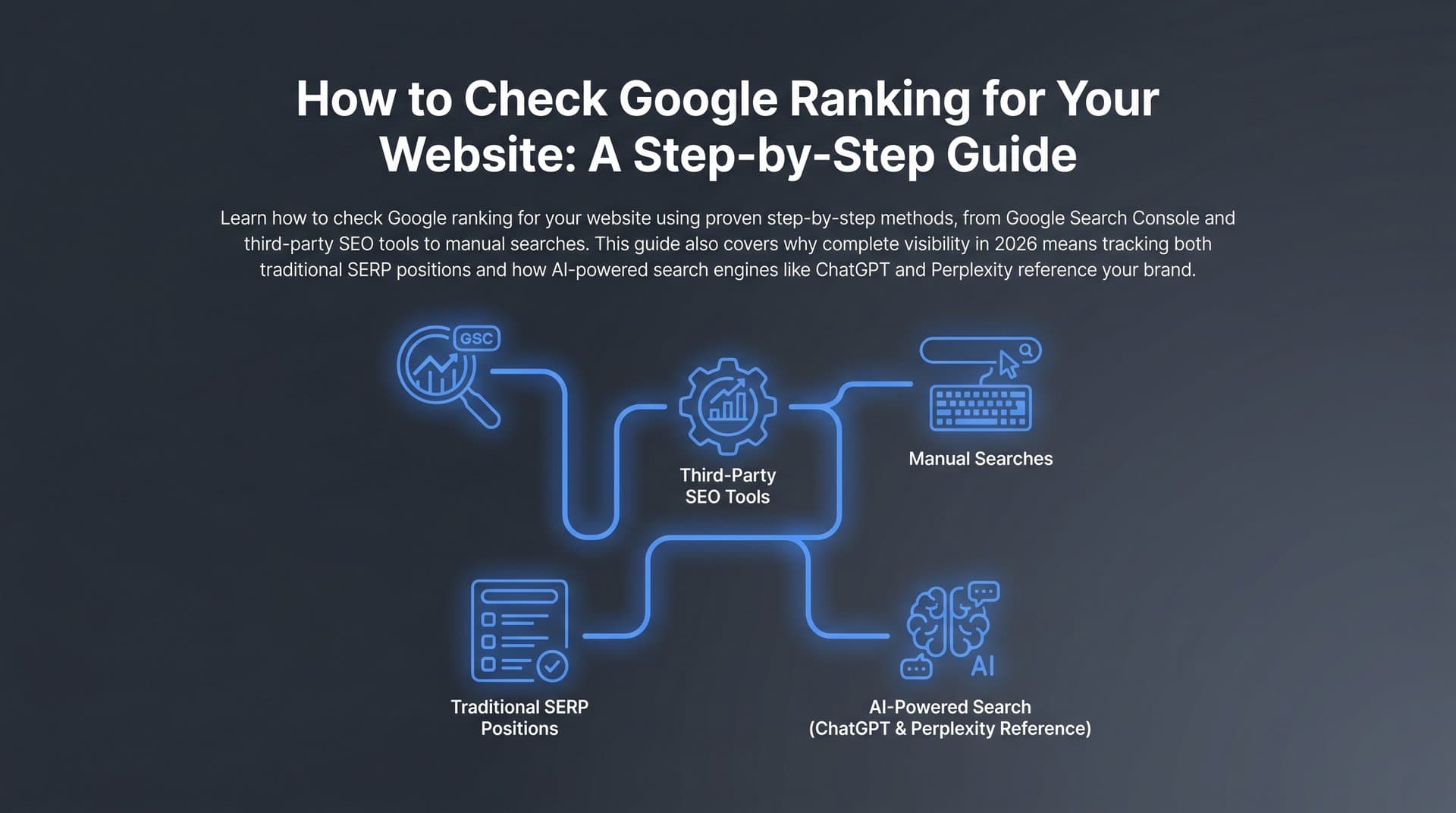
Third-party rank trackers like Ahrefs, Semrush, or Moz add another layer: they crawl search results from specific locations and devices to give you a point-in-time position for a tracked keyword. This is useful for monitoring specific target keywords daily, but it's worth understanding why this data sometimes conflicts with Search Console. Search Console reports on actual user searches and real impressions your site received. Third-party tools simulate searches from fixed locations. Neither is wrong; they're measuring different things.
The most important misconception to clear up is this: there is no single, universal ranking position for any keyword. Rankings are personalized based on search history, localized based on the user's geography, and device-specific, meaning your page may rank differently on mobile versus desktop. When you check your position in Google search, that's an approximation of a range of experiences across many different users. Useful for trend analysis, but not a precise measurement of any one user's experience.
Understanding these nuances prevents two common mistakes: panicking over normal fluctuations and celebrating position improvements that don't actually reflect meaningful traffic gains.
Generating Your Ranking Report: Tools, Sources, and Automation
Knowing what to measure is step one. Step two is building a reliable pipeline that gets that data in front of you regularly without requiring manual effort every time.
Start with Google Search Console's Performance report. It's free, it's authoritative, and it's the only tool that shows you data based on actual Google search activity on your site. To use your SEO ranking data effectively, leverage the filtering options strategically:
Filter by Query to analyze how specific keywords are performing. Sort by impressions to find keywords where you're visible but not converting clicks, and by clicks to identify your top-performing queries.
Filter by Page to evaluate how individual URLs are performing across all the queries they rank for. This is particularly useful when diagnosing why a specific page's traffic has changed.
Filter by Country and Device when your audience is geographically concentrated or when you're trying to understand mobile versus desktop performance gaps.
Adjust the Date Range to compare periods. The "Compare" feature in Search Console lets you set two date ranges side by side, which is invaluable for spotting trend changes after a site update or algorithm shift.
Google Analytics 4 complements Search Console by showing you what happens after the click. Landing page performance data in GA4, including engagement rate, session duration, and conversion events, helps you connect ranking improvements to actual business outcomes. Understanding organic traffic in Google Analytics is essential for measuring whether position gains translate to real sessions and conversions.
For daily position monitoring on specific target keywords, a dedicated rank tracker is worth the investment. These tools track your chosen keywords from specific locations and devices, alert you to significant position changes, and often include competitor tracking so you can see when a competitor gains or loses ground on keywords you share.
The most important workflow improvement you can make is automation. Google Search Console allows data exports via API, and tools like Looker Studio (formerly Google Data Studio) can connect directly to Search Console to create dashboards that update automatically. Set up a Looker Studio report once, share it with your team or clients, and it becomes a living document that refreshes with current data without anyone needing to manually pull reports. Many rank trackers also offer scheduled email reports and Slack integrations, so significant ranking changes reach you proactively rather than waiting for a weekly check.
Reading the Data: Separating Signal from Noise
Here's where many marketers get tripped up. They see their average position drop two spots on a Monday morning and immediately assume something is broken. In most cases, it isn't. Ranking volatility is normal, and Google has publicly confirmed that it processes thousands of algorithm updates per year across its various systems. Daily fluctuations of a few positions for any given keyword are expected behavior, not a crisis.
The skill you need to develop is distinguishing between routine volatility and meaningful shifts that warrant action. A few positions up or down over a day or two is noise. A consistent directional movement over two or more weeks is a signal. A sudden drop of ten or more positions that persists across multiple days is a flag that something specific has changed.
When you see a meaningful shift, the first step is cross-referencing the timing against two things. First, check your own site's change log: was new content published, were pages redirected, was a site speed improvement deployed, or was anything accidentally deindexed? Site-level events are often the cause of ranking changes, and they're easy to overlook if you don't maintain a record of what changed when. If you suspect indexation issues, understanding how to index your website on Google can help you diagnose and resolve them quickly.
Second, check Google's algorithm update timeline. Several SEO publications and tools track confirmed and suspected Google algorithm updates in real time. If your ranking drop aligns with a known core update, the cause is likely algorithmic rather than technical, and the response strategy is different: focus on content quality and authority rather than technical fixes.
One of the most valuable frameworks for prioritizing your attention within a ranking report is the concept of striking-distance keywords. These are keywords where your pages currently rank in positions 5 through 20. They already have relevance and authority signals with Google; they're just not quite on page one or not in the top few results where most clicks happen. These keywords represent your highest-ROI optimization opportunities because the incremental improvement needed to move them is much smaller than what would be required to rank a new page from scratch.
Filter your Search Console Performance report to show queries where your average position falls between 5 and 20, then sort by impressions. The queries with the most impressions in that range are your priority list. Even moving a keyword from position 11 to position 6 can meaningfully change the click volume it generates, because CTR curves are steep in the top ten results.
From Report to Playbook: Turning Data Into Prioritized Actions
A ranking report that doesn't trigger specific actions is just a dashboard you check and close. The goal is to build a decision framework that converts data into a prioritized SEO workload every time you review your reports.
A practical prioritization order looks like this:
1. Fix declining pages first. If pages that previously drove meaningful traffic have dropped significantly in rankings, investigate immediately. Check for indexation issues using the URL Inspection tool in Search Console, review whether the page has been accidentally excluded via robots.txt or a noindex tag, and assess whether the content has become outdated or thin relative to what competitors are now publishing. If your content is not ranking in search, recovering lost rankings is almost always faster than building new ones from scratch.
2. Optimize striking-distance keywords next. For the keywords you identified in the 5-20 position range, the optimization actions typically include: strengthening the on-page content to more comprehensively address the search intent, improving internal linking to the target page from other relevant pages on your site, and refining the title tag and meta description to improve CTR. Sometimes a simple title tag rewrite that better matches search intent is enough to move a keyword from position 9 to position 4.
3. Address high-impression, low-CTR pages. These pages are appearing in search results but not earning clicks. This is often a title and description problem, but it can also indicate a mismatch between the search intent of the query and the content on the page. Review the actual queries driving impressions, look at what the top-ranking results look like, and adjust your page's positioning accordingly.
4. Identify content gap opportunities. Look for clusters of related queries where your site ranks for some variations but not others. This often reveals topics where you have partial coverage but lack a comprehensive, authoritative piece. Publishing a well-structured, in-depth article on the topic can consolidate your rankings and capture the full range of related queries at once. For a broader strategy, explore how to improve organic search ranking across your entire keyword portfolio.
Technical actions also flow directly from ranking data. Pages with high impressions but poor CTR and low average position often benefit from Core Web Vitals improvements, because page experience is a ranking factor. Pages that have dropped out of rankings entirely may have crawl or indexation issues that need to be diagnosed through Search Console's Coverage report. Building a habit of connecting ranking symptoms to their likely technical causes is what separates reactive SEO from a systematic practice.
The New Visibility Layer: AI Search and Why It Belongs in Your Reports
Traditional SERP position tracking was sufficient when Google's ten blue links were the dominant discovery format. In 2026, that's no longer the case. Google's AI Overviews now appear across a significant share of search results, synthesizing information from multiple sources into a direct answer that often reduces clicks to the underlying pages. Simultaneously, AI-native platforms like ChatGPT, Claude, and Perplexity are handling a growing share of informational and research queries that used to flow exclusively through traditional search.
The practical implication is significant: your brand can rank in position 3 on Google for a competitive keyword and still be completely absent from the AI Overview that appears above it. Conversely, your brand might be regularly cited by Claude or Perplexity in response to industry questions even if you don't hold a top-three SERP position. Neither of these realities shows up in a traditional website ranking report from Google. Understanding the AI search engine ranking factors that drive this visibility is becoming essential.
Expanding your ranking report to include AI visibility means tracking a different set of signals. The relevant questions become: Is your brand mentioned when AI models respond to queries relevant to your product or industry? Is the sentiment of those mentions positive, neutral, or negative? How frequently are you cited compared to competitors? And are those AI mentions actually driving traffic to your site?
This is where GEO, or Generative Engine Optimization, enters the picture. GEO is the emerging discipline of optimizing your content so it gets referenced and recommended by AI models, not just indexed by Google's traditional crawler. The tactics overlap with good SEO practice: authoritative, well-structured content that clearly answers specific questions tends to get cited by AI models. But GEO also involves ensuring your brand's factual information is accurate and consistent across the web, that your content addresses the specific formats AI models prefer to cite, and that your site's authority signals are strong enough for AI models to treat you as a reliable source.
Tracking AI visibility alongside traditional rankings gives you a complete picture of your brand's search presence. If you've noticed competitors ranking in AI search results where you're absent, dedicated visibility tracking can help you monitor how AI models talk about your brand, track the sentiment and frequency of those mentions, and identify gaps where competitors are being recommended and you're not. This data belongs in your ranking report alongside your Search Console metrics.
Building a Reporting Cadence That Compounds Over Time
Consistency matters more than sophistication when it comes to ranking reports. A simple report reviewed on a reliable schedule will drive more growth than a complex dashboard checked sporadically. The goal is to build a reporting rhythm that matches the pace at which meaningful changes actually occur.
A practical three-tier cadence works well for most teams and agencies:
Weekly quick-checks (15-20 minutes): Scan for significant position changes on your priority keywords, review any Search Console alerts for coverage or manual action issues, and check whether any pages have experienced sharp drops in impressions or clicks. The goal isn't deep analysis; it's catching problems early before they compound.
Monthly deep-dives (1-2 hours): Compare month-over-month performance across your full keyword set, identify trends in striking-distance keywords, review content performance against traffic goals, and assess whether recent content or technical changes have had a measurable impact. Using a structured SEO monthly reporting format ensures you cover every critical dimension consistently and can plan the next month's content and technical work.
Quarterly strategic reviews (half-day): Step back from individual keyword performance and look at the bigger picture. Are you gaining or losing market share in your core topic areas? Are there emerging keyword opportunities you haven't addressed? How is your AI visibility trending relative to competitors? This is also the right cadence for presenting ranking data to stakeholders, because quarterly reviews allow you to connect ranking improvements to business outcomes like organic lead volume and revenue attribution.
When presenting to founders, clients, or non-technical stakeholders, translate rankings into business language. Position improvements matter less to most stakeholders than the organic sessions, leads, or revenue those positions generate. Agencies in particular benefit from leveraging the best SEO reporting tools to build reports that show the connection: "We moved these five keywords into the top five, which contributed to a 20% increase in organic sessions to our pricing page this quarter." That narrative is far more compelling than a table of position numbers.
Automation is what makes this cadence sustainable. When your ranking data flows automatically into dashboards, when content updates trigger automated reindexing through tools like IndexNow, and when your reporting workflow runs without manual data pulls, you spend your time on analysis and action rather than data collection. That compounding efficiency is what separates teams that consistently grow organic traffic from those that stay stuck in reactive mode.
Putting It All Together
A website ranking report from Google is only as valuable as the decisions it drives. The data is readily available, the tools are accessible, and the frameworks for interpreting and acting on ranking signals are well established. What separates the teams that grow consistently from those that stagnate is the discipline to review the data regularly, interpret it in context, and translate it into a prioritized action plan every single time.
The progression is straightforward: collect accurate data from Search Console and complementary tools, interpret fluctuations by separating noise from meaningful signals, prioritize optimizations by focusing on declining pages and striking-distance keywords first, and expand your visibility tracking to include AI search platforms that are reshaping how your audience discovers content.
In 2026, that last step is no longer optional. Traditional SERP rankings tell you where you stand in Google's index. AI visibility tells you whether your brand is part of the conversation happening across the AI platforms your audience is increasingly turning to for answers. Both belong in your reporting framework.
Stop guessing how AI models like ChatGPT and Claude talk about your brand. Get visibility into every mention, track content opportunities across AI platforms, and automate your path to organic traffic growth. Start tracking your AI visibility today and see exactly where your brand appears across the top AI platforms, alongside your traditional Google ranking data, in one unified view.