The content landscape has fundamentally shifted. AI-powered search platforms like ChatGPT, Perplexity, and Claude now answer user queries directly, and whether your brand appears in those answers depends on how well your content is structured, indexed, and optimized for AI consumption. For marketers, founders, and agencies, this creates a new operational challenge: managing content not just for traditional SEO, but simultaneously for AI visibility, indexing speed, and cross-platform discoverability.
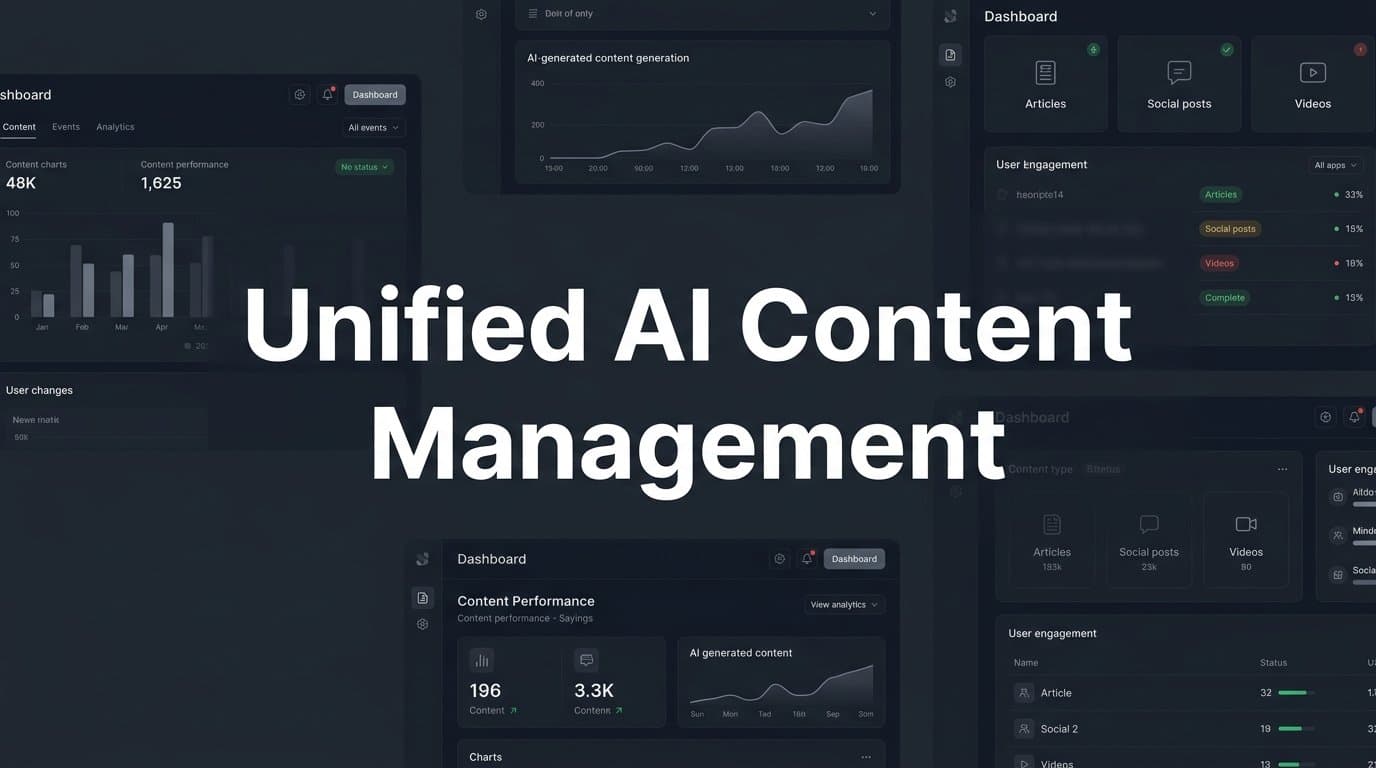
Unified AI content management is the strategic framework that brings all of these moving parts together. Rather than juggling disconnected tools for content creation, publishing, indexing, and performance tracking, a unified approach centralizes these workflows under a single system. The result is less friction, fewer blind spots, and faster organic growth.
This guide covers seven actionable strategies to build and execute a unified AI content management system. Whether you're scaling a SaaS brand, running a content agency, or growing organic traffic as a founder, these strategies will help you create content that ranks in traditional search, gets cited by AI models, and reaches your audience faster than fragmented workflows ever could. Each strategy is designed to be implemented progressively: start with the foundation and layer in sophistication as your system matures.
1. Centralize Your Content Intelligence Before You Create Anything
The Challenge It Solves
Most content teams operate with a split brain. One group researches keywords for Google. Another monitors brand mentions. Nobody is systematically tracking what questions AI platforms are actually answering for your target audience. The result is a content calendar built on incomplete intelligence, producing articles that miss emerging AI-driven demand entirely.
The Strategy Explained
Before a single word is written, build a unified content intelligence layer that combines traditional keyword research with AI prompt tracking. This means identifying not just what people search on Google, but what prompts they're submitting to ChatGPT, Claude, and Perplexity that relate to your category. These two data sets often diverge significantly. A keyword that shows moderate search volume may be generating substantial AI query traffic, and vice versa.
Generative Engine Optimization (GEO) begins at the research stage. When you understand which prompts AI models are fielding in your niche, you can create content specifically designed to be the answer those models cite. This dual-lens approach ensures every piece of content you produce has a clear path to visibility in both traditional and AI-powered search.
Implementation Steps
1. Audit your existing keyword research process and identify where AI prompt data is currently absent from your planning workflow.
2. Set up systematic prompt tracking across major AI platforms to capture the questions your target audience is asking AI models about your category, competitors, and use cases.
3. Build a unified content brief template that includes both SEO keyword targets and the specific AI prompts each piece of content should be positioned to answer.
4. Prioritize topics where both traditional search volume and AI query frequency overlap, as these represent the highest-leverage opportunities for unified content performance.
Pro Tips
Don't treat AI prompt research as a one-time exercise. AI platforms update their training data and response patterns continuously, so your prompt tracking should run on a recurring cadence. Tools like Sight AI's AI Visibility tracking surface these shifts automatically, giving your content intelligence layer a live feed rather than a static snapshot.
2. Structure Content for Both Search Engines and AI Models Simultaneously
The Challenge It Solves
Content optimized purely for Google's ranking signals often lacks the structural clarity that AI models need to extract and cite information confidently. Conversely, content written with AI citation in mind can feel thin or overly clinical to human readers and search crawlers. Without a dual-purpose formatting approach, you're constantly choosing between two audiences instead of serving both.
The Strategy Explained
The good news is that what makes content citation-worthy for large language models overlaps significantly with what makes it authoritative for search engines. AI practitioners and SEO communities have broadly observed that LLMs tend to favor content with clear entity definitions, structured headings, high factual density, and direct answers to specific questions. These are also signals that Google's quality systems reward.
Apply dual-purpose formatting principles consistently. Use descriptive H2 and H3 headings that mirror the language of actual user questions. Open each section with a direct, declarative answer before expanding into supporting detail. Define key terms explicitly within the content rather than assuming reader context. Include structured data where appropriate to help both crawlers and AI models understand entity relationships on the page.
Implementation Steps
1. Rewrite your content brief template to include a "direct answer" field for every major section, forcing writers to articulate the core answer before adding supporting context.
2. Adopt a consistent heading hierarchy that mirrors natural question patterns: "What is X," "How does X work," "Why does X matter" structures perform well across both search and AI citation contexts.
3. Add explicit entity definitions for key terms, products, and concepts in every article, particularly in introductory sections where AI models often pull citation text.
4. Audit your top-performing existing content and apply these structural principles retroactively, prioritizing pages that already have search traction but low AI citation rates.
Pro Tips
Short, self-contained paragraphs outperform dense prose in AI citation contexts. If a paragraph requires reading the surrounding paragraphs to make sense, it's less likely to be extracted as a standalone citation. Write every key point as if it could stand alone as a quoted answer.
3. Build a Scalable AI-Assisted Content Production Workflow
The Challenge It Solves
AI visibility is partly a volume game. The more high-quality, well-structured content you publish on relevant topics, the more surface area you create for AI models to discover and cite your brand. But producing content at the volume required for meaningful AI visibility is beyond the capacity of most content teams operating with traditional workflows and fully manual production processes.
The Strategy Explained
The solution isn't to replace human judgment with automation, but to deploy specialized AI agents for the tasks where they accelerate production without compromising quality. Different content formats benefit from different agent specializations: a listicle requires different structural logic than a technical explainer or a comparison guide. Using format-specific agents rather than a single general-purpose tool produces noticeably better first drafts.
Critically, scalable AI-assisted production requires deliberate human-in-the-loop review stages. AI agents handle research synthesis, structural drafting, and formatting. Human editors handle accuracy verification, brand voice calibration, and strategic alignment. This division keeps production velocity high while maintaining the factual density and editorial quality that AI citation requires.
Sight AI's content platform includes 13+ specialized AI agents covering formats like listicles, guides, and explainers, with an Autopilot Mode that manages the production pipeline while preserving editorial control checkpoints.
Implementation Steps
1. Map your content calendar to specific formats and assign the appropriate AI agent or workflow template to each format type before production begins.
2. Define your human review stages explicitly: what does an editor check for at the draft stage versus the pre-publish stage? Document this as a repeatable quality gate.
3. Build a content brief library that feeds your AI agents with consistent context about brand voice, target audience, and structural requirements so output quality is predictable across the team.
4. Set a weekly or monthly production target that your AI-assisted workflow can sustain, then gradually increase volume as the system stabilizes.
Pro Tips
Resist the temptation to publish AI-generated content without substantive human review. AI models cite content that demonstrates genuine expertise and factual accuracy. Thin or generic content, regardless of how efficiently it was produced, will underperform in both search and AI citation contexts. Quality gates are a feature of scalable production, not a bottleneck.
4. Automate Publishing and Indexing to Eliminate Discovery Delays
The Challenge It Solves
Teams managing content across disconnected tools frequently experience a frustrating gap between content completion and content discovery. An article finishes editorial review, gets manually uploaded to the CMS, waits for a sitemap update, and then sits unindexed for days or weeks while search engines and AI crawlers remain unaware of its existence. Every day of delay is a day your competitors can fill that content gap.
The Strategy Explained
A unified AI content management system closes this gap by connecting CMS auto-publishing directly to indexing protocols. The IndexNow protocol, supported by Bing, Yandex, and other search engines, enables near-instant URL submission at the moment of publication. This is verifiable via official IndexNow.org documentation. When combined with automated sitemap updates, the pipeline from content completion to search engine discovery becomes effectively zero-touch.
This matters for AI visibility because AI platforms rely on indexed, crawlable content to update their knowledge and citation pools. Content that is slow to be indexed is slow to be discovered by the systems that determine AI-generated answers. Speed of discovery is a competitive variable that unified publishing automation directly addresses.
Implementation Steps
1. Audit your current publishing workflow and document every manual step between content approval and live publication, identifying where delays most commonly occur.
2. Integrate IndexNow protocol into your publishing pipeline so that every new URL is automatically submitted to supported search engines at the moment it goes live.
3. Set up automated sitemap generation and submission so your sitemap reflects your current content inventory in real time rather than on a manual update schedule.
4. Connect your CMS to auto-publishing triggers so approved content moves to live status without requiring manual intervention from your publishing team.
Pro Tips
Sight AI's Website Indexing tools include IndexNow integration and automated sitemap updates built into the publishing workflow, eliminating the need to manage these connections separately. If you're building this infrastructure from scratch, prioritize IndexNow integration first, as it delivers the most immediate impact on discovery speed.
5. Track AI Visibility Across Multiple LLM Platforms Consistently
The Challenge It Solves
Most brands have no systematic view of how AI models represent them. They don't know whether ChatGPT recommends them in relevant queries, whether Claude describes their product accurately, or whether Perplexity cites their content when users ask category-level questions. Without this visibility, content strategy decisions are made blind to one of the fastest-growing discovery channels available.
The Strategy Explained
Systematic AI visibility tracking requires running structured prompt sets across multiple LLM platforms on a consistent cadence and analyzing the results for brand presence, sentiment, and citation patterns. This is not a one-time audit. AI models update their responses as they ingest new training data and as retrieval-augmented generation systems pull fresher content. Your visibility today may differ significantly from your visibility next month.
An AI Visibility Score provides a quantified baseline that makes performance trends visible over time. Tracking sentiment alongside presence tells you not just whether your brand appears in AI responses, but how it's being characterized. Negative or inaccurate AI representations can be addressed through targeted content creation, but only if you know they exist.
Sight AI's platform tracks brand mentions and sentiment across ChatGPT, Claude, Perplexity, and other major AI platforms, providing an AI Visibility Score that benchmarks your current standing and surfaces changes as they occur.
Implementation Steps
1. Define a core prompt set that covers your brand name, product category, key use cases, and competitor comparison queries. This becomes your baseline tracking suite.
2. Run your prompt set across each major AI platform and document the responses, noting where your brand appears, how it's described, and which competitors are mentioned alongside or instead of you.
3. Establish a tracking cadence: weekly for high-priority prompts, monthly for broader category queries. Consistency matters more than frequency.
4. Create a simple scoring system that quantifies presence and sentiment so you can track trends over time rather than comparing raw text responses across periods.
Pro Tips
Pay particular attention to prompts where competitors are mentioned and you are not. These represent your highest-priority content gaps. Creating targeted content that directly addresses the topics driving those competitor citations is one of the most efficient ways to improve your AI visibility score over time.
6. Implement a Closed-Loop Content Performance System
The Challenge It Solves
Content teams often operate in a publish-and-forget mode. An article goes live, generates some initial traffic, and then fades from the team's attention as the next piece enters production. Without a systematic feedback loop connecting performance data back to content decisions, you repeat the same strategic guesses with every new piece instead of compounding on what actually works.
The Strategy Explained
A closed-loop content performance system connects three data streams: traditional SEO metrics (rankings, organic traffic, click-through rates), AI visibility metrics (brand presence, sentiment, citation frequency across LLM platforms), and content production decisions. The insight from each published piece feeds directly into the brief for the next relevant piece.
This is where unified AI content management becomes genuinely compounding. When your performance data lives in the same system as your content production workflow, the feedback loop is tight and automatic. You can see which structural approaches correlate with higher AI citation rates, which topics drive both organic search traffic and AI visibility simultaneously, and which content formats generate the most durable performance over time.
Over time, this closed loop transforms your content operation from a cost center producing articles into a learning system that gets measurably better with every publication cycle.
Implementation Steps
1. Define the specific performance metrics you will track for every published piece: at minimum, organic traffic trend, keyword ranking movement, and AI visibility presence for target prompts.
2. Set a review cadence for published content: a 30-day check for indexing and initial ranking signals, a 90-day review for traffic trends, and a 6-month audit for AI citation patterns.
3. Create a performance insight template that translates data from each review into actionable brief inputs: what structural elements to replicate, which topics to expand, which angles underperformed.
4. Feed these insights back into your content intelligence layer from strategy one, so your topic prioritization evolves based on real performance rather than initial assumptions.
Pro Tips
The most valuable insights often come from content that underperforms. When a well-structured piece fails to gain AI citation traction, investigate whether the topic is dominated by established sources, whether your entity definitions are clear enough, or whether the prompt set you're targeting is simply too competitive for your current domain authority. Failures are data.
7. Align Your Team and Tools Around a Single Content Operations Hub
The Challenge It Solves
Even with strong individual strategies in place, fragmented tooling creates invisible inefficiencies. When content intelligence lives in one platform, production happens in another, publishing requires a third, and performance tracking exists in a fourth, the friction between systems consumes time and creates handoff errors. Governance becomes nearly impossible to enforce at scale, and new team members face a steep operational learning curve just to understand the workflow.
The Strategy Explained
Aligning your team around a single content operations hub means auditing your current tool stack and consolidating wherever possible into a platform that covers the full content lifecycle: research and intelligence, AI-assisted production, publishing and indexing, and visibility tracking. The goal is not to use fewer tools for its own sake, but to eliminate the gaps between tools where data is lost and workflows break down.
Governance standards are what make this hub scalable. Document the workflow for every content format. Define who owns each stage. Establish quality standards that apply consistently regardless of who is producing the content. When these standards live in the same system where content is actually created, they function as guardrails rather than suggestions.
Sight AI is built specifically as this kind of unified operations hub, combining AI visibility tracking, 13+ specialized content agents, IndexNow-powered indexing, and CMS auto-publishing in a single platform. This means your team's content intelligence, production workflow, publishing pipeline, and performance tracking all share the same data layer, eliminating the translation costs that fragmented stacks impose.
Implementation Steps
1. Conduct a full audit of your current content stack: list every tool your team uses across research, writing, editing, publishing, and tracking, and document the manual handoffs between them.
2. Identify the three to five highest-friction points in your current workflow, where time is most consistently lost or where data most frequently fails to transfer between systems.
3. Evaluate whether your current tools can be integrated more tightly or whether consolidation to a unified platform would eliminate those friction points more effectively.
4. Document your governance standards in the same system where content is produced: brief templates, quality checklists, publishing criteria, and performance review schedules should all be accessible within the workflow rather than stored separately.
Pro Tips
Consolidation doesn't have to happen all at once. Start by unifying the two highest-friction handoffs in your current workflow, prove the efficiency gain, and use that momentum to justify further consolidation. Teams that attempt a full-stack migration simultaneously often face adoption resistance that undermines the entire effort. Progressive consolidation sustains momentum.
Putting It All Together: Your Implementation Roadmap
Unified AI content management isn't a single tool or a one-time project. It's an ongoing operational discipline that compounds over time. Brands that establish this infrastructure now will have a meaningful advantage as AI search continues to grow in influence across every category and industry.
Start with strategy one: centralize your content intelligence before creating anything new. That foundation determines the quality of every downstream decision. Then layer in structured content production, automated publishing and indexing, and consistent AI visibility tracking. As your system matures, the closed-loop performance feedback in strategy six becomes your most powerful growth lever, turning every published article into data that makes the next one better.
The goal is a content operation where creation, publishing, indexing, and visibility tracking all speak to each other. Sight AI's platform is built specifically for this: from AI visibility tracking across ChatGPT, Claude, and Perplexity, to 13+ specialized AI content agents, IndexNow-powered instant indexing, and CMS auto-publishing. It's the infrastructure layer that makes unified AI content management operational rather than theoretical.
The brands appearing in AI search answers tomorrow are building these systems today. Stop guessing how AI models like ChatGPT and Claude talk about your brand, and get full visibility into every mention, every content opportunity, and every path to faster organic growth. Start tracking your AI visibility today and see exactly where your brand appears across top AI platforms.