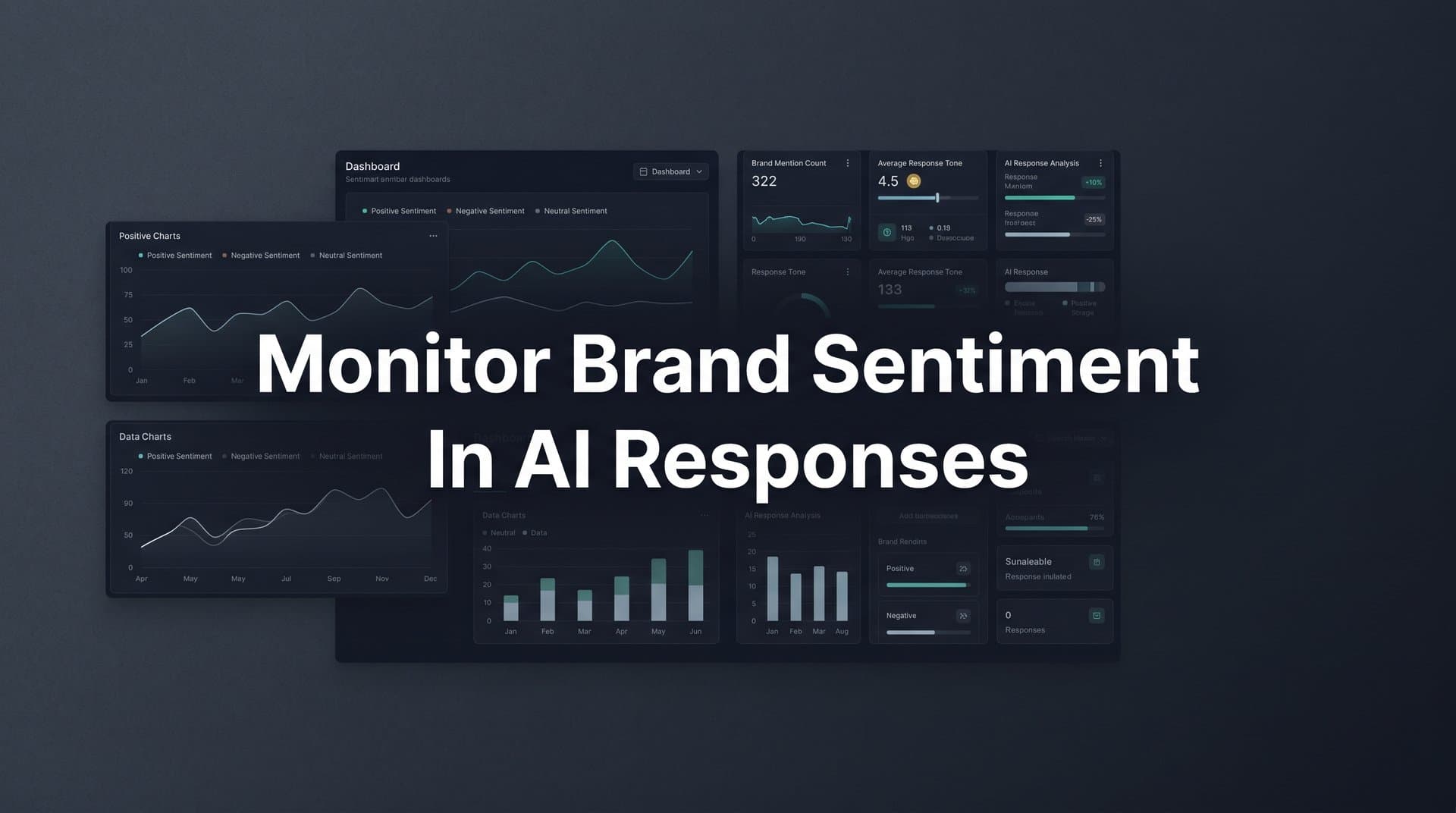
When ChatGPT recommends your competitor instead of you, do you even know it happened? Right now, thousands of potential customers are asking AI models about products in your category. They're typing questions like "What's the best project management tool?" or "Which CRM should I use for a small team?" And somewhere in those responses, AI models are forming opinions about your brand—opinions you've never seen.
Here's the uncomfortable truth: AI models now influence purchasing decisions at scale. They don't just retrieve information anymore. They synthesize, recommend, and yes, develop sentiment about brands based on the data they've absorbed. When Claude describes your product as "a solid option but with some reported integration issues," that's sentiment. When Perplexity positions you third in a list of recommendations, that's sentiment. When ChatGPT includes a caveat about your pricing model, that's sentiment too.
Traditional social listening won't catch this. You can't monitor AI sentiment the same way you track Twitter mentions or Reddit threads. AI models aggregate thousands of signals—reviews, articles, forum discussions, structured data—and distill them into characterizations that millions of users will see. Unlike a single negative tweet, a skeptical AI response reaches everyone who asks that question.
The challenge is visibility. Most marketers have absolutely no idea how AI platforms talk about their brands. They're optimizing for Google while AI search quietly reshapes their reputation. This guide changes that. You'll learn the exact process for tracking sentiment in AI responses: which platforms to monitor, how to design effective prompts, how to classify sentiment consistently, and how to turn insights into action. By the end, you'll have a repeatable system for understanding your true AI reputation—before it impacts your bottom line.
Step 1: Identify Your Priority AI Platforms and Brand Mentions
You can't monitor everything, so start where your audience actually is. Not all AI platforms matter equally for your brand. A B2B SaaS company might find that ChatGPT and Claude dominate professional research queries, while a consumer brand discovers that Perplexity drives product discovery. Your first job is mapping the landscape.
Begin with the major platforms: ChatGPT, Claude, Perplexity, Google Gemini, and Microsoft Copilot. These six handle the vast majority of AI-powered search and recommendations. Visit each platform and run a simple test. Type your brand name and see what happens. Then try a category query: "best [your product category]" or "top tools for [your use case]." Document everything you find.
Now expand your query list beyond just your brand name. Think like your customers. They're not always searching for you directly—they're asking questions your product solves. Create categories of queries to monitor:
Direct brand queries: Your company name, product names, and common misspellings. These show how AI models characterize you when explicitly asked.
Category queries: "Best [product type]" or "top [industry] tools." These reveal whether AI models include you in recommendations and how you're positioned against competitors.
Problem-solving queries: "How do I [solve specific problem]?" These show if AI models recommend your solution when users describe pain points.
Comparison queries: "X vs Y" or "alternatives to [competitor]." These expose how AI models frame your competitive positioning.
For each platform, manually test 10-15 prompts spanning these categories. Yes, this is tedious. Do it anyway. You're establishing a baseline. Copy the full AI response into a document, noting the platform, exact prompt, date, and your initial sentiment read. Look for patterns: Does ChatGPT consistently mention you in top-three lists? Does Claude include caveats about your pricing? Does Perplexity cite specific reviews or sources when discussing your brand? Understanding how to track sentiment across AI platforms starts with this foundational research.
Success looks like this: a spreadsheet with platforms in columns, query types in rows, and documented responses showing where your brand appears, how it's characterized, and which platforms matter most for your monitoring efforts. This baseline becomes your reference point for tracking changes over time.
Step 2: Set Up Systematic Prompt Tracking
Random spot-checks won't cut it. AI responses can vary based on how questions are phrased, when they're asked, and even subtle context differences. You need a systematic approach that captures consistent data across time and platforms.
Start by organizing your prompts into standardized categories. This isn't about testing every possible variation—it's about creating repeatable prompt templates that represent how real users search. Design four core prompt types:
Direct queries: "What is [your brand]?" or "Tell me about [your product]." These establish baseline sentiment when users ask about you explicitly.
Recommendation queries: "What's the best tool for [use case]?" or "Recommend a solution for [problem]." These show if AI models proactively suggest you.
Comparison queries: "[Your brand] vs [competitor]" or "Compare [product A] and [product B]." These reveal how AI models frame your competitive strengths and weaknesses.
Problem-solution queries: "I need to [accomplish goal], what should I use?" These capture whether AI models connect your product to user needs.
Create a tracking system that logs responses consistently. A simple spreadsheet works: columns for date, platform, prompt category, exact prompt text, full response, sentiment classification, and notes. If you're monitoring multiple brands or products, add columns for those distinctions. The key is consistency—anyone on your team should be able to look at your tracking sheet and understand exactly what was tested and what was found. Learning how to track AI prompt responses effectively requires this level of documentation.
Establish your monitoring cadence based on brand priority and resources. High-visibility brands in competitive categories might track daily, testing a core set of prompts across major platforms every morning. Most brands can start with weekly monitoring, running the same prompt set every Monday to catch trends without burning out your team.
Here's a practical weekly routine: Pick five platforms and ten core prompts. That's 50 responses to capture and classify. At 2-3 minutes per response, you're looking at roughly two hours of monitoring per week. Schedule it like any other marketing task. Consistency matters more than volume—weekly tracking over three months reveals more than sporadic deep dives.
Success indicator: you can run your monitoring routine without thinking. The prompts are documented, the spreadsheet is templated, and any team member could execute the process and log results in the same format. When tracking becomes systematic rather than ad hoc, you start seeing patterns instead of anecdotes.
Step 3: Classify Sentiment Using a Standardized Framework
Reading an AI response and thinking "that seems negative" isn't analysis. You need a framework that turns subjective impressions into consistent classifications. Without standardization, different team members will categorize the same response differently, making trend analysis impossible.
Define four sentiment categories with clear criteria:
Positive sentiment: AI models recommend your brand, use favorable adjectives, position you early in lists, or highlight specific strengths without major caveats. Look for language like "excellent choice," "highly recommended," "stands out for," or inclusion in "best" or "top" designations.
Neutral sentiment: AI models mention your brand factually without clear endorsement or criticism. The response describes what you do, lists features, or includes you in comprehensive overviews without evaluative language. Neutral doesn't mean bad—it means the AI is presenting information without steering users toward or away from you.
Negative sentiment: AI models include warnings, highlight complaints, position you low in rankings, or explicitly recommend alternatives. Watch for phrases like "however, users report," "some concerns about," "limited compared to," or positioning after multiple competitors with stronger endorsements.
Mixed sentiment: AI models present balanced perspectives, acknowledging both strengths and weaknesses. These responses might say "great for X but consider Y for Z" or "strong features, though pricing may be a concern." Mixed sentiment is common and often reflects nuanced brand perceptions in the training data.
Now look for specific sentiment signals within AI responses. These indicators help you classify consistently. Dedicated sentiment analysis for AI responses requires understanding these patterns:
Recommendation language reveals AI preference. When models say "I recommend," "consider," or "best option," that signals positive sentiment. When they say "you might also consider" after mentioning competitors first, that's weaker positioning.
Warning language indicates concerns. Phrases like "be aware," "some users report," "however," or "keep in mind" typically precede caveats or criticisms. Count these flags—three caveats in a response suggests negative sentiment even if the opening seems positive.
List positioning matters tremendously. AI models often list options in preferential order. First position typically indicates the model's top recommendation. If you consistently appear third or fourth, that's meaningful sentiment data regardless of the accompanying text.
Comparative language shows relative positioning. How does the AI describe you versus competitors in the same response? If competitors get "industry-leading" while you get "solid option," that's a sentiment gap worth noting.
Create a simple scoring rubric. Assign each response a sentiment score: +2 for strongly positive, +1 for positive, 0 for neutral, -1 for negative, -2 for strongly negative. This lets you calculate average sentiment scores across platforms, prompt types, or time periods. When everyone on your team uses the same rubric, you get consistent data you can actually analyze.
Success indicator: three different team members can independently classify the same set of AI responses and reach the same sentiment conclusions at least 80% of the time. If classifications vary wildly, your framework needs clearer criteria.
Step 4: Analyze Patterns and Context Triggers
Raw sentiment data is just numbers until you understand what drives it. The real insights come from pattern analysis: which contexts trigger positive versus negative sentiment, how your positioning changes across prompt types, and what your sentiment trends reveal about your brand's AI reputation.
Start by mapping sentiment to prompt categories. Pull your tracking data and calculate average sentiment scores for each prompt type. You might discover that direct brand queries generate positive sentiment, but recommendation queries consistently favor competitors. Or perhaps comparison prompts highlight your strengths while problem-solving queries miss you entirely. These patterns tell you where your AI reputation is strong and where it needs work.
Compare your sentiment against competitors mentioned in the same responses. This is where AI sentiment tracking gets powerful. When an AI model lists three project management tools, how does your characterization compare to the others? If competitors get enthusiastic endorsements while you get qualified mentions, that's a competitive sentiment gap. The ability to track brand sentiment across AI models reveals these competitive dynamics clearly.
Look for context triggers that shift sentiment. Sometimes the way a question is phrased dramatically changes how AI models respond. A prompt asking "best affordable CRM" might generate different sentiment than "best CRM for enterprise." Test variations and document which contexts work in your favor. Understanding these triggers helps you anticipate how different user queries will surface your brand.
Track sentiment changes over time to spot emerging issues or improvements. Plot your average sentiment scores weekly or monthly. A sudden drop in sentiment across multiple platforms suggests something changed in the data AI models are processing—maybe a wave of negative reviews, a competitor comparison article, or a product issue that's being widely discussed. Catching these shifts early lets you respond before they solidify into lasting reputation damage.
Pay attention to the sources AI models cite when they mention your brand. Many platforms like Perplexity show their sources. If negative sentiment consistently links to specific reviews, articles, or forum threads, you've identified the content influencing AI characterizations. This gives you a clear target for reputation management efforts. Understanding how to track LLM citations helps you identify these influential sources.
Success indicator: you can explain why certain prompts generate different sentiment outcomes. You understand which contexts favor your brand, which competitors consistently outperform you in AI recommendations, and what content or signals might be driving negative sentiment patterns. This understanding transforms data into strategy.
Step 5: Build Your Sentiment Response Strategy
Tracking sentiment without taking action is just expensive research. Now that you understand your AI sentiment landscape, you need strategies for each scenario you'll encounter. Different sentiment patterns require different responses.
For negative sentiment, investigate the root cause before reacting. AI models don't invent criticisms—they reflect patterns in their training data or retrieval sources. When you see consistent negative mentions, identify what's driving them. Are there prominent negative reviews on major platforms? Did a comparison article highlight your weaknesses? Is there outdated information about a problem you've since fixed? Our guide on negative brand sentiment in AI responses covers specific remediation tactics.
Create corrective content that addresses the specific issues AI models are surfacing. If AI responses consistently mention integration problems, publish detailed documentation about your integrations, case studies showing successful implementations, and updated feature announcements. The goal is creating authoritative positive content that can influence future AI training or retrieval. This isn't about manipulation—it's about ensuring accurate, current information is available.
For neutral sentiment, your opportunity is elevation. Neutral mentions mean AI models acknowledge your existence but aren't actively recommending you. Develop content that provides stronger positive signals: customer success stories, feature comparisons showing your advantages, expert endorsements, and clear use-case documentation. Make it easy for AI models to characterize your strengths, not just your existence.
Focus on creating structured, authoritative content that AI systems can easily process. Detailed comparison pages, FAQ sections, feature lists with clear benefits, and case studies with measurable outcomes all provide the kind of signal-rich content that influences AI characterizations. Think about the questions users ask and create comprehensive answers that position you favorably.
For positive sentiment, your job is protection and amplification. When AI models already recommend you, maintain the conditions creating that sentiment. Monitor for changes, continue publishing positive signals, and watch for competitor moves that might shift the landscape. Positive sentiment isn't permanent—it reflects current data patterns that can change.
Amplify positive mentions by ensuring the content AI models cite remains accessible and current. If an AI response links to a positive review or article, make sure that content stays live and updated. Build on positive positioning by creating more content in the same vein—if AI models praise your customer support, publish more support success stories and documentation.
Document your response strategies in a playbook. When negative sentiment appears for feature X, what's your content response? When competitors gain ground in category Y, what's your positioning strategy? Having documented responses means you can act quickly when sentiment shifts, rather than scrambling to figure out what to do.
Success indicator: you have clear, documented action plans for each sentiment category. Your team knows what content to create for negative sentiment, how to elevate neutral mentions, and how to protect positive positioning. Sentiment tracking becomes a feedback loop that directly informs your content and positioning strategy.
Step 6: Automate and Scale Your Monitoring
Manual prompt testing works for establishing baselines and understanding patterns, but it doesn't scale. As you expand monitoring across more platforms, prompts, and brands, automation becomes essential. The question is what to automate and how to maintain quality while scaling.
Evaluate AI visibility platforms designed specifically for this use case. These tools automate the prompt testing process across multiple AI models, track responses over time, classify sentiment, and alert you to significant changes. Look for platforms that cover the AI models your audience uses, provide sentiment analysis capabilities, and integrate with your existing marketing dashboards. A thorough AI brand tracking software comparison can help you evaluate your options.
When assessing automation tools, prioritize a few key capabilities. The platform should test prompts consistently across multiple AI models without manual intervention. It should track response changes over time so you can spot sentiment shifts. It should provide sentiment classification, though you may need to refine categories to match your framework. And it should offer alerting for significant changes—you want to know immediately if sentiment drops or a competitor suddenly dominates recommendations.
Set up alerts for scenarios that require immediate attention. A sudden sentiment drop across multiple platforms suggests something changed in your brand's digital footprint. A new competitor appearing consistently in recommendation responses means your competitive landscape shifted. A specific prompt category showing declining mentions indicates you're losing relevance in that use case. Configure alerts so you're notified of these patterns without drowning in noise.
Integrate sentiment data into your broader brand health dashboards. AI sentiment is one signal among many—combine it with traditional SEO metrics, social sentiment, review scores, and traffic data for a complete picture. When AI sentiment trends down while other metrics stay stable, you know where to focus. When everything drops together, you're seeing a broader reputation issue. Specialized AI model sentiment tracking software can streamline this integration.
Even with automation, maintain some manual monitoring. Automated tools excel at scale and consistency, but human review catches nuances algorithms might miss. Schedule monthly manual reviews where you personally test key prompts and read full AI responses. This keeps you connected to how AI models actually talk about your brand, beyond sentiment scores and dashboards.
Start your automation journey gradually. Don't try to automate everything at once. Begin with your most important platform and prompt category. Validate that automated tracking matches your manual results. Then expand to additional platforms and prompts as you gain confidence in the system. This phased approach helps you catch issues before they corrupt your entire dataset.
Success indicator: you receive automated weekly or daily reports showing sentiment trends across platforms and prompt categories, with alerts for significant changes, all without manual prompt testing. Your team spends time analyzing insights and creating responses rather than collecting data. That's when sentiment tracking becomes a strategic advantage rather than a research project.
Your AI Sentiment Tracking Advantage
Tracking sentiment in AI responses is no longer optional for brands serious about their digital reputation. You now have the complete framework: identify which AI platforms matter for your audience, set up systematic prompt tracking with consistent categories, classify sentiment using standardized criteria, analyze patterns to understand what drives different outcomes, build targeted response strategies for each sentiment scenario, and automate monitoring to scale without losing quality.
The brands that win in AI search aren't the ones with the biggest budgets or the flashiest products. They're the ones that understand how AI models characterize them, spot reputation issues before they spread, and systematically create the signals that drive positive sentiment. While your competitors wonder why AI models recommend alternatives, you'll have data showing exactly why it happens and a strategy for changing it.
Start this week with manual monitoring. Pick ChatGPT and Claude—they're accessible and widely used. Test ten prompts spanning direct queries, recommendations, and comparisons. Document the responses and classify the sentiment. You'll immediately see where your brand stands in AI conversations. That visibility alone puts you ahead of most marketers still optimizing for algorithms that matter less every day.
As AI search continues growing, the gap between brands that monitor their AI sentiment and those flying blind will only widen. The conversations happening in AI responses today are shaping purchasing decisions, building brand perceptions, and influencing millions of users who never see a traditional search result. Start tracking your AI visibility today and see exactly where your brand appears across top AI platforms—because you can't optimize what you can't see, and you can't protect a reputation you're not monitoring.