The best SEO writing software in 2026 depends on which part of the workflow you need to automate. Sight AI covers the full loop (drafting, CMS publishing, IndexNow indexing and AI visibility tracking), Surfer SEO and Clearscope lead on on-page optimization, Frase leads on research briefs, and Jasper leads on enterprise brand voice. Copy.ai, Writesonic, MarketMuse and Semrush ContentShake AI round out the list for pipeline automation, budget volume, strategy and Semrush-native drafting.
SEO writing software now goes well beyond keyword insertion. Current platforms combine AI generation, on-page optimization signals, GEO (Generative Engine Optimization) readiness and automated publishing. That shortens the time from "keyword identified" to "article indexed." We evaluated each tool on five criteria: content quality, SEO depth, automation, AI visibility features and value for money. We gave extra weight to tools that help you publish, index and get cited by ChatGPT, Claude and Perplexity, not just draft text.
Quick comparison
| Tool | Primary strength | Auto-publishing | Free option |
|---|---|---|---|
| Sight AI | Full write-publish-index loop plus AI visibility tracking | Yes (CMS + IndexNow) | See pricing page |
| Surfer SEO | Real-time NLP content scoring | WordPress integration | Free Keyword Surfer extension |
| Jasper | Enterprise brand voice | Via integrations | Trial |
| Frase | SERP-driven content briefs | Limited | Trial |
| Clearscope | Auditing existing content | No | No |
| Copy.ai | Multi-step workflow automation | Via integrations | Yes |
| Writesonic | Budget bulk articles, live web data | WordPress | Yes |
| MarketMuse | Domain-specific topical strategy | No | Limited free tier |
| Semrush ContentShake AI | Drafts from Semrush data | WordPress | Trial |
Free options and tiers change often, so confirm current details on each vendor's site before buying.
1. Sight AI
Best for: Teams that need the full content loop: write, optimize, publish, index, and track AI visibility.
Sight AI is an all-in-one AI SEO and GEO content platform. It generates optimized articles, auto-publishes them to your CMS, triggers near-instant indexing and tracks how AI models mention your brand.

Where This Tool Shines
Most SEO writing tools stop at "generate." Sight AI closes the entire loop. Once content is produced, it pushes the article to your CMS, fires IndexNow to speed up Google and Bing discovery and updates your sitemap automatically. Most teams currently stitch that workflow together across three or four separate tools.
The other standout capability is AI visibility tracking. Sight AI monitors how ChatGPT, Claude, Perplexity and other major AI platforms mention your brand, including sentiment analysis. In 2026, getting cited by AI models is becoming as valuable as ranking on page one. Sight AI is the only tool on this list that tracks that metric and helps you improve it.
Key Features
13+ Specialized AI Writing Agents: Purpose-built agents for listicles, guides, explainers and other formats produce content with the right structure for each format, rather than generic long-form output.
Autopilot Mode: Continuous, hands-off content production that keeps your publishing cadence consistent without manual work on every article.
AI Visibility Score: Tracks brand mentions across 6+ AI platforms with sentiment analysis, showing how AI models perceive and reference your brand.
IndexNow Integration: Notifies search engines automatically after publishing, reducing the lag between content going live and getting indexed.
CMS Auto-Publishing: Connects directly to your content management system to streamline the write-to-publish workflow.
Best For
Marketers, founders and agencies who want organic and AI search growth from a single platform. It is particularly valuable for teams scaling content volume that can't afford to manage separate tools for writing, optimization, publishing, indexing and AI visibility monitoring.
Pricing
Visit trysight.ai for current pricing tiers. Plans vary by content volume and team size.
2. Surfer SEO
Best for: Writers and editors who want real-time, data-driven optimization guidance while drafting.
Surfer SEO is a content optimization platform that scores your draft in real time against NLP signals extracted from top-ranking SERP pages.

Where This Tool Shines
Surfer's Content Score is one of the most trusted optimization signals in the SEO community. As you write, the editor compares your article against the top-ranking pages for your target keyword. It flags term frequency gaps and suggests structural changes, which takes much of the guesswork out of optimization.
The Topical Map feature adds a strategic layer by helping you plan clusters of content rather than isolated articles. For teams that already have strong writers and need a reliable optimization framework, Surfer provides exactly that without overcomplicating the workflow.
Key Features
Real-Time Content Score: NLP-based scoring that updates as you write, benchmarked against current top-ranking pages for your keyword.
Topical Map: A content planning tool that identifies topic clusters and content gaps across your niche.
AI-Generated Outlines and Drafts: Structured outlines and first drafts informed by SERP data, giving writers a head start.
Google Docs and WordPress Integrations: Optimization signals appear directly inside the tools writers already use.
Keyword Surfer Extension: A browser extension that shows keyword data while you browse SERPs, useful for quick research.
Best For
Content teams with established writers who need an optimization layer rather than full automation. It also suits SEO managers who want consistent quality control across multiple contributors.
Pricing
Visit surferseo.com for current plan pricing. Tiers vary by content volume and team size.
3. Jasper
Best for: Enterprise teams with strict brand voice requirements producing content across multiple formats and channels.
Jasper is an enterprise AI content platform known for brand voice consistency. It lets large teams produce on-brand content at scale across formats.

Where This Tool Shines
Jasper's Brand Voice feature is genuinely impressive. You feed it existing company content, and it learns your tone, vocabulary and style. Its output then reflects that voice consistently. This matters for enterprise brands, where off-tone content can cause real problems, and it is what separates Jasper from generic AI writers.
The Campaigns feature builds on this by generating multiple assets from a single brief: blog posts, social copy, email sequences and ads, all in one coordinated workflow. For marketing teams running integrated campaigns, that cohesion saves significant coordination time.
Key Features
Brand Voice Training: Learns your company's tone and style from existing content to keep all AI-generated output consistent.
Campaigns Feature: Generates multiple content formats from a single campaign brief, keeping messaging aligned across channels.
50+ Content Templates: Pre-built templates for blog posts, ads, emails, social media and more.
Surfer SEO Integration: Adds Surfer's optimization on top of Jasper's drafts, though this requires a separate Surfer subscription.
Team Collaboration and Approval Workflows: Built-in review processes for larger content teams with multiple stakeholders.
Best For
Enterprise marketing teams and agencies managing multiple brand accounts where tone consistency is non-negotiable. It is less suited to lean teams that need deep SEO automation, since optimization relies on a third-party integration.
Pricing
Visit jasper.ai for current enterprise and team pricing. Jasper is generally positioned at the higher end of the market.
4. Frase
Best for: Research-heavy content workflows where brief quality determines article quality.
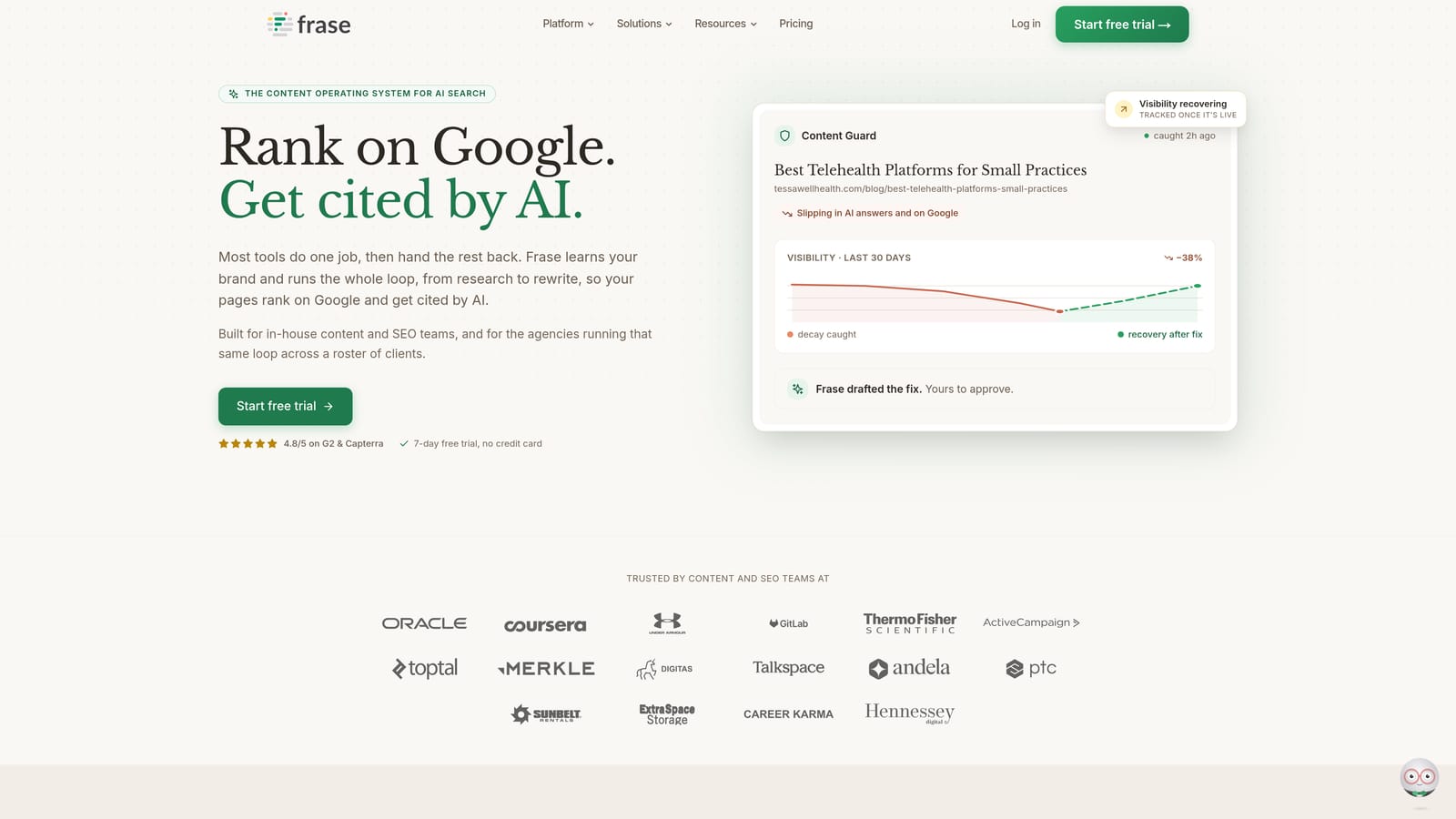
Frase is a research-first SEO platform that turns SERP data into structured content briefs automatically. Its AI writing assistant is built directly into the brief editor.
Where This Tool Shines
Frase is built on the idea that better research produces better content. Enter a keyword, and Frase pulls in the top SERP results and extracts headings, People Also Ask questions, forum discussions and key topics. It then organizes everything into a structured brief, so writers spend less time on manual research and more time writing.
The handoff from brief to draft is particularly smooth. You can move from research to writing without switching contexts, and the AI assistant can generate sections directly from the brief structure. For teams whose writers need deep SERP context before they start drafting, Frase is the strongest option on this list.
Key Features
Automated SERP Analysis: Compiles top-ranking pages into structured briefs automatically, covering headings, topics and word counts.
Question Research: Pulls relevant questions from People Also Ask, Reddit and other forums to inform content depth.
Content Scoring: Grades your draft against top-ranking competitors to find coverage gaps before publishing.
Embedded AI Writing Assistant: Generates content directly within the brief editor, keeping research and drafting in one place.
Team Sharing: Supports brief-to-draft handoffs between researchers, strategists and writers.
Best For
Content strategists and editorial teams where brief quality is the primary bottleneck. Also strong for agencies that need to deliver detailed briefs to freelance writers at scale.
Pricing
Visit frase.io for current pricing. Frase's entry-level plans are more accessible than those of some enterprise-focused competitors.
5. Clearscope
Best for: Auditing and optimizing existing content libraries, not just creating new articles.
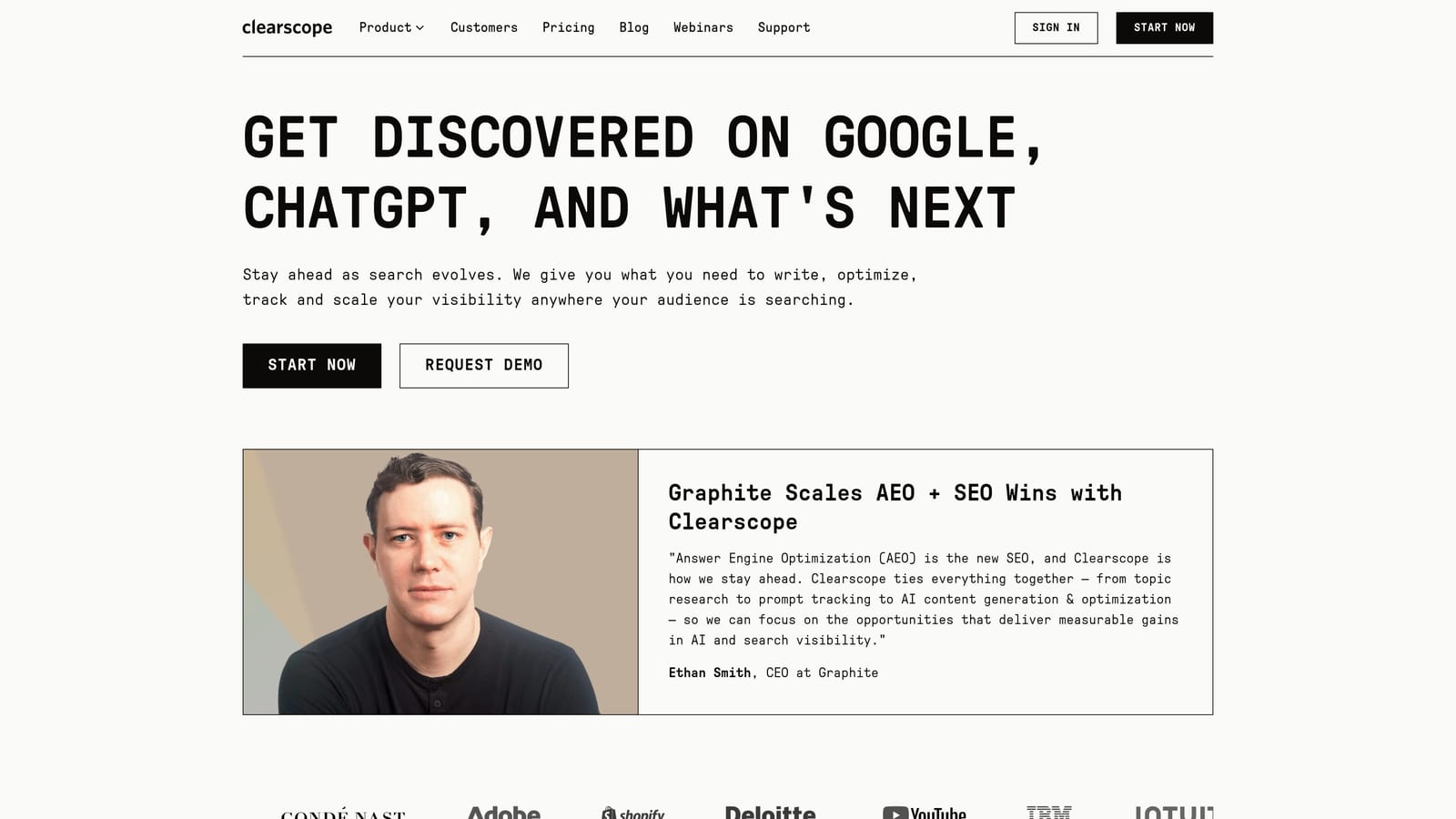
Clearscope is a content optimization and grading platform. It uses Google NLP analysis to recommend term frequencies for both new and existing articles.
Where This Tool Shines
Clearscope is particularly valuable for teams with large content inventories. Its content audit grades existing articles against current SERP data. It shows which pages have drifted out of optimization and which terms are now missing. Many teams find that optimizing existing content improves rankings faster than publishing new articles.
The grading system is clean and actionable. Writers see exactly which terms to add and how often, without having to interpret raw NLP data. That removes ambiguity from the optimization process, which helps when your writers aren't deeply technical about SEO.
Key Features
Term Frequency Grading: Google NLP-based recommendations for which terms to include and how often, updated against current SERP data.
Content Inventory: Audits and grades your existing articles, then helps you prioritize which pages to optimize first.
Google Docs and WordPress Integrations: Optimization signals appear directly inside the tools writers already use.
Keyword Discovery: Surfaces related terms and subtopics within the editor to make content more comprehensive.
Team Reporting: Tracks content grade improvements over time, useful for showing SEO progress to stakeholders.
Best For
SEO managers and content teams at established sites whose existing article libraries need systematic optimization. It is less suited to teams starting from scratch who need AI drafting alongside optimization.
Pricing
Visit clearscope.io for current pricing. Clearscope is generally positioned at mid-market to enterprise price points.
6. Copy.ai
Best for: Teams that want to automate entire content operations pipelines, not just individual article drafts.
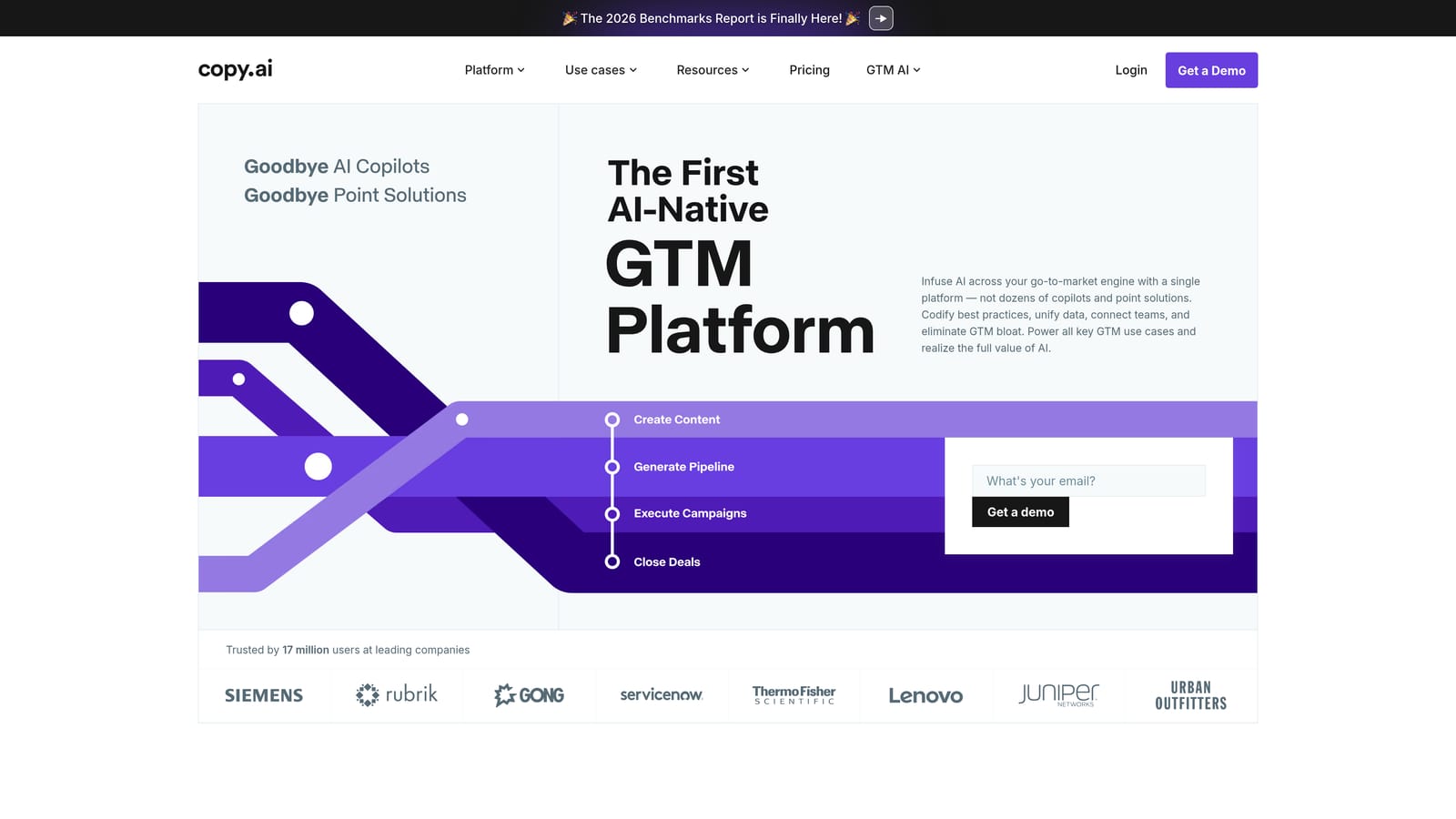
Copy.ai is an AI content automation platform. Its workflow builder chains research, briefing, drafting and repurposing into end-to-end content pipelines.
Where This Tool Shines
Copy.ai's workflow builder is the differentiator. Instead of generating a single piece of content, you build automated sequences that run without manual prompting at each step. For example, one workflow can pull a topic, generate a brief, produce a draft, create social snippets and format an email summary. For content operations teams managing high volumes across multiple formats, this kind of automation saves more time with every run.
The Infobase feature stores your company knowledge, product details and brand guidelines, so every workflow output stays accurate. It is particularly useful when AI-generated content must reflect specific product positioning without constant manual editing.
Key Features
Workflow Builder: Chains AI content tasks in sequence without manual prompting between steps.
Brand Voice and Infobase: Stores company knowledge, tone guidelines and product information for consistent, accurate output.
Multi-Format Output: Generates blog posts, social media content, email copy and ad creative from a single workflow.
CRM and Marketing Platform Integrations: Connects with sales and marketing tools to embed content generation into broader go-to-market workflows.
Free Tier Available: Lets teams test the platform before committing to a paid plan.
Best For
Content operations teams and growth marketers who think in workflows rather than individual pieces. Also useful for agencies that need to produce several content formats at once for each client.
Pricing
Visit copy.ai for current free and paid tier pricing.
7. Writesonic
Best for: High-volume content production on a budget, especially for topics requiring current information.
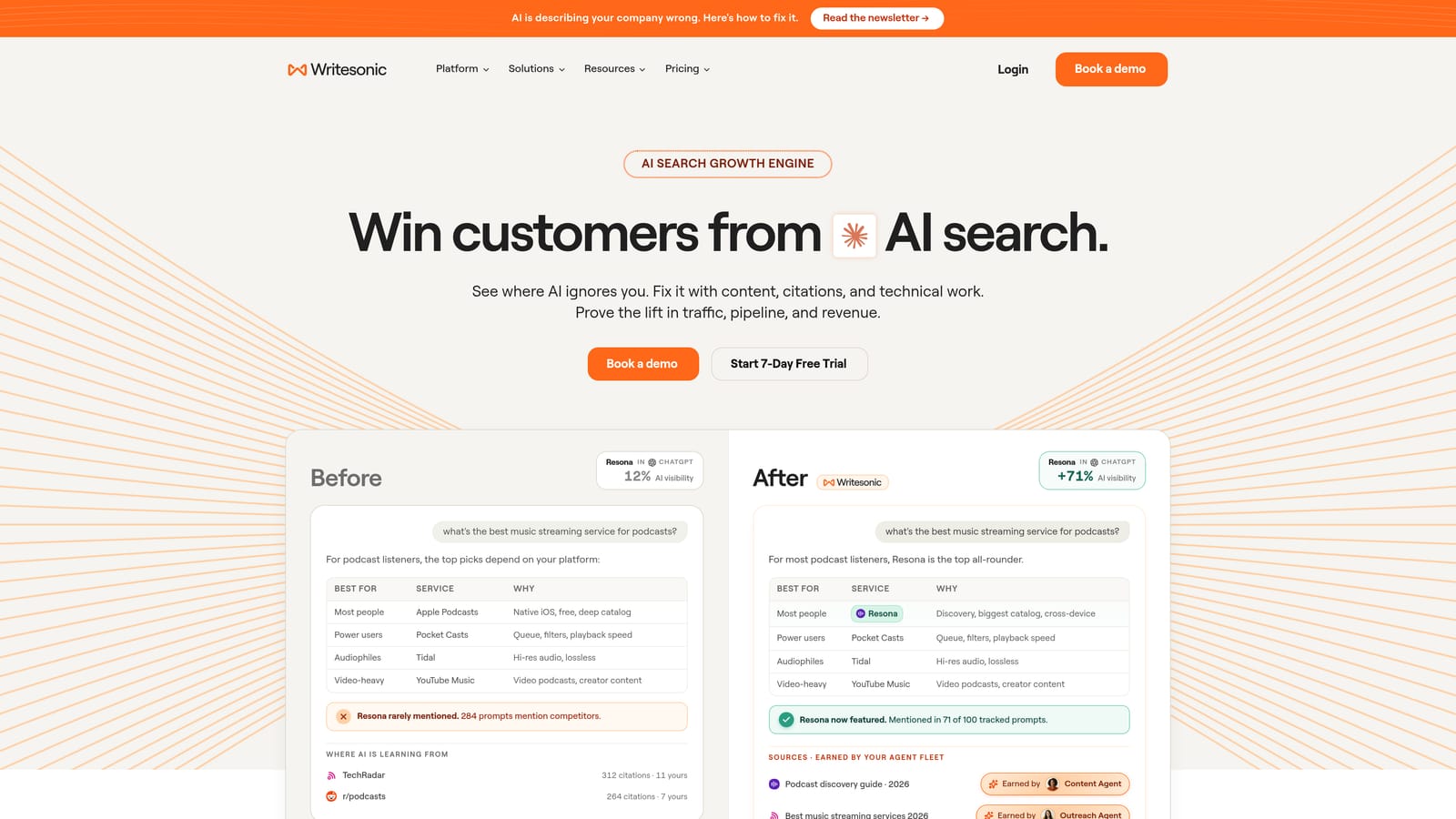
Writesonic is a budget-friendly AI writing platform with a dedicated SEO article mode. It also includes Chatsonic, a conversational AI with real-time web access for current-events content.
Where This Tool Shines
Writesonic's real competitive edge is Chatsonic's real-time web access. Most AI writing tools work from training data with a knowledge cutoff. That causes problems for content that references recent developments, industry news or current statistics. Chatsonic pulls live information, which makes it genuinely useful for news-adjacent SEO topics where freshness matters.
Bulk article generation also stands out for high-volume use cases. Teams producing dozens of articles per month at a competitive price will find Writesonic's mix of volume, speed and direct WordPress publishing particularly practical.
Key Features
AI Article Writer: A long-form SEO article mode that structures content for search intent and readability.
Chatsonic with Real-Time Web Access: A conversational AI that can reference current events and recent data, addressing the knowledge cutoff problem common to AI writers.
Bulk Article Generation: Produces multiple articles at once, making high-volume content production feasible.
Direct WordPress Publishing: Pushes articles directly to WordPress without a separate CMS step.
Competitive Pricing with Free Tier: Accessible price points make it viable for lean teams and solo operators.
Best For
Solo founders, small teams and agencies that need high-volume output without enterprise budgets. Particularly strong for fast-moving topics where current information is a competitive advantage.
Pricing
Visit writesonic.com for current free and paid tier pricing. Tiers vary by word volume.
8. MarketMuse
Best for: Strategic content planning based on your domain's existing topical authority.
MarketMuse is an AI content strategy platform. It models your site's existing topical authority to generate personalized content difficulty scores and data-driven briefs.
Where This Tool Shines
MarketMuse's personalized difficulty scores are its standout feature. Generic keyword difficulty tools tell you how hard a keyword is to rank for in the abstract. MarketMuse tells you how hard it is for your specific domain, based on what you already rank for and where your topical gaps are. That context can change which topics you prioritize.
This makes MarketMuse most valuable for strategic planning rather than day-to-day drafting. If you're deciding which topics to invest in next quarter, MarketMuse gives you a defensible, data-backed answer grounded in your actual competitive position rather than generic market averages.
Key Features
Personalized Difficulty Scores: Content opportunity scoring based on your domain's existing topical authority rather than generic keyword metrics.
Data-Driven Content Briefs: Briefs include recommended topics, questions and internal link suggestions tailored to your site's existing content.
Competitive Content Gap Analysis: Identifies topics competitors cover that your site doesn't, surfacing strategic opportunities.
Content Inventory and Prioritization: Helps teams decide which existing articles to optimize and which new topics to pursue.
AI-Generated First Drafts: Produces initial drafts once briefs are finalized, though writing is secondary to the strategy layer.
Best For
SEO strategists and content directors at established sites who need defensible, data-driven decisions about where to invest content resources. Less suited to teams that mainly need fast drafting volume.
Pricing
Visit marketmuse.com for current pricing. A limited free tier is available. Paid plans sit at higher price points, reflecting the platform's strategic depth.
9. Semrush ContentShake AI
Best for: Existing Semrush users who want to add AI article generation without adopting a separate tool.
Semrush ContentShake AI is an AI writing tool built into the Semrush ecosystem. It pulls directly from Semrush keyword and competitor data to generate SEO-optimized article drafts.
Where This Tool Shines
The core value here is integration. If your team already runs keyword research, competitor analysis and site audits through Semrush, ContentShake AI removes the need to export data into a separate writing tool. The pipeline from keyword discovery to published draft stays within one platform.
Its drafts are informed by actual Semrush data rather than generic NLP signals, which gives them a more grounded SEO foundation than many standalone AI writers. For Semrush subscribers, this is often the most efficient path to AI-assisted content production without adding another vendor.
Key Features
Semrush-Powered Draft Generation: Drafts are built from live Semrush keyword and competitor data rather than generic training data.
Content Score: Grades articles on readability and SEO signals to guide revisions before publishing.
Direct WordPress Publishing: Pushes finalized articles directly to WordPress, reducing manual CMS steps.
Tone Adjustment and Rephrasing Tools: Refines draft language when the tone needs adjusting, without a full rewrite.
Full Semrush Suite Integration: Connects with Semrush's broader toolset, including keyword research, site audit and competitor tracking.
Best For
Teams already subscribed to Semrush who want AI writing without adding a separate tool or budget line. If you're not already in the Semrush ecosystem, its standalone value is weaker than that of dedicated platforms.
Pricing
ContentShake AI is included in select Semrush plans or available as an add-on. Visit semrush.com for current plan details.
Which Tool Is Right for Your Workflow?
Nine tools, nine distinct approaches. Here's how to narrow the options quickly.
If you need the complete content loop, from AI-generated drafts through publishing, indexing and AI visibility tracking, Sight AI is the only platform that covers all of it natively. It's built for marketers and agencies who want organic and AI search growth from one place, without stitching together separate tools for each step.
If your team already has strong writers and needs an optimization layer on top, Surfer SEO or Clearscope are the most reliable choices. Surfer is better for drafting with real-time guidance. Clearscope excels at auditing and improving existing content libraries.
If research quality is your primary bottleneck, Frase offers the most structured, SERP-informed brief workflow in the category. Writers who need deep context before drafting get more from Frase than from tools that prioritize speed over research depth.
The remaining tools each fit a specific need:
- Jasper is the strongest option for enterprise brand consistency across large teams.
- Copy.ai offers the most flexible pipeline builder for workflow automation across multiple content formats.
- Writesonic suits high-volume production on a lean budget and adds real-time web access.
- MarketMuse provides the deepest analytical foundation for strategic planning tied to your domain's topical authority.
- ContentShake AI adds AI drafting for existing Semrush subscribers without another vendor.
The category has matured to the point where the right tool depends less on which has the best AI model and more on which workflow gaps you're trying to close. Most teams find that the write-to-index gap and the AI visibility blind spot are the two most overlooked problems in their current stack. If publishing is your gap, our roundup of content publishing automation tools goes deeper on CMS and indexing automation.
A practical evaluation checklist
- Map your bottleneck first. Is it research, drafting, optimization, publishing or measurement? Buy for the slowest step.
- Test on three real keywords. Compare one informational, one commercial and one long-tail draft against what currently ranks on page one.
- Measure editing time. Track how long it takes to bring each draft to publishable quality. A cheap tool that needs 90 minutes of edits per article is not cheap.
- Check integrations. Confirm native support for your CMS (WordPress, Webflow, headless) and your existing keyword research stack.
- Verify fact handling. Ask about live web access or source grounding, and fact-check statistics in every trial draft.
- Look beyond Google. Ask whether the tool measures citations in AI answers, not only blue-link rankings.
Frequently asked questions
What is the best free SEO writing assistant?
Copy.ai and Writesonic both offer free tiers that are useful for testing AI drafting, and Surfer's Keyword Surfer browser extension is free for quick keyword research. MarketMuse has a limited free tier for content analysis. Free plans typically cap word counts, projects or features such as publishing integrations. They work well for evaluating output quality, but sustained production usually requires a paid plan.
Can SEO writing software automate the full workflow from keyword research to publishing?
Some platforms can. Sight AI handles generation, CMS publishing, IndexNow submission and sitemap updates. Semrush ContentShake AI connects Semrush keyword data to WordPress publishing, and Copy.ai chains steps through its workflow builder. Most other tools cover only one or two stages. For a deeper look at end-to-end setups, see our guide to content pipeline automation software.
Will Google penalize AI-written SEO content?
Google's stated position is that it rewards helpful, original content regardless of how it is produced. It acts against content made primarily to manipulate rankings, including scaled low-value pages. AI drafts rank when they are accurate and add real expertise or data, and when they match search intent. Plan for human editing, fact-checking and original insight on every article rather than publishing raw output.
What is the difference between an SEO writing assistant and SEO automation software?
An SEO writing assistant, such as Surfer, Clearscope or Frase, guides a human writer with briefs, term recommendations and content scores. SEO automation software goes further: it generates articles, publishes them to the CMS, submits URLs for indexing and runs on a schedule. Many teams pair an assistant for high-stakes pages with automation for scalable long-tail content.
Do these tools help content get cited by ChatGPT and Perplexity?
Most of these tools focus on Google rankings only. Clear structure, direct answers and FAQ sections help both. Of the tools listed here, only Sight AI tracks how AI models mention your brand, with sentiment analysis, so you can measure whether your content earns AI citations.
Stop guessing how AI models like ChatGPT and Claude talk about your brand. Start tracking your AI visibility today and see exactly where your brand appears across top AI platforms, while generating the SEO and GEO-optimized content that puts you there.