Most SEO efforts fail not because of poor execution, but because of poor planning. Without a structured SEO planning template, teams scatter their efforts across random keywords, publish content without strategic intent, and lose months of potential organic growth to disorganization.
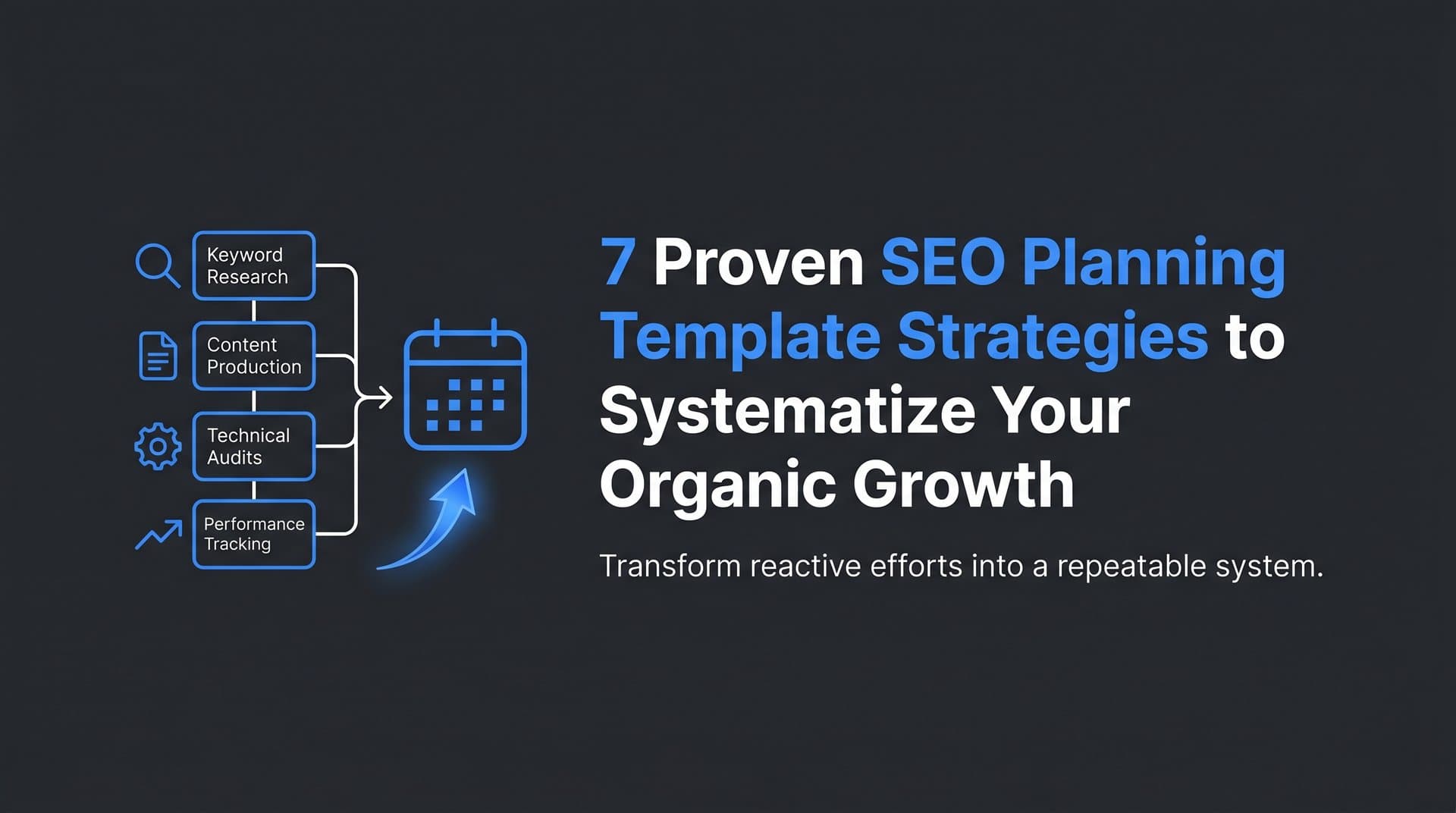
A well-built SEO planning template transforms chaotic, reactive SEO work into a repeatable system. One that aligns keyword research, content production, technical audits, and performance tracking into a single, living document that your entire team can navigate.
Whether you're a solo founder mapping out your first content calendar or an agency managing dozens of client campaigns, having a templated approach ensures nothing falls through the cracks. The difference between SEO that compounds over time and SEO that stalls is almost always structural, not tactical.
In this guide, we break down seven strategies for building and using SEO planning templates that actually drive results. From structuring your keyword universe to integrating AI visibility tracking into your workflow, each strategy is designed to be immediately actionable. Start building your template today and you'll see compounding returns over the coming months.
1. Build a Keyword Universe Map Before Touching a Single Page
The Challenge It Solves
Most content teams jump straight into writing without a clear picture of the keyword landscape they're operating in. The result is a scattered content library full of overlapping topics, missed opportunities, and no clear narrative thread connecting one piece to the next. A keyword universe map fixes this by giving you the full picture before a single word is written.
The Strategy Explained
A keyword universe map is a master inventory of every keyword cluster relevant to your business, organized by topic, search intent, and funnel stage. Think of it as the foundation layer of your entire SEO planning template. Before you plan any content, you need to know what topics you're trying to own, what questions your audience is asking at each stage of the buying journey, and which clusters represent the highest opportunity relative to your current domain authority.
Organize your keyword universe into three tiers: core pillar topics (broad, high-volume themes your site should anchor around), cluster keywords (supporting topics that feed into each pillar), and long-tail opportunities (specific, intent-rich queries ideal for conversion-focused content). Label each cluster with its primary intent: informational, navigational, commercial, or transactional. Understanding search intent in SEO is critical to getting this classification right.
Implementation Steps
1. List your core product or service categories and map them to the problems your audience searches for, creating one pillar topic per major category.
2. Use keyword research tools to expand each pillar into 10 to 20 supporting cluster keywords, noting search volume, difficulty, and intent for each.
3. Tag each keyword cluster by funnel stage (awareness, consideration, decision) so your content plan naturally guides readers toward conversion.
4. Add a priority score to each cluster based on opportunity size and competitive difficulty, then sort your map so the highest-impact clusters rise to the top of your production queue.
Pro Tips
Revisit your keyword universe map quarterly. Search behavior shifts, new competitors enter the space, and your domain authority grows over time, all of which change the opportunity calculus. Treat this map as a living document, not a one-time research exercise. Color-coding clusters by status (planned, in progress, published, optimized) makes it easy to see gaps at a glance.
2. Design a Content-to-Keyword Mapping Matrix
The Challenge It Solves
Keyword cannibalization is one of the most common and most avoidable SEO pitfalls. It happens when multiple pages on your site compete for the same keyword, splitting authority and confusing search engines about which page to rank. Without a centralized mapping system, cannibalization creeps in silently, especially as your content library grows.
The Strategy Explained
A content-to-keyword mapping matrix is a spreadsheet or database that assigns a primary keyword and two to four secondary keywords to every piece of content on your site. It doubles as your editorial calendar, giving you a single source of truth for what's been published, what's in production, and what's still planned. Having a solid SEO keywords strategy is essential before populating this matrix.
Each row in your matrix represents one content piece. Columns should include: the primary keyword, secondary keywords, target URL, content type (pillar, cluster, landing page), funnel stage, publication date, and current ranking position. When you plan new content, you check the matrix first to confirm no existing page already targets that keyword. This one habit alone prevents months of wasted effort.
Implementation Steps
1. Audit your existing content library and retroactively assign primary keywords to every published page, flagging any cases where two pages share the same target keyword.
2. Resolve cannibalization conflicts by either consolidating the competing pages into one stronger piece or differentiating their keyword targets so they serve distinct search intents.
3. For all future content, add a new row to the matrix before production begins, confirming the primary keyword is unoccupied and the content fills a genuine gap in your keyword universe.
4. Connect your matrix to your editorial calendar so content planning, assignment, and scheduling all happen within the same document.
Pro Tips
Add a "ranking check" column that you update monthly with the current position for each page's primary keyword. Over time, this column becomes a performance dashboard embedded directly in your planning template, making it easy to spot pages that need optimization without pulling a separate report.
3. Integrate a Technical SEO Audit Checklist Into Your Template
The Challenge It Solves
Technical SEO problems are silent killers. Crawl errors, slow page speeds, broken internal links, and missing structured data can quietly suppress your rankings for months before anyone notices. Most teams run a technical audit once and then forget about it. By the time they revisit it, the site has accumulated dozens of new issues.
The Strategy Explained
Embedding a recurring technical SEO audit checklist directly into your planning template turns technical health from a one-time project into a systematic habit. Major SEO platforms like Ahrefs, Moz, and Semrush consistently emphasize that technical audits should be recurring events, not one-time fixes. Your template should include a dedicated technical section with a quarterly review cadence and a clear checklist of items to verify each cycle.
Your checklist should cover four core areas: crawlability (are all important pages accessible to search engines?), indexation (are the right pages indexed and the right pages excluded?), performance (are Core Web Vitals within acceptable ranges?), and structured data (are schema markups implemented correctly and returning valid results?). Understanding the tradeoffs between SEO automation vs manual optimization can help you decide which audit tasks to automate.
Implementation Steps
1. Create a "Technical Health" tab in your SEO planning template with a checklist organized by the four core areas above, plus a date column to log when each item was last reviewed.
2. Schedule a quarterly technical audit on your team calendar and block time to work through the checklist systematically, documenting findings and assigning remediation tasks.
3. Add a "Critical Issues" section at the top of your technical tab where any high-priority problems are flagged immediately, regardless of the quarterly schedule.
4. Track remediation progress within the template so you have a historical record of what was fixed and when, which is useful for diagnosing future ranking changes.
Pro Tips
Don't wait for quarterly reviews to catch obvious issues. Set up automated alerts through your preferred SEO tool so that critical crawl errors or sudden drops in indexed pages trigger immediate notifications. Use the quarterly audit for deeper analysis and the automated alerts as your early warning system between cycles.
4. Layer in an Internal Linking Strategy Framework
The Challenge It Solves
Internal linking is consistently cited as one of the most underutilized on-page SEO tactics. Most teams add internal links reactively, dropping them in wherever they happen to remember a related article. This approach leaves authority distribution to chance and creates crawl inefficiencies that limit how well search engines understand your site's topical structure.
The Strategy Explained
A hub-and-spoke internal linking framework maps the relationships between your pillar pages (hubs) and their supporting cluster content (spokes). Adding this framework to your SEO planning template ensures that every new piece of content is connected to the right hub page and that authority flows deliberately across your site rather than pooling in a few popular pages. This is a core component of any effective SEO content strategy.
Your internal linking framework should track four things: the source page, the target page, the anchor text used, and whether the link currently exists. This gives you a clear picture of where links are in place, where gaps remain, and whether your anchor text is optimized for the target keyword. Over time, this map becomes an invaluable reference for content updates and site restructuring.
Implementation Steps
1. List all your pillar pages and identify which cluster content pieces belong under each hub, creating a visual hierarchy of your site's topical architecture.
2. For each cluster piece, identify two to three other relevant pages it should link to and two to three pages that should link back to it, documenting these relationships in your framework.
3. Audit existing content for link gaps, flagging pages that receive few or no internal links despite being high-priority targets, and schedule update passes to add missing links.
4. Use descriptive, keyword-rich anchor text for internal links where natural, avoiding generic phrases like "click here" in favor of anchors that reinforce the target page's topical relevance.
Pro Tips
Every time you publish a new piece of content, immediately add it to your internal linking framework and identify at least three existing pages that should link to it. Building this habit into your publishing workflow prevents new content from being orphaned, which is one of the fastest ways to slow down indexing and limit a new page's ranking potential.
5. Add an AI Visibility Tracking Layer to Your Plan
The Challenge It Solves
Traditional rank tracking tells you where your pages appear in Google search results. But a growing share of search behavior now happens inside AI-powered answer engines like ChatGPT, Perplexity, and Claude. If your brand isn't being mentioned in those AI-generated responses, you're invisible to a significant and rapidly expanding segment of your potential audience. Most SEO planning templates don't account for this at all.
The Strategy Explained
AI visibility tracking, often called Generative Engine Optimization (GEO), is the practice of monitoring whether and how AI models mention your brand when answering questions relevant to your business. Adding this layer to your SEO planning template means you're planning content not just for Google rankings but for AI model citations as well. Learning more about AI SEO optimization can help you understand how to get your brand recommended by these platforms.
The two dimensions to track are presence (is your brand being mentioned at all?) and sentiment (when it is mentioned, is the framing positive, neutral, or negative?). Tools like Sight AI let you monitor brand mentions across multiple AI platforms simultaneously, track sentiment trends over time, and identify the specific prompts and topics where your brand is or isn't appearing. This data becomes a direct input into your content planning process.
If you discover your brand is absent from AI responses around a high-value topic, that gap becomes a content priority in your SEO plan. If sentiment is neutral where it should be positive, that signals a need for more authoritative, citation-worthy content on that subject.
Implementation Steps
1. Add an "AI Visibility" tab to your SEO planning template that tracks your brand's mention rate across key AI platforms, updated at least monthly.
2. Identify the 10 to 20 prompts most relevant to your business and test them regularly across ChatGPT, Claude, and Perplexity to see whether your brand appears in the responses.
3. Log gaps and sentiment issues as content opportunities, linking them back to your keyword universe map to prioritize which gaps to address first.
4. Use AI visibility data to refine your content strategy: topics where AI models already cite you are opportunities to deepen authority, while topics where you're absent are opportunities to establish presence.
Pro Tips
AI visibility and traditional SEO rankings are increasingly correlated. Pages that rank well in Google and demonstrate strong topical authority are more likely to be cited by AI models. Building content that satisfies both dimensions at once is the most efficient path forward, and your SEO planning template should reflect that dual objective.
6. Create a Performance Review Cadence With Built-In KPIs
The Challenge It Solves
Many SEO plans are built once and then ignored. Without a structured review cadence, teams continue executing against assumptions that data has already invalidated. The plan becomes a historical artifact rather than a living guide, and performance plateaus because no one is systematically asking whether the strategy is working.
The Strategy Explained
Embedding a performance review cadence directly into your SEO planning template creates accountability and ensures your strategy evolves with real data. The key is defining specific KPIs at three time horizons: weekly, monthly, and quarterly. Each horizon answers a different question about your SEO health. Leveraging SEO ranking data effectively is what separates teams that iterate from teams that stagnate.
Weekly reviews answer: is our execution on track? Monthly reviews answer: are our efforts producing early signals of progress? Quarterly reviews answer: is our overall strategy moving the needle on business outcomes? By separating these questions into distinct review layers, you avoid the trap of either micromanaging every fluctuation or waiting too long to catch strategic drift.
Implementation Steps
1. Define your weekly KPIs around execution metrics: pages published versus planned, internal links added, technical issues resolved, and content updates completed.
2. Define your monthly KPIs around early performance signals: organic impressions, click-through rates, new keywords entering the top 20, and AI visibility mention rate changes.
3. Define your quarterly KPIs around business outcomes: organic traffic growth, keyword ranking improvements for target clusters, leads or conversions attributed to organic, and domain authority trends.
4. Build a review template within your SEO plan that prompts you to compare current KPIs against previous periods and document one to three strategic adjustments based on what the data shows.
Pro Tips
Resist the urge to track everything. More KPIs don't mean better visibility; they mean more noise. Choose three to five metrics per review horizon that directly reflect the outcomes you care about, and be ruthless about ignoring vanity metrics that feel good but don't connect to real business impact. A focused dashboard inside your planning template is far more useful than an exhaustive one.
7. Automate Content Production and Indexing Within Your Workflow
The Challenge It Solves
Even the most carefully designed SEO planning template fails if content production is too slow to execute against it. Manual writing, editing, formatting, publishing, and indexing workflows create bottlenecks that turn a 12-month content plan into a 24-month one. The gap between strategic intent and actual output is where most SEO plans quietly die.
The Strategy Explained
Connecting AI content generation and automated indexing to your planning template compresses the time between ideation and discovery. The goal isn't to remove human judgment from the process; it's to eliminate the mechanical friction that slows execution without adding strategic value. If you're exploring how to scale SEO content production, automation is the key lever.
On the content generation side, platforms like Sight AI offer specialized AI agents for SEO and marketing designed to produce SEO and GEO-optimized articles across multiple formats, including listicles, guides, and explainers. These agents work from your keyword inputs and content briefs, generating drafts that align with your mapping matrix and keyword universe. Autopilot Mode takes this further by enabling continuous content production without manual triggering for each piece.
On the indexing side, IndexNow integration means that as soon as content is published, the URL is automatically submitted to supported search engines, reducing the lag between publication and indexation. Combined with automated sitemap updates and CMS auto-publishing capabilities, this creates a pipeline where a planned content piece moves from brief to live page to indexed URL with minimal manual intervention.
Implementation Steps
1. Add a "Production Pipeline" section to your SEO planning template that tracks each content piece from brief to draft to review to published to indexed, with dates at each stage.
2. Connect your content brief template to an AI content generation workflow so that approved briefs automatically trigger draft production rather than waiting in a manual queue.
3. Enable IndexNow integration on your publishing platform so that every new URL is submitted for indexing immediately upon publication, rather than waiting for search engine crawlers to discover it organically.
4. Review your production pipeline metrics monthly as part of your performance cadence, identifying where bottlenecks are slowing the flow from plan to published content.
Pro Tips
Automation is most effective when it operates within clearly defined guardrails. Before enabling any automated production workflow, ensure your content briefs are detailed enough to produce on-strategy output. A well-structured brief is the single most important input in an automated content system. Garbage in, garbage out applies here as much as anywhere in SEO.
Pulling It All Together: Your SEO Planning Template Roadmap
Seven strategies, one living document. The power of an SEO planning template isn't in any single component; it's in how all seven layers work together as a coherent system.
The implementation sequence matters. Start with the keyword universe map (Strategy 1) because everything else depends on it. Build your content-to-keyword matrix (Strategy 2) to translate that map into an actionable editorial plan. Layer in technical audits (Strategy 3) and internal linking (Strategy 4) to ensure your site's foundation supports the content you're creating.
Then add the modern differentiators. AI visibility tracking (Strategy 5) ensures your plan accounts for where search is heading, not just where it's been. A structured performance review cadence (Strategy 6) keeps your strategy responsive to real data rather than stale assumptions. And production automation (Strategy 7) closes the gap between strategic intent and actual output.
The best SEO planning template is never finished. It's a document you revisit weekly, refine monthly, and restructure quarterly as your data, your domain, and your market evolve. Static plans become obsolete within weeks. Living plans compound over time.
If you're ready to add a modern layer to your SEO planning workflow, tracking how AI models like ChatGPT and Claude talk about your brand is no longer optional. It's a core visibility channel. Start tracking your AI visibility today and see exactly where your brand appears across top AI platforms, so you can build content strategies that win in both traditional search and the AI-powered answer engines reshaping how people find information.