Blog content is one of the most powerful drivers of organic traffic, but only when it's built on a solid SEO foundation. The challenge most marketers, founders, and agencies face isn't a lack of ideas. It's producing content that actually ranks in traditional search and gets cited by AI models like ChatGPT, Claude, and Perplexity.
This guide walks you through a proven, repeatable process for SEO content generation that covers everything from keyword research to publishing and indexing. By the end, you'll have a clear workflow to produce blog articles optimized for both search engines and AI-generated answers, two channels that are increasingly driving discovery in 2026.
Whether you're scaling a content program for a growing SaaS brand or building a content engine for agency clients, these steps apply directly to your workflow. You'll learn how to identify high-opportunity topics, structure content for both humans and algorithms, generate optimized drafts efficiently, and get your content indexed and visible faster.
Each step is designed to be actionable immediately. No vague theory, just a clear sequence you can implement today.
Step 1: Build a Keyword and Topic Foundation
Every strong blog content program starts with a clear understanding of what your audience is searching for and why. Begin with seed keywords tied directly to your core product or service. From there, expand using keyword research tools to surface long-tail variations that carry more specific search intent.
The common mistake here is chasing volume alone. A keyword with 50,000 monthly searches and fierce competition from established publications is often less valuable than a 1,000-search keyword where your content can realistically reach page one. Prioritize by combining search volume, keyword difficulty, and business relevance.
Before you commit to a topic, classify the intent behind each keyword:
Informational intent: The searcher wants to learn something. These keywords are ideal for guides, tutorials, and explainers, which is exactly the format you're reading now.
Commercial investigation intent: The searcher is comparing options before a decision. Comparison posts and review-style content perform well here.
Transactional intent: The searcher is ready to act. These keywords belong on landing pages, not blog posts.
Matching content type to intent isn't just good SEO practice. It's the difference between content that converts and content that bounces.
Next, think in topic clusters rather than isolated articles. A pillar post covers a broad topic comprehensively, while a set of supporting posts explore specific subtopics in depth. Each supporting post links back to the pillar, and the pillar links out to the supporting posts. Over time, this structure builds topical authority that signals expertise to both search engines and AI models.
Here's a step that many content teams skip entirely: check what AI models currently say about your target topics. If you search a question in ChatGPT or Perplexity and your brand is nowhere in the answer, that's a content gap worth closing. AI visibility tracking tools can surface these gaps systematically, so you're not manually querying every platform.
By the end of this step, you should have a prioritized list of target keywords, each tagged with intent type and mapped to a content format. That list becomes the backbone of your editorial calendar.
Step 2: Analyze the SERP Before You Write a Single Word
Before you open a blank document, spend time studying what's already ranking. This is one of the most skipped steps in SEO content generation, and it's also one of the most valuable.
Search your target keyword and examine the top 10 results carefully. Note the content format: is it a listicle, a step-by-step guide, a comparison, or a definition post? Note the average depth and length. Scan the common subheadings. This tells you what Google currently believes satisfies the searcher's intent, and you need to understand that before you try to beat it.
Now look for content gaps. Which subtopics do the top-ranking articles cover poorly? What questions do they leave unanswered? What perspective is missing entirely? These gaps are your differentiation opportunities. An article that covers everything the competitors cover, plus fills in what they miss, has a strong structural advantage.
Check the People Also Ask box and related searches at the bottom of the SERP. These surfaces are Google surfacing adjacent questions that real users are asking. Incorporating answers to these questions in your article strengthens topical coverage and increases your chances of appearing in featured snippets.
Pay close attention to whether AI Overviews appear in the SERP for your target keyword. If they do, note which sources Google's AI cites. Those sources have earned a level of trust and authority that signals what content quality and format AI systems prefer. This is directly relevant to your GEO strategy in the next step.
Finally, assess competitive reality honestly. If every top result is from a major publication with decades of domain authority, consider whether a more specific angle or a closely related subtopic would give you a faster path to visibility. Sometimes a slight pivot in topic framing opens up a much more winnable keyword.
The success indicator for this step is simple: you have a clear picture of what exists, what's missing, and what your article needs to do differently to earn a top position. Without that picture, you're writing blind.
Step 3: Create a GEO and SEO-Optimized Content Brief
A content brief is the blueprint that separates strategic content from random publishing. It takes everything you learned in steps one and two and translates it into a clear set of instructions for whoever is writing or generating the draft.
At minimum, your brief should include the target keyword, three to five secondary keywords, the intended search intent, a recommended H2 and H3 structure, target word count, and internal linking opportunities. That's the SEO foundation.
For GEO optimization, the brief needs an additional layer. AI models favor content that is direct, well-structured, and authoritative. That means your brief should specify sections where you'll include clear definitions, direct answers to common questions, and factual statements that can stand alone as citable responses. Vague or promotional language doesn't get surfaced in AI-generated answers. Precise, useful information does.
Include E-E-A-T signals in your brief explicitly. Who is the author? What makes this source credible on this topic? What first-hand experience or expertise will be demonstrated in the content? Google's quality guidelines place significant weight on these signals, and AI models have similar preferences for authoritative sourcing.
Map your internal links before writing begins. Identify four to six relevant pages on your site that you can link to naturally within the content. Doing this in the brief stage prevents the common problem of forced internal links added as an afterthought after the draft is complete.
Specify the tone and audience level clearly. A beginner's guide to SEO content generation reads very differently from an advanced workflow guide for agency teams. Mismatching tone to audience is a quick way to increase bounce rates.
Tools like Sight AI's AI Content Writer can generate structured briefs and full drafts using specialized agents trained for SEO and GEO optimization. With 13+ AI agents working in concert, the platform reduces brief creation time significantly while keeping output aligned with ranking and AI visibility goals. This is especially useful when you're producing content at scale and need consistency across dozens of articles per month.
A well-built brief is the single biggest lever for improving content quality before the writing even starts.
Step 4: Generate and Refine Your Blog Draft
With a solid brief in hand, you're ready to generate your draft. Whether you're writing manually, using an AI content writer, or combining both, the brief is your anchor. Every section, every subheading, every internal link placement should trace back to the decisions you made in step three.
If you're using AI-assisted generation, treat the output as a strong starting point rather than a finished product. Review every draft for factual accuracy, brand voice alignment, and logical flow. AI drafts can produce well-structured content quickly, but they require a human editorial pass to catch inaccuracies and ensure the voice feels authentic to your brand.
Start with the title tag and meta description. Include the primary keyword naturally in the title, keep it under 60 characters to avoid truncation in SERPs, and write a meta description that communicates a clear value proposition in under 160 characters. These two elements determine whether your article gets clicked even when it ranks.
Structure the article with a strong introduction that hooks the reader and immediately signals what they'll learn. Readers and search engines both make fast judgments about content quality in the first few paragraphs. Follow the introduction with logical H2 sections that mirror the search intent you identified in step one.
Here's where you can create real separation from competitors: add original insights, examples, or perspectives that the top-ranking articles don't have. This is what earns backlinks and AI citations over time. Generic content that restates what everyone else has already written doesn't attract links, and it doesn't get cited by AI models either.
Incorporate semantic keywords and related terms naturally throughout the article. These are the words and phrases that contextually surround your primary keyword in the way real experts write about a topic. Avoid forcing keywords into sentences where they don't fit. Keyword stuffing signals low quality to both search engines and AI models, and it makes the content harder to read.
Close the article with a clear call to action aligned with where the reader is in their decision journey. An informational guide like this one should lead toward a next step that builds on what the reader just learned, not a hard sell that feels disconnected from the content.
Step 5: Add Internal Links and On-Page SEO Elements
A well-written draft becomes a well-optimized article through careful attention to on-page SEO elements. This step is where you make sure search engines can fully understand, index, and credit your content.
Start with internal linking. Add four to six internal links using descriptive anchor text that reflects the target keyword of the linked page. Avoid generic anchors like "click here" or "read more." Descriptive anchors tell both readers and search engines what the linked page is about, which distributes authority more effectively across your site.
Check your primary keyword placement against these standard positions:
1. In the first 100 words of the article body
2. In at least one H2 heading
3. In the URL slug, kept short and descriptive
4. In the title tag and meta description (handled in step four)
These placements signal relevance to search engines without requiring any manipulation of the natural writing flow.
Optimize every image in the article. Write descriptive alt text that explains what the image shows, compress file sizes to support page speed, and use descriptive file names rather than generic strings like "IMG_4521.jpg." Page speed is a confirmed ranking factor, and image optimization is one of the fastest ways to improve it.
Add schema markup where it's relevant. A step-by-step guide like this one is a strong candidate for HowTo schema. FAQ sections can use FAQ schema. Article schema provides structured metadata that helps search engines understand the content type and author. These markup types can trigger rich results in SERPs, which typically improves click-through rates.
As your blog scales, manually identifying internal linking opportunities across hundreds of articles becomes impractical. Automated internal linking tools can surface relevant connections across your existing content library, ensuring that new articles are woven into your site architecture from day one.
Review the article for readability before publishing. Short paragraphs, clear subheadings, and scannable structure aren't just good writing practices. They directly influence how long readers stay on the page, which feeds behavioral signals that search engines track.
The success indicator: the article passes an on-page SEO audit with no critical errors and includes logical, helpful internal links that guide readers deeper into your content ecosystem.
Step 6: Publish, Index, and Accelerate Discovery
Publishing is not the finish line. It's the starting gun for the indexing and discovery phase, and how you handle this step determines how quickly your content starts earning traffic.
Publish the article with a canonical URL that clearly reflects the topic. Ensure the page has proper meta tags, is included in your XML sitemap, and has no indexing blocks in your robots.txt or page-level meta tags. These are foundational checks that are easy to overlook and costly when missed.
Submit the URL directly to Google Search Console using the URL Inspection tool and request indexing. Do not rely solely on organic crawling, particularly for new content on newer domains. Manual submission signals to Google that this content is ready to be evaluated, and it typically accelerates the process.
Use IndexNow-enabled tools to notify multiple search engines simultaneously upon publication. IndexNow is an open protocol supported by Bing, Yandex, and other engines that allows instant notification of new or updated URLs. This significantly reduces the lag between publishing and indexing across the broader search ecosystem, not just Google.
Keep your XML sitemap current. A stale sitemap that doesn't reflect your latest content slows discovery. Ideally, your CMS or publishing workflow automatically updates the sitemap whenever new content is published. Sight AI's website indexing tools include IndexNow integration and automated sitemap updates, which removes this as a manual step in your workflow.
Promote the article through your owned channels immediately after publishing. Email your list, share across social channels, and include it in your next newsletter. Early engagement signals, including clicks, time on page, and social shares, contribute to how quickly and how highly a new article is evaluated.
The common pitfall here is publishing and waiting passively. Proactive indexing submission and early promotion are standard practices for any competitive content program. Treat every publish as an active launch, not a passive upload.
Step 7: Track Performance and Optimize for AI Visibility
Publishing without tracking is like running a campaign without measuring results. The final step in this workflow closes the loop between content production and continuous improvement.
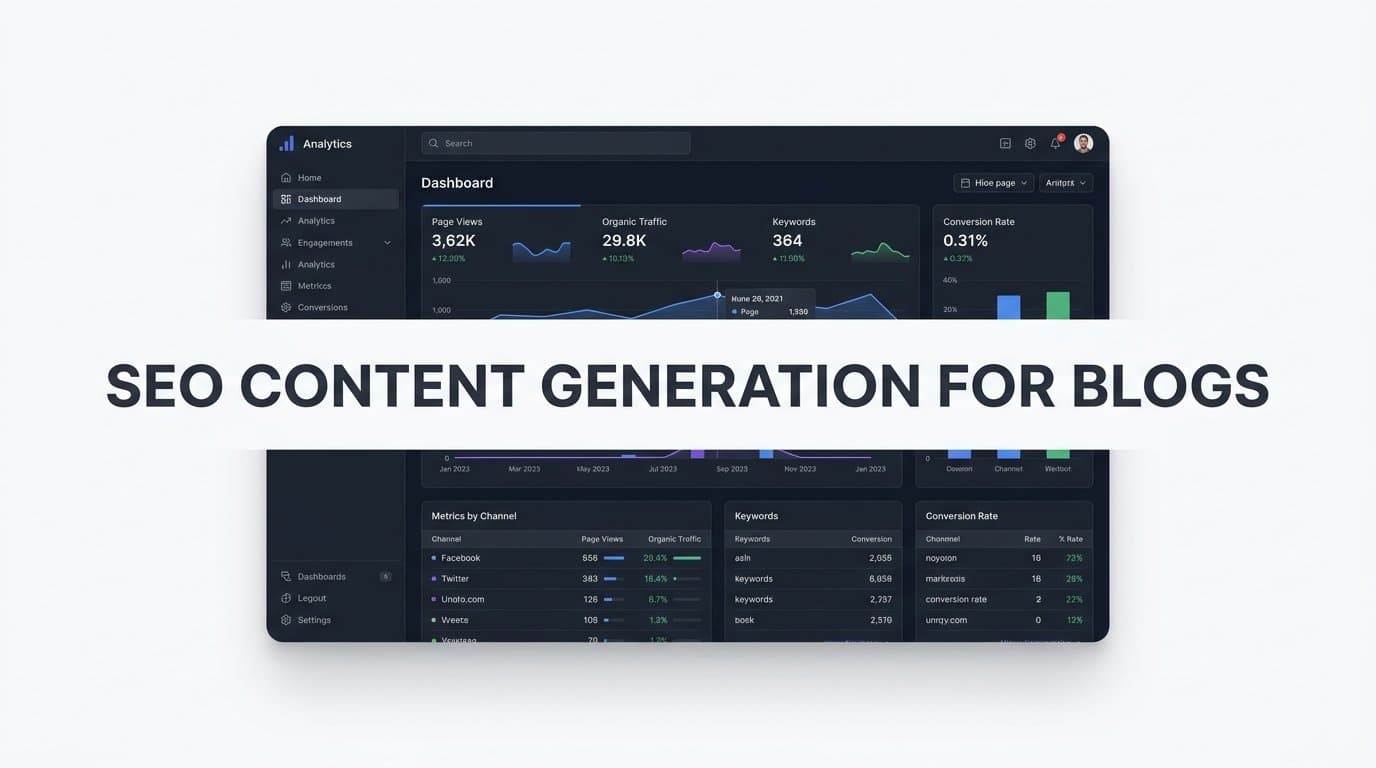
Monitor organic rankings and traffic through Google Search Console and your analytics platform. For each article, track impressions, clicks, click-through rate, and average position for the target keyword. These metrics tell you whether the article is gaining traction and where it needs support.
Set a review cadence for each article. Thirty to ninety days post-publish is a reasonable window to assess initial performance. Some articles will rank quickly; others need time to build authority. The review cadence keeps you from either abandoning articles too soon or ignoring ones that need updates.
Now layer in AI visibility tracking. This is the dimension of content performance that most teams aren't measuring yet, and it's increasingly important as AI-generated answers reshape how users discover information. Monitor whether your brand and your articles are being cited or referenced in AI-generated answers across ChatGPT, Claude, Perplexity, and other platforms.
Sight AI's AI visibility tracking software monitors brand mentions across 6+ AI platforms, providing an AI Visibility Score with sentiment analysis and prompt tracking. This tells you not just whether you're being cited, but how AI models characterize your brand relative to competitors. That intelligence directly informs your next content priorities.
Use sentiment analysis to identify positioning gaps. If AI models are describing your brand in ways that don't align with your positioning, that's a signal to create content that corrects the narrative. If competitors are being cited in answers where you should be, that's a content gap you can close with a targeted article.
For articles ranking on page two or three, content refreshes often produce faster ranking gains than publishing entirely new articles. Update with fresh data, expand thin sections, improve the structure, and resubmit for indexing. A well-executed refresh on a page-two article can move it to page one faster than a brand-new piece starting from zero.
Feed all performance data back into your keyword research process. High-performing topics signal where to build more depth in your content cluster. Low performers reveal either execution gaps or keyword targeting mismatches worth correcting.
The success indicator for this step: the article ranks in the top ten for its target keyword and appears as a cited source in AI-generated answers for related queries. When both conditions are true, your content is working across both discovery channels.
Putting It All Together: Your SEO Content Generation Checklist
Effective SEO content generation for blogs is a system, not a one-time task. Each step in this guide builds on the last: solid keyword research informs your brief, your brief guides your draft, your draft is optimized for on-page signals, and proactive indexing ensures search engines and AI models find your content fast.
As AI search continues to reshape how users discover information, optimizing for both traditional SEO and generative engine visibility is no longer optional. It's the baseline for competitive content programs in 2026.
Use this checklist before every article you publish:
1. Target keyword identified with intent confirmed
2. SERP analyzed and content gaps mapped
3. Brief created with GEO signals, E-E-A-T elements, and internal links planned
4. Draft generated and reviewed for accuracy, brand voice, and semantic depth
5. On-page SEO elements complete: keyword placement, schema, image optimization, internal links
6. URL submitted for indexing via Search Console and IndexNow
7. Performance tracking set up with AI visibility monitoring active
Platforms like Sight AI combine AI content generation, automated indexing, and AI visibility tracking in one workflow, so you can execute this entire process faster and at scale. From the AI Content Writer with 13+ specialized agents to automated sitemap updates and cross-platform AI mention tracking, the platform is built for exactly the kind of systematic content program this guide describes.
Start with one article using this framework, measure the results, and systematize what works. Start tracking your AI visibility today and see exactly where your brand appears across top AI platforms, so every piece of content you publish moves the needle in both search and AI-generated discovery.