Publishing consistent, optimized blog content is one of the most effective ways to grow organic traffic — but doing it manually at scale is exhausting. Between keyword research, drafting, optimizing, publishing, and now tracking whether AI models are even citing your content, the workflow has grown far beyond what any small team can sustain without help.
SEO blog automation software changes that equation. The best tools in this category handle everything from content generation and CMS publishing to indexing and AI visibility tracking, freeing your team to focus on strategy instead of execution. And in 2026, that last piece matters more than ever: with AI-powered search changing how people discover content, simply publishing isn't enough. You need to know if your content is getting found and cited by AI models answering your audience's questions.
This list covers the top tools for automating your SEO blog workflow, evaluated on content quality, automation depth, SEO and GEO optimization capabilities, integrations, and value for marketers, founders, and agencies. Whether you need end-to-end automation or a specialized piece of the puzzle, there's an option here for you.
1. Sight AI
Best for: Marketers and agencies who need content creation, AI visibility tracking, and indexing in one platform.
Sight AI is an all-in-one SEO and GEO content automation platform that covers the full content lifecycle: writing, publishing, indexing, and tracking how your brand appears across major AI models.

Where This Tool Shines
Most SEO blog automation tools solve one part of the problem. Sight AI is built around the idea that content production and content visibility are inseparable. You can generate a perfectly optimized article, but if it never gets indexed quickly or never earns a mention in AI-generated answers, the ROI is limited.
Sight AI addresses this by combining 13+ specialized AI agents for content generation with an AI Visibility Score that tracks how your brand is mentioned and positioned across ChatGPT, Claude, Perplexity, and other major AI platforms. Add automatic IndexNow submission on publish, and you have a genuinely closed-loop system that most competitors can only approximate by stitching together multiple tools.
Key Features
13+ Specialized AI Agents: Purpose-built agents for different content formats including listicles, guides, and explainers, each optimized for both traditional SEO and generative engine optimization (GEO).
Autopilot Mode: Hands-off content publishing workflows that handle scheduling, generation, and CMS delivery without manual intervention at each step.
AI Visibility Score: Tracks brand mention frequency and sentiment across 6+ AI platforms, giving you a clear picture of how AI models talk about your brand and where gaps exist.
IndexNow Integration: Automatically submits newly published content for indexing the moment it goes live, reducing the lag between publish and discovery by traditional search engines.
CMS Auto-Publishing: Eliminates the manual copy-paste step by pushing finished content directly to your CMS, keeping the workflow fully automated end-to-end.
Best For
Solo founders who need a complete system without building a stack, agencies managing content for multiple clients, and growth-focused marketing teams who want to automate content creation while simultaneously tracking their brand's presence in AI-generated search results. If your bottleneck is both volume and visibility, this is the most complete option on this list.
Pricing
Paid plans are available. Visit trysight.ai for current pricing details, as plans and tiers are updated regularly.
2. Writesonic
Best for: Teams prioritizing high-volume, factually grounded long-form blog content at speed.
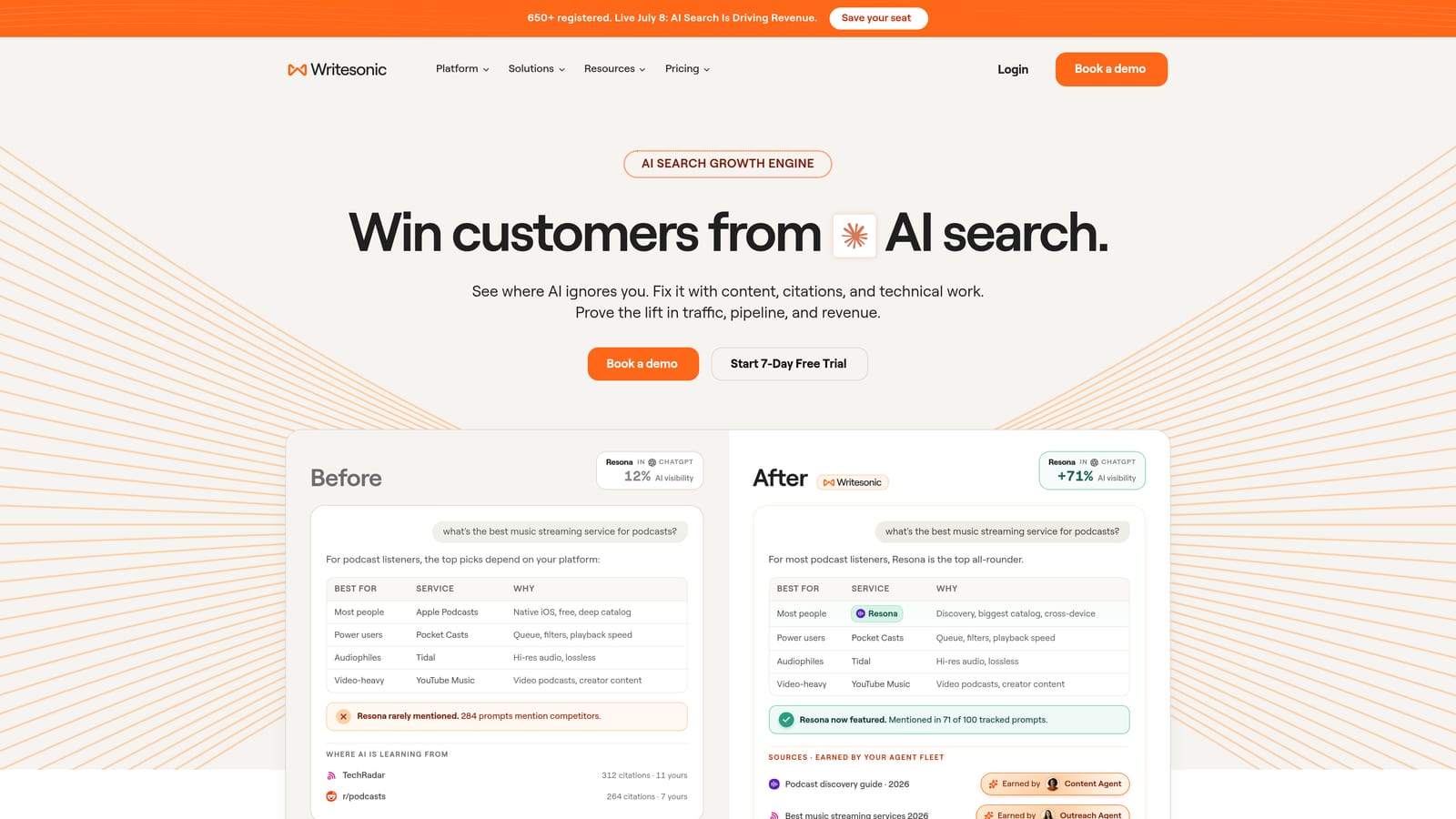
Writesonic is a well-established AI writing platform with strong long-form article generation capabilities, real-time web search grounding, and built-in SEO optimization features.
Where This Tool Shines
Writesonic has built a reputation for producing blog content that reads naturally and stays factually grounded, largely because its article generation pulls from real-time web search rather than relying solely on training data. For teams publishing across competitive, fast-moving topics, that accuracy layer matters.
Its bulk content generation capabilities make it particularly useful for agencies running high-volume content operations. When you need to produce dozens of articles per month across multiple clients or topics, Writesonic's workflow is designed to scale without proportional increases in editorial overhead.
Key Features
Long-Form Article Generation: Produces full blog posts grounded in real-time web search results, improving factual accuracy and topical relevance.
Built-In SEO Optimization: Keyword targeting and meta description generation are integrated directly into the article creation workflow.
Bulk Content Generation: Supports high-volume content production suited to agencies and teams managing multiple content streams simultaneously.
Brand Voice Customization: Allows teams to define and maintain a consistent tone across all generated articles, reducing the editing burden for brand alignment.
Multiple Content Format Templates: Goes beyond blog posts to support a range of content types, making it flexible for teams with diverse content needs.
Best For
Content-focused teams and agencies whose primary bottleneck is article volume and quality. Writesonic is a strong fit when you need a reliable content generation engine and are comfortable handling indexing and AI visibility tracking with separate tools.
Pricing
A free tier is available. Paid plans scale by word volume and features. See writesonic.com/pricing for current details.
3. AirOps
Best for: Growth teams and SEO agencies building custom programmatic content pipelines at scale.
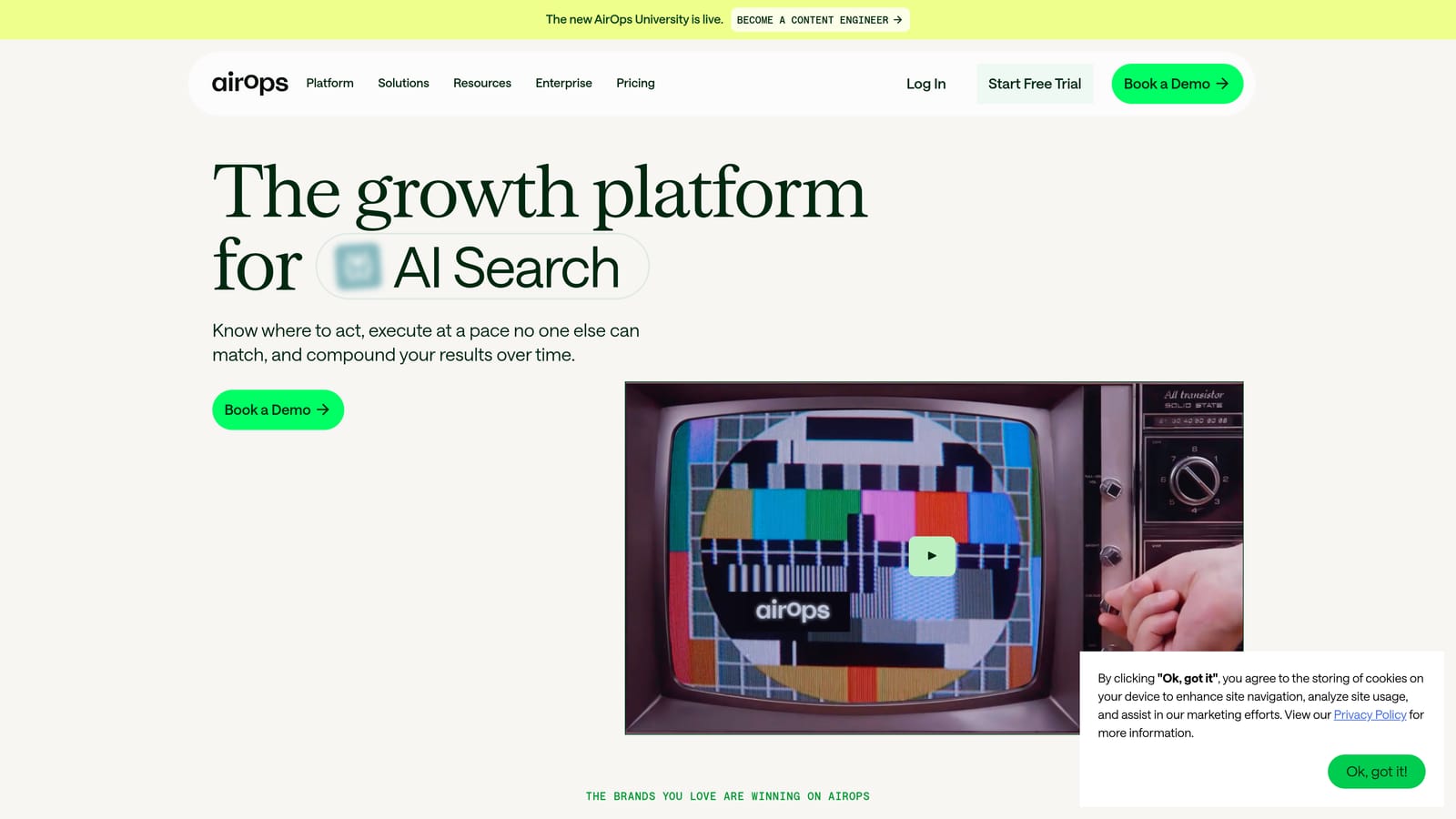
AirOps is a no-code AI workflow automation platform that lets SEO and growth teams build fully customized content pipelines, from keyword ingestion through article generation to CMS publishing.
Where This Tool Shines
Think of AirOps as the plumbing layer for SEO content automation. Rather than giving you a fixed content generation workflow, it gives you a visual builder to design exactly the pipeline your team needs. Pull keywords from a spreadsheet, trigger article generation, apply your formatting rules, and push to your CMS, all without writing a line of code.
This flexibility makes AirOps particularly powerful for programmatic SEO use cases where you're generating large volumes of structured content: location pages, product category descriptions, topical cluster articles. If your content strategy involves patterns and templates at scale, AirOps is built for that kind of systematic execution.
Key Features
Visual No-Code Workflow Builder: Design custom SEO content automation pipelines through a drag-and-drop interface accessible to non-technical team members.
Data Source Integrations: Connects to spreadsheets, databases, and APIs to trigger content generation from existing keyword and topic data.
Programmatic SEO Support: Handles location pages, product descriptions, and topical cluster content generation at scale with consistent structure.
Multiple LLM Integrations: Supports flexible model selection so teams can choose the right AI for different content types and quality requirements.
Team Collaboration Features: Built with agency and enterprise workflows in mind, supporting multi-user access and workflow management.
Best For
Technical SEO teams and growth-focused agencies running programmatic content operations. AirOps is the right choice when you need maximum flexibility to build a content pipeline tailored to your specific data sources and publishing infrastructure rather than fitting your workflow into a pre-built tool.
Pricing
Tiered plans based on usage volume. See airops.com for current pricing.
4. Profound
Best for: Brands and agencies focused on understanding and improving their GEO performance in AI-generated search answers.
Profound is an AI search visibility analytics platform that tracks how your brand appears in AI-generated answers, helping content teams identify which topics to prioritize for maximum GEO impact.
Where This Tool Shines
Profound operates at the intelligence layer of your content strategy. Rather than generating content, it tells you which content is working in AI-generated search environments and where your brand is missing from conversations it should be part of. That insight is increasingly valuable as AI-powered search drives a growing share of how users discover information.
The competitive share-of-voice analysis is particularly useful for agencies. When a client asks "how do we compare to our competitors in AI search," Profound gives you a data-driven answer rather than an educated guess. It turns GEO performance from a vague concept into something measurable and reportable.
Key Features
AI Answer Tracking: Monitors brand mentions and positioning across major LLMs to show exactly how and when your brand appears in AI-generated responses.
GEO Performance Analytics: Measures how effectively your content is earning placement in AI-generated answers over time.
Competitive Share-of-Voice Analysis: Benchmarks your brand's AI search presence against competitors to identify where you're winning and where you're losing ground.
Content Gap Identification: Surfaces topics and queries where AI models are answering without mentioning your brand, revealing content opportunities.
Reporting Dashboards: Structured reporting designed for marketing teams and agencies presenting AI visibility performance to stakeholders.
Best For
Marketing teams and agencies that want to measure and improve their brand's presence in AI-generated search results. Profound works best as an intelligence layer alongside a content generation tool, informing which topics to produce content about rather than producing the content itself.
Pricing
Contact Profound directly for pricing. See profound.ai for details.
5. Peec
Best for: Agencies managing multiple brand clients who need clear, comparable AI visibility reporting.
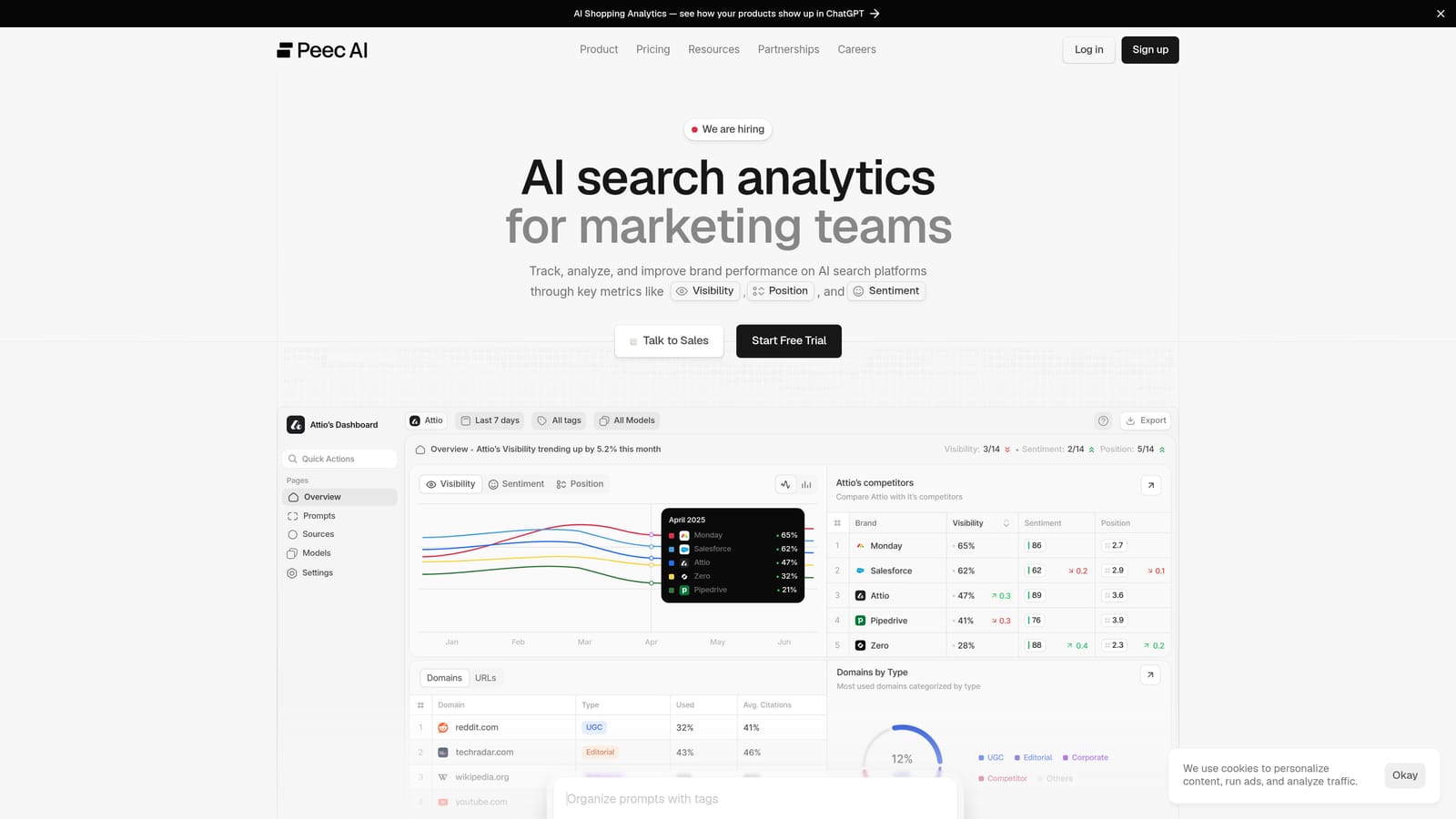
Peec is an AI brand monitoring tool focused on measuring share-of-voice in AI search results, giving marketers and agencies a clear picture of how their brand compares to competitors in LLM-generated responses.
Where This Tool Shines
Peec is built with agency workflows in mind. If you're managing AI visibility reporting across multiple clients, you need a tool that makes it easy to track, compare, and present brand performance in AI-generated answers without building custom reports from scratch for each account.
The competitive benchmarking feature is where Peec earns its place in a content automation stack. Knowing that your brand is mentioned less frequently than a key competitor in AI responses to a specific category of queries is exactly the kind of insight that should be driving your content prioritization decisions.
Key Features
Brand Mention Monitoring: Tracks how often and in what context your brand appears in AI model responses across monitored queries.
Competitive Benchmarking: Compares your brand's AI mention frequency and positioning against named competitors in AI-generated answers.
Multi-Client Support: Designed for agency workflows managing AI visibility tracking and reporting across multiple brand accounts simultaneously.
Trend Tracking: Monitors changes in AI visibility over time, allowing teams to measure the impact of content strategy adjustments on AI mention rates.
Alerts and Reporting: Notifies teams of significant changes in brand mention frequency and provides structured reports for client delivery.
Best For
Digital agencies managing AI visibility performance for multiple clients, and in-house marketing teams that need a straightforward way to benchmark their brand's AI search presence against competitors and track improvement over time.
Pricing
See peec.ai for current plan details and pricing tiers.
6. Promptwatch
Best for: SEO practitioners who need granular, prompt-level data on how specific content drives AI model mentions.
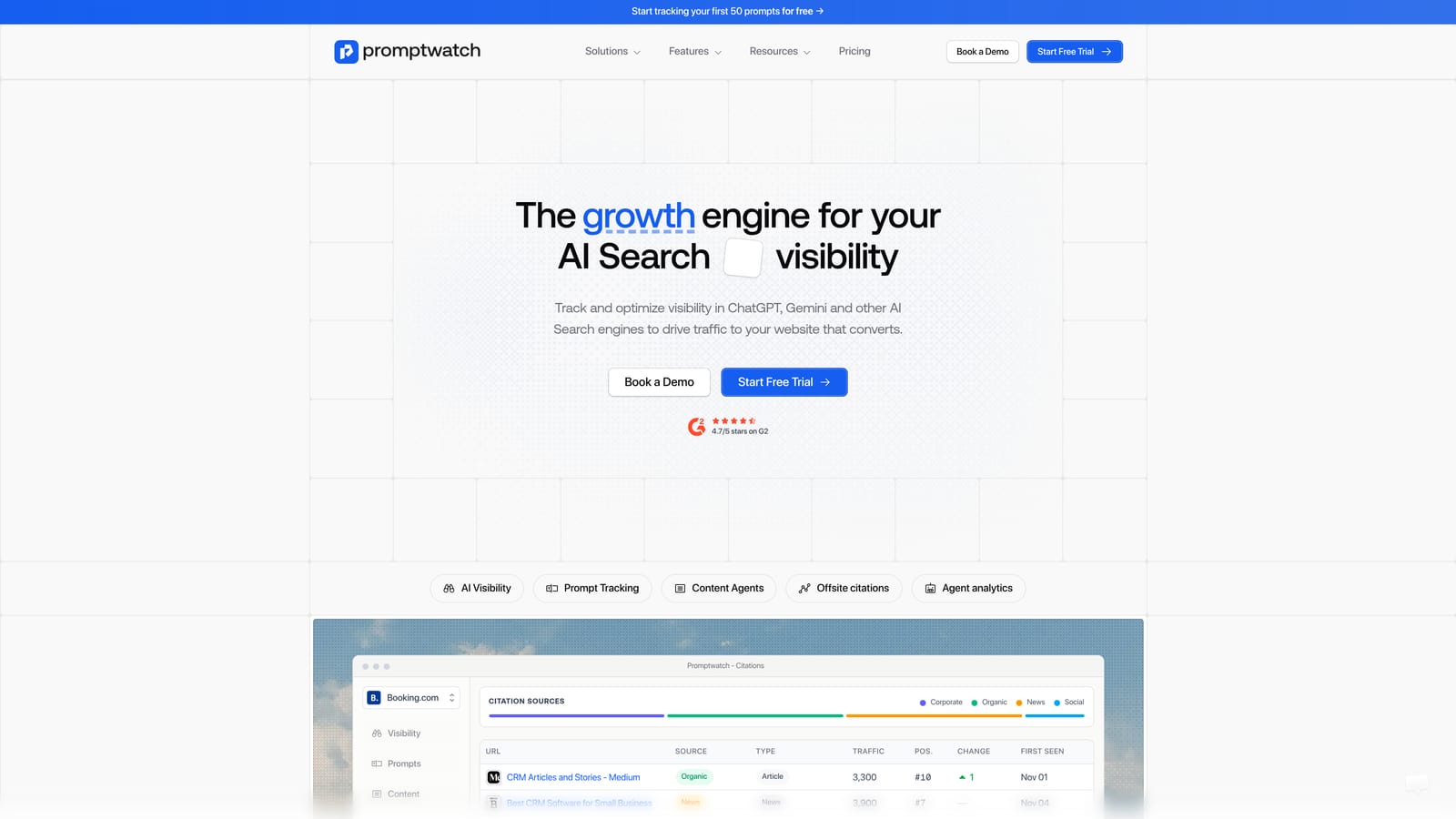
Promptwatch is a prompt-level AI visibility tracking tool that monitors specific queries to reveal when and how your brand appears in AI model responses, providing detailed data for GEO-focused SEO practitioners.
Where This Tool Shines
Where Profound and Peec give you a broad view of AI visibility performance, Promptwatch goes granular. Instead of tracking overall brand presence, it monitors specific prompts and queries, letting you trace exactly which content pieces are responsible for earning AI mentions and which aren't pulling their weight.
This level of detail is particularly valuable for practitioners running content experiments. If you're testing different angles, formats, or depth levels to see what earns more AI citations, Promptwatch gives you the feedback loop to make those decisions based on data rather than intuition. It's the most technical option in this list, and that specificity is exactly the point.
Key Features
Prompt-Level Tracking: Monitors specific queries across AI models to show exactly when and how your brand appears in responses to those particular searches.
Content Attribution: Identifies which specific content pieces are driving AI mentions, connecting your publishing activity to AI visibility outcomes.
Sentiment and Positioning Analysis: Tracks not just whether your brand appears in AI answers, but how it's described and positioned within those responses.
Multi-Model Monitoring: Supports tracking across ChatGPT, Claude, Perplexity, and other major AI platforms from a single dashboard.
Content Testing Support: Enables A/B testing of content angles and formats to identify which approaches improve AI mention rates for target queries.
Best For
Technical SEO practitioners and GEO specialists who want to understand the direct relationship between specific content decisions and AI visibility outcomes. Promptwatch pairs naturally with a content generation tool to close the loop between what you publish and how AI models respond to it.
Pricing
See promptwatch.io for current pricing information.
Choosing the Right Tool for Your Workflow
The tools on this list split naturally into two categories: content generation and automation on one side, and AI visibility tracking on the other. Understanding which bottleneck you're solving first makes the choice straightforward.
If you need everything in one place, Sight AI is the clearest starting point. It's the only tool here that combines content generation, automated indexing, and AI visibility tracking in a single platform, which matters if you're a solo founder or a lean team that can't afford to manage and integrate three separate tools.
If content volume is your primary constraint and you're comfortable handling distribution and tracking separately, Writesonic delivers reliable long-form output at scale. Teams with more technical requirements and a need for fully custom pipelines should evaluate AirOps, which gives you the flexibility to build exactly the workflow your operation needs.
For brands and agencies where the priority is understanding AI search visibility rather than generating more content, Profound, Peec, and Promptwatch each serve a distinct need. Profound is strongest for GEO performance analytics and content gap identification. Peec is built for multi-client agency reporting and competitive benchmarking. Promptwatch goes the deepest on prompt-level attribution, making it the right fit for practitioners who want to connect specific content decisions to specific AI visibility outcomes.
The clearest signal for which tool to choose is where your biggest bottleneck sits: content production, distribution, or visibility in AI-generated answers. If you're not sure, start by asking whether AI models are mentioning your brand in the conversations your audience is having. If you don't know the answer, that's the gap to close first.
Start tracking your AI visibility today and see exactly where your brand appears across top AI platforms, what content is driving those mentions, and where your biggest opportunities for organic growth are hiding.