If you've ever watched a perfectly written article sit in a "ready to publish" folder for three days because someone needs to format the headers, add the meta description, upload the featured image, and remember to hit "submit to Google Search Console," you already understand the problem. The content is done. The opportunity is live. But the workflow is broken.
For marketers, founders, and agencies running content at scale, this bottleneck isn't just frustrating. It's expensive. Every hour spent manually moving content through a CMS is an hour not spent on strategy, optimization, or the next piece that could be capturing search traffic right now. And in a landscape where AI-powered search engines like Perplexity, ChatGPT, and Google AI Overviews are actively surfacing fresh, well-indexed content to users, publishing delays translate directly into missed visibility windows.
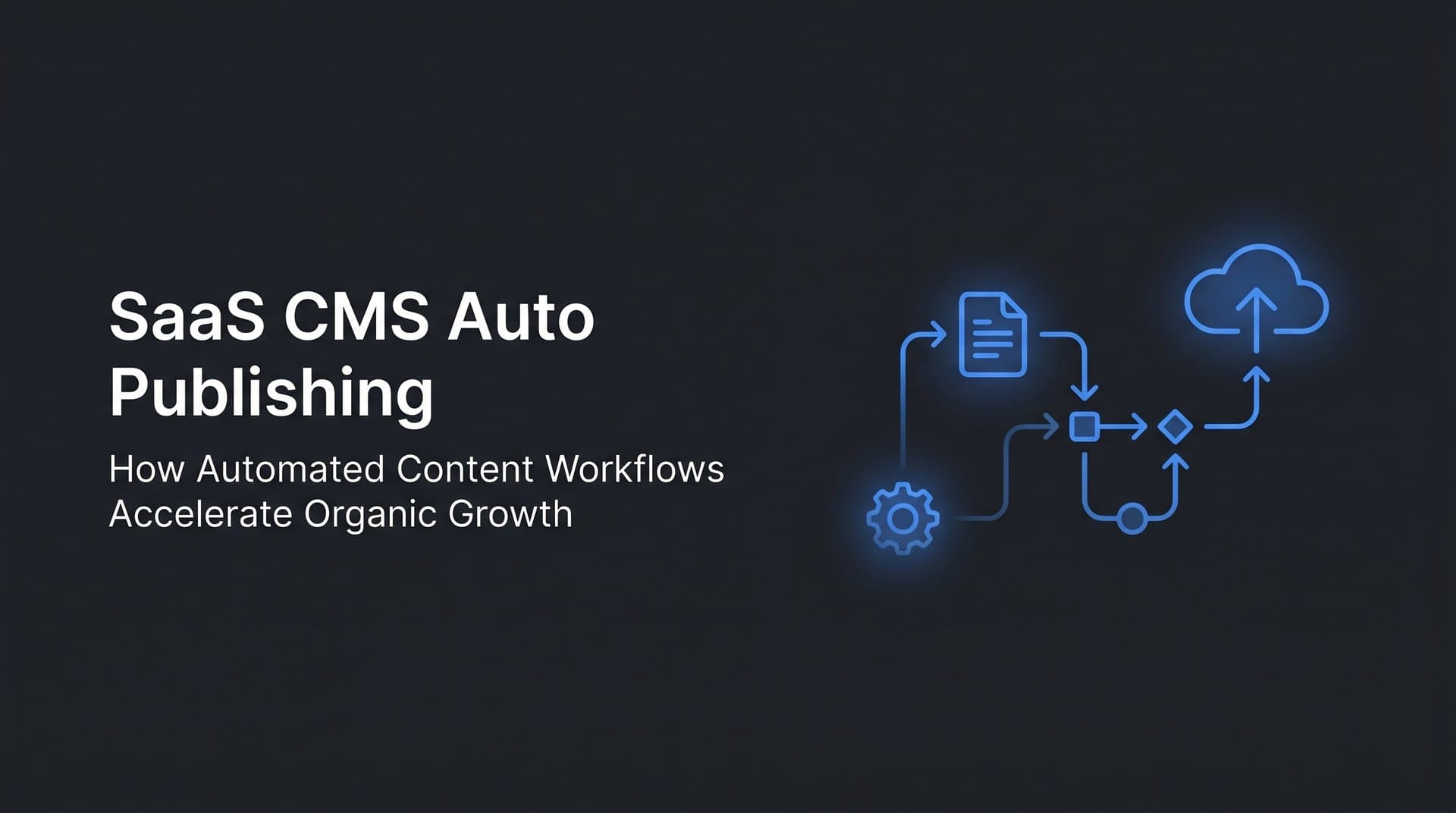
This is where SaaS CMS auto publishing changes the game. Rather than treating publishing as a final manual step, automated content workflows treat it as a seamless handoff: content is generated, enriched with SEO metadata, pushed live to your CMS via API, and immediately pinged to search engines for indexing. The entire pipeline runs with minimal human intervention, compressing what used to take days into minutes.
The stakes have never been higher. AI search models reward content that is indexed quickly, structured clearly, and updated consistently. Traditional search engines continue to use content freshness as a ranking signal. And the teams winning organic traffic right now are the ones who have figured out how to publish more, faster, without sacrificing quality. This article breaks down exactly how SaaS CMS auto publishing works, what separates strong platforms from basic schedulers, and how to build an end-to-end content engine that takes you from idea to indexed page at scale.
The Publishing Bottleneck That's Costing You Rankings
Let's walk through a typical content publishing workflow at most organizations. A writer submits a draft. An editor reviews it. Someone formats the headers and adds internal links. A different person uploads it to the CMS, adds the meta title, writes the meta description, selects the category, attaches the featured image, sets the canonical URL, and schedules the post. Then, after it goes live, someone manually submits the URL to Google Search Console or waits for the crawler to find it on its own.
Count the handoffs. Count the tools. Count the people. Each step introduces a delay, and delays compound. A piece of content that could have been live Tuesday morning might not actually appear in search results until Friday, after the crawler eventually discovers it. For topics with a short relevance window, like industry news, product launches, or trending queries, that gap can mean the difference between ranking on page one and never ranking at all.
The SEO impact of publishing delays is real and often underappreciated. Google uses content freshness as a ranking signal, particularly for queries where recency matters. When your content sits unpublished in a queue, you're not just losing time. You're losing the topical relevance window, the freshness signal, and potentially ceding ground to a competitor who published faster on the same topic. Teams looking to solve this challenge often turn to content publishing workflow automation to eliminate these costly delays.
There's also a compounding effect on domain authority signals. Many SEO practitioners note that consistent publishing cadence, maintaining a steady rhythm of new indexed pages, correlates with stronger topical coverage signals over time. When manual workflows create irregular publishing patterns, you lose the momentum that comes from consistent content output.
SaaS CMS auto publishing addresses this directly. At its core, it's a software-driven workflow where content is automatically formatted, enriched with metadata, and pushed live to a CMS with minimal human intervention. Rather than relying on a person to move content through each stage, the pipeline is configured once and executes automatically. The human role shifts from operator to strategist: setting the rules, reviewing quality gates, and analyzing performance rather than clicking through CMS menus.
This isn't about removing human judgment from content. It's about removing human labor from the parts of publishing that don't require judgment. Formatting a meta description, adding schema markup, submitting a URL to an indexing protocol: these are mechanical tasks. When software handles them automatically, your team gets back the hours they were spending on mechanics and can reinvest them in the work that actually moves the needle.
How Auto Publishing Pipelines Actually Work
Understanding the technical architecture behind auto publishing helps you evaluate tools more intelligently and configure them more effectively. The core mechanism is API-based CMS integration, and it's more accessible than it might sound.
Modern CMS platforms expose REST APIs that allow external applications to create, update, and publish content programmatically. WordPress has its REST API. Webflow has its CMS API. Headless platforms like Contentful, Strapi, and Sanity are built API-first, designed specifically for programmatic content delivery. When a SaaS auto publishing tool integrates with one of these platforms, it sends a structured content payload via API: the title, body content, metadata, tags, categories, and any other required fields. The CMS receives the payload and creates the post, either publishing it immediately or staging it according to configured rules. For a deeper look at how these connections work, explore CMS integration for automated publishing.
The key word here is "structured." For auto publishing to work reliably, content needs to arrive at the CMS in a format the platform expects. This is where content enrichment layers become critical. Before a piece of content is pushed to the CMS, a well-designed auto publishing system applies several layers of enrichment automatically.
Meta title and description generation: Rather than leaving these fields blank or requiring manual input, the system generates SEO-optimized meta titles and descriptions based on the content, target keyword, and character limits appropriate for search engine display.
Schema markup injection: Structured data like Article schema, FAQ schema, or HowTo schema is automatically added to the page, helping search engines understand the content type and improving eligibility for rich results.
Internal link suggestions: Some systems analyze existing site content and automatically suggest or inject relevant internal links, strengthening topical authority signals across the site.
Open Graph and social tags: Metadata for social sharing is automatically populated, ensuring that when the content is shared on LinkedIn or Twitter, it displays correctly without additional manual configuration.
After the content is live, the most forward-thinking auto publishing systems trigger an indexing notification automatically. This is where IndexNow comes in. IndexNow is an open-source protocol supported by Microsoft Bing, Yandex, and other search engines that allows websites to notify search engines the moment new content is created or updated. Instead of waiting for a crawler to discover the page organically, a single API call to the IndexNow endpoint tells participating search engines: "This URL just went live. Come index it now." Teams seeking to accelerate this process benefit from dedicated content indexing automation tools.
The combination of CMS API publishing, metadata enrichment, and IndexNow integration creates a pipeline where content moves from finalized draft to indexed, discoverable page in a fraction of the time traditional workflows require. The automated sitemap update is the final piece: as new pages are published, the sitemap is updated automatically, giving search engine crawlers a continuously current map of the site's content.
Five Capabilities That Separate Strong Auto Publishing Tools from Basic Schedulers
It's worth being clear about what SaaS CMS auto publishing is not. Scheduling a WordPress post to go live at 9 AM on Tuesday is not auto publishing. That's a basic scheduler, and virtually every CMS has had this feature for years. True auto publishing is fundamentally different in scope, capability, and impact.
Here's what separates platforms that genuinely automate the publishing pipeline from tools that simply delay the same manual process:
1. Multi-CMS support with CMS-agnostic integration: A real auto publishing tool doesn't lock you into one platform. It integrates with WordPress, Webflow, Contentful, and other CMS environments through standardized API connections. This matters enormously for agencies managing multiple client sites and for companies that operate more than one web property. The ability to push content to different CMS platforms from a single workflow engine is what makes scale possible without proportional increases in manual effort. You can explore the leading options in our guide to auto publish to CMS tools.
2. Automatic SEO metadata injection: Every published page should arrive in the CMS complete: meta title, meta description, canonical URL, Open Graph tags, and schema markup already applied. Tools that require you to fill these in manually after publishing aren't saving you time on the most SEO-critical parts of the process. Metadata automation is non-negotiable for teams serious about organic performance.
3. IndexNow and Search Console API integration: Publishing content and waiting for it to be discovered is a passive strategy. Strong auto publishing tools actively notify search engines the moment content goes live. IndexNow integration means participating search engines receive an instant ping. For teams publishing at high velocity, this capability compounds significantly: every new page enters the indexing queue immediately rather than waiting days for crawler discovery.
4. Content versioning and rollback: Automation introduces risk if there's no safety net. Platforms that support content versioning maintain a history of published states, allowing teams to roll back to a previous version if an error is introduced during automated enrichment or publishing. This is particularly important for agencies where a publishing error on a client site carries reputational and contractual consequences.
5. Bulk publishing with queue management: For teams generating content at scale, the ability to queue dozens of articles and publish them according to a configured schedule, with rate limiting to avoid overwhelming a CMS or triggering spam signals, is essential. Understanding bulk content publishing automation helps teams implement this capability effectively. Queue management also allows prioritization: breaking news or time-sensitive content can be moved to the front of the queue while evergreen pieces publish on their regular cadence.
These five capabilities matter most for agencies and multi-site operators who need to scale content output without scaling headcount. When a single platform handles CMS integration, metadata, indexing notification, versioning, and queue management, the operational overhead of content publishing shrinks dramatically. Teams that previously needed a dedicated publishing coordinator can redirect that capacity toward content strategy and performance analysis.
From Published to Indexed: Closing the Discovery Gap
Here's a misconception that costs many teams real organic traffic: the belief that "published" equals "visible." It doesn't. When you hit publish on a piece of content, it's live on your website. But that doesn't mean search engines know it exists yet, and it certainly doesn't mean it's appearing in search results.
The gap between a page going live and a page being indexed can range from hours to weeks, depending on your site's crawl budget, domain authority, how recently the site was last crawled, and whether you've done anything to actively notify search engines. For high-authority domains with frequent crawling, this gap might be short. For newer sites or pages buried deep in the site architecture, it can stretch uncomfortably long. Implementing website indexing automation software is one of the most effective ways to address this challenge.
During that gap, your content is effectively invisible. It's not ranking. It's not capturing traffic. And if a competitor published on the same topic and got indexed first, they're already accumulating the freshness signals and click-through data that influence rankings. The discovery gap is a real competitive disadvantage, and most teams don't even realize they have it.
Auto publishing tools that integrate with IndexNow compress this gap dramatically. When a new page is published and an IndexNow ping is sent automatically, participating search engines receive an immediate notification to crawl and index that URL. Instead of waiting for a scheduled crawl to discover the page, the indexing process begins within minutes of publication. Automated sitemap updates reinforce this by ensuring that the site's sitemap always reflects the current content inventory, giving crawlers a reliable reference point.
This speed advantage extends beyond traditional search. AI-powered search tools, including ChatGPT with web browsing, Perplexity, and Google AI Overviews, pull from indexed web content when generating responses. Content that isn't indexed isn't accessible to these systems. Content that is indexed quickly has a meaningful advantage: it enters the pool of available sources sooner, increasing the probability of being surfaced in AI-generated answers.
As AI search continues to grow as a discovery channel, the time-to-index metric takes on new strategic importance. Brands that consistently publish fresh, well-structured content and get it indexed quickly are building a compounding advantage in both traditional and AI-powered search. The discovery gap isn't just a technical inconvenience. It's a strategic liability that auto publishing tools with proper indexing integration can eliminate.
Building an End-to-End Automated Content Engine
Understanding individual components of auto publishing is useful. Understanding how they connect into a single, seamless pipeline is transformative. Here's what a fully integrated automated content engine looks like from start to finish.
The pipeline begins with content generation. AI writing tools, particularly those built with specialized agents for different content formats, can produce SEO-optimized drafts based on target keywords, topical briefs, and brand guidelines. The best systems don't just generate text: they apply GEO (Generative Engine Optimization) principles, structuring content to be surfaced by AI models as well as traditional search engines. Platforms offering AI content writing with auto publishing combine these generation and distribution capabilities into a single workflow. This means clear headings, direct answers to likely queries, authoritative sourcing, and structured data compatibility.
From generation, content moves into an optimization layer. This is where keyword placement is reviewed, readability is assessed, internal linking opportunities are identified, and metadata is generated. In a well-configured pipeline, this layer operates automatically, applying a consistent set of SEO and GEO standards to every piece of content before it ever touches the CMS.
Next comes auto publishing to the CMS. Via API integration, the fully enriched content payload is sent to the target platform, whether that's WordPress, Webflow, or a headless CMS. Publishing rules configured in advance determine whether content goes live immediately or enters a review queue for human approval before publication. Quality gates at this stage might include minimum word count checks, metadata completeness verification, or keyword density validation. For a comprehensive look at the tools powering this stage, see our roundup of content pipeline automation software.
Immediately after publishing, the indexing notification fires. An IndexNow ping is sent to participating search engines, and the sitemap is updated to include the new URL. The page enters the indexing queue within minutes rather than days.
Finally, performance data flows back into the system. Organic traffic, ranking positions, click-through rates, and AI visibility metrics are tracked in dashboards that connect publishing activity to outcomes. This feedback loop is what transforms a publishing pipeline into a learning engine: you can see which topics and formats are gaining traction and adjust your content strategy accordingly.
Platforms like Sight AI are designed to connect these stages. With AI content writing powered by 13+ specialized agents, CMS auto-publishing via API integration, IndexNow connectivity, and AI Visibility tracking across multiple AI platforms, the workflow from ideation to indexed, discoverable page runs through a single system. Setting up CMS connections typically involves authenticating with your CMS API, configuring field mappings, and setting publishing rules. From there, the pipeline runs automatically, with your team reviewing performance rather than managing mechanics.
Measuring What Actually Matters After Auto Publishing
Automation without measurement is just faster guessing. Once your auto publishing pipeline is running, the metrics you track determine whether you're optimizing intelligently or simply publishing at higher volume without understanding the impact.
The first metric to establish is time-to-index. This measures how long it takes from a page going live to it appearing in search engine indexes. With IndexNow integration, this should compress to minutes for participating search engines. Tracking this baseline, and monitoring it over time, confirms that your indexing pipeline is functioning correctly and gives you a benchmark for improvement.
Publishing velocity, measured in pages published per week or month, is your throughput metric. It tells you whether automation is actually increasing your content output or simply making the same volume easier to manage. For most teams, the goal is to increase velocity without increasing headcount, and this metric makes that progress visible. Teams looking to dramatically scale output should explore strategies for automated blog publishing to understand realistic benchmarks.
Organic traffic growth rate, measured at both the page level and the domain level, connects publishing activity to business outcomes. By correlating publishing velocity with traffic trends, you can identify whether increased publishing frequency is translating into meaningful organic growth. SEO performance dashboards that surface this correlation make it straightforward to demonstrate content ROI.
The emerging metric that forward-thinking teams are adding to their dashboards is AI visibility. This tracks how often and how favorably AI models like ChatGPT, Claude, and Perplexity mention your brand in response to relevant queries. Understanding AI visibility for SaaS companies is becoming essential as AI search grows as a discovery channel, and this metric becomes increasingly important for understanding your total organic presence.
Consistent, fast publishing feeds AI visibility directly. AI models surface content from indexed sources, and brands that publish frequently on relevant topics, get indexed quickly, and maintain well-structured content are more likely to appear in AI-generated answers. Tracking your AI visibility score alongside traditional SEO metrics gives you a complete picture of how your content engine is performing across both discovery channels.
Your Next Steps Toward a Faster Content Engine
SaaS CMS auto publishing isn't a convenience feature you add when you have time to set it up. It's a competitive capability that determines how quickly your content reaches the audiences searching for it, in both traditional search and AI-powered discovery environments.
The teams winning organic traffic right now have solved the publishing bottleneck. They're not spending hours on CMS mechanics. They're publishing more, getting indexed faster, and showing up in AI-generated answers because their content is consistently fresh, well-structured, and discoverable. The gap between them and teams still running manual workflows is widening every week.
Start by auditing your current workflow. Count the manual steps between "content approved" and "URL indexed." Identify where delays accumulate. Then ask whether those delays are creating value or simply consuming time that could be spent on strategy. For most teams, the answer is clear.
An integrated platform that combines AI content generation, automated publishing, IndexNow integration, and AI visibility tracking eliminates the bottlenecks that are slowing your organic growth. You set the rules, review the performance, and let the pipeline handle the mechanics.
Stop guessing how AI models like ChatGPT and Claude talk about your brand. Get visibility into every mention, track content opportunities, and automate your path to organic traffic growth. Start tracking your AI visibility today and see exactly where your brand appears across top AI platforms.