AI-powered search engines have quietly become one of the most important discovery channels on the internet. When someone asks ChatGPT, Claude, or Perplexity to recommend a tool, a service, or a brand in your category, you either show up or you don't. There's no page two to fall back on.
The challenge is that most traditional SEO tools weren't built for this. Tracking whether your brand appears in an AI-generated response requires a fundamentally different approach than monitoring keyword rankings in Google. That's exactly why a new category of AI visibility tools has emerged, with Profound being one of the more recognized names in the space.
But Profound isn't the only option, and depending on your team's size, workflow, and goals, it might not be the right one. This guide breaks down the top platforms for tracking and improving your brand's presence in AI search, covering monitoring depth, content workflow integration, platform coverage, and pricing transparency.
1. Sight AI
Best for: Marketers and agencies who want to monitor, create, and publish in one platform.
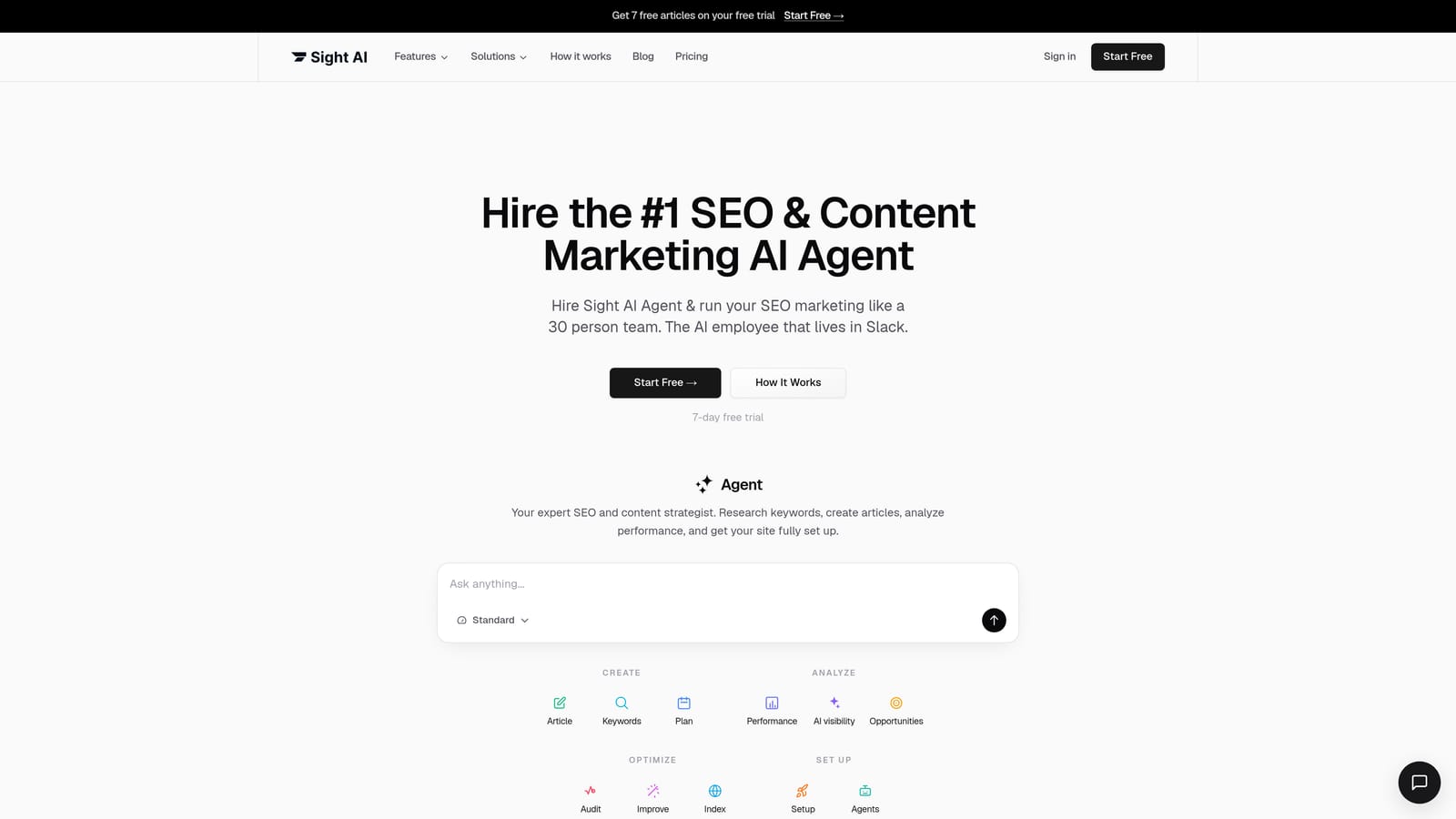
Sight AI is the only platform in this category that closes the full loop from AI brand monitoring to content generation to automated indexing, all within a single workflow.
Where This Tool Shines
Most AI visibility tools tell you where you stand. Sight AI tells you where you stand and then helps you do something about it. The platform tracks brand mentions across six or more AI models, including ChatGPT, Claude, and Perplexity, and pairs that data with a content engine specifically designed to improve your GEO (Generative Engine Optimization) presence.
The Autopilot Mode is a genuine differentiator for lean teams. Rather than requiring a content strategist to manually interpret monitoring data and brief writers, Sight AI can move from insight to published content with minimal manual intervention. For agencies managing multiple clients or founders wearing multiple hats, that kind of workflow compression matters.
Key Features
AI Visibility Score: A proprietary scoring system that quantifies your brand's presence across AI platforms, complete with sentiment analysis so you know not just whether you're mentioned, but how.
Prompt Tracking: Identifies exactly which queries trigger your brand mentions and which ones you're missing, giving your content team a clear brief for where to focus.
13+ Specialized AI Agents: Purpose-built agents for generating listicles, guides, explainers, and other formats optimized for both traditional SEO and generative engine discovery.
Autopilot Mode: Runs content generation workflows with minimal manual input, useful for teams that need consistent publishing velocity without adding headcount.
IndexNow Integration: Automatically submits new content to search engines via IndexNow, updates sitemaps, and supports CMS auto-publishing so content gets discovered faster.
Best For
Growth marketers, content-focused agencies, and founders who want a single platform that handles AI monitoring, content creation, and technical indexing. Particularly well suited for teams that are serious about GEO as a growth channel and don't want to stitch together three separate tools to get there.
Pricing
Visit trysight.ai for current plans and free trial availability. Pricing tiers are designed to accommodate both individual users and agency-scale operations.
2. Profound
Best for: Enterprise teams focused on share-of-voice analysis and competitive AI benchmarking.
Profound is an enterprise-grade AI answer monitoring platform built for structured brand tracking and competitive intelligence across AI-powered search engines.
Where This Tool Shines
Profound is built for organizations that need to measure AI visibility at scale and present those findings to stakeholders. Its structured prompt testing approach lets teams systematically evaluate how AI models respond to a curated library of queries, making it possible to track share-of-voice trends over time rather than relying on one-off spot checks.
The competitive benchmarking dashboards are a clear strength. If you're in a category where multiple brands are competing for AI-generated recommendations, Profound gives you a structured view of how your visibility compares to rivals, which is genuinely useful for strategic planning and executive reporting.
Key Features
Structured Prompt Testing: Run brand visibility tests across a defined set of queries at scale, enabling consistent measurement of AI response behavior over time.
Share-of-Voice Analysis: Track how often your brand appears in AI responses relative to competitors across major AI platforms.
Competitive Benchmarking Dashboards: Visual reporting tools that make it straightforward to compare your AI presence against named competitors.
Enterprise Reporting: Analytics and reporting infrastructure suited for larger teams with formal reporting requirements.
Best For
Mid-market and enterprise brands with dedicated analytics or SEO teams who need robust monitoring and competitive intelligence. Best for organizations where content creation and monitoring are handled by separate teams and an integrated content workflow isn't a priority.
Pricing
Profound uses enterprise-oriented pricing. Visit profoundapp.com for current plan details and to request a demo.
3. Promptwatch
Best for: Brand managers who want granular, prompt-level insight into AI mention behavior.
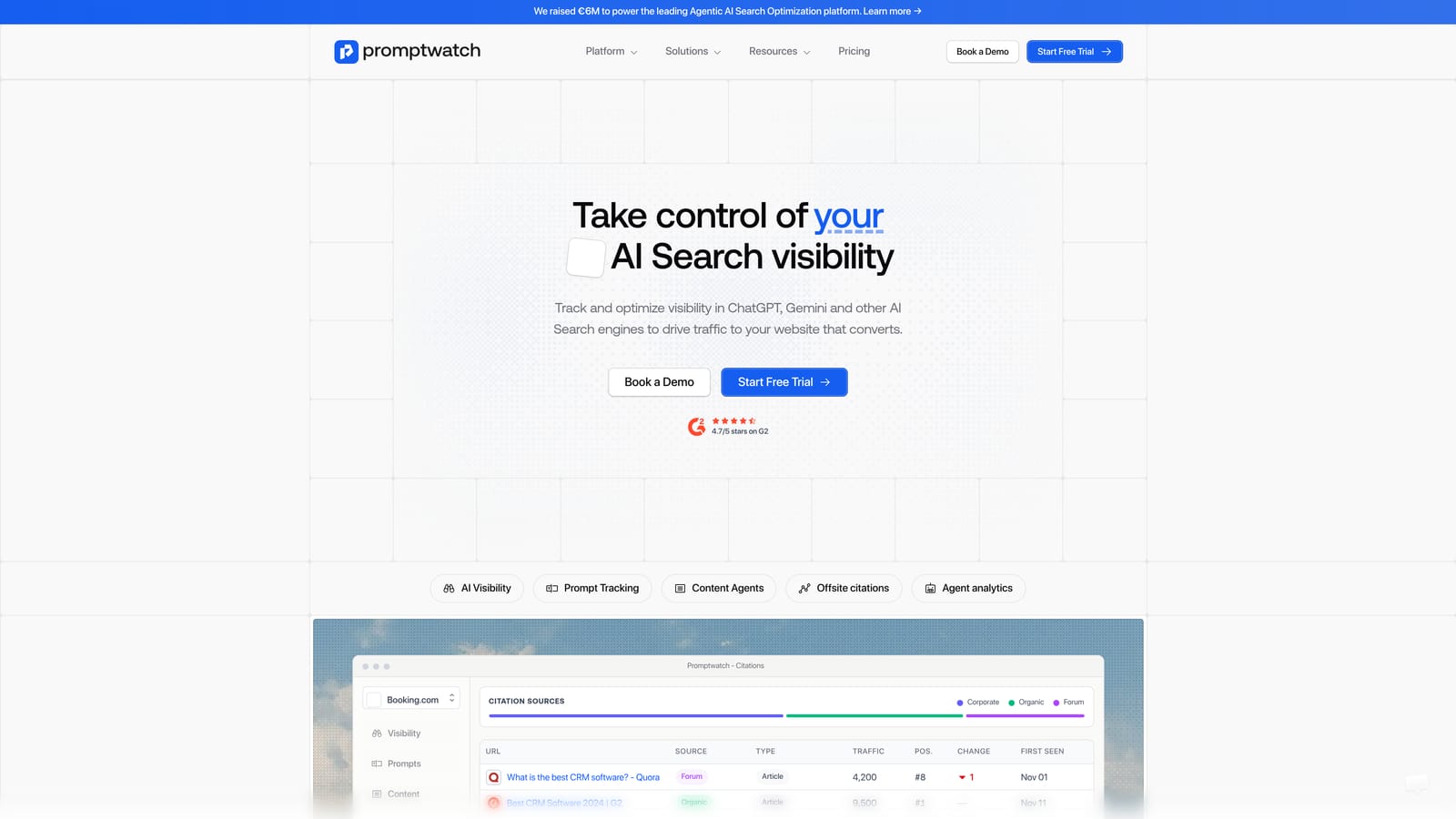
Promptwatch is a specialist monitoring tool focused specifically on tracking which queries cause AI models to mention or overlook your brand, with an alert system built for real-time awareness.
Where This Tool Shines
The value proposition here is precision. While broader platforms give you a general picture of AI visibility, Promptwatch lets you drill down to the specific prompt level, understanding which exact questions surface your brand and which ones hand the spotlight to a competitor. That level of granularity is genuinely useful for SEO specialists and brand managers who want to reverse-engineer AI response patterns.
The alert system adds a practical layer of real-time monitoring. Rather than running manual checks, teams get notified when their brand mention status changes in AI responses, which is valuable for catching competitive shifts or the impact of new content before they show up in quarterly reports.
Key Features
Prompt-Level Brand Tracking: Monitor your brand's appearance at the individual query level, not just as an aggregate metric.
Alert System: Receive notifications when AI responses change with respect to your brand mentions, enabling faster reaction to competitive shifts.
Competitive Prompt Analysis: Understand which prompts drive visibility for competitors so you can identify gaps in your own content strategy.
Prompt Library Management: Organize and maintain an ongoing library of tracked queries for systematic monitoring over time.
Best For
SEO specialists, brand managers, and digital PR teams who want deep, query-level visibility into AI response behavior. A strong specialist choice for teams that already have content workflows in place and primarily need the monitoring layer.
Pricing
Visit promptwatch.io for current plan details and feature tier breakdowns.
4. Peec
Best for: Early-stage startups and small teams taking their first steps into AI visibility monitoring.
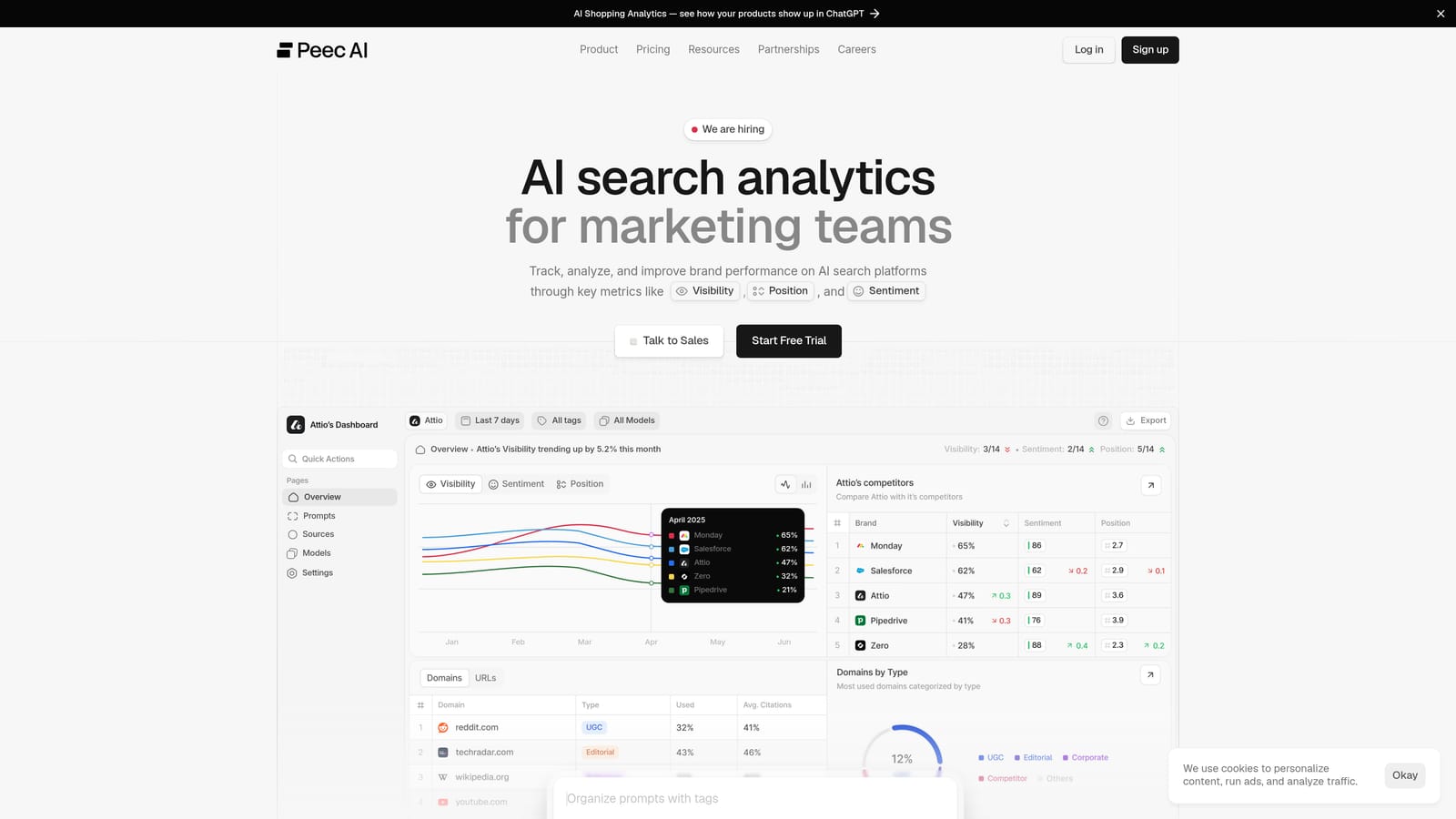
Peec is a lightweight AI mention tracker designed to give smaller teams a straightforward view of how AI models reference their brand, without enterprise-level complexity or setup overhead.
Where This Tool Shines
Not every team needs a full-stack platform on day one. Peec's appeal is accessibility: it's built for teams who recognize that AI search visibility matters but aren't yet ready to invest in a complex monitoring infrastructure. The setup is minimal, the reporting is readable without a data analyst, and the core function, knowing whether your brand shows up in AI responses, is delivered without friction.
For founders or solo marketers who are just beginning to understand their AI search presence, Peec provides a useful starting point. It answers the fundamental question, "Does AI mention us?" and gives you enough signal to start making decisions about content strategy.
Key Features
Brand Mention Tracking: Monitor how your brand is referenced across AI platforms without complex configuration requirements.
Accessible Reporting Interface: Clean, readable dashboards designed for users who aren't data specialists.
Quick Setup: Minimal onboarding friction, making it practical for teams with limited technical resources.
Entry-Level Accessibility: Priced and scoped for teams that are new to AI visibility monitoring rather than those with mature programs.
Best For
Early-stage startups, bootstrapped founders, and small marketing teams who want to establish a baseline understanding of their AI search presence before investing in more comprehensive tooling. A practical first step rather than a long-term enterprise solution.
Pricing
Visit peec.ai for current pricing and available plan tiers.
5. AirOps
Best for: Content operations teams scaling AI-assisted content production pipelines.
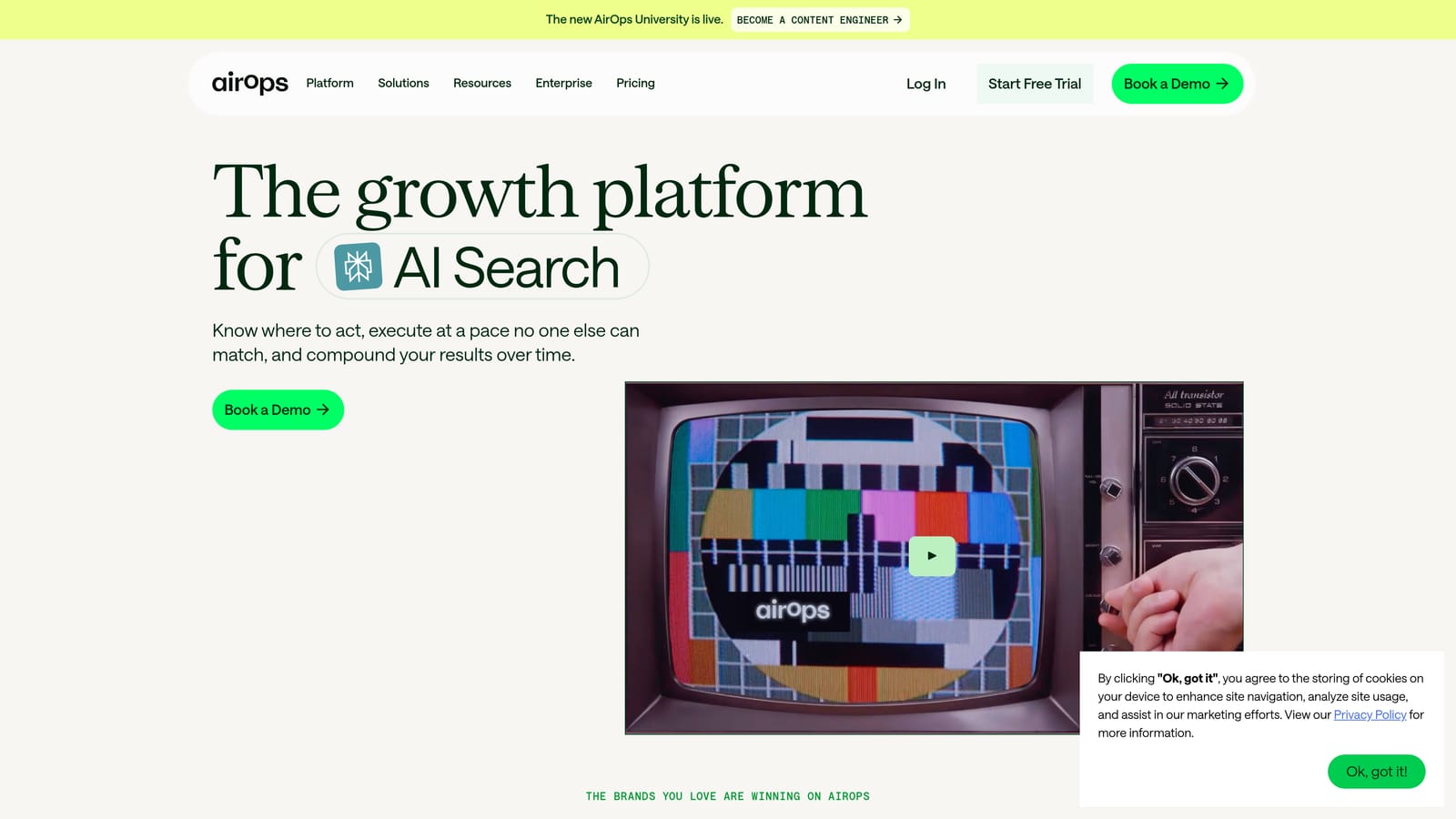
AirOps is an AI workflow automation platform built for teams that need to scale content production through structured prompt engineering and visual workflow builders.
Where This Tool Shines
It's worth being direct here: AirOps is not primarily an AI visibility monitoring tool. It sits in a complementary but distinct category, helping content operations teams build repeatable, scalable AI content workflows. If your challenge is "we need to produce more AI-assisted content faster," AirOps is built for that problem.
The visual workflow builder is particularly well suited for agencies and content ops teams that run complex multi-step content production processes. You can chain prompts, pull in data sources, and create reusable templates that make high-volume content production more systematic. Teams that already have monitoring covered elsewhere and need to scale their content output will find genuine value here.
Key Features
Visual AI Workflow Builder: Design and automate multi-step content production workflows without requiring engineering resources.
Prompt Template Library: Build, store, and reuse prompt templates across content types and client accounts.
Data Source Integrations: Connect external data sources to feed AI-assisted content workflows with relevant context at scale.
Collaboration Tools: Team-oriented features for content ops groups managing multiple workflows and contributors simultaneously.
Best For
Content operations teams and agencies that need to scale AI-assisted content production and already have separate tools handling AI visibility monitoring. AirOps fills a content scaling need rather than a brand monitoring need, so it works best as part of a broader stack.
Pricing
Visit airops.com for current plan details and team pricing options.
6. Writesonic
Best for: Content marketers prioritizing publishing volume and SEO-optimized article generation.
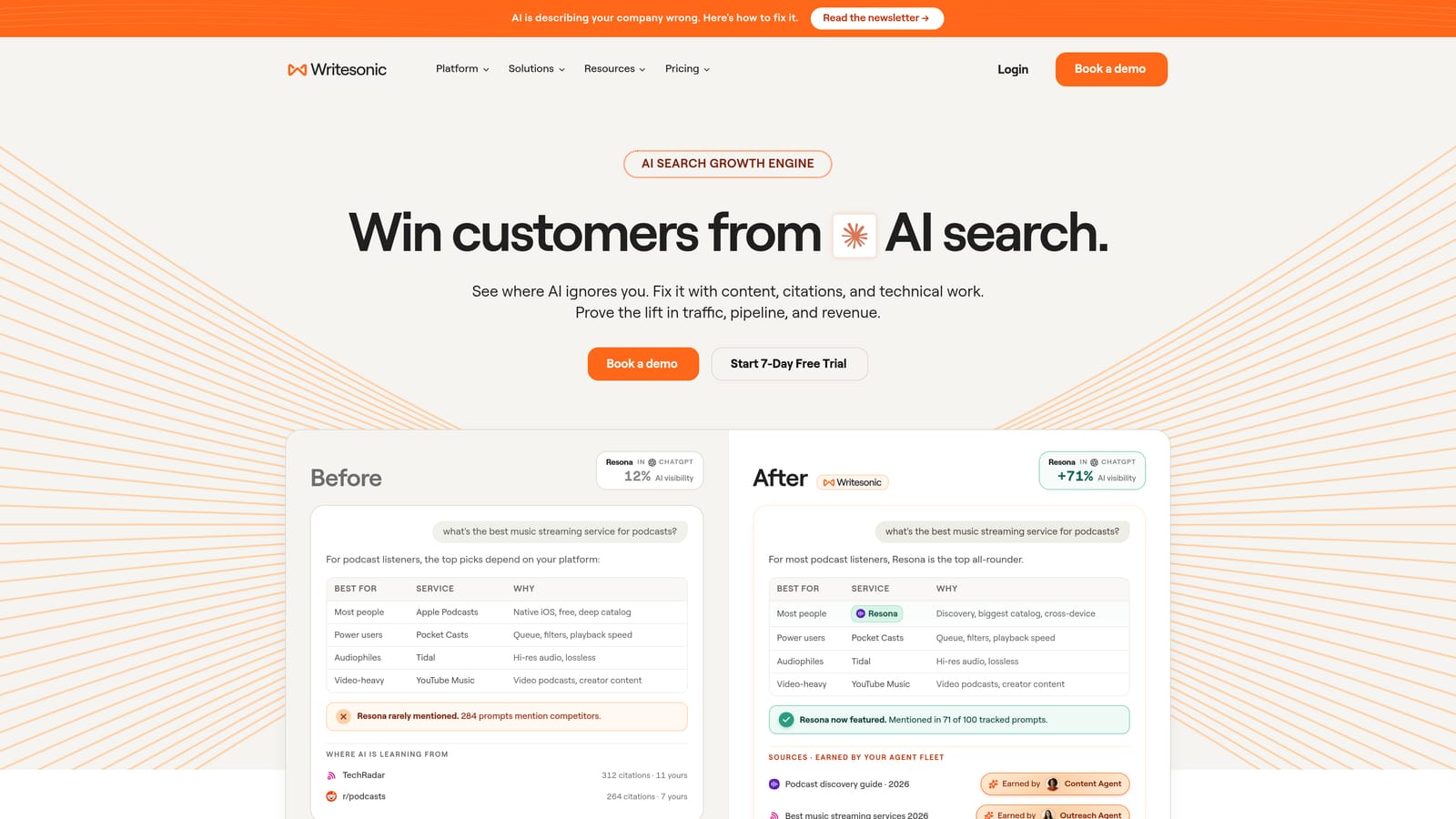
Writesonic is a broad AI writing platform with article generation, SEO content features, and Chatsonic for conversational AI-assisted research and drafting.
Where This Tool Shines
Like AirOps, Writesonic deserves an honest framing: it's primarily a content creation tool, not an AI visibility tracker. It appears in evaluations like this one because content-first teams often assess their full AI search stack together, and Writesonic is a well-known name in AI content generation. If your immediate need is producing SEO-optimized articles at volume, Writesonic delivers a capable, accessible solution.
The brand voice customization feature is genuinely useful for teams managing content at scale across multiple formats. Chatsonic adds a conversational research layer that some writers find helpful for drafting and ideation. The free tier also makes it an accessible starting point for teams testing AI writing tools before committing to a paid plan.
Key Features
AI Article Writer with SEO Mode: Generate long-form content with built-in SEO optimization guidance for traditional search visibility.
Chatsonic: A conversational AI interface for research, drafting assistance, and content ideation integrated into the writing workflow.
Brand Voice Customization: Train the platform to write in a consistent tone and style across content types and campaigns.
Free Tier: An accessible entry point for individuals and small teams evaluating AI writing tools before committing to a paid plan.
Best For
Content marketers focused on SEO article production and publishing velocity who don't yet need AI visibility monitoring. Best evaluated as a content creation tool rather than an AI search monitoring solution, and ideally paired with a dedicated visibility tracker if AI search presence is a priority.
Pricing
A free tier is available. Paid plans start at varying price points depending on volume and feature needs. Visit writesonic.com for current rates.
Which Platform Fits Your Situation
The right tool depends almost entirely on what problem you're actually trying to solve. These six platforms serve meaningfully different needs, so a quick use-case breakdown is more useful than a single winner declaration.
If you want monitoring plus a content workflow in one place: Sight AI is the only platform in this list that handles AI brand tracking, GEO-optimized content generation, and automated indexing under one roof. For teams that want to act on monitoring data without switching tools, that integration is the core value.
If you're an enterprise team focused purely on monitoring and benchmarking: Profound is a strong fit. Its structured prompt testing and competitive share-of-voice dashboards are built for organizations with formal reporting requirements and separate content teams.
If you need granular, prompt-level monitoring with alerts: Promptwatch is the specialist choice. It goes deeper on individual query behavior than broader platforms and is well suited for SEO specialists who want to understand exactly which questions surface their brand in AI responses.
If you're just starting out and need a simple baseline: Peec gives you an accessible entry point into AI visibility monitoring without enterprise complexity or a steep learning curve. It's a practical first step for early-stage teams.
If your challenge is scaling content production workflows: AirOps and Writesonic serve content operations needs rather than AI visibility monitoring. They belong in your stack as content tools, ideally paired with a dedicated monitoring platform.
The broader pattern here is worth noting. AI search visibility is not a passive outcome. It requires active monitoring to understand where you stand, strategic content creation to improve your presence, and fast indexing to make sure new content gets discovered. Tools that handle only one piece of that chain leave you managing the rest manually.
Stop guessing how AI models like ChatGPT and Claude talk about your brand. Start tracking your AI visibility today and see exactly where your brand appears across top AI platforms, what the sentiment looks like, and which content opportunities you're currently missing.