Optimizing your content for AI search isn't about small tweaks to your old SEO playbook. It's a fundamental shift in thinking. You need to move away from just chasing keyword rankings and start creating authoritative, conversational, and highly structured information that AI models can easily understand and, most importantly, cite.
The new goal is to become a trusted, primary source that directly answers a user's question, ensuring your brand gets featured inside an AI-generated summary, not just buried in a list of blue links.
The New Rules of Ranking in AI Search

Welcome to the next chapter of search. The old tactics of keyword density and backlink volume just don't cut it anymore. To win today, you have to get inside the "mind" of the large language models (LLMs) powering Google's AI Overviews and tools like ChatGPT. It's about understanding how they discover, process, and present information.
This isn't about tricking an algorithm. It's about making your content the most reliable, clear, and citable resource on any given topic.
The growth here is staggering. AI search in the U.S. is projected to jump from just 13 million users in 2023 to 90 million by 2027. This isn't a distant trend; it's happening right now. With nearly half of Google searches already triggering AI Overviews, the pressure is on. While these new features might reduce clicks to traditional results, they create massive opportunities for the sources they choose to cite.
From Keywords to Concepts
The biggest mental shift you need to make is from keywords to concepts. Traditional SEO was a game of targeting specific search terms. AI search optimization, on the other hand, is all about building comprehensive topical authority.
LLMs are built to understand context, nuance, and user intent—not just to match words on a page. This means your content has to answer the user's initial question and anticipate the next three questions they'll have.
This new mindset demands a sharp focus on:
- Conversational Language: Write like a human. Use a natural, direct tone that mirrors how people actually ask questions.
- Answer-Centric Formatting: Structure your information in clean, digestible snippets. Think FAQs, bulleted lists, and clear headings that an AI can easily pull from.
- Demonstrated Expertise: Prove you know your stuff. Back up claims with verifiable data, feature expert authors, and provide fresh, original insights.
The goal is no longer just to rank, but to be selected and featured. Visibility in an AI-generated answer is often more valuable than a standard organic click because it positions your brand as a definitive source of truth, capturing high-intent users before they even visit a website.
To help visualize this change, here’s a quick breakdown of the old vs. new.
Traditional SEO vs AI Search Optimization at a Glance
This table breaks down the core differences between the classic SEO approach we've used for years and the new reality of optimizing for AI-driven search.
| Focus Area | Traditional SEO Approach | AI Search Optimization Approach |
|---|---|---|
| Primary Goal | Rank #1 in the ten blue links. | Be the cited source within an AI-generated summary. |
| Content Focus | Target specific, high-volume keywords. | Cover a topic comprehensively, answering related questions. |
| Language Style | Formal, keyword-optimized prose. | Natural, conversational language that mimics human dialogue. |
| Structure | Long-form articles optimized for a single keyword. | Highly structured content with clear headings, lists, and data points. |
| Authority Signal | Backlinks are the primary indicator of authority. | E-E-A-T signals (Expertise, Experience, Authoritativeness, Trust). |
| Technical Focus | On-page optimization (titles, meta descriptions). | Structured data (Schema markup) to define content for machines. |
| Measurement | Keyword rankings, organic traffic, and click-through rate (CTR). | Citation frequency in AI results, brand mentions, and direct traffic. |
As you can see, while some fundamentals remain, the emphasis has clearly shifted toward clarity, authority, and machine-readability.
Non-Negotiable Pillars for AI Visibility
In this new ecosystem, some elements are simply table stakes. Your content will be invisible to AI if you don't have a solid foundation in structure and authority. You can find more specifics in our complete guide to AI search engine optimization, but it all boils down to a few core pillars.
Here’s what you absolutely must get right:
- Structured Data (Schema): This is the single most important technical element. Schema is machine-readable code that explicitly tells AI models what your content is about—whether it’s a product, a person, a recipe, or an FAQ page. Don't skip this.
- E-E-A-T Signals: Google’s signals for Experience, Expertise, Authoritativeness, and Trustworthiness are more important than ever. AI models rely heavily on these to vet sources. This means clear author bios, cited sources, original data, and transparent company information are essential.
- Content Freshness: Outdated information is a red flag. Regularly updating your content to reflect the latest data and trends signals to AI that your information is current and reliable, making it a much safer and more trustworthy choice for an answer.
Creating Content That AI Models Trust and Cite

To get your content featured in AI-generated answers, you have to stop thinking like a traditional SEO and start acting like an expert source being interviewed. The goal is no longer just to rank. It's to provide information so clear, credible, and well-structured that an AI model has no choice but to cite you as the authority.
This means weaving authority directly into the fabric of your articles right from the start. AI systems don't read articles from top to bottom like a person does. They parse content, breaking it down into modular chunks to evaluate each piece for relevance and credibility before assembling an answer. Your job is to make those chunks as valuable as possible.
Build a Logical Content Hierarchy
Your first move is creating a clean, logical hierarchy that serves as a roadmap for both human readers and AI crawlers. A solid structure helps the AI understand the relationships between concepts on the page, distinguishing the main ideas from the supporting details.
Without a strong hierarchy, your article just becomes a "wall of text" that machines struggle to parse effectively.
It's simple, really. Your H1 tag is your article's headline—it sets the topic. Your H2s should introduce the major subtopics, and your H3s should break those down into more specific, granular points. This nesting isn't just a design choice; it’s a critical signal of your content's organization.
Let's say a SaaS company is writing a guide on project management software. A generic H2 like "Software Features" is too vague. A much better, AI-friendly H2 would be "Key Features for Remote Team Collaboration," followed by H3s like "Real-Time Task Syncing" and "Integrated Communication Channels." That level of specificity makes it incredibly easy for an AI to grab the right information for a targeted query.
Create Citable Snippets and Data Points
AI models are constantly on the hunt for concise, data-rich paragraphs they can lift directly into an answer. I call these "citable snippets." They are self-contained, fact-based statements that make perfect sense even when pulled out of their original context.
The most effective way to optimize content for AI search is to embed clear, verifiable facts directly into your prose. Instead of saying a feature is "fast," state that it "reduces processing time by 40%."
To make your content more citable, zoom in on these elements:
- Original Data: If you have unique research, survey results, or internal data, feature it prominently. This immediately positions you as a primary source, not just another blog rehashing information.
- Expert Quotes: Including quotes from subject matter experts (and listing their credentials) adds a layer of verifiable authority that AI models can recognize.
- Structured Formats: Use bullet points, numbered lists, and tables. These are prime targets for AI extraction because they present complex information in a scannable, machine-readable format.
Think about it: a generic blog post might bury its key takeaways in dense paragraphs. An optimized article, on the other hand, presents them in a crisp, bulleted list under a descriptive heading. That kind of clarity is irresistible to an AI looking for a quick summary.
Prioritize and Demonstrate E-E-A-T
Experience, Expertise, Authoritativeness, and Trustworthiness (E-E-A-T) are the bedrock of optimizing for AI. These models are designed to prioritize information from credible sources to avoid spreading misinformation. You can't just be trustworthy; you have to show them why you're a trustworthy source, explicitly.
Here’s how to put E-E-A-T into practice on your site:
- Author Bios: Don't just slap a name on a post. Create detailed author bios with credentials, relevant experience, and links to professional profiles like LinkedIn. This connects your content to a real, verifiable expert.
- Cite Reputable Sources: When you make a claim, link out to authoritative studies, government reports, or established industry publications. This shows you've done your homework and grounds your content in a broader network of trust.
- Update Content Regularly: Stale information is a major red flag. Clearly display "last updated" dates and make a habit of refreshing your content with new data and insights. It signals that your information is timely and reliable.
By mastering these techniques, you'll be well on your way to creating content that AI models not only understand but actively choose to feature. To go even deeper, check out our guide on the core principles of answer engine optimization and how they apply in the real world.
Mastering the Technical Side of AI Optimization

While top-notch writing and citable snippets are the star players, they're only half the story. To really get your content optimized for AI search, you need a rock-solid technical foundation. This is what turns your brilliant ideas into a language that machines can parse, categorize, and trust without any guesswork.
Think of your site’s backend elements as the silent partners that give AI models the context and confidence they need to feature your content. Without a technically sound structure, even the most authoritative article is just a blob of text that an AI will struggle to make sense of—and will likely just ignore.
Implement Machine-Readable Structured Data
Structured data, also known as schema markup, is hands-down the most powerful tool in your technical AI optimization kit. It's a specific vocabulary you add to your site's code to explicitly tell AI models what your content is all about. Instead of making them guess, you're handing them a neatly organized file explaining what every element on the page actually represents.
For instance, without schema, an AI just sees the words "Jane Doe." With schema, it understands that "Jane Doe" is a person, an author, and an expert in a specific field. That small distinction is absolutely massive for building E-E-A-T signals.
For the biggest impact, focus on implementing schema types that directly align with your content formats.
- FAQPage Schema: Perfect for your question-and-answer sections. This schema signals to an AI that you have direct, concise answers ready to be pulled into a response.
- HowTo Schema: Use this for any step-by-step guide. It structures your instructions in a clear sequence, making it incredibly easy for an AI to present your process.
- Product Schema: A must for e-commerce. It provides crucial details like price, availability, and review ratings that AIs love to use in product comparisons.
- Article Schema: This clearly defines your content as an article, specifying the author, publication date, and headline, which reinforces its credibility.
Think of schema as a set of clear labels for your content. It removes the guesswork for AI models, allowing them to classify and trust your information faster and more accurately. This is a non-negotiable step for modern AI visibility.
The proof is already in the data. AI Overviews and Mode now pop up in 47% of Google results. While they average 12 links per response, there’s only a 14% overlap with the top 10 organic results. This means technically optimized content has a unique shot at getting featured—a finding you can dig into with recent Semrush research on AI search traffic.
Build Topical Authority with Strategic Internal Linking
Internal linking is way more than just a trick to keep users clicking around your site. It’s a critical tool for weaving a web of topical authority that AI crawlers can easily follow. Every internal link you place acts as a vote of confidence, telling AI models which pages on your site are the heavy hitters for a given topic.
A strong internal linking strategy connects all your supporting articles back to a central, authoritative pillar page. This creates a content hub that proves you have comprehensive expertise. When an AI crawler lands on one page, it can discover all your related content in a flash, reinforcing your site’s depth of knowledge on the subject.
This practice also gets your content discovered faster. For an even quicker turnaround on indexing, consider integrating protocols that push updates directly to search engines. You can learn exactly how to set this up in our IndexNow implementation guide.
Don't Forget Core Web Vitals and Metadata
Finally, remember that AI models are built to favor user-friendly experiences. A site that’s slow, clunky, or a pain to navigate sends all the wrong quality signals. This is where Core Web Vitals (CWV) come into play. A fast loading time, quick responsiveness, and visual stability aren't just nice-to-haves anymore; they're foundational elements of technical health.
Alongside CWV, don’t sleep on the basics.
- Optimized Metadata: Your title tags and meta descriptions are often the very first pieces of information an AI sees. Make sure they are clear, concise, and accurately reflect the page's content.
- Descriptive Alt Text: AI can interpret images, but descriptive alt text gives them explicit context. This turns your visuals into another valuable data point that reinforces your topic.
By mastering these technical elements, you create a fully optimized ecosystem where your great content isn't just discoverable but is perfectly structured for AI consumption and citation.
How to Measure Your AI Search Visibility
If you’re optimizing for AI, you have to throw out the old playbook for measuring success. Traditional metrics like keyword rankings and organic traffic just don't capture the full picture anymore. When your content gets cited in an AI-generated answer, you've scored a major visibility win—even if that user never clicks through to your site. This is a whole new ballgame, and it demands a fresh set of tools and metrics to track performance.
The best way to start is by simply getting your hands dirty. You need to manually test how your content shows up across different AI models like ChatGPT, Perplexity, and Claude. This gives you a real, immediate feel for how they interpret queries relevant to your brand. Don't just lob simple questions at them; think like a real user and craft specific, conversational prompts.
For example, instead of just asking "best project management software," try a more detailed prompt like, "What are the best project management tools for a remote marketing team of 15 people?" Then, dig into the results. Is your brand mentioned? Are your competitors getting the spotlight? This hands-on process gives you instant, qualitative feedback on your AI content optimization efforts.
Key Performance Indicators for AI Search
To move past one-off checks and build a real strategy, you need to start tracking a new set of key performance indicators (KPIs). These metrics are all about your influence within AI answers, not just your rank on a SERP.
Here are the most important KPIs to keep an eye on:
- Volume of AI-Driven Citations: This is your North Star. It’s the raw count of how many times your content, brand, or data is referenced across AI platforms for your target topics.
- Sentiment of Mentions: It's not enough to just get mentioned. How are you being mentioned? Is it positive, neutral, or framed in a way that builds authority? Negative sentiment could be a red flag that your content needs a refresh.
- Share of Voice in AI: Just like in old-school SEO, you need to know where you stand. This metric tracks your percentage of total citations for a given topic compared to everyone else in your space.
Tracking these new KPIs is absolutely essential because they measure what really matters in the age of AI: influence and authority. A single, well-placed citation in a popular AI model can build more credibility than a dozen low-quality backlinks ever could.
For a deeper dive into the specific metrics that matter and how to track them effectively, you might be interested in our guide on how to measure your AI visibility.
Automating Your Tracking with AI Visibility Tools
Manual testing is great for getting a feel for things, but it's impossible to scale. Nobody has time to check hundreds of prompts across multiple AI models every single week. This is where specialized tools become non-negotiable for building a measurement strategy that actually works.
Platforms like Sight AI are built to automate this entire process. Instead of you spending hours manually prompting chatbots, these tools monitor the leading AI models for you, 24/7. They pull everything into a clean, unified dashboard so you can see exactly where and how your brand is being mentioned.
Here’s a glimpse of how a dashboard from Sight AI visualizes these complex metrics.
This screenshot shows how you can track prompts, mentions, and sentiment over time. It gives you a clear, data-driven view of your AI search visibility without any of the manual guesswork.
By automating the tracking, you free up your team to focus on what really drives results: analyzing the insights and creating content to fill the gaps. An automated system can instantly flag which competitors are getting cited for high-value topics, showing you exactly where you need to create better, more comprehensive content to earn that citation next time. It takes the manual drudgery out of measurement and turns it into a real strategic advantage.
Building an Automated AI Content Engine
Once you've got the hang of creating and measuring AI-optimized content, the real game-changer is figuring out how to scale. An automated, sustainable system is what separates brands just tinkering with AI from those who will come to dominate AI-powered search. This is where you graduate from one-off projects to a powerful, always-on content machine.
The whole thing starts with data. You need to know where to aim before you fire. Tools like Sight AI are built for this, identifying high-value content gaps where your competitors are getting all the attention. By seeing exactly which topics, questions, and keywords they're being cited for in AI results, you can zero in on your biggest opportunities with surgical precision. No more wasting time creating content nobody is asking for.
From Insight to Creation with Specialized AI
Armed with these insights, you can bring in specialized AI agents to do the heavy lifting. This isn't about telling a generic chatbot to "write a blog post." It’s about using purpose-built agents, each with a specific job in the content assembly line.
- Research Agents: These agents scan the web, pulling facts, stats, and expert takes from top-ranking articles and sources already cited by AI.
- Outlining Agents: They take all that research and structure it into a logical, AI-friendly format with clear H2s and H3s, making sure the topic is covered from every important angle.
- Generation Agents: Finally, these agents draft the complete article based on that solid outline, weaving in citable snippets, data points, and natural language.
If you want to dig deeper into scaling your production, this guide on AI powered content creation is a great resource. This method ensures every single piece you create is built on a foundation of what’s already working.
The Final Mile: Distribution and Discovery
Getting the content created is only half the battle. A truly automated engine also handles the crucial final steps: getting it published and discovered. This "final mile" is where manual workflows usually create bottlenecks, but automation can make it completely seamless.
The process is straightforward: the new content gets pushed directly to your CMS, your sitemap is automatically updated with the new URL, and—most importantly—an automatic IndexNow submission is fired off. This protocol pings search engines like Google and Bing the second a page goes live, dramatically cutting down the time it takes for your content to get indexed and start showing up in AI answers.
The real magic of an automated engine is its relentless consistency. The ability to research, create, and publish one perfectly optimized article every single day creates a compounding effect on your topical authority and cements your brand's presence in AI results.
This simple workflow shows how you can turn raw data into measurable AI visibility.
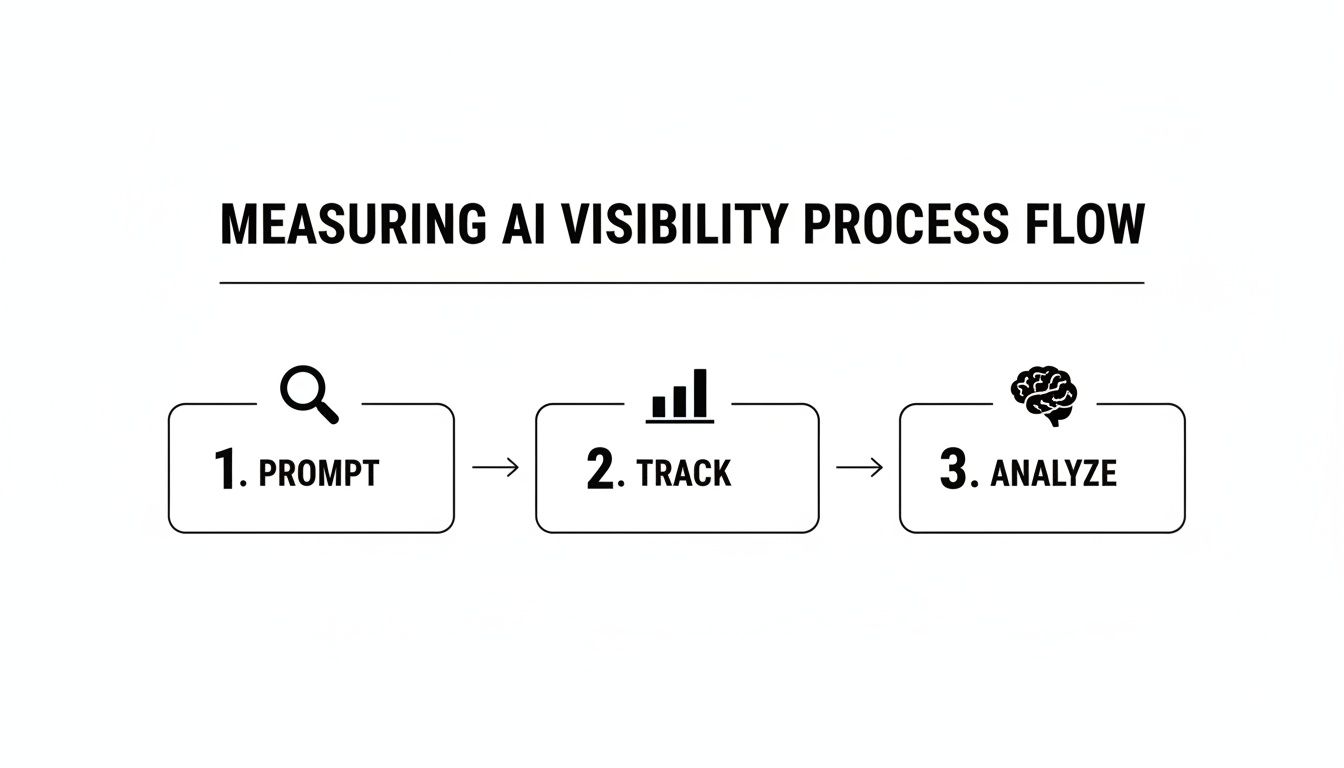
This loop—prompting for insights, tracking performance, and analyzing the results—creates a powerful feedback cycle that just keeps getting smarter.
Putting Your Content Engine on Autopilot
This systematic approach, which we call "Autopilot," shifts content creation from a reactive chore to a proactive growth strategy. The payoff is huge. We're seeing that traffic coming from AI search results is a goldmine, converting at 4.4 times the rate of traditional organic search traffic. On top of that, visitors who land on your site from an AI overview are 68% more likely to stick around, which signals much higher intent.
By consistently finding the gaps, generating expert-level content, and ensuring it gets discovered fast, you build an unbeatable content moat around your business. This is how you systematically turn AI visibility into a predictable, measurable outcome. For a closer look at the platforms that make this a reality, check out our breakdown of leading content automation tools.
Common Questions About AI Search Optimization
As marketers and SEOs grapple with this new world, a lot of the same questions keep popping up. It's a big shift, moving from a world obsessed with keywords to one driven by AI, and it definitely requires a different way of thinking. This section is all about giving you clear, direct answers to the most common questions we hear every day.
The goal is to cut through the noise and give you the confidence you need to actually optimize your content for AI search. Let's get into it.
How Is Optimizing for AI Search Different from Traditional SEO?
The biggest difference comes down to the end goal. Traditional SEO is a game of ranking high on a results page to win a click. Simple as that. But when you're optimizing for AI search, the prize is totally different: you want to become a trusted, citable source inside an AI-generated, conversational answer.
It’s a subtle change, but it changes everything. The focus shifts from things like keyword density and backlinks to structured data, natural language, and providing direct, unambiguous answers to very specific questions.
Your job isn't just to be found anymore; it's to be woven directly into the AI's response. That means you have to go much deeper on proving your E-E-A-T (Experience, Expertise, Authoritativeness, and Trustworthiness) and making sure your content covers a topic from every conceivable angle.
Think of it this way: Traditional SEO gets you an invitation to the party. AI search optimization gets you quoted in the keynote speech. One is about presence; the other is about authority.
Can I Use AI to Write Content for AI Optimization?
Yes, you absolutely can—and you probably should—but you have to be smart about it. Just asking a generic chatbot to "write a blog post" and hitting publish is a recipe for failure. That kind of content almost always lacks the originality, depth, and human touch needed to actually stand out to other AI models.
The real magic happens with a human-AI collaboration.
- AI for the Heavy Lifting: Use specialized AI tools to do the grunt work. They can analyze competitor content, spot gaps in the conversation, and generate a well-structured first draft in minutes.
- Human for the Finishing Touches: This is where you come in. An expert needs to fact-check everything, inject unique insights, add original data or personal stories, and refine the tone to match your brand. That final layer of authenticity is what builds real E-E-A-T.
This hybrid approach gives you the speed of AI without sacrificing the irreplaceable value of genuine human experience.
Which Metrics Should I Track for AI Search Success?
Success here looks different, so you need to look beyond traditional metrics like rankings and organic traffic. While those numbers are still part of the picture, they don't tell the whole story. The new KPIs are all about measuring your influence and authority within the AI ecosystem itself.
Here are the four most important metrics you should start tracking now:
- Brand Mentions and Citations: How often does your brand, your content, or your data get cited in AI answers on platforms like ChatGPT, Perplexity, and Google's AI Overviews?
- Sentiment Analysis: When your brand does get mentioned, is it in a positive, neutral, or negative light? Understanding the sentiment shows you how AI models perceive your authority and trustworthiness.
- Referral Traffic from AI Sources: Dive into your analytics and see who's coming to your site from AI platforms. This is a direct line showing you how citations are driving high-intent traffic back to you.
- Share of Voice in AI: For your most important topics, what percentage of the citations do you own compared to your competitors? This is the ultimate benchmark for measuring your dominance in the AI space.
How Long Does It Take to See Results from AI Optimization?
You might be surprised. The timeline can vary, but for new content that’s properly optimized right out of the gate, you could see results much faster than you’d think. With the right technical setup, like automatic IndexNow submissions, a new article can get picked up by search engines and their AI crawlers within hours or days.
But building enough topical authority to be consistently cited by the major AI models is more of a long game. That usually takes anywhere from several weeks to a few months of focused effort.
Consistency is everything. A steady drumbeat of high-quality, deeply researched, and technically sound content will compound its results way faster than just publishing a great article once in a while. It’s all about building a library of trustworthy information that AI models learn to rely on over and over again.
Ready to stop guessing and start measuring your AI search visibility? Sight AI gives you the complete toolkit to monitor your brand across all major AI models, identify your competitors' strategies, and automate the creation of content that gets cited. Book a demo today.