You've just presented your quarterly marketing report to the C-suite. The CMO leans forward: "We're investing heavily in AI optimization—getting mentioned in ChatGPT responses, optimizing for Perplexity, training Claude to recommend us. But what's the actual return? Show me the numbers." You pause. Traditional analytics show traffic is up, but how much came from AI? Your brand appears in more AI responses than ever, but what's that worth in dollars? The spreadsheet you prepared suddenly feels inadequate.
This scenario plays out in marketing departments everywhere. As AI-powered search and recommendations reshape how customers discover brands, marketers face a measurement crisis. The old playbook—track rankings, count clicks, measure conversions—breaks down when discovery happens inside conversational AI platforms that don't send referral data. Yet the investment is real: content optimization, platform monitoring, strategic positioning. Without a framework to measure ROI of AI optimization, you're flying blind.
The good news? Measuring AI optimization ROI isn't impossible—it just requires new thinking. This framework will show you exactly how to calculate returns, prove value to stakeholders, and build a measurement system that connects AI visibility to revenue. Let's transform that uncomfortable boardroom moment into your competitive advantage.
The New Economics of AI-Driven Discovery
Traditional search created a simple value chain: rank higher, get more clicks, convert more customers. The math was straightforward. AI-driven discovery operates differently, creating a parallel channel that follows its own economic logic.
When someone asks ChatGPT for project management tool recommendations or queries Claude about the best CRM for small businesses, they're engaging in a fundamentally different discovery process. There's no search results page to rank on. No blue links to click. Instead, the AI synthesizes information and provides direct recommendations, often naming specific brands within its response.
This creates what we might call the "recommendation economy." Your brand either gets mentioned or it doesn't. It gets recommended enthusiastically or with caveats. It appears first in the list or buried at the end. Each of these outcomes has economic value, but it's not measured in clicks. Understanding AI search optimization vs traditional SEO helps clarify why measurement approaches must evolve.
Here's where traditional ROI calculations fall short: they're built on direct attribution. User searches, clicks your result, converts. Clean and measurable. But AI discovery introduces indirection. A user asks an AI for recommendations, learns about your brand, then searches for you directly days later. Traditional analytics attributes this to "direct traffic" or "branded search," completely missing the AI touchpoint that initiated the journey.
The compounding value effect makes this even more complex. When your brand appears in AI responses consistently, you're not just capturing individual conversions—you're building brand awareness at scale. Every mention is like earned media. Every positive recommendation is like a referral from a trusted advisor. These create downstream effects that ripple through your entire funnel: higher branded search volume, improved conversion rates on all channels, reduced customer acquisition costs.
Think about it this way: if an AI mentions your brand to 10,000 users this month, even if only 5% take action immediately, you've just influenced 500 potential customers. But the other 9,500 didn't disappear—they've been exposed to your brand, creating awareness that might convert weeks or months later through entirely different channels. Traditional attribution models miss this completely.
The economics also differ because AI optimization creates durable assets. Unlike paid search ads that stop working the moment you stop paying, content optimized for AI visibility continues generating mentions indefinitely. A single well-optimized piece of content might appear in thousands of AI responses over months or years, creating compounding returns that paid channels can't match.
Core Metrics That Actually Matter for AI Optimization ROI
If traditional metrics fall short, what should you measure instead? The answer lies in building a new metrics framework specifically designed for AI visibility.
AI Visibility Score: This foundational metric tracks how frequently your brand appears in AI responses across major platforms. When users ask questions in your category, what percentage of the time does ChatGPT mention you? What about Claude, Perplexity, Gemini, and other AI platforms? This isn't about vanity—it's about market share in the recommendation economy. If competitors appear in 60% of relevant AI responses while you appear in 15%, you're losing mindshare at scale.
Measuring visibility requires systematic tracking. You need to monitor a consistent set of prompts that represent how your target customers actually discover solutions. For a project management tool, that might include prompts like "best tools for remote team collaboration" or "project management software for startups." Track these prompts weekly across multiple AI platforms to establish your baseline visibility and monitor changes over time. The right AI search optimization tools can automate much of this monitoring process.
Share of Voice Analysis: Appearing in AI responses matters, but context determines value. Are you mentioned first or fifth? Are you recommended enthusiastically or with qualifications? Share of voice measures your prominence relative to competitors within AI responses. A response that says "The top choice is [Competitor], though [Your Brand] is also worth considering" delivers less value than "Leading solutions include [Your Brand] and [Competitor]."
This metric reveals competitive positioning in the AI landscape. If your share of voice is declining even as overall visibility stays flat, competitors are gaining ground in how AI models prioritize recommendations. This early warning signal lets you adjust strategy before it impacts revenue.
Sentiment and Recommendation Quality: Not all mentions are created equal. An AI that mentions your brand while highlighting limitations delivers different value than one that recommends you enthusiastically. Sentiment analysis tracks the tone and context of mentions: positive, neutral, or negative. Recommendation quality goes deeper, analyzing whether the AI positions you as a top choice, a specialized option, or a cautionary tale.
Track specific language patterns. Does the AI say "highly recommended" or "worth considering"? Does it mention your strengths or focus on weaknesses? These qualitative factors directly impact conversion likelihood. A user who reads "excellent for enterprise teams" responds differently than one who sees "limited features but affordable."
Citation Frequency and Context Relevance: When AI models cite your content as a source, they're validating your authority. Citation frequency measures how often your website, blog posts, or resources appear as references in AI responses. This matters because citations often correlate with more detailed, favorable mentions.
Context relevance ensures you're appearing in the right conversations. Being mentioned frequently in responses about "cheap alternatives" might drive volume but attract low-value customers. Appearing in responses about "enterprise solutions" or "premium options" attracts higher-intent prospects. Track which contexts generate mentions and align them with your ideal customer profile.
These core metrics create a measurement foundation. Unlike vanity metrics, each connects directly to business outcomes: visibility drives awareness, share of voice indicates competitive strength, sentiment predicts conversion likelihood, and citations signal authority. Together, they form the numerator in your ROI calculation.
Building Your ROI Calculation Framework
With the right metrics identified, you can construct an actual ROI formula that connects AI optimization efforts to financial returns. This framework translates visibility into dollars and costs into investment calculations stakeholders understand.
Start with the basic ROI formula adapted for AI optimization: (AI-attributed revenue plus brand value increase) minus (optimization costs plus tool investments), divided by total costs, expressed as a percentage. Let's break down each component.
AI-Attributed Revenue: This is the direct revenue you can trace back to AI discovery. Begin by implementing post-purchase surveys that ask "How did you first hear about us?" with "AI assistant recommendation (ChatGPT, Claude, etc.)" as an option. Track customers who indicate AI discovery and calculate their lifetime value. If 50 customers per month report AI discovery and their average LTV is $2,000, that's $100,000 in monthly AI-attributed revenue. For a deeper dive into this methodology, explore our guide on how to measure AI recommendation ROI.
Layer in indirect attribution by correlating AI visibility increases with traffic and conversion spikes. When your visibility score jumps from 20% to 35% in a category, do you see corresponding increases in branded search volume or direct traffic? Use statistical correlation to estimate what portion of these "unattributed" conversions likely originated from AI discovery.
Brand Value Increase: AI mentions generate awareness that has monetary value even before conversion. Calculate equivalent paid media costs: if appearing in AI responses reaches 10,000 users per month, what would you pay for 10,000 impressions in paid search or social ads? Industry averages suggest $5-15 CPM (cost per thousand impressions), meaning that visibility is worth $50-150 per thousand users reached. Multiply your estimated monthly reach through AI mentions by your industry's typical CPM to quantify brand value.
Consider share of voice premium. If you dominate AI recommendations in your category, you're capturing mindshare that competitors must spend heavily to overcome. Estimate the advertising spend competitors would need to match your AI visibility, then count a portion of that as defensive brand value you've created.
Optimization Costs: Calculate your total investment in AI optimization. Include content creation costs (writing, editing, publishing), technical optimization (schema markup, site structure improvements), monitoring tools (AI visibility tracking platforms), and team time (strategy, analysis, reporting). If you spend $5,000 monthly on content, $2,000 on tools, and allocate 40 hours of team time at $100/hour, your monthly optimization cost is $11,000.
Putting It Together: Let's work through an example. Your monthly AI-attributed revenue is $100,000 (from surveys and correlation analysis). Your brand value increase from AI visibility is $25,000 (based on equivalent paid media costs). Your total optimization costs are $11,000. The calculation: ($100,000 + $25,000 - $11,000) / $11,000 = 10.36, or 1,036% ROI.
This framework gives you a defensible number to present to stakeholders. It's not perfect—attribution is never perfect—but it's logical, conservative, and based on measurable inputs. Most importantly, it's trackable over time, letting you demonstrate improving returns as your optimization matures.
Attribution Challenges and How to Solve Them
The biggest obstacle to measuring AI optimization ROI is the attribution gap. Users discover you through AI, but analytics show them arriving via direct traffic or branded search. This "dark funnel" problem makes AI's impact invisible to standard tracking.
Understanding why this happens helps you solve it. When someone asks ChatGPT for recommendations, receives your brand name, then opens a browser and searches for you directly, there's no referral parameter. No UTM tag. No cookie to track. From your analytics perspective, they're a direct visitor or organic branded search—high intent, but mysterious origin. This represents one of the key AI search optimization challenges marketers must overcome.
The dark funnel is particularly pronounced with AI because the discovery and action happen in different environments. Unlike clicking a social media ad (tracked) or a search result (tracked), AI conversations happen in isolated applications. Users might ask about solutions on their phone during a commute, then research on their laptop at work hours later. The connection is broken.
Survey-Based Attribution: The most reliable solution is asking customers directly. Implement post-purchase surveys with specific questions about discovery: "Before today, had you heard of our brand?" and "Where did you first learn about us?" Include explicit options for AI platforms: "ChatGPT or similar AI," "Perplexity or AI search," "AI assistant in another app."
Make surveys brief and incentivized. A single question with a small discount on the next purchase generates high response rates. Even a 30% survey completion rate provides statistically significant data about discovery channels. Track responses monthly and calculate what percentage attribute discovery to AI sources.
Enhance surveys with follow-up questions for AI-attributed customers: "Which AI platform?" "What were you asking about?" "How long ago?" These details help you connect specific optimization efforts to outcomes and identify which types of prompts drive the highest-value customers.
Correlation Analysis: When direct attribution is impossible, correlation becomes your friend. Track your AI visibility metrics alongside website analytics. When your visibility score increases significantly, do you see corresponding spikes in branded search volume within days or weeks? Does direct traffic trend upward? Do conversion rates improve?
Use statistical tools to measure correlation strength. If branded search volume correlates strongly with AI visibility changes (correlation coefficient above 0.7), you can reasonably attribute a portion of branded search growth to AI optimization. This isn't perfect attribution, but it's evidence-based estimation.
Create control periods for comparison. If you pause AI optimization efforts for a month, do visibility scores plateau or decline? Does branded search growth slow? These natural experiments help isolate AI's impact from other marketing activities.
Technology-Assisted Tracking: AI visibility tracking tools can correlate mention increases with traffic and revenue changes automatically. When you track prompts systematically and monitor how often your brand appears in responses, you create a timeline of visibility changes. Overlay this with your analytics data to spot patterns. Comparing options through an AI search optimization platform comparison helps identify which tools offer the best attribution features.
Some attribution will always remain uncertain. Accept this and focus on directional accuracy rather than perfect precision. If multiple signals—surveys, correlation analysis, and visibility tracking—all suggest AI optimization drives 15-20% of new customer acquisition, you have a defensible estimate even without perfect attribution.
Benchmarking and Reporting for Stakeholder Buy-In
Measuring ROI is only valuable if stakeholders understand and trust your methodology. Effective reporting transforms data into strategic insights that drive continued investment.
Establishing Baselines: Before optimization begins, document your starting point. What's your current visibility score across AI platforms? How often do competitors appear versus you? What's your share of voice? These baseline metrics are essential for demonstrating improvement. Without them, you can't prove that a 35% visibility score is good—stakeholders don't know if you started at 5% or 50%.
Capture baseline metrics over at least two weeks to account for natural variation. AI models update regularly, and visibility can fluctuate. A two-week average provides a stable starting point. Document the specific prompts you're tracking so you can maintain consistency in future measurements.
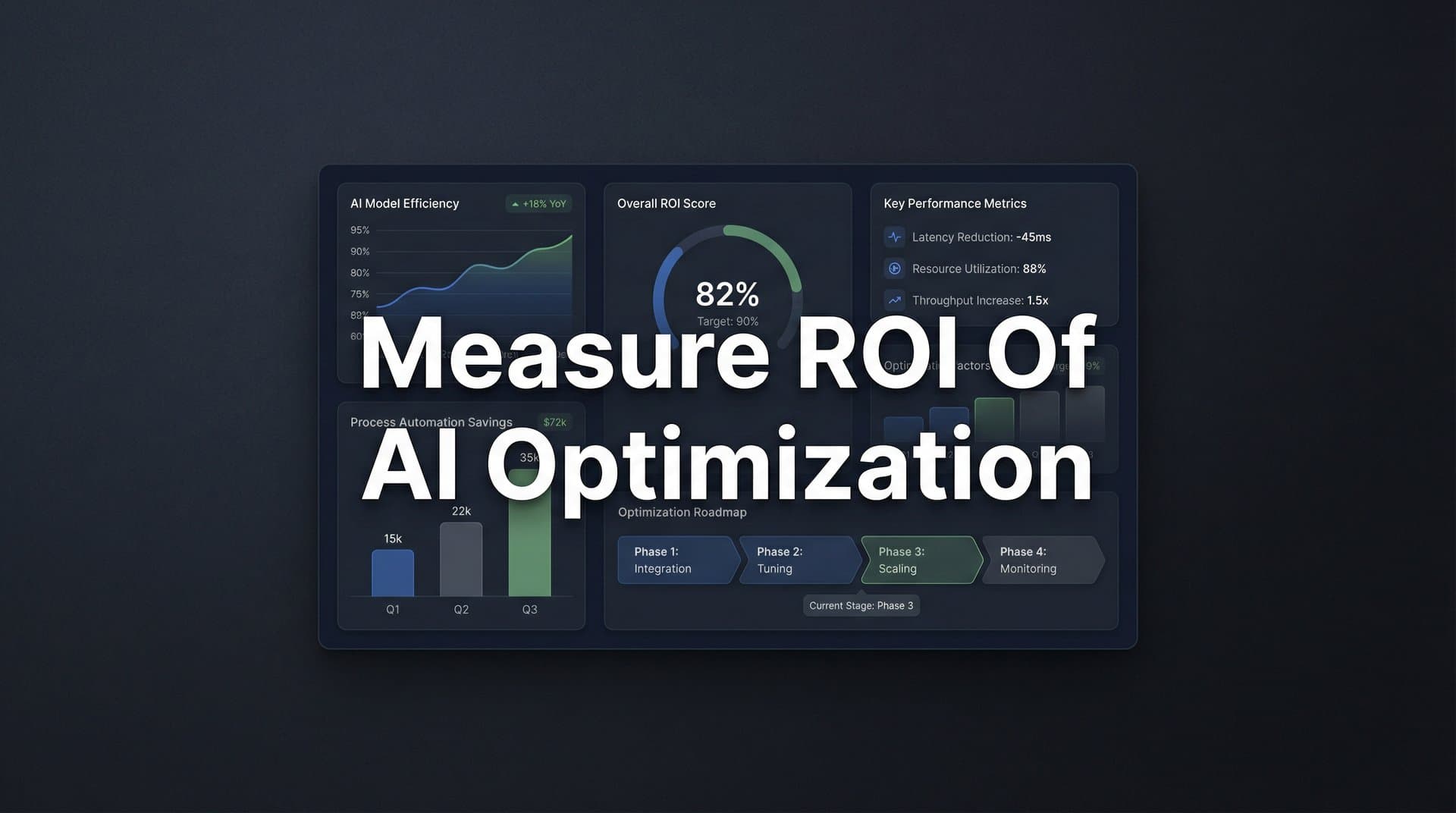
Executive Dashboard Design: Create a simple dashboard that connects AI visibility to business outcomes. Executives don't need to see every metric—they need to see the story. Include four key elements: AI Visibility Score (trending over time), AI-Attributed Revenue (monthly), Share of Voice versus top competitors (bar chart), and ROI percentage (calculated using your framework).
Add context with brief annotations. When visibility jumps, note what optimization drove it: "New content targeting 'enterprise solutions' prompts increased visibility 15%." When revenue spikes, connect it to visibility: "AI-attributed revenue up 40% following Q2 optimization push." This narrative helps stakeholders understand cause and effect.
Use visual indicators that communicate quickly: green for positive trends, yellow for plateaus, red for declines. Executives scanning the dashboard should grasp performance at a glance, then dig into details if interested.
Industry Benchmarks: Context matters enormously in reporting. A 25% visibility score might be excellent in a crowded category or disappointing in a niche market. While comprehensive industry benchmarks for AI optimization are still emerging, you can create internal benchmarks by tracking competitors. A solid AI search optimization strategy includes competitive benchmarking from day one.
Monitor 3-5 direct competitors using the same prompts you track for yourself. Calculate their average visibility score and share of voice. Position your performance relative to this competitive set: "Our visibility score of 32% exceeds the category average of 24% and ranks second among tracked competitors." This demonstrates competitive strength, not just absolute numbers.
As the field matures, industry-specific benchmarks will emerge. Companies in SaaS typically see different visibility patterns than e-commerce brands or professional services. Track trends in your specific sector and adjust expectations accordingly.
Reporting Cadence: Monthly reporting works well for AI optimization ROI. It's frequent enough to spot trends but not so frequent that you're reporting noise. AI visibility changes gradually as models retrain and content gets indexed, so weekly reports often show minimal movement.
Include quarterly deep dives that analyze trends, test new optimization approaches, and recalibrate your ROI framework. These strategic reviews keep your measurement methodology current as AI platforms evolve and your understanding of attribution improves.
Putting Your Measurement Strategy Into Action
Theory becomes valuable only through implementation. Here's your practical roadmap for launching AI optimization ROI measurement this month.
Week One - Establish Your Baseline: Identify 10-15 prompts that represent how your target customers discover solutions in your category. These should be natural questions people actually ask, not keyword-stuffed queries. Test these prompts across ChatGPT, Claude, and Perplexity. Document which platforms mention your brand, how often, and in what context. Calculate your baseline visibility score and share of voice. This is your starting point.
Week Two - Implement Attribution Mechanisms: Add a discovery question to your post-purchase survey or onboarding flow. Set up tracking spreadsheets or dashboards to log AI-attributed customers. If you're using AI visibility tracking tools, configure them to monitor your target prompts automatically. Create a simple system for correlating visibility changes with analytics data. Following proven AI search optimization techniques ensures your tracking aligns with industry best practices.
Week Three - Calculate Initial ROI: Gather your cost data: content creation, tools, team time. Estimate your AI-attributed revenue using early survey responses and correlation analysis. Calculate brand value based on equivalent paid media costs. Run your first ROI calculation using the framework. Don't expect perfection—this is your version 1.0.
Week Four - Build Your Dashboard: Create a simple reporting template that tracks visibility score, AI-attributed revenue, share of voice, and ROI percentage. Set up monthly reporting cadence. Schedule your first stakeholder presentation to share baseline data and explain your measurement approach. Get buy-in for continued tracking and optimization.
Ongoing Optimization: Review metrics monthly. When visibility increases, analyze what content or optimization drove it. When revenue attribution improves, document the tactics that worked. Iterate on your prompt list as you learn which queries drive the highest-value customers. Refine your ROI calculation as attribution data becomes more robust. Effective content optimization for LLM search directly impacts the metrics you're tracking.
Test and learn continuously. Try optimizing for different types of prompts and measure the impact. Experiment with content formats and track which generate the most AI citations. This iterative approach improves both your optimization effectiveness and measurement accuracy over time.
The measurement cadence matters: track visibility weekly, calculate ROI monthly, conduct strategic reviews quarterly. This rhythm provides enough data to spot trends without overwhelming your team with constant analysis.
The Competitive Advantage of Measurement Clarity
While competitors struggle to justify AI optimization investments with vague promises of "improved visibility," you'll present concrete ROI calculations. This clarity becomes your strategic advantage in two ways.
First, it unlocks continued investment. When you can demonstrate that AI optimization delivers 10x ROI, budget conversations shift from "should we invest?" to "how much more should we invest?" Stakeholders fund initiatives that prove returns. Your measurement framework transforms AI optimization from experimental spending to strategic investment.
Second, it accelerates your learning curve. Measurement reveals what works. You'll discover which content types generate the most AI citations, which prompts drive high-value customers, and which platforms deliver the best ROI. Competitors optimizing blindly waste resources on tactics that don't move the needle. You invest strategically in what the data proves works.
The field of AI optimization is still young. Companies that establish measurement frameworks now will build years of performance data while competitors are still debating whether AI visibility matters. This data advantage compounds over time, informing increasingly sophisticated optimization strategies.
Remember that measuring AI optimization ROI requires new thinking, but it follows logical principles. You're tracking visibility, attributing revenue, calculating costs, and demonstrating returns—the same fundamentals that govern any marketing ROI calculation. The channels and metrics are new, but the underlying economic logic is timeless.
Start with visibility tracking as your foundation. You can't measure ROI without knowing whether AI platforms mention your brand, how often, and in what context. Start tracking your AI visibility today and see exactly where your brand appears across top AI platforms. Once you have visibility data, attribution and ROI calculations follow naturally. The competitive advantage belongs to marketers who measure what others merely guess at.