You just discovered that ChatGPT recommended your product to a potential customer. Great news, right? But here's the question keeping marketers up at night: what's that recommendation actually worth to your business?
AI-powered search engines and assistants like ChatGPT, Claude, and Perplexity are reshaping how customers discover brands. When these AI models recommend your product or service, it drives traffic, builds trust, and influences purchasing decisions. But quantifying that value? That's where things get complicated.
Unlike traditional SEO where clicks and rankings are straightforward, AI recommendations happen in conversational interfaces where attribution gets murky. A customer might ask Claude for software recommendations, see your brand mentioned, research you later on their phone, and convert three days later on their laptop. How do you connect those dots?
The challenge isn't just academic. Without clear ROI metrics, you can't justify budget for AI visibility optimization. You can't prove to stakeholders that this emerging channel deserves investment. And you definitely can't optimize what you're not measuring.
This guide walks you through a practical framework for tracking, measuring, and calculating the return on your AI visibility efforts. You'll learn how to establish baselines, set up proper tracking, attribute conversions, and build a reporting system that proves the business impact of AI recommendations. No guesswork, no fake metrics—just a systematic approach to understanding what AI visibility is actually worth to your bottom line.
Step 1: Define Your AI Recommendation Metrics Framework
Before you can measure ROI, you need to know what you're measuring. Think of your metrics framework as the foundation—get this wrong, and everything built on top of it crumbles.
Start by organizing your metrics into three core categories. First, visibility metrics track how often and how well AI models mention your brand. This includes mention frequency across different platforms, the sentiment of those mentions (positive, neutral, or negative), and your positioning within recommendations (are you the first suggestion or buried in a list?).
Second, engagement metrics measure what happens after someone encounters your brand in an AI recommendation. This covers referral traffic from AI platforms, time spent on your site, pages per session, and bounce rates. These metrics tell you whether AI recommendations are sending qualified traffic or just curious browsers.
Third, conversion metrics connect AI visibility to actual business outcomes. Track leads generated, sales closed, revenue attributed to AI channels, and customer lifetime value. This is where ROI becomes tangible—where mentions turn into money.
Map metrics to stakeholder priorities: Your CEO cares about revenue and market share. Your CFO wants cost per acquisition compared to other channels. Your content team needs to know which topics drive the most valuable recommendations. Design your framework to answer the questions that matter to decision-makers.
Next, identify which AI platforms deserve your attention. Not all AI models matter equally for every business. B2B software companies might find ChatGPT and Claude drive the most valuable traffic, while local businesses might see more impact from Google AI Overviews and Perplexity. Focus your measurement efforts where your customers actually search.
Create a simple tracking template before you start collecting data. A spreadsheet works fine initially—you can upgrade to sophisticated dashboards later. Include columns for date, platform, mention context, sentiment, traffic driven, and conversions attributed. This becomes your single source of truth as data accumulates.
The framework you build in this step determines everything that follows. Take time to get it right. A well-designed metrics framework makes measurement straightforward; a poorly designed one makes everything harder. For a deeper dive into the specific numbers you should track, explore our guide on how to measure AI visibility metrics.
Step 2: Establish Your Baseline Measurements
You can't measure improvement without knowing where you started. Establishing baselines gives you the reference points needed to calculate ROI accurately.
Begin with an AI visibility audit. Manually test prompts related to your industry across ChatGPT, Claude, Perplexity, and Google AI Overviews. Ask questions your customers would ask: "What's the best [product category] for [use case]?" or "Compare [your brand] to [competitor]." Document every mention—or notable absence.
Record the context of each mention. Are you recommended as a top choice, mentioned as an alternative, or compared unfavorably to competitors? Context matters as much as frequency. Being mentioned 50 times as a budget option carries different value than being mentioned 10 times as the premium solution.
Track competitor mention frequency as a benchmark. If competitors appear in AI recommendations twice as often as your brand, you're losing market share in this channel. This competitive baseline helps you understand not just your absolute performance, but your relative position in the AI recommendation landscape. Learn how to systematically track competitor AI mentions to stay ahead.
Document your existing traffic sources and conversion rates. Pull 90 days of historical data from your analytics platform. Calculate your current cost per acquisition across all channels. These numbers provide the comparison points you'll need later when calculating AI recommendation ROI.
Set a 30-day baseline period: Commit to measuring without changing anything for at least a month. This gives you clean baseline data before you start optimizing for AI visibility. Resist the urge to implement changes immediately—you need this control period to measure against.
Pay special attention to traffic sources that might already include AI referrals. Many AI-referred visitors show up as "direct" traffic because referrer data isn't passed through conversational interfaces. Look for unusual spikes in direct traffic, particularly from mobile devices, as these might indicate existing AI recommendation impact you're not properly attributing.
Document everything in your tracking template. Baseline measurements become increasingly valuable over time—they're the proof points that demonstrate growth. Six months from now, when you're presenting ROI to executives, these baseline numbers tell the story of where you started.
Step 3: Implement AI-Specific Traffic Attribution
Here's where measurement gets technical. AI-referred traffic is notoriously difficult to track because it doesn't behave like traditional referral traffic. Solving attribution is essential for accurate ROI calculation.
Start by setting up UTM parameters specifically for AI platforms. When you control the link (like in your website URL that might be recommended), add tracking parameters: ?utm_source=ai&utm_medium=recommendation&utm_campaign=chatgpt. This works when AI models include clickable links in their responses.
But here's the problem: AI models often don't include clickable links. Users see your brand mentioned, then manually type your URL or search for you separately. These visitors arrive as direct traffic, making them invisible in standard analytics.
Create landing page variations for AI attribution: Develop specific landing pages or URLs you mention in AI training contexts. For example, if you're working on getting mentioned in AI recommendations, reference "yoursite.com/ai" in relevant content. When traffic hits that specific URL, you know it likely came from AI recommendations even without referrer data.
Configure Google Analytics 4 to create custom channel groupings for AI traffic. Set up rules that identify traffic from known AI platforms: perplexity.ai as referrer goes into "AI Recommendations" channel group. Do the same for ChatGPT's browsing feature and other identifiable AI sources.
Implement server-side tracking for more accurate attribution. Client-side tracking (standard Google Analytics) fails when users have ad blockers or privacy settings enabled. Server-side tracking captures more complete data, particularly important for AI-referred traffic where attribution is already challenging.
Use query string parameters to identify AI-referred visitors. If users are copying and pasting your URL from AI responses, include a memorable parameter like "?ref=ai" in the URLs you want AI models to recommend. This creates a trackable signal even when referrer data is missing.
Set up goal tracking specifically for AI-attributed conversions. Create separate conversion goals in your analytics platform for traffic identified as AI-referred. This allows you to calculate conversion rates specifically for this channel, essential for ROI analysis. Understanding how to track AI recommendations systematically makes this process much more manageable.
Test your attribution setup thoroughly. Have team members simulate AI-referred traffic: see a recommendation in ChatGPT, visit your site, complete a conversion. Verify that your tracking system correctly attributes the journey. Fix any gaps before relying on this data for ROI calculations.
Step 4: Calculate Your AI Recommendation Value
Now we get to the money question: what are these AI recommendations actually worth? This is where visibility metrics transform into business metrics that executives understand.
Start with direct revenue attribution. For any conversion you've successfully attributed to AI recommendations, multiply the number of conversions by your average order value. If AI-referred traffic generated 50 conversions at $200 average order value, that's $10,000 in direct revenue.
But direct attribution tells only part of the story. Apply customer lifetime value calculations to AI-attributed conversions. If your average customer generates $2,000 in lifetime value, those 50 conversions represent $100,000 in long-term value, not just $10,000 in immediate revenue.
Factor in assisted conversion value: AI recommendations often start the customer journey even when another channel gets credit for the final conversion. Someone might discover you through a ChatGPT recommendation, research you over several days, then convert through a Google search. Use multi-touch attribution models to assign partial credit to AI recommendations for these assisted conversions.
Calculate opportunity cost savings compared to paid acquisition. If your current cost per acquisition through Google Ads is $150, and AI recommendations are delivering customers at a lower effective cost, that difference represents value. When AI delivers 50 customers that would have cost $7,500 via paid channels, you've generated that amount in savings.
Build your ROI formula: (AI-attributed revenue - AI optimization costs) / AI optimization costs × 100. If AI recommendations generated $100,000 in customer lifetime value, and you spent $15,000 on content optimization and tracking tools, your ROI is ($100,000 - $15,000) / $15,000 × 100 = 567% ROI.
Include both hard and soft costs in your calculation. Hard costs include tools for tracking AI visibility, content creation specifically for AI optimization, and any consulting or agency fees. Soft costs include internal team time spent on AI visibility efforts. Accurate cost accounting makes your ROI calculation credible. For broader context on proving value, our guide on measuring content marketing ROI provides complementary frameworks.
Compare AI recommendation ROI to other channels. If your paid search ROI is 300% and your AI recommendation ROI is 567%, you have a compelling case for shifting budget toward AI visibility optimization. Relative performance matters as much as absolute numbers when competing for resources.
Remember that AI recommendation value compounds over time. Unlike paid ads that stop delivering the moment you stop paying, improved AI visibility continues generating recommendations long after the initial optimization work. Factor this durability into your value calculations—the ROI you calculate today will likely improve as the benefits accumulate.
Step 5: Track Sentiment and Recommendation Quality
Not all AI mentions are created equal. A lukewarm mention buried in a list of ten alternatives carries vastly different value than an enthusiastic primary recommendation. Quality matters as much as quantity.
Measure recommendation strength by categorizing mentions into tiers. Tier 1: Primary recommendation where you're suggested as the top or only solution. Tier 2: Included in a short list of top options. Tier 3: Mentioned among many alternatives. Tier 4: Mentioned with caveats or as a budget option. Track the distribution of your mentions across these tiers.
Monitor sentiment shifts over time. AI models might mention your brand positively this month, neutrally next month, or negatively if competitor content gains traction. Sentiment directly impacts conversion rates—positive recommendations convert at higher rates than neutral mentions, which convert better than negative references. Understanding sentiment analysis for AI recommendations helps you interpret these quality signals.
Document the specific language AI models use: Does ChatGPT call you "industry-leading" or "adequate"? Does Claude mention your "innovative features" or your "basic functionality"? The adjectives and context surrounding your mentions reveal how AI models perceive your positioning.
Track which prompt variations trigger your brand mentions. Test different ways of asking the same question. "What's the best project management software?" might yield different recommendations than "What project management tool do startups use?" Understanding which prompts trigger mentions helps you optimize for the queries that matter most to your target customers.
Monitor competitive positioning within recommendations. When AI models mention you alongside competitors, what's the order? Are you listed first, suggesting primary recommendation status? Or do you appear after competitors, indicating secondary consideration? Position within lists correlates with click-through and conversion rates.
Measure consistency across platforms. Your brand might be strongly recommended by ChatGPT but rarely mentioned by Claude. Platform-specific performance reveals where your AI visibility efforts are working and where gaps exist. Consistency across platforms indicates strong, broad AI visibility. Learn how to monitor AI model responses across different platforms effectively.
Track recommendation context changes. AI models might recommend you for specific use cases this month and different ones next month as their training data evolves. These shifts reveal how AI models categorize your brand and which positioning is sticking in their recommendations.
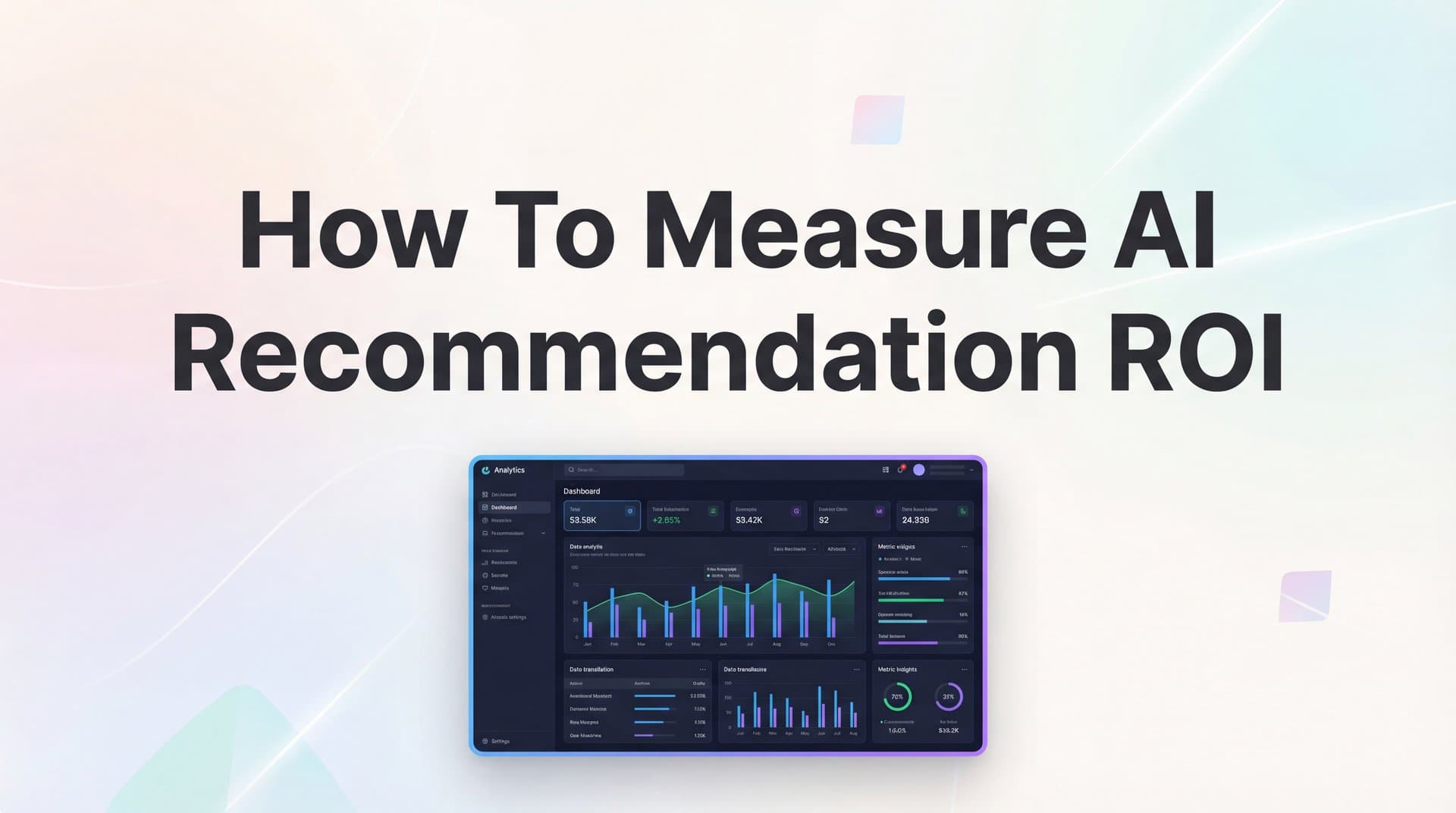
Step 6: Build Your ROI Reporting Dashboard
Data without presentation is just noise. A well-designed reporting dashboard transforms your measurements into insights that drive decisions and secure resources.
Create a monthly reporting template that connects visibility metrics to revenue impact. Start with the business outcomes executives care about: revenue generated, cost per acquisition, and market share gains. Then work backward to show how visibility metrics led to those outcomes. This narrative structure makes the connection between AI mentions and business results clear.
Include trend lines showing improvement over time. A single month's data is interesting; six months of upward trends is compelling. Graph your mention frequency, sentiment scores, and attributed revenue over time. These trend lines demonstrate momentum and justify continued investment.
Add competitive context: Show your mention frequency compared to top competitors. Display your share of voice in AI recommendations. These relative metrics help stakeholders understand not just your absolute performance, but your position in the competitive landscape. Our guide on how to do SEO competitor analysis provides frameworks you can adapt for AI visibility reporting.
Present ROI in multiple formats to resonate with different stakeholders. Your CEO wants to see total revenue impact. Your CFO wants cost per acquisition compared to other channels. Your content team wants to know which topics drive the most valuable mentions. Design dashboard views for each audience.
Include a "wins" section highlighting specific high-value conversions attributed to AI recommendations. Case examples make abstract metrics concrete: "Enterprise client discovered through ChatGPT recommendation, $50K annual contract value." These stories stick in stakeholders' minds better than aggregate numbers.
Add forward-looking projections based on current trends. If your AI-attributed revenue is growing 20% month-over-month, project where that trajectory leads in six months. Projections help stakeholders see the future value of continued investment, not just past performance.
Keep the dashboard simple and scannable. Executives don't have time to dig through dozens of metrics. Lead with the three numbers that matter most, then provide detail for those who want to drill deeper. A cluttered dashboard gets ignored; a focused one drives action.
Update your dashboard on a consistent schedule. Monthly reporting works well for most businesses—frequent enough to catch trends, not so frequent that noise obscures signal. Consistency builds trust in your measurement system and makes month-over-month comparisons meaningful.
Putting It All Together
Measuring AI recommendation ROI requires a systematic approach that connects visibility metrics to actual business outcomes. You can't skip steps—proper measurement builds on the foundation of clear metrics, accurate baselines, and reliable attribution.
Start by defining your metrics framework and establishing baselines. Know what you're measuring and where you're starting from. Then implement proper attribution tracking before attempting to calculate returns. Without accurate attribution, your ROI calculations are guesses dressed up as data.
The brands that master this measurement process will have a significant advantage. While competitors guess at the value of AI visibility, you'll know exactly where to invest for maximum return. You'll have the data to justify budget, the insights to optimize strategy, and the proof points to demonstrate impact.
Here's your quick-start checklist: Define your three metric categories today. Audit your current AI visibility this week—test those prompts and document where you appear. Set up attribution tracking within 30 days using UTM parameters, custom channel groupings, and landing page variations. Build your first ROI report by end of quarter, connecting visibility metrics to revenue impact.
The AI recommendation landscape is evolving rapidly. AI models update their training data constantly, competitor content shifts the recommendation landscape, and new platforms emerge regularly. The sooner you establish measurement systems, the better positioned you'll be to adapt and grow your ROI. If you're ready to take action, our AI recommendation optimization guide shows you how to improve the visibility you're measuring.
Remember that measurement is iterative. Your first ROI calculation won't be perfect—attribution will have gaps, some conversions will be missed, and your cost accounting might need refinement. That's okay. Start measuring now with the systems you can implement today, then improve your measurement accuracy over time.
Stop guessing how AI models like ChatGPT and Claude talk about your brand. Start tracking your AI visibility today and see exactly where your brand appears across top AI platforms. Get visibility into every mention, track content opportunities, and automate your path to organic traffic growth. The data you need to calculate ROI starts with knowing where and how AI models recommend you—and that measurement begins now.