Organic traffic remains the highest-ROI acquisition channel for most digital businesses, but the rules for earning it have fundamentally changed. Traditional SEO tactics like keyword stuffing and mass link building no longer move the needle the way they once did. Meanwhile, AI-powered search experiences from ChatGPT, Perplexity, and Google's AI Overviews are reshaping how users discover brands entirely.
Today, improving organic traffic with AI means more than automating old workflows. It means understanding how AI models reference your brand, producing content that satisfies both search engine algorithms and generative AI citation patterns, and using intelligent tools to accelerate every step from keyword research to indexing.
Think of it like this: there are now two parallel discovery systems running simultaneously. The first is traditional search, where Google ranks your pages based on authority, relevance, and technical health. The second is generative AI, where models like Claude and Perplexity synthesize answers and cite sources they deem authoritative. If you're only optimizing for the first system, you're leaving a growing share of organic discovery on the table.
This guide walks you through six concrete steps to build an AI-driven organic traffic engine. You'll learn how to audit your current AI visibility, identify high-impact content opportunities, generate SEO and GEO (Generative Engine Optimization) optimized articles, ensure rapid indexing, build smart internal linking structures, and measure results with the right dashboards.
Whether you're a solo founder trying to grow without paid ads or an agency managing dozens of client sites, these steps give you a repeatable system for compounding organic growth. Let's get into the process.
Step 1: Audit Your AI Visibility and Current Organic Baseline
Before you optimize anything, you need to understand exactly where you stand. Jumping straight into content production without a baseline is like navigating without a map. You might move fast, but you won't know if you're heading in the right direction.
Start with your traditional organic baseline. Pull data from Google Search Console to identify your top 20 performing keywords, your highest-traffic pages, and any pages that have seen significant ranking drops over the past three to six months. Pair this with your analytics platform to understand which pages are actually converting visitors, not just attracting them. Declining pages often signal content that has gone stale or been outpaced by stronger competitors.
Now here's where most marketers stop, and where you shouldn't. The second dimension of your audit is AI visibility, and it's the one most teams are completely blind to right now.
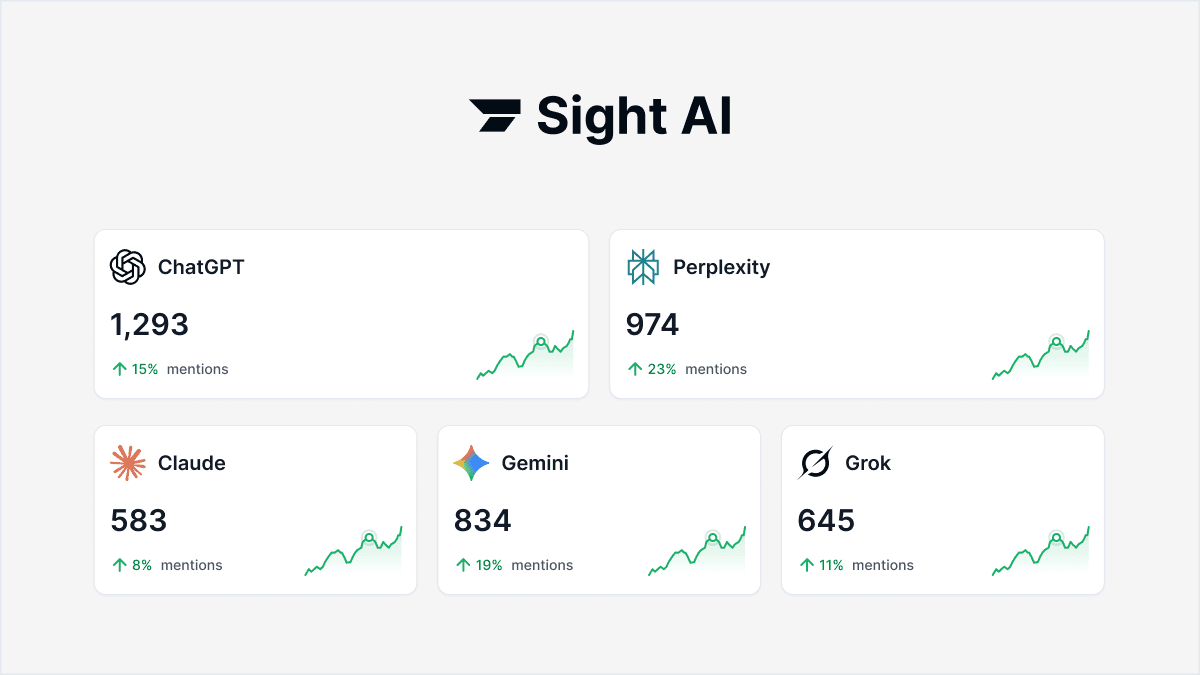
AI models like ChatGPT, Claude, and Perplexity are actively citing sources when they answer user queries. If your brand isn't appearing in those citations, you're invisible to a growing segment of users who never click a traditional search result. They ask an AI, get an answer, and move on. The brands that get cited in those answers are capturing organic traffic from AI search that doesn't show up anywhere in your Google Search Console data.
Using an AI visibility tracking tool, you can monitor which prompts trigger mentions of your brand, how your brand is described when it is mentioned, and which competitors appear alongside you or instead of you in AI-generated responses. This sentiment and citation analysis reveals a completely new dimension of organic presence that traditional analytics platforms don't capture.
To complete your audit, create a simple benchmark document with four components: your current monthly organic sessions, your top 20 keywords with their current positions, your AI mention frequency across major platforms, and a sentiment score for how those mentions describe your brand. This document becomes your north star. Every optimization you make in the following steps gets measured against it.
Success indicator: You have a single document that captures both your traditional SEO baseline and your AI visibility baseline. You know exactly which keywords you own, which you're losing, and whether AI models are citing you, ignoring you, or mentioning competitors in your place.
Step 2: Uncover High-Impact Content Opportunities with AI-Powered Research
With your baseline established, the next step is identifying where to invest your content efforts for maximum return. This is where AI-powered research gives you a genuine edge over competitors still relying on traditional keyword tools alone.
Traditional keyword research tells you what people search for and how competitive those terms are. That's useful, but it's incomplete. The missing layer is AI citation potential: which topics are AI models actively answering where they lack strong, authoritative sources to cite? Those gaps are your biggest opportunities.
Here's why this matters. When a user asks Perplexity a question and the AI struggles to find a high-quality, specific source, it either gives a generic answer or cites whatever authoritative-looking content it can find. If you publish a well-structured, factually dense article on that topic before your competitors do, you position yourself as the go-to citation. That's a compounding advantage because once AI models associate your brand with a topic, that association tends to persist and strengthen.
To build your content opportunity list, combine three signals:
Search volume and keyword difficulty: Use your preferred keyword research for organic SEO tool to identify terms with meaningful search volume and manageable competition. This is your baseline filter.
AI citation gaps: Run queries related to your target topics through major AI platforms and note which sources they cite. If competitors appear consistently but your brand doesn't, you have a clear gap to fill. If no strong sources appear at all, that's an even bigger opportunity.
Competitor content gaps: Identify topics your competitors rank for that your site doesn't cover. These represent proven demand where you have no presence yet.
From these three signals, build a prioritized content calendar. Separate your targets into two buckets: quick-win keywords with low competition where you can publish targeted content and expect ranking movement within weeks, and strategic long-form topics designed specifically for AI citation that may take longer to gain traction but deliver durable authority over time.
Success indicator: You have a content calendar with at least 20 prioritized topics, each tagged by search volume, difficulty, and AI citation opportunity level. You know exactly what to write next and why.
Step 3: Generate SEO and GEO-Optimized Content at Scale
Here's where improving organic traffic with AI gets tangible. You have your opportunities identified. Now you need to produce content that satisfies two distinct audiences: search engine algorithms and generative AI models. The good news is that the best practices for each overlap significantly, but the emphasis differs enough that you need to be intentional about both.
SEO-optimized content targets search engine rankings. It focuses on keyword placement, topical relevance, E-E-A-T signals (Experience, Expertise, Authoritativeness, Trustworthiness), and technical on-page elements. GEO-optimized content targets being cited by generative AI. It prioritizes factual density, clear entity definitions, structured formatting, and an authoritative tone that AI models can extract and reference confidently. You need both in every piece you publish.
When using AI content generation with SEO optimization, matching the article format to search intent is critical. A user searching "how to improve organic traffic with AI" wants a step-by-step guide, not a listicle. A user searching "best AI SEO tools" wants a comparison. Specialized AI agents can generate the right format for each intent type, which means your content starts structurally aligned with what both users and search engines expect.
The key on-page elements that serve both SEO and GEO goals include:
Structured headings: Clear H2 and H3 hierarchy helps search engines understand your content structure and gives AI models clean extraction points for specific answers.
Entity definitions: When you introduce a concept like GEO or IndexNow, define it explicitly. AI models rely heavily on clear entity definitions when synthesizing answers.
Factual density: Include verifiable facts, specific processes, and concrete recommendations. Vague content doesn't get cited by AI models because it doesn't provide extractable value.
Authoritative tone: Write as a practitioner with direct experience, not as a content aggregator. First-person expertise signals matter to both Google's quality evaluators and AI citation algorithms.
Schema markup: Structured data helps search engines categorize your content and can increase the likelihood of appearing in rich results and AI-powered features.
The most effective workflow at scale uses AI to generate the initial draft and humans to review for accuracy, brand voice consistency, and the addition of original insights that AI cannot fabricate. This isn't optional. AI-generated content that skips human review often contains subtle inaccuracies or generic observations that undermine your credibility with both readers and AI citation systems.
For teams managing high content volume, AI content writer with autopilot capabilities allow you to maintain consistent publishing velocity without sacrificing editorial standards. The key is setting clear quality parameters upfront so the system produces drafts that require minimal revision rather than heavy rewriting.
Success indicator: You're publishing content that is explicitly structured for both search engine rankings and AI citation, with a documented review process ensuring quality at scale.
Step 4: Accelerate Indexing So New Content Drives Traffic Faster
Publishing great content is only half the battle. If search engines don't discover and index that content quickly, you miss the relevance window when your topic is most actively searched. Slow indexing is one of the most common and most fixable bottlenecks in organic traffic growth.
The traditional indexing process relies on search engine crawlers discovering your new pages organically, which can take anywhere from a few days to several weeks depending on your site's crawl frequency and authority. For a high-volume content operation, that delay compounds into significant lost traffic opportunity. Understanding how content indexing delays cost traffic is essential for prioritizing this step.
The IndexNow protocol solves this problem directly. IndexNow allows you to notify participating search engines, including Microsoft Bing and Yandex, the moment new content is published. Instead of waiting for a crawler to find your page, you push a notification that says "this URL has new content, come look now." The result is dramatically faster movement from publication to indexing to ranking eligibility.
For Google specifically, the process involves submitting URLs through Google Search Console's URL Inspection tool and ensuring your XML sitemap is properly structured, automatically updated with every new publication, and submitted to both Google and Bing Webmaster Tools. Many sites neglect sitemap hygiene, which creates silent indexing failures where pages simply never get crawled because they're not discoverable through the sitemap.
Common sitemap mistakes that block indexing include: listing URLs that return redirect or error responses, including noindexed pages in the sitemap, failing to update the sitemap's last-modified timestamps, and not submitting the sitemap URL to search engine webmaster tools at all. Audit your sitemap against these issues before assuming your indexing pipeline is working correctly.
Crawl budget is the other lever worth understanding. Search engines allocate a finite number of crawl requests to each site per day. If your site has thousands of low-value or duplicate pages consuming that budget, your high-value new content may not get crawled promptly. Platforms offering SEO software with auto indexing can streamline this entire process for you.
To verify indexing status, use the site: search operator in Google to check whether specific URLs appear in the index, and use Google Search Console's URL Inspection tool for detailed crawl and index status information. When pages aren't appearing, request a recrawl directly through the tool.
Success indicator: New content is appearing in Google's index within 24 to 72 hours of publication, and your sitemap shows no errors in Google Search Console.
Step 5: Build an Intelligent Internal Linking Architecture
Internal linking is consistently underestimated as an organic traffic lever, and it's one of the few optimization strategies that is almost entirely within your control. Unlike backlink acquisition or algorithm updates, you can build and refine your internal linking structure any time you want, and the benefits compound with every new piece of content you publish.
Here's why it matters so much. Internal links do three things simultaneously: they distribute page authority from your high-authority pages to newer, less established ones; they improve crawlability by giving search engine bots clear pathways through your site; and they signal topical depth to both search engines and AI models by showing that your site covers a subject comprehensively rather than superficially.
The most effective internal linking structure follows a hub-and-spoke model. You create pillar pages that cover broad topics comprehensively, then produce supporting content that dives deep into specific subtopics, with each supporting piece linking back to the pillar and cross-linking to related supporting content. This architecture tells search engines that your site has genuine expertise on a topic, not just isolated articles. Understanding how blogging grows organic traffic reinforces why this structure matters so much.
For example, if your pillar page covers "AI-powered SEO," your supporting content might include articles on AI visibility tracking, GEO content optimization, IndexNow implementation, and AI content generation workflows. Each of those articles links to the pillar, and the pillar links to each of them. The cluster communicates authority through structure, not just content.
Automated internal linking tools can handle the mechanical work of connecting new articles to relevant existing content, which is critical when you're publishing at scale. Without automation, internal linking becomes an afterthought and orphan pages, articles with no internal links pointing to them, accumulate silently and underperform despite strong content quality. Investing in organic growth automation software can eliminate this bottleneck entirely.
Audit your existing internal links periodically for three common problems: orphan pages that have no internal links pointing to them, over-optimized anchor text that uses the exact same keyword phrase repeatedly (which looks manipulative to search engines), and links pointing to low-value or thin pages that dilute the authority flow.
Success indicator: Every new article you publish has at least three to five relevant internal links pointing to it from existing content, and your pillar pages are clearly established as the authority hubs for each topic cluster.
Step 6: Measure, Iterate, and Compound Your Results
The difference between marketers who see compounding organic growth and those who plateau is simple: the former measure systematically and iterate based on data, while the latter publish and hope. This final step is what transforms the previous five steps from a one-time project into a self-improving system.
Start by setting up a unified performance dashboard that brings together the metrics that matter most. Your dashboard should include organic sessions and their trend over time, keyword ranking movements for your target terms, indexing status for recently published content, click-through rates from search results, and your AI visibility score including mention frequency and sentiment across major AI platforms. A dedicated SEO content platform with analytics can consolidate all of these metrics into one view.
The cadence of your review matters as much as what you review. On a weekly basis, monitor ranking movements for recently published content, check indexing status for new articles, and flag any significant traffic drops on existing pages. Monthly, do a deeper analysis: which content types are driving the most organic sessions, which topic clusters are gaining traction, how your AI mention frequency has shifted, and whether your overall AI visibility score is improving.
When you identify content that's outperforming expectations, don't just celebrate it. Systematically expand it. If a particular topic cluster is driving disproportionate traffic, publish more supporting content within that cluster, strengthen the internal linking, and look for related keyword opportunities you haven't covered yet. This is how you scale organic traffic growth over time.
Content refresh decisions should also be data-driven. Pages that were strong performers but have declined over the past six months often need updated information, improved structure, or stronger internal linking rather than retirement. Pages that have never gained traction despite adequate time in the index may need a more fundamental rethink of their topic, format, or keyword targeting.
The compounding effect of this system becomes most visible at the six to twelve month mark. Early content investments build topical authority, which makes subsequent content easier to rank. Strong internal linking distributes that authority across your growing content library. Rapid indexing ensures new content enters the ranking pool quickly. And AI visibility tracking ensures you're capturing organic discovery from generative AI channels that your competitors may not even be measuring yet.
Success indicator: You have a dashboard you review on a fixed weekly and monthly schedule, and you can point to specific content decisions made based on that data that led to measurable traffic improvements.
Putting It All Together: Your AI-Driven Organic Traffic Checklist
Improving organic traffic with AI is not a one-time project. It's an ongoing system where each step feeds into the next, creating a flywheel that accelerates over time. Here's your six-step checklist to keep the system running:
1. Audit your AI visibility and organic baseline. Establish where you stand with both traditional search metrics and AI citation data before optimizing anything. This is your benchmark for everything that follows.
2. Research high-impact content opportunities. Combine search volume, keyword difficulty, and AI citation potential to build a prioritized content calendar that targets both quick wins and long-term authority.
3. Generate SEO and GEO-optimized content at scale. Use AI content generation tools with specialized agents to produce the right format for each search intent, then apply human review to ensure accuracy and original insight.
4. Accelerate indexing with IndexNow and sitemap optimization. Don't let great content sit unindexed. Implement IndexNow, maintain a clean sitemap, and monitor indexing status actively so new content starts driving traffic as quickly as possible.
5. Build intelligent internal linking. Connect every new article to your existing content library using a hub-and-spoke model. Automate where possible and audit regularly for orphan pages and linking gaps.
6. Measure and iterate with a unified dashboard. Track organic sessions, keyword rankings, indexing status, and AI visibility score in one place. Review weekly, analyze monthly, and double down on what's working.
The best place to start is the audit. Understanding where you stand with both traditional search and AI visibility is the foundation everything else builds on. You can't improve what you can't see, and right now, most marketers and founders are operating with a significant blind spot around how AI models perceive and cite their brand.
Stop guessing how AI models like ChatGPT and Claude talk about your brand. Start tracking your AI visibility today and see exactly where your brand appears across top AI platforms, uncover the content opportunities your competitors are missing, and automate your path to organic traffic growth with a platform built for the way search actually works in 2026.