
Low-competition keywords are your secret weapon. They're specific, often longer search phrases that have far fewer websites fighting for the top spots on Google. While they usually have lower search volume, the user intent behind them is sky-high, making them incredibly valuable for driving targeted traffic that actually converts.
The Real Advantage of Untapped Keywords
Most SEO playbooks are obsessed with high-volume keywords. This turns the first page of Google into a digital warzone where small businesses and new sites are forced to compete against established giants with massive budgets and domain authority. It’s an expensive, resource-draining game that most can't win.
But what if you could bypass that crowded arena entirely?
Focusing on low-competition keywords is a strategic pivot. You stop playing the volume game and start playing the value game. Instead of chasing a broad, generic term like "SEO tools," you go after a highly specific, high-intent phrase like "lightweight keyword rank tracker for SaaS founders." The person typing that into Google knows exactly what they want and is much closer to making a purchase.
Why Less Traffic Can Mean More Business
It’s one of the biggest myths in SEO: more traffic always equals more success. The truth is, qualified traffic is what moves the needle. Targeting these underserved queries lets you attract a motivated audience actively looking for the solutions you provide.
Here's why it works so well:
- Higher Conversion Rates: Users searching for specific, long-tail phrases are deep in the buying journey. They've done their initial research and are ready to act.
- Faster Ranking Potential: With way less competition, your content can climb the search engine results pages (SERPs) much, much faster. We're talking weeks, not months or years.
- Building Topical Authority: When you consistently rank for related low-competition terms, you send a powerful signal to Google that you're an expert in that specific niche.
Just think about the sheer scale of search behavior. Google handles over 8.5 billion searches every single day, and a mind-boggling 15% of those are queries that have never been searched before. This creates a massive, constantly refreshing pool of low-competition opportunities. It's no surprise that long-tail keywords, which are naturally less competitive, deliver around 2.5 times higher conversion rates than their short-tail counterparts. If you're curious about the data behind this, AIOSEO has a great roundup of SEO statistics.
To really understand the difference, let's break down the two types of keywords head-to-head.
High-Competition vs. Low-Competition Keywords At a Glance
| Characteristic | High-Competition Keywords (Head Terms) | Low-Competition Keywords (Long-Tail) |
|---|---|---|
| Search Volume | Very High (10k+ monthly searches) | Low to Medium (<1,000 monthly searches) |
| Keyword Length | Short (1-2 words) | Long (4+ words) |
| User Intent | Broad, often informational or navigational | Highly specific, often transactional or commercial |
| Competition | Extremely High (dominated by authority sites) | Low (often overlooked by big players) |
| Conversion Rate | Low | High |
| Ranking Difficulty | Very Difficult | Easy to Moderate |
| Example | "CRM software" | "CRM for small real estate teams" |
As you can see, the path of least resistance often leads to the most valuable customers.
The core principle is simple: Don't fight for a tiny slice of a huge, competitive pie. Find smaller, underserved pies and claim the whole thing for yourself.
This strategy isn't just for beginners; it's a cornerstone of any smart and resilient SEO keyword strategy. By finding and capturing these untapped phrases, you build a foundation of organic traffic that is both sustainable and highly profitable. You attract visitors who aren't just browsing—they're actively looking for the exact expertise, product, or service you offer. This approach builds the momentum and authority you'll need to eventually compete for those bigger, more challenging terms down the road.
Building Your Low-Competition Keyword Discovery Arsenal
Alright, let's move from theory to practice. Finding the best low-competition keywords means you have to stop looking where everyone else is. Forget just plugging terms into the usual keyword tools. We need to become digital anthropologists, observing how real people actually talk and what they're struggling with.
This isn't about one magic trick; it's about building a multi-pronged approach to unearth search terms your competitors have completely overlooked. The core idea? Listen first, search second. When you do this, you capture the exact language of your audience, giving you a massive advantage in creating content that truly connects and, more importantly, ranks.
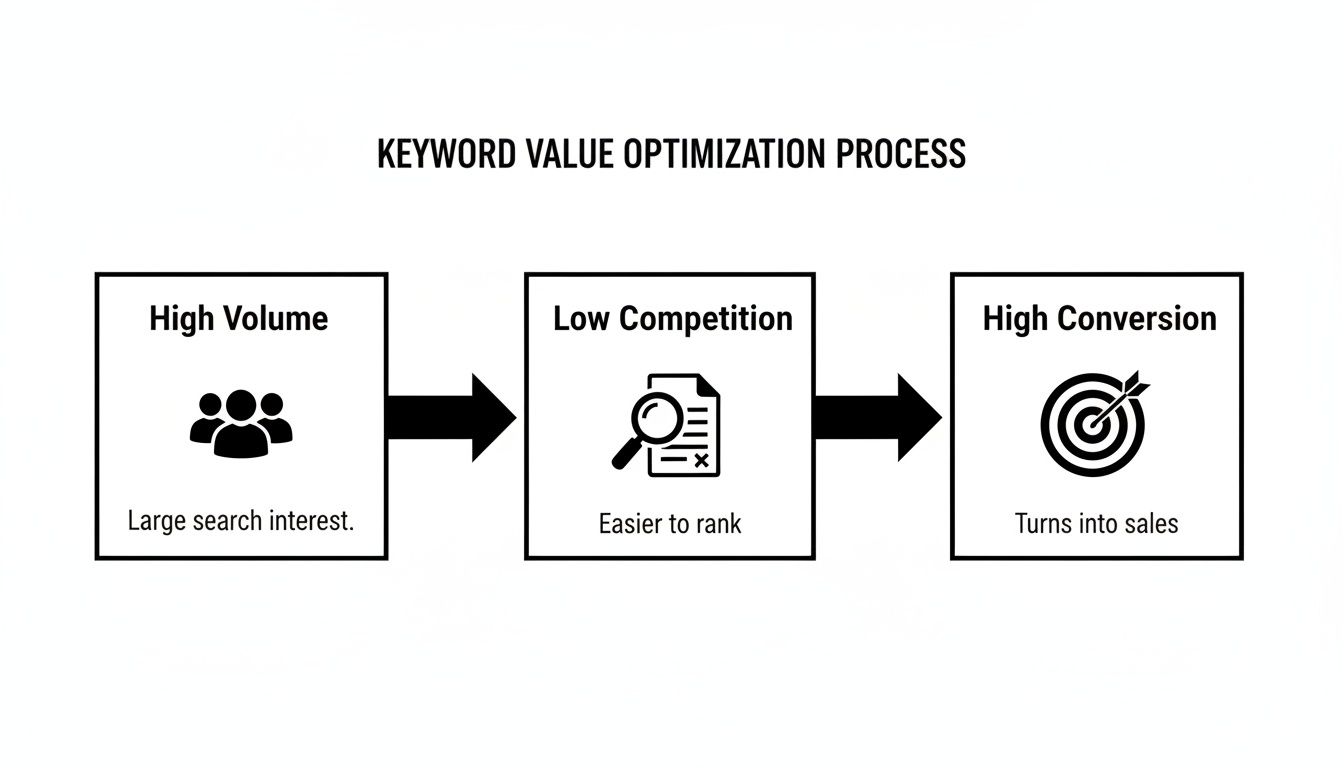
This graphic perfectly illustrates our goal. We're looking for that sweet spot where audience interest (volume), strategic opportunity (low competition), and business value (conversion potential) all meet.
Mine Community Forums for Raw User Language
Places like Reddit and Quora are absolute goldmines. Seriously. They're unfiltered streams of consciousness where your potential customers describe their problems in their own words—not in polished, SEO-friendly jargon. Your mission is to find the recurring questions, frustrations, and product comparisons that signal an unmet need.
Let's say you're marketing a project management tool. Instead of just searching for "project management software," you'd hang out in subreddits like r/freelance or r/smallbusiness and look for threads titled:
- "How do you keep track of client revisions without losing your mind?"
- "Looking for a Trello alternative that isn't so complicated."
- "What's the best cheap tool for managing a small remote team?"
These questions are your keywords. They are specific, dripping with intent, and represent real-world problems. Get these phrases into a spreadsheet. They'll form the foundation of a content strategy built around solving actual user pain points—a fantastic way to find low-competition keywords.
Uncover Hidden Gems in Google's Own Features
Google itself leaves a trail of breadcrumbs about user behavior, if you just know where to look. Features like Autocomplete and 'People Also Ask' (PAA) are direct reflections of what people are searching for around any given topic.
When you start typing a search into Google, those autocomplete suggestions are a solid starting point. To go deeper, try adding modifiers like "how," "what," "vs," or "for" to your main topic. For example, typing "CRM for..." might spit out suggestions like "CRM for financial advisors" or "CRM for solo entrepreneurs." Each one is a more specific, lower-competition keyword than the original.
The 'People Also Ask' section is just as valuable. It shows you the related questions people frequently ask. The real magic happens when you click on one of these questions—the list expands, revealing even more related queries. You can quickly map out an entire topic cluster just by following this thread of user curiosity. For a deeper dive, our guide on keyword research for organic SEO has some more advanced techniques.
Key Takeaway: Stop seeing Google's SERP features as just answer boxes. They are interactive brainstorming tools that offer a direct line into the user's mind and the branching paths of their search journey.
Analyze Competitors with an 'Also Ranks For' Strategy
A competitor gap analysis is a classic SEO move, but let's put a spin on it. Instead of just looking at the keywords a competitor is obviously targeting, we want to find what they rank for by accident. Most good SEO tools have an "Also Ranks For" or "Keyword Gap" feature that shows you every keyword a single URL ranks for.
Here’s the play: Find a competitor's blog post that's targeting a broad, high-competition term. Run that specific URL through your tool. You'll almost always find that it ranks on page two or three for dozens of long-tail variations they didn't even intentionally target.
Those are your golden opportunities. Your competitor already did the heavy lifting of creating an authoritative page, but you can swoop in, create a more focused piece of content that perfectly matches the intent of one of those neglected keywords, and outrank them for it.
And remember, building a strong keyword arsenal isn't just for blog posts. Applying these same principles to other platforms is key, and unlocking growth with YouTube video keywords offers some fantastic insights into keyword strategy that are valuable well beyond just video content.
How to Accurately Measure Keyword Competition
Pulling together a list of potential keywords is just the opening act. The real skill is figuring out which ones you can actually rank for.
Relying solely on a tool's "Keyword Difficulty" score is like trying to predict a rainstorm by looking at a single cloud—you're missing the bigger picture. This is where we need to roll up our sleeves and dive into a manual SERP analysis, just like a seasoned SEO pro would.

The goal is simple: size up the top 10 results for your target keyword and get a true feel for the competition. Are you staring down a list of untouchable industry giants? Or is the page filled with smaller players, five-year-old articles, and forum threads? The answer tells you whether you've found a green light or a dead end.
Decoding the Search Results Page
When you eyeball the SERP, you're not just looking at a list of blue links. You're trying to understand the intent Google has decided the query has, and you're evaluating the authority of the domains it chose to feature.
Here are the key signals I always look for:
- Weak Domains Ranking High: If you see sites with a low Domain Authority (DA) or Domain Rating (DR)—think anything below 50—cracking the first page, that's a fantastic sign. It tells you Google is rewarding pages for their content quality, not just the sheer power of their domain.
- User-Generated Content (UGC): Are there posts from Reddit or Quora in the top 10? This is a huge green flag. It often means there’s a serious lack of high-quality, dedicated content out there, forcing Google to pull answers from community discussions.
- Outdated or Thin Content: Click into those top-ranking articles. Are they from 2019? Do they barely scratch the surface of the topic? Old and shallow content is practically begging to be replaced by a more comprehensive, up-to-date resource.
This hands-on approach gives you a real-world feel for the competitive landscape that a single metric can't provide. For a deeper dive, our guide on how to do competitive analysis in SEO can walk you through the entire process.
Assessing Page-Level Authority and Content Type
After checking out the domains, it's time to zoom in on the specific pages that are ranking. The type of content and the strength of that individual URL often matter just as much as the website's overall authority.
Ask yourself these questions:
- Are the Titles a Perfect Match? If every top-ranking page has a title that is an exact match for your keyword, the competition is direct and fierce. But if the titles are more general, it suggests those pages are ranking almost by accident, leaving a nice opening for your perfectly targeted article.
- Is it All Blog Posts? If the SERP is clogged with product pages, e-commerce categories, or homepages, it can be tough for a new blog post to break in. You want to look for SERPs that have a healthy mix of informational articles.
- How Many Links Point to the Page? Pop the URL into your SEO tool and check how many backlinks point directly to that ranking page, not just the domain as a whole. If the top pages have very few referring domains, you've got a much better shot at competing.
A common mistake is getting scared off by a high-DA site. But often, that big-name site is ranking with a page that has zero backlinks and isn't even properly optimized for the query. That's a vulnerability you can absolutely exploit.
Interpreting SERP Features as Opportunities
At first glance, SERP features like Featured Snippets, 'People Also Ask' boxes, and video carousels might seem like extra competition. But really, they often signal opportunity. Their presence means Google is actively looking for structured, clear, and multi-format answers.
For instance, a Featured Snippet at the top tells you Google wants a quick, direct answer to a question. You can structure your content to provide a clear, snippet-worthy definition right at the beginning to try and steal that coveted spot.
Understanding these nuances is more important than ever. Keyword difficulty is still the gatekeeper, and with 94% of clicks going to organic results, you need smart strategies. Data shows 58% of SEOs feel more competition from AI-generated content, but this also carves out new opportunities, especially since 20% of mobile searches are voice-based. You can explore more useful SEO statistics on keyword.com to see how the landscape is shifting.
By performing this manual SERP review, you move beyond guesswork. You gain a clear, data-informed perspective on whether a keyword with low competition is a genuine opportunity or just a hidden trap. This vital step ensures your content efforts are focused on topics you can realistically own.
Prioritizing Keywords For Maximum Business Impact
So you've done the hard work and unearthed a list of keywords with low competition. That’s a huge win, but it also creates a new problem: where on earth do you start? Trying to tackle everything at once is a surefire way to get burned out with mediocre results. The real magic happens when you prioritize ruthlessly, making sure every single article you write has a clear business purpose.
Don't fall into the common trap of just chasing the keyword with the biggest search volume. A keyword with 50 monthly searches from a high-value customer is infinitely more valuable than a term with 500 searches from people who will never buy from you. What we need is a simple, repeatable framework to connect your SEO work to tangible results like leads, sales, and brand authority.
A Practical Scoring Model
To cut through the noise, let's build a straightforward scoring system. You can do this in any spreadsheet. We'll score each keyword on a scale of 1-5 across three core pillars that actually matter to your business.
- Relevance Score (1-5): How perfectly does this keyword match what you sell? A 5 means the searcher is looking for exactly your product or service. A 1 might be a topic that's only loosely related.
- Intent Score (1-5): What is the searcher trying to do? A high-intent, transactional keyword like "best accounting software for freelance designers" is a solid 5. An early-stage informational query like "what is double-entry bookkeeping" is probably a 2.
- Potential Score (1-5): This one is a mix of search volume and strategic value. A keyword with solid volume that could also establish you as an expert in the space deserves a high score. A super-niche term with only 10 searches a month would score lower.
Just add these three scores together to get a "Total Priority Score." The keywords with the highest totals are the ones you should focus on first. This simple system turns a chaotic list into an actionable content plan.
The Three Pillars Of Prioritization
Let's dig a little deeper into what each of these pillars really means. Getting this right is the difference between getting any traffic and getting the right traffic.
Relevance Is Your North Star
Relevance is non-negotiable. If a keyword doesn't lead back to your product or service, the traffic is worthless. For a company selling project management software, the keyword "agile project management techniques" is a perfect 5/5 in relevance. A term like "how to improve team communication," while interesting, is less directly tied to the product—that might be a 3/5.
The ultimate test for relevance is simple. Ask yourself: "If someone lands on our site from this keyword, will they find a clear solution to their problem that involves what we sell?"
Decoding User Intent
Intent reveals the why behind a search. Is the person trying to learn, compare options, or make a purchase right now? Keywords with modifiers like "best," "alternative," "review," or "pricing" scream commercial intent. These are bottom-of-the-funnel queries that can lead straight to conversions.
Targeting these first can generate quick wins and help prove the value of your SEO efforts. You can learn more about connecting this to real financial outcomes by exploring how to calculate your content marketing return on investment.
Gauging True Potential
Potential is more than just raw search volume. A keyword might have fewer searches but could unlock a new, high-value audience. Or maybe it’s a foundational topic you absolutely must cover to build topical authority in your niche.
Think strategically here. Which keywords, if you ranked for them, would have the biggest ripple effect on your brand's credibility and authority in the market?
Your Keyword Prioritization Scoring Matrix
To make this all tangible, here’s a simple template you can build in a spreadsheet. This framework forces you to evaluate every low-competition keyword against your actual business goals, turning each article into a calculated investment.
| Keyword | Search Volume | Relevance Score (1-5) | Intent Score (1-5) | Potential Score (1-5) | Total Priority Score |
|---|---|---|---|---|---|
| "best crm for small agencies" | 250 | 5 | 5 | 4 | 14 |
| "how to track sales leads" | 800 | 3 | 2 | 3 | 8 |
| "hubspot vs zoho for startups" | 150 | 4 | 4 | 5 | 13 |
| "what is lead scoring" | 1,200 | 2 | 1 | 2 | 5 |
Based on this model, "best crm for small agencies" jumps to the top of the list, even with lower search volume. It has the perfect mix of high relevance, strong purchase intent, and solid potential, making it the smartest place to focus your content creation efforts first.
Creating and Scaling Content That Actually Ranks
You've done the hard work and have a solid list of low-competition keywords. Now what? This is where the magic happens—turning a promising term on a spreadsheet into a living, breathing asset that climbs the search rankings. It’s about more than just writing. It’s about building content so perfectly tuned to user intent that search engines can't help but put it in front of people.
The whole process breaks down into a few key phases. First, you architect a detailed outline that gets to the heart of the user's problem. Then, you have to structure the content for both readability and SEO. And finally, there's the post-publish sprint, a step most people skip, that gets your new article seen and indexed fast.

Architecting a High-Performance Content Outline
Before you even think about writing a single sentence, your outline needs to be a rock-solid blueprint. A well-crafted outline is your guarantee that the content will be comprehensive, flow logically, and hit every point a searcher is looking for. The easiest way to get started? Just go analyze the top-ranking pages for your target keyword.
Look at their subheadings. What specific questions are they answering? Your mission is to create a "skyscraper" outline—one that covers everything they do, but better and with more depth.
Let's say your keyword is "best project management tool for small agencies." A basic article might just list some tools. A great outline would dig deeper with sections like:
- Key Features Agencies Actually Need
- Comparing Pricing Models (Per User vs. Flat Fee)
- Integration Capabilities with Other Agency Tools
- Real User Reviews and Case Studies
This structure moves beyond a simple listicle and starts solving the real pain points and answering the unspoken questions of your target audience.
A strong outline is your first line of defense against thin content. It forces you to think through the user’s entire journey, ensuring every section adds distinct value and moves them closer to a solution.
Leveraging AI Agents for Efficient Production
Let’s be honest: creating in-depth, well-researched content on a consistent basis is a huge bottleneck for most teams. This is where specialized AI agents completely change the game. Instead of fiddling with a generic chatbot, platforms like Sight AI use a team of specialized agents to handle the heavy lifting.
Think of it like an assembly line. One agent might be an expert at researching the SERPs and competitor articles. Another drafts the content based on proven SEO best practices. A different agent can source or create relevant images, while another makes sure all the on-page SEO details like meta descriptions and internal links are dialed in perfectly.
This approach lets you scale high-quality content without having to scale your headcount. It also helps you maintain a consistent publishing schedule, which is a massive ranking signal for Google. If you want to dive deeper into this workflow, check out our guide on how to scale SEO content production.
Essential On-Page SEO Best Practices
With the content drafted, it’s time for the final on-page polish. These seemingly small details can make a huge difference in how search engines understand and rank your page.
Your On-Page SEO Checklist:
- Strategic Keyword Placement: Make sure your primary keyword shows up naturally in your H1 title, the first 100 words, at least one H2 subheading, and your URL slug.
- Compelling Meta Tags: Your meta title and description need to do more than just include the keyword. They need to be compelling enough to make someone click. Treat them like ad copy for your organic listing.
- Internal Linking: Weave in at least 2-3 internal links to other relevant, authoritative pages on your site. This helps crawlers discover more of your content and passes link equity around your site.
- Image Optimization: Every image needs a descriptive file name and alt text that includes relevant keywords. This isn't just for SEO; it makes your site more accessible and can help you rank in Google Images.
The Crucial Post-Publish Workflow
Hitting "publish" isn't the finish line. If you want to get on page one faster, you have to actively tell search engines that your awesome new content exists.
First, check that your sitemap is updated. Most modern CMS platforms handle this automatically, but it never hurts to double-check. An up-to-date sitemap is the fastest way for Google and Bing to find your new URL.
From there, you can take it a step further by proactively submitting your URL through services like IndexNow, which pings search engines directly. This can slash your indexing time from days or even weeks down to a matter of hours. Platforms like Sight AI automate this entire post-publish sequence, handling the CMS push, sitemap updates, and IndexNow submissions without you lifting a finger.
This full-circle workflow—from keyword to indexed content—is how you close the loop and truly win with keywords with low competition. The explosion of AI search only makes this strategy more potent. While AI search traffic jumped an incredible 527% year-over-year, Google still rules the roost. Platforms built for this new era, like Sight AI, help brands pinpoint underserved topics and produce the optimized content needed to capture this growing traffic. You can discover more insights about AI SEO statistics on semrush.com.
Common Questions About Low Competition Keywords
Diving into a strategy focused on keywords with low competition can feel like a big shift from the usual SEO advice. It’s totally natural to have questions about how this all plays out in the real world. Let’s clear up some of the most common ones so you can move forward with confidence.
Many people get fixated on the numbers, but success here requires a crucial mindset shift. The right answer always comes back to your specific business model and goals.
What Is a Good Search Volume for a Low Competition Keyword
Honestly, there's no single magic number. It all depends on who you're trying to reach.
For a B2B SaaS company with a high-ticket product, a keyword with just 50 highly-targeted monthly searches could be pure gold. That’s 50 potential customers actively looking for a solution like yours every single month. The intent is everything.
On the flip side, a content-heavy blog monetized with ad revenue might need more eyeballs to make the numbers work. For them, setting the floor a bit higher, maybe in the 200-1,000 monthly search range, makes more sense. The key is to stop chasing raw volume and start focusing on the quality and intent of the searcher.
A low-volume keyword with strong commercial intent, like 'best accounting software for freelance artists,' is infinitely more valuable than a vague, high-volume term like 'accounting tips'. You're looking for that sweet spot where the search volume is high enough to matter for your goals, but low enough that the SERPs aren't already dominated by untouchable authority sites.
At the end of the day, relevance to your business goals should always win out over the temptation of a big search volume number.
How Long Does It Take to Rank for These Keywords
This is where targeting keywords with low competition really starts to pay off. The biggest advantage? Speed.
Trying to rank for a hyper-competitive head term can feel like a grueling, year-long marathon. It can take 6-12 months just to see the first signs of life. But with low-competition terms, you can often see real, positive movement in just a few weeks or months.
Of course, a few things can influence that timeline:
- Your Site's Overall Authority: An established site with a good reputation will naturally rank faster than a brand-new one.
- Content Quality: Your content can't just be good; it has to be genuinely better and more helpful than what's already on page one.
- Internal Linking: A smart internal linking strategy tells search engines what your most important pages are and helps spread authority across your site.
To get traffic flowing even faster, you can use modern tools that automatically ping search engines like Google and Bing via protocols like IndexNow the moment you publish. This drastically cuts down the time it takes for them to discover, crawl, and rank your new page.
Can I Build a Whole Strategy on These Keywords
Absolutely. In fact, for a new website or a business trying to break into a crowded market, it's often the smartest and most sustainable way to gain a foothold.
Think of it as building a strong foundation, one brick at a time. Each low-competition keyword you rank for adds to your site's overall topical authority. Every article becomes an asset that drives targeted traffic, has the potential to earn backlinks, and builds your domain's credibility with search engines.
This approach creates a powerful snowball effect. Over time, the authority you build by dominating these smaller niches will give you the power to start competing for those more difficult, higher-volume keywords. It's a compounding strategy that builds a steady, reliable stream of highly relevant traffic while establishing your brand as a go-to resource. It’s not a shortcut; it's just a more deliberate way to win at SEO.
Ready to stop guessing and start ranking? Sight AI turns AI and search insights into a powerful content engine. Our platform identifies high-value content gaps your competitors are missing and uses a team of specialized AI agents to produce SEO-optimized articles that get you discovered. Automate your content and accelerate your growth with Sight AI.