Picture this: a potential customer opens ChatGPT and types "what's the best tool for tracking SEO performance?" Your competitor's name appears in the first sentence. Yours doesn't. That buyer may never visit a search results page, never see your ad, and never encounter your content — because the AI already made the recommendation without you.
This is happening right now, across millions of queries every day. AI models like ChatGPT, Claude, and Perplexity are becoming primary discovery channels for buyers researching software, services, and solutions. And unlike Google, where you can audit your rankings and optimize your way into visibility, most marketers have no idea whether their brand appears in AI responses — or how it's described when it does.
Understanding how LLMs mention brands is no longer a curiosity for AI enthusiasts. It's a foundational skill for anyone serious about organic growth in 2026. The mechanics are learnable, the signals are actionable, and the brands that figure this out early will have a structural advantage that compounds over time.
This article breaks down exactly how LLMs decide which brands to surface: the role of training data and parametric knowledge, how retrieval-augmented systems like Perplexity pull live content, why prompt phrasing shifts which brands appear, what content signals carry the most weight, and how to measure and grow your brand's presence across AI platforms. Think of it as the SEO playbook for the AI search era — grounded in how these systems actually work, not how we wish they did.
The Anatomy of an LLM Response: Where Brand Mentions Come From
When an LLM mentions a brand, it isn't consulting a database or running a search query. It's doing something more subtle: generating the statistically most likely continuation of a prompt based on patterns absorbed during training. To understand why your brand appears or disappears in AI responses, you need to understand where those patterns come from.
LLMs are trained on massive web corpora — text drawn from sources like Common Crawl, Wikipedia, books, forums, and curated web content. During training, the model develops internal representations of entities: brands, products, people, and concepts. A brand that appears frequently, consistently, and across diverse high-authority sources gets represented as a strong entity in the model's weights. A brand mentioned once on an obscure blog post barely registers.
This is what AI researchers call parametric knowledge: information baked directly into the model's parameters during training. When you ask ChatGPT to recommend a project management tool, it draws on parametric knowledge to generate that response. The brands it surfaces are the ones that accumulated enough signal in its training data to be reliably associated with that category.
But parametric knowledge isn't the only pathway. A second architecture — retrieval-augmented generation, or RAG — works differently. Models like Perplexity don't rely solely on what they learned during training. At query time, they retrieve live web content and synthesize it into a response. This means freshly published, well-indexed content can influence brand mentions in AI search results almost immediately, without waiting for a model retraining cycle.
These two pathways favor different brand signals. Parametric models reward long-term, sustained content presence across authoritative domains. RAG-based models reward recency, indexing speed, and structural clarity in the content they retrieve. A smart brand visibility strategy accounts for both.
Source diversity matters enormously in the parametric pathway. A brand mentioned in a single high-authority article is treated very differently than one cited across dozens of independent reviews, comparison guides, forum discussions, and editorial roundups. The model learns from the web's consensus — not from any single source. This is why brands that have earned mentions across multiple domains and content types have a structural advantage in how AI models choose brands to recommend.
The practical implication: your brand's presence in AI responses is a function of your total content footprint across the web, weighted by source authority and cross-domain consistency. It's organic growth logic applied to a new layer of the information ecosystem.
Prompt Architecture and Why the Same Brand Wins Some Queries and Loses Others
Here's something that surprises most marketers when they first encounter it: the same AI model, asked two slightly different questions about the same topic, can produce entirely different brand recommendations. This isn't a bug. It's a direct consequence of how LLMs process language and associate brands with specific contexts.
Prompt phrasing is a powerful variable. A query framed as "best tool for content marketing automation" activates different associative patterns than "how do I scale my content production?" The first framing signals a product evaluation context, pulling brands the model associates with the "best tool" category label. The second framing signals a problem-solving context, which may surface different brands — or no specific brands at all. Minor shifts in wording, specificity, or framing can produce meaningfully different outputs from the same model.
This phenomenon is well-documented in prompt engineering literature and has direct implications for brand visibility. If your brand is strongly associated with one category framing in training data but not another, you'll appear reliably for some query types and be invisible for others — even when your product is equally relevant to both.
Category framing is the deeper mechanism at work here. LLMs develop learned associations between brands and specific use-case clusters. Think of it as the model building a mental map: "Brand X belongs in the project management cluster," or "Brand Y is associated with the SEO tools category." A brand that owns a clear category label in training data will appear consistently for prompts that activate that category — and may be absent from adjacent categories even when the product overlap is significant.
This creates what you might call competitive displacement. When a dominant brand occupies a category slot in the model's learned associations — because it has been consistently mentioned in that context across thousands of training documents — other brands face a structural disadvantage. It's not that the model is biased against them; it's that the signal density simply isn't there. The dominant brand's content footprint has shaped the model's category representation, and newer or less prominent brands have to work harder to break into that associative cluster.
The strategic response is to think carefully about which category labels and problem framings you want your brand associated with, and then create content that consistently links your brand to those specific contexts. Not just "we're a great tool" — but "we're the tool for this specific problem, described in this specific way." That precision in positioning, repeated across enough authoritative sources, is what shifts how LLMs categorize your brand over time.
It also means testing matters. Querying AI models with the actual prompts your target audience is likely to submit — and observing whether your brand appears, and in what context — gives you direct feedback on where your category associations are strong and where they need reinforcement. If you find your brand isn't being mentioned by AI models for key queries, that's a diagnosable signal gap, not a mystery.
The Content Signals That Shape Brand Mentions Across AI Models
Not all content is created equal in the eyes of an LLM. The type of content you publish, where it's published, and how it's structured all influence whether and how your brand gets represented in model outputs. Understanding these signals is the bridge between content strategy and AI visibility.
Structured, authoritative content is disproportionately represented in LLM training corpora. Research on web crawl composition suggests that well-linked content from high-authority domains appears more heavily in training sets than low-authority or thinly structured pages. This means comparison articles, how-to guides, and listicles with clear brand positioning — the kind of content that earns links and gets cited — carry more weight in shaping model representations than generic blog posts or thin product pages.
Publishing this content type directly increases your brand's mention probability. When you write a definitive comparison guide that positions your brand against alternatives, that content can be absorbed into training data, referenced by RAG systems, and cited by other publishers — all of which strengthen your entity signal across the AI ecosystem. Understanding the best ways to get mentioned by AI starts with producing exactly this kind of structured, citation-worthy content.
Entity consistency: LLMs build internal representations of brands as named entities. Consistent naming across all your content and third-party mentions — using the same brand name, product names, and category descriptors — strengthens this entity signal. If your brand is referred to differently across different sources (abbreviated, shortened, or described inconsistently), the model's representation of your brand becomes fragmented and weaker. Clarity and consistency in how you and others describe your brand compounds over time.
Problem-category association: Every piece of content you publish is an opportunity to reinforce the link between your brand and a specific problem category. Content that explicitly frames your brand as the solution to a defined problem — and does so repeatedly across multiple pieces — trains the model's associative patterns in your favor. This is why category-defining content (articles that establish what a problem is, why it matters, and how your brand addresses it) is particularly valuable.
Third-party validation: Being mentioned in reviews, roundups, and editorial content on high-authority sites carries more weight than self-published content alone. LLMs learn from the broader web's consensus, not just from what you say about yourself. A brand that appears in independent comparison articles, user reviews on established platforms, and editorial coverage across multiple domains has a much stronger entity signal than one that only appears in its own blog posts and landing pages. Earning these third-party mentions is the AI-era equivalent of link building — and it's just as important.
The content strategy implication is clear: prioritize the content types that earn citations, build structured authority, and position your brand against specific categories and problems. Quality and coverage both matter, but structure and placement matter more than many marketers realize.
How Different AI Platforms Handle Brand Mentions Differently
One of the most common mistakes brands make when thinking about AI visibility is treating all AI platforms as interchangeable. They aren't. ChatGPT, Perplexity, and Claude have meaningfully different architectures, and those differences directly affect how brand mentions work on each platform.
ChatGPT, particularly the GPT-series models, relies heavily on parametric knowledge. The brand associations embedded in its responses reflect patterns from its training data, which has a defined cutoff date. This means brands need sustained, long-term content presence to penetrate model weights. A burst of content published after a training cutoff won't immediately affect what ChatGPT says about your brand — the impact accumulates over successive training cycles. For parametric models, the strategy is about building a durable content footprint over time, not chasing short-term spikes.
Perplexity operates differently. As a retrieval-augmented system, it pulls live web content at query time and synthesizes it into responses. This makes it behave more like a real-time search engine than a static knowledge base. Freshly indexed, well-structured content can influence brand mentions on Perplexity much faster than waiting for a model retraining cycle. If your brand isn't showing up in Perplexity, the fix often lies in indexing velocity and content structure rather than long-term authority building.
Claude, developed by Anthropic, has its own training methodology and may apply different weighting to source types and content categories. While the specifics of Claude's training composition aren't fully public, the practical reality is that no two models behave identically. A brand that appears consistently in ChatGPT responses may be less prominent in Claude's outputs, or vice versa, depending on the training data distribution and model architecture.
This platform variability has a strategic implication that many brands haven't yet internalized: you need a cross-platform visibility strategy, not a one-size-fits-all approach. Optimizing purely for parametric models while ignoring RAG-based platforms leaves significant visibility on the table. And monitoring brand mentions across AI platforms gives you an accurate picture of how AI is representing you to potential buyers across every major channel.
The brands that will win AI visibility over the next few years are those that understand these architectural differences and build content strategies that address both pathways: long-term authority building for parametric models, and fast indexing with structured content for retrieval-augmented systems. These aren't competing strategies — they're complementary layers of the same approach.
Measuring Whether Your Brand Is Actually Being Mentioned
Here's a gap that catches most marketers off guard: you can rank on page one of Google for your most important keywords and still be completely absent from AI responses. Traditional SEO metrics — rankings, impressions, clicks — don't capture AI visibility. They measure performance in one information channel while leaving another entirely unmeasured.
This creates a blind spot. Brands are investing in content, building authority, and watching their organic traffic grow — while having no idea whether any of that effort is translating into AI mentions. And as AI search becomes a more significant discovery channel, that blind spot becomes increasingly costly.
The foundational measurement practice for AI visibility is prompt tracking: systematically querying AI models with the questions your target audience is actually asking, then observing whether your brand appears, how it's described, and what context surrounds the mention. This isn't a one-time audit — it's an ongoing monitoring practice, because model outputs can shift as training data updates and retrieval systems index new content. A complete guide to tracking brand mentions in AI models covers exactly how to build this into a repeatable workflow.
Prompt tracking needs to be systematic to be useful. That means identifying the specific queries your buyers are likely to submit to AI models — product category questions, comparison queries, problem-framing prompts — and testing them across multiple platforms. A brand might appear prominently in Perplexity responses but be absent from ChatGPT outputs for the same query, which points to a specific gap in long-term content authority.
Beyond binary presence or absence, sentiment matters. An AI model might mention your brand while describing it as "expensive," "complex," or "better suited for enterprise users" — qualifications that can actively discourage the buyer who's reading the response. Understanding whether LLMs describe your brand positively, neutrally, or negatively is as important as tracking whether you appear at all. Discovering your brand is being mentioned incorrectly in AI responses is a common and correctable problem once you have the right monitoring in place.
This is where an AI Visibility Score becomes a practical tool rather than a vanity metric. A structured score that tracks mention frequency, sentiment, and competitive positioning across multiple AI platforms gives you a quantified baseline — and a way to measure whether your content investments are actually moving the needle on AI visibility over time.
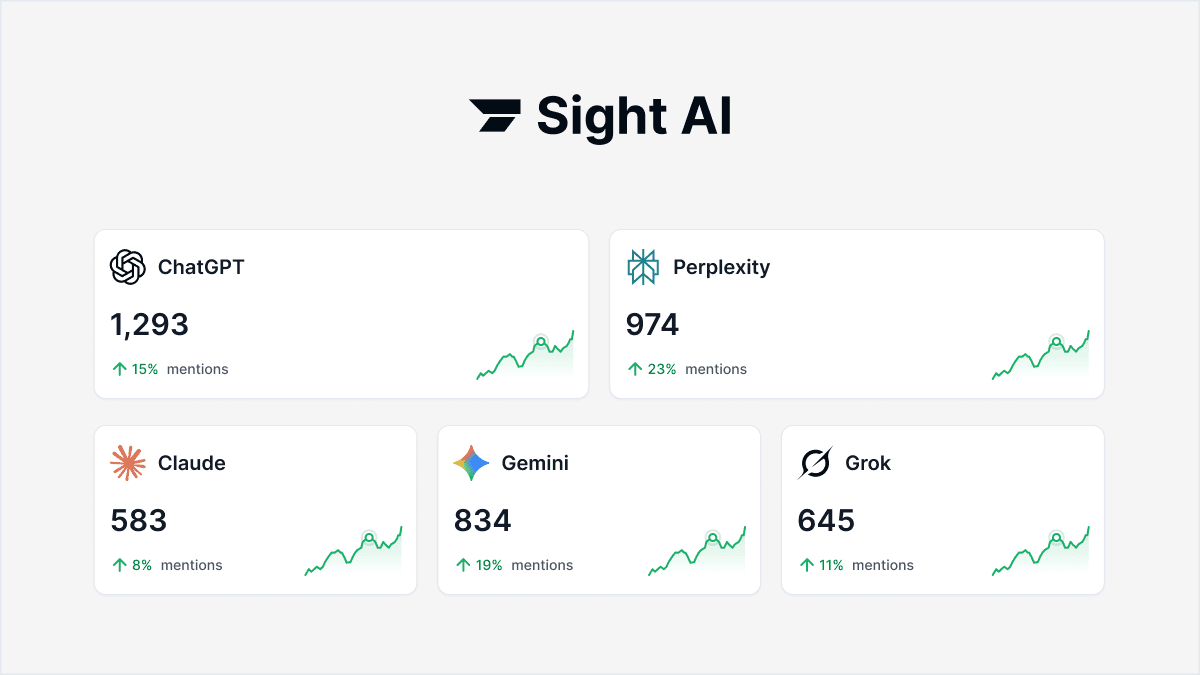
Tools like Sight AI are built specifically for this measurement layer, tracking brand mentions across AI models including ChatGPT, Claude, and Perplexity, with sentiment analysis and prompt tracking built in. This kind of dedicated AI visibility monitoring is what closes the gap between traditional SEO analytics and the new reality of AI-driven discovery.
Building a Strategy to Earn More AI Brand Mentions
Understanding how LLMs mention brands is only useful if it leads to action. The good news is that the mechanics described throughout this article point toward a clear, executable strategy — one that builds on what marketers already know about organic growth and extends it into the AI search layer.
The content architecture for this strategy centers on what's emerging as Generative Engine Optimization, or GEO. GEO is a developing practice area focused on creating content that directly answers the prompts your audience submits to AI models. This means publishing explainer articles that define your category, comparison guides that position your brand against alternatives, and listicles that place your brand in curated solution sets. These content types are structurally more likely to be absorbed into training data and retrieved by RAG systems because they match the format AI models draw on when generating recommendations.
Content specificity matters: Generic content that vaguely describes your product is less effective than content that explicitly links your brand to specific problem categories, use cases, and buyer contexts. Every piece of content is an opportunity to reinforce the associative patterns you want LLMs to learn. Write for the prompt your buyer will submit, not just for the keyword they might type into Google.
Indexing velocity for RAG platforms: For retrieval-augmented systems like Perplexity, getting content indexed quickly is a meaningful competitive advantage. The IndexNow protocol — supported by Microsoft Bing, Yandex, and other search engines — allows websites to notify search engines of new or updated content in near real-time, dramatically reducing the lag between publishing and discovery. Integrating IndexNow into your publishing workflow means your content enters the retrieval pool faster, which translates to faster brand mention opportunities on RAG-based AI platforms. Improving your overall web indexing strategy is foundational to competing on retrieval-augmented platforms.
Third-party mention campaigns: Because LLMs weight third-party mentions more heavily than self-published content, actively pursuing editorial coverage, review placements, and inclusion in independent roundups and comparison articles is a core part of the AI visibility strategy. This is the link-building equivalent for the AI era — and it compounds in the same way, with each new mention reinforcing your brand's entity signal across the training data ecosystem.
The compounding flywheel looks like this: use AI visibility tracking to identify which prompts your brand is missing from, create GEO-optimized content to fill those gaps, publish and index that content quickly to capture RAG-based mentions, and monitor the results to find the next set of gaps. Each cycle strengthens your brand's entity signal, expands your category associations, and increases the probability of appearing in the AI responses your buyers are reading.
Sight AI's platform is designed to support exactly this workflow: tracking AI visibility across platforms, surfacing content opportunities, generating SEO and GEO-optimized articles through specialized AI agents, and automating fast indexing through IndexNow integration. It's the operational layer for executing this strategy at scale.
The Bottom Line on AI-Driven Brand Visibility
LLM brand mentions are not random. They are the predictable output of content signals, entity strength, prompt architecture, and platform-specific retrieval logic. The brands that appear in AI responses have earned that presence — through sustained content authority, consistent entity signals, third-party validation, and in some cases, fast indexing that gets them into RAG-based retrieval pools ahead of competitors.
The inverse is equally true: brands that are absent from AI responses are absent for specific, diagnosable reasons. Weak entity signals, narrow category associations, thin third-party mention profiles, or slow indexing are all addressable gaps. Once you understand the mechanics, you can engineer your brand's presence in AI responses rather than hoping to appear.
The urgency here is real. AI search is not a future trend — it's a present reality for a growing segment of buyers. The brands building AI visibility strategies now are accumulating compounding advantages in training data representation and entity strength. Waiting means starting further behind.
The operational path forward combines three things: knowing where you stand across AI platforms, creating content that earns mentions, and getting that content indexed fast enough to matter. Start tracking your AI visibility today and see exactly where your brand appears across top AI platforms — because you can't optimize what you can't measure, and the measurement starts here.