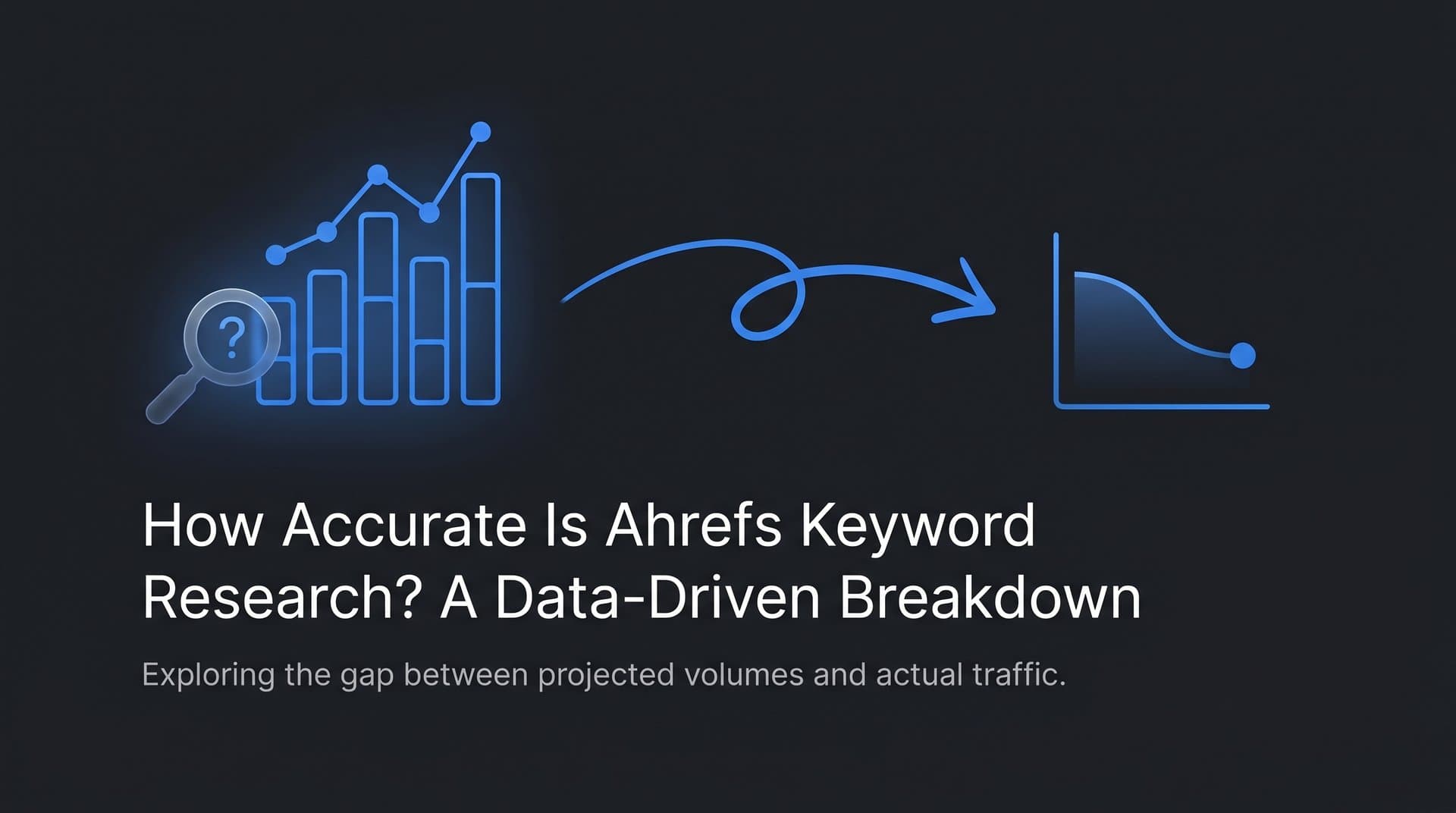
You've done everything right. You researched keywords in Ahrefs, found terms with solid search volume and manageable difficulty scores, built out a content calendar, published the articles, and waited. Then you opened Google Search Console three months later and discovered the actual traffic numbers looked nothing like what Ahrefs projected.
Sound familiar? You're not alone. This is one of the most common frustrations among marketers and SEO practitioners who rely heavily on third-party keyword tools to guide their strategy.
Ahrefs is genuinely one of the most powerful SEO platforms available. Its keyword explorer, backlink analysis, and site audit features are used by agencies and in-house teams worldwide. But "widely used" and "perfectly accurate" are two very different things. When you're making decisions about where to invest content resources, which topics to prioritize, and what traffic to expect, understanding the limitations of your data is just as important as knowing how to use the tool itself.
This article is a practical, honest breakdown of how accurate Ahrefs keyword research actually is. We'll look at where the data comes from, where it tends to hold up, where it falls short, and how the rise of AI-driven search has introduced an entirely new category of blind spots that no traditional keyword tool currently addresses. By the end, you'll have a clearer picture of how to use Ahrefs intelligently as part of a broader, more complete intelligence stack.
Where Ahrefs Gets Its Keyword Data (And Why the Source Shapes the Story)
To evaluate how accurate Ahrefs keyword research is, you first need to understand where the data actually comes from. Ahrefs has been transparent about this on their own blog: they use a combination of clickstream data, third-party data providers, and cross-referencing with Google Keyword Planner. Each of these sources introduces its own layer of estimation.
Clickstream data is collected from browser extensions, apps, and ISP-level tracking panels. Essentially, a panel of users has their browsing behavior monitored, and that behavior is used to model broader search patterns. The problem is that no clickstream panel is perfectly representative of the entire internet. There's inherent sampling bias, particularly for mobile searches, which now represent the majority of queries globally. If mobile users are underrepresented in the clickstream panel, mobile-driven search trends will be underrepresented in the data.
Google Keyword Planner, the other major input, is designed primarily for paid advertisers. It groups keywords into volume ranges rather than providing exact figures, and it tends to inflate or deflate numbers based on advertiser demand rather than pure organic search behavior. When Ahrefs cross-references clickstream data with Keyword Planner ranges, the result is an estimate built on two imperfect foundations. Understanding how Google Keyword Planner search volume works helps contextualize why these estimates can diverge from reality.
There's also the matter of update cadence. Ahrefs doesn't update its keyword database in real time. There's a lag between when search behavior shifts and when that shift is reflected in the tool. For trending topics, seasonal keywords, or newly emerging query patterns, this lag can mean you're looking at data that's already outdated by the time you're making decisions.
It's worth being clear about something that's easy to overlook: this is not a flaw unique to Ahrefs. Semrush, Moz, Ubersuggest, and every other third-party SEO tool faces the same fundamental constraint. None of them have direct access to Google's actual search query data. Google keeps that information proprietary. Every search volume number you see in any third-party tool is an approximation, built from indirect signals and statistical modeling. Knowing this doesn't make the tools less useful, but it should inform how much weight you give any single number.
Search Volume Estimates: Directionally Useful, Numerically Imprecise
Here's where the rubber meets the road for most marketers. You see a keyword showing 2,400 monthly searches in Ahrefs. You build a content brief around it, optimize the article, and then check Google Search Console six months later to find you're getting impressions but at a fraction of what you expected. What went wrong?
The honest answer is that Ahrefs' volume estimates are often directionally correct but can vary significantly from actual query volume, especially for long-tail and niche keywords. A keyword showing high volume is usually genuinely more searched than one showing low volume. But the specific number itself should be treated as a range, not a precise figure. For a deeper understanding of how volume metrics work across tools, our guide on SEO keyword volume provides additional context.
One structural reason for this is how Ahrefs handles volume rounding. Rather than displaying exact numbers, Ahrefs groups search volumes into buckets: 50, 100, 250, 500, 1,000, and so on. For high-volume head terms, this rounding is relatively inconsequential. A keyword that gets 50,000 searches per month showing as 49,000 or 52,000 doesn't change your strategic decision much.
But for lower-volume terms, the rounding can be significant. A keyword showing 50 monthly searches might actually get anywhere from 20 to 80. That's a wide range, and for niche content strategies where you're targeting many low-volume terms, this imprecision compounds. A cluster of keywords that looks like it should drive several hundred monthly visits might realistically deliver much less, or occasionally much more.
Ahrefs tends to perform more reliably for high-volume, well-established head terms with consistent search patterns over time. These are the keywords where clickstream panels have more data points, where the Google Keyword Planner ranges are more granular, and where seasonal fluctuations are better understood. The reliability degrades as you move toward emerging queries, conversational search patterns, and the kind of long-tail specificity that often drives the most qualified traffic.
The practical implication: use Ahrefs search volume as a signal for relative priority, not as a traffic forecast. If you're building a business case that depends on precise traffic projections, you'll need to validate those estimates against Google Search Console data for similar content you've already published.
Keyword Difficulty Scores: A Useful Compass With Known Blind Spots
Ahrefs' Keyword Difficulty score is one of the most referenced metrics in SEO, and also one of the most misunderstood. The KD score is calculated primarily based on the number of referring domains pointing to the top 10 ranking pages for a given keyword. The more backlinks those pages have, the higher the difficulty score.
This is a meaningful signal. Backlinks remain one of Google's most important ranking factors, and pages with strong link profiles are genuinely harder to displace. But the KD score captures only one dimension of ranking difficulty, and there are several important factors it doesn't account for at all. Learning how to find competition level for keywords using multiple signals gives you a more complete picture than relying on a single metric.
Content quality and depth don't factor into KD. A keyword might show a low difficulty score because the top-ranking pages are thin, outdated, or poorly written, which actually represents a real opportunity. Alternatively, a keyword might show moderate difficulty but be dominated by a handful of mega-brands whose domain authority and user trust make them nearly impossible to outrank regardless of how good your content is.
Search intent alignment is another gap. If the top-ranking pages for a keyword are all product pages and you're planning to write an informational blog post, the KD score won't tell you that your content type is misaligned with what Google wants to show for that query. You could have excellent backlinks and still struggle to rank because you're fighting the wrong format battle.
SERP feature dominance matters too. A keyword that triggers a featured snippet, a People Also Ask box, a local pack, or a knowledge panel effectively reduces the organic real estate available for traditional blue-link results. KD doesn't account for how much of the SERP is already occupied by features that your content can't compete for.
The right way to use KD is as one signal among several, not as a binary go/no-go decision point. A low KD score is an invitation to investigate further, not a guarantee of ranking success. A high KD score doesn't mean you shouldn't target a keyword, especially if you have strong topical authority and a differentiated content angle. Treat it as a starting filter, then layer in manual SERP analysis before committing to a content investment.
The Growing Blind Spot: Queries That Never Reach the Keyword Database
Even if Ahrefs' volume and difficulty estimates were perfectly accurate, there's a category of search behavior that the tool simply cannot measure. And this category is growing rapidly.
Zero-click searches represent a substantial portion of Google queries. These are searches where the answer is surfaced directly in the SERP through a featured snippet, knowledge panel, or other rich result, and the user never clicks through to any website. Traditional keyword volume doesn't distinguish between queries that generate clicks and those that don't. A keyword showing significant monthly volume might deliver very few actual website visits because most searchers get what they need without clicking.
Voice queries present a similar challenge. Conversational, question-based searches typed or spoken into voice assistants follow different patterns than the typed queries that traditional keyword databases are built around. These queries are often longer, more specific, and phrased in ways that don't match the keyword formats Ahrefs tracks.
But the most significant and fastest-growing blind spot is AI-powered search. When someone types a question into ChatGPT, Perplexity, or Claude, that query doesn't appear in any keyword database. The answer they receive might recommend specific brands, cite particular websites, or present information in ways that shape purchase decisions, but none of that activity is visible to traditional SEO tools. Understanding how to measure SEO success now requires looking beyond traditional keyword metrics alone.
This matters enormously for brand strategy. A competitor might be consistently recommended by AI models for queries in your category while you're being omitted entirely, and your keyword research tool would show no evidence of this gap. Your rankings in Google might look stable while your brand's visibility in AI-driven discovery is eroding.
This is where the concept of AI visibility becomes critical. AI visibility refers to how and how often your brand is mentioned, cited, or recommended across AI platforms. It's a metric that fills a gap that tools like Ahrefs were never designed to address. As more users turn to AI models for research, recommendations, and decision-making, tracking your presence in those environments becomes as strategically important as tracking your Google rankings.
Building a More Complete Keyword Intelligence Stack
Given these limitations, the question isn't whether to use Ahrefs but how to use it as part of a broader, more grounded intelligence system. Here's a practical framework for building that stack.
Start with Ahrefs for directional discovery. Use it to identify keyword clusters, understand competitive landscapes, and generate content ideas. It's excellent for this purpose. The keyword explorer surfaces related terms, questions, and topic variations that would take much longer to find manually. Just treat the volume numbers as relative signals rather than precise forecasts. Our guide on keyword research for organic SEO outlines a complementary approach to discovery that works alongside Ahrefs.
Validate with Google Search Console actuals. GSC is the closest thing to ground truth available to most marketers. It shows actual impressions and clicks for queries where your site appeared in results. Use it to calibrate your expectations: if you've published content targeting similar keywords in the past, compare what Ahrefs projected against what GSC delivered. That ratio becomes your personal accuracy benchmark for your specific site and niche.
Layer in Google Trends for velocity signals. Ahrefs volume data represents a historical average, but Google Trends shows whether interest in a topic is growing, stable, or declining. A keyword with moderate volume but rising trend velocity is often a better investment than a high-volume keyword that's plateauing. Trends also helps identify seasonal patterns that averaged monthly volumes can obscure.
Add AI visibility tracking to capture the full picture. This is the layer that most keyword strategies currently lack entirely. Tools that monitor how AI models like ChatGPT, Claude, and Perplexity reference your brand and your competitors reveal a dimension of search visibility that no traditional keyword tool can see. You can identify which topics your brand is being associated with in AI responses, where competitors are being recommended instead of you, and which content gaps you need to fill to improve your AI citations.
Use competitor SERP analysis to ground difficulty assessments. Before committing to a keyword, manually examine the top 10 results. Look at the content types, the brand authority of the ranking pages, the presence of SERP features, and the quality of the existing content. Running thorough SEO competitive research takes more time than reading a KD score, but it gives you a much more accurate picture of what you're actually competing against.
The goal is a workflow where Ahrefs provides the starting map, GSC and Trends provide the reality check, and AI visibility tracking fills the gaps that traditional tools were never built to address.
Content Strategy Beyond the Numbers: Where Intent and Authority Win
Here's a perspective worth sitting with: the most successful content strategies aren't built primarily around search volume and difficulty scores. They're built around a deep understanding of what the audience actually needs, what the brand can credibly address, and what content formats genuinely serve both.
Over-reliance on keyword metrics leads to a particular failure mode: teams publish technically optimized content that ranks for its target keyword but doesn't convert, doesn't build authority, and doesn't differentiate the brand. The content exists to satisfy a metric rather than to serve a reader. Search engines are increasingly good at identifying this distinction. Building a cohesive SEO keywords strategy that balances data with editorial judgment helps avoid this trap.
Search intent alignment is more important than volume. A keyword with modest search volume but strong commercial intent and clear alignment with your product's value proposition will outperform a high-volume keyword that attracts casual browsers who have no intention of engaging further. Ahrefs can help you identify intent signals, but it can't make the judgment call for you.
This is where SEO and GEO, Generative Engine Optimization, are converging. GEO is the emerging discipline of optimizing content so it gets cited, recommended, and referenced by AI models. As AI-driven search becomes a more significant channel for discovery and decision-making, content needs to be structured not just for Google's crawlers but for the way AI models parse, evaluate, and cite information.
Content that demonstrates genuine expertise, provides clear and citable answers, and builds topical authority over a domain tends to perform well in both traditional search and AI-generated responses. Learning how to optimize content for SEO with these dual objectives in mind ensures your efforts compound across both channels.
The actionable next steps here are straightforward. Audit your existing content against actual performance data in GSC. Identify the keywords where your rankings and traffic don't match Ahrefs' projections and investigate why. Then look at your AI search visibility: are your competitors being recommended in AI responses for queries in your category while your brand is absent? That gap is often more strategically significant than any single keyword ranking.
The Bottom Line on Ahrefs Accuracy
Ahrefs remains one of the most valuable tools in the SEO practitioner's toolkit. Its keyword discovery capabilities, competitive analysis features, and backlink data are genuinely useful for building content strategy. But "useful" and "accurate" aren't the same thing, and treating Ahrefs numbers as precise predictions rather than directional estimates is a mistake that leads to misaligned expectations and missed opportunities.
The search landscape is also changing in ways that make traditional keyword research increasingly incomplete as a standalone strategy. AI-driven discovery is reshaping how people find information, evaluate brands, and make decisions. The brands that will thrive in this environment are those tracking their visibility across both traditional search and AI platforms, not just optimizing for the metrics that third-party keyword tools can measure.
Use Ahrefs for what it's genuinely good at. Validate its estimates against real data. And build the additional intelligence layers that give you a complete picture of where your brand appears, and where it doesn't, across the full spectrum of modern search.
Start tracking your AI visibility today and see exactly where your brand appears across top AI platforms like ChatGPT, Claude, and Perplexity. Stop guessing how AI models talk about your brand, and start building a content strategy that captures both traditional and AI-driven search opportunities.