Most marketers can tell you their target keywords. Far fewer can tell you where they actually rank for them right now, on a mobile device, in a different city, without the bias of their own browsing history skewing the results. That gap between what you think your rankings are and what they actually are is costing real traffic and real revenue.
The good news is that checking your Google rank accurately is more accessible than ever, with free tools, reliable third-party platforms, and clear methodologies that remove the guesswork. The more nuanced reality is that Google rankings, while still essential, are no longer the only search surface that matters. AI-powered platforms like ChatGPT, Claude, and Perplexity are reshaping how people discover brands, products, and answers, and your position in those systems looks nothing like a traditional SERP ranking.
This guide covers the full picture. You will learn how to check your Google rank accurately, which tools to trust, how to interpret what the data actually means, and why forward-thinking marketers are now layering AI visibility tracking alongside traditional rank monitoring. Whether you are a founder trying to understand your organic footprint or an agency building reporting workflows for clients, this is the explainer you have been looking for.
Why Google Rankings Still Drive Business Growth
Before diving into methods and tools, it helps to be precise about what "Google check rank" actually means in practice. Rank checking is the process of determining where a specific page on your website appears in Google's search results for a given keyword query. Position 1 means you are the first organic result. Position 10 means you are at the bottom of the first page. Position 11 means you have fallen to page two, where click-through rates drop dramatically.
Here is something that trips up many marketers early on: the results you see when you search Google yourself are not the same results your audience sees. Google personalizes results based on your search history, location, device, and whether you are signed into a Google account. If you have visited your own website dozens of times, Google knows that and may surface it higher for you specifically. This creates a false sense of ranking performance that can mislead your entire strategy.
This distinction between personalized results and actual organic rankings is why dedicated tracking tools exist. They query Google from neutral environments, across multiple locations and devices, to report the real average position your pages hold. Understanding how to check your position in Google search accurately is the foundation of any data-driven SEO workflow.
Some marketers question whether rank tracking is still worth the effort as AI search grows. The answer is clearly yes, at least for now. Organic search from Google continues to represent the largest single source of website traffic for most businesses across most industries. Appearing prominently for high-intent keywords still translates directly into clicks, leads, and revenue. The fundamentals of SEO, including understanding where you rank and why, remain as commercially important as ever.
What has changed is that Google rankings are no longer the only game in town. Treating rank tracking as your sole visibility metric is increasingly incomplete. But the solution is to add new tracking layers, not abandon the ones that still work.
Five Reliable Methods to Check Your Google Rankings
Not all rank-checking methods are created equal. Some are free but limited. Others are comprehensive but require investment. The right approach depends on your scale, your reporting needs, and how much precision your strategy requires.
Google Search Console: This is your first stop and, for most purposes, your most trustworthy source of ranking data. Search Console is a free tool provided by Google itself, which means it reflects first-party data directly from the source. Under the Performance report, you can see average position, impressions, clicks, and click-through rate for every keyword your site has appeared for in Google Search. It covers the last 16 months of data, allows filtering by device, country, and search type, and requires no additional setup beyond verifying your website ownership. The caveat worth knowing: Search Console reports "average position," which is a weighted average across all instances a URL appeared for a query. If your page appears in both position 3 and position 8 for the same keyword on different days, the average will land somewhere in between. This can smooth over meaningful fluctuations, so treat it as a directional baseline rather than a precise daily snapshot.
Manual incognito searches: Opening a private browsing window and searching your target keywords is a quick way to spot-check rankings while reducing personalization bias. Without your browsing history, Google cannot tailor results specifically to you. This method works for quick sanity checks and is useful when you want to see the SERP layout for a specific query. Its limitations are significant at scale though. You cannot efficiently track hundreds of keywords this way, and incognito mode does not eliminate geo-based or device-based variation. Your location still influences what Google shows you, and the results on your laptop differ from those on a mobile device in another city.
Third-party rank tracking tools: Platforms like Ahrefs, SEMrush, and Moz offer automated daily rank tracking that solves the scale problem entirely. You input your target keywords, specify your target location and device type, and the tool queries Google on your behalf from neutral environments, reporting your positions over time. These tools also offer competitor rank comparisons, SERP feature monitoring, and historical trend charts that make it easy to spot meaningful changes. For a deeper dive into selecting and using these platforms, our guide on how to track keyword rankings covers the full evaluation process. When choosing a tool, look for daily tracking frequency, local rank tracking by city or region, mobile versus desktop separation, SERP feature detection, and API access if you need to pipe data into custom dashboards. One important note: positions reported by third-party tools will sometimes differ slightly from what Search Console shows. This is normal. The tools use different methodologies, and Search Console's average position calculation behaves differently from a point-in-time rank check. Use both in parallel rather than expecting them to match exactly.
Reading the Data: What Your Rank Report Actually Tells You
Getting rank data is step one. Understanding what it means is where strategy actually lives.
Position fluctuations are normal and constant. Google updates its algorithm continuously, and rankings shift daily even for well-established pages. Moving from position 5 to position 7 over a single week is not necessarily a signal that something is wrong. What matters is the trend over time: is a keyword steadily improving, holding steady, or declining across a 30 to 90 day window? Single-day snapshots create noise. Trend lines create insight. Learning to work with SEO ranking data effectively is what separates reactive teams from strategic ones.
A meaningful ranking change is one that is sustained across multiple tracking periods and correlates with a shift in traffic or clicks for that keyword. If a page drops from position 4 to position 14 and stays there for two weeks, that warrants investigation. If it bounces between 5 and 8 over the same period, that is Google testing and settling, not a strategic problem.
SERP features add another layer of complexity that pure position numbers miss. Today's Google results pages are crowded with featured snippets, People Also Ask boxes, local packs, image carousels, video results, and paid ads. A page ranking in position 1 organically might actually appear as the fifth visible element on the page if several SERP features are stacked above it. This means your effective visibility can decrease even when your ranking holds steady, and it can increase if you capture a featured snippet or appear in a People Also Ask box regardless of your organic position.
Modern rank tracking tools flag which SERP features are present for each keyword and whether you own any of them. This data matters as much as the position number itself.
The most important shift in how to use rank data is connecting it to business outcomes. Position is a leading indicator, not a success metric on its own. A keyword ranking at position 3 that drives zero conversions is less valuable than a keyword at position 6 that consistently generates qualified leads. Understanding organic traffic in Google Analytics helps you build reporting that correlates ranking changes with traffic, conversion rate, and revenue where possible. This transforms rank tracking from a vanity exercise into a genuine strategic input.
Rank Tracking Mistakes That Skew Your Strategy
Even experienced marketers fall into rank tracking traps that produce misleading data and misaligned priorities. Knowing what to avoid is as important as knowing what to do.
Checking rankings from your own logged-in browser: This is the most common mistake and the most damaging one. When you search Google while signed into your Google account, or even in a regular browser window with your history intact, you are seeing a personalized version of the results. Your own site will often appear higher than it does for a neutral user. This creates false confidence and prevents you from seeing the real competitive landscape your audience encounters. Always use Search Console data or a third-party tool for accurate position reporting.
Tracking too many vanity keywords: It feels satisfying to rank on page one for a broad, high-volume keyword in your industry. But if that keyword attracts researchers and students rather than buyers, its ranking position does not translate to business value. Many teams waste significant tracking and optimization effort on keywords that look impressive in reports but contribute minimally to revenue. Focus your tracking on high-intent terms: keywords that signal purchase readiness, comparison shopping, or specific problem-solving. If your content is struggling to gain traction despite your efforts, understanding why content is not ranking in search can help you diagnose the root cause.
Ignoring local and device-specific variations: Google serves different results based on the searcher's location and device type. A business ranking well for a keyword in one city may rank poorly for the same keyword in another. Mobile rankings frequently differ from desktop rankings, both in position and in the SERP features displayed. If your audience is geographically distributed or primarily mobile, tracking only a single location and device type will give you an incomplete and potentially misleading picture. Set up location-specific and device-specific tracking for your most important keywords, especially if you operate in multiple markets or serve a mobile-heavy audience.
Beyond Google: Why AI Visibility Is the New Ranking Frontier
Here is where the conversation gets genuinely new. Traditional rank tracking tells you where your pages appear in Google's index. But a growing portion of your audience is no longer starting their search on Google at all.
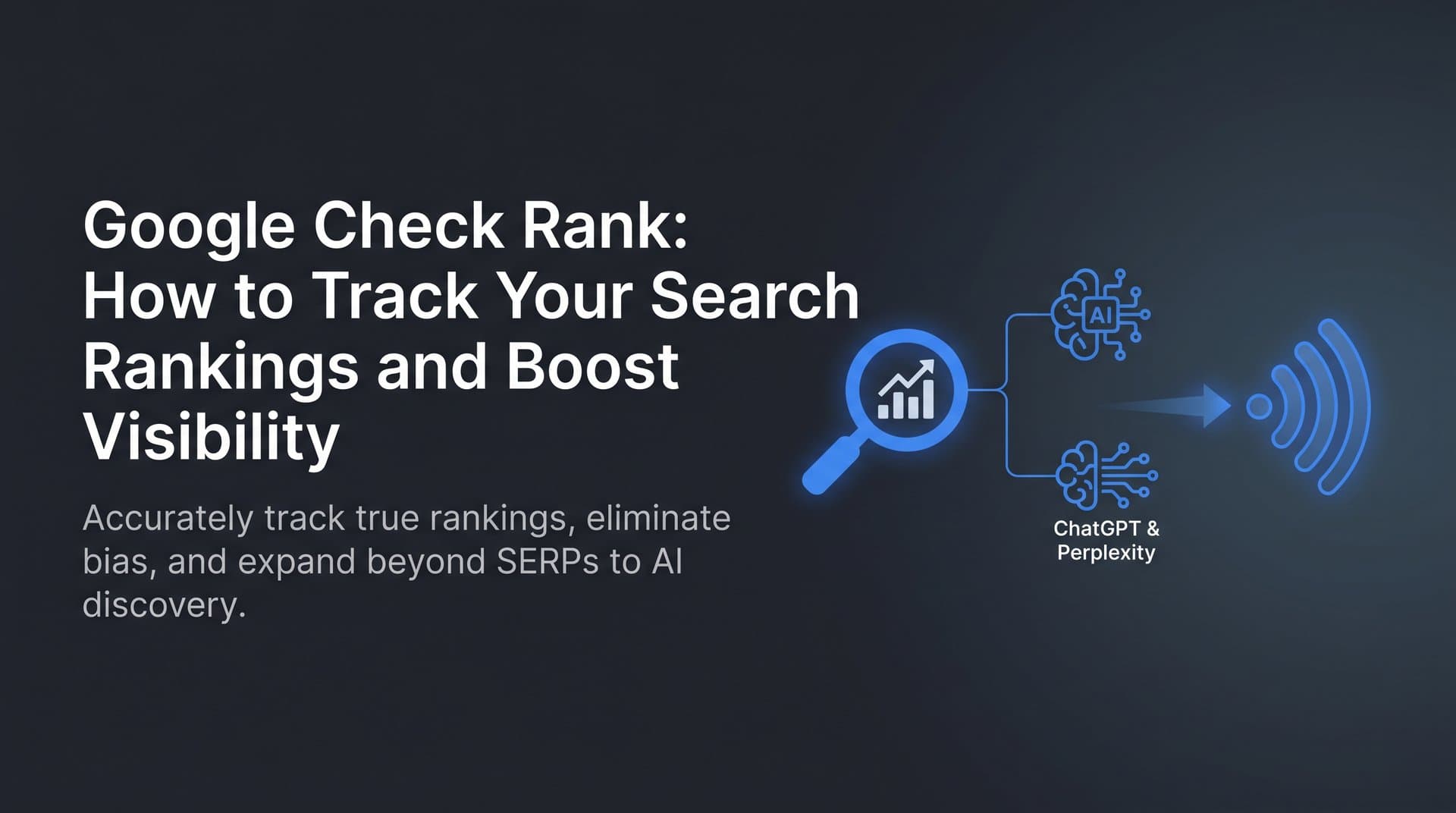
AI-powered platforms like ChatGPT, Claude, and Perplexity are handling a significant and growing volume of informational and research queries. When someone asks one of these systems "What is the best project management tool for remote teams?" or "Which SEO platform should I use for a startup?", they receive a synthesized answer that may or may not mention your brand. There is no position 1 through 10 in these responses. Your brand is either referenced or it is not. Understanding the AI search engine ranking factors that influence these mentions is becoming essential for forward-thinking marketers.
This is a fundamentally different visibility model. In traditional SEO, you can rank at position 7 and still receive clicks. In AI search, if you are not mentioned in the response, you effectively do not exist for that query. The stakes of being included versus excluded are higher, and the signals that influence inclusion are different from the signals that drive Google rankings.
AI visibility refers to how frequently and favorably AI models reference your brand when answering relevant queries. This includes which prompts trigger mentions of your brand, what sentiment surrounds those mentions, whether you are positioned as a top recommendation or a secondary option, and how your presence compares to competitors across different AI platforms. If you have noticed that competitors are ranking in AI search while your brand is absent, that gap represents a significant and growing missed opportunity.
Tracking this requires a different toolset. Traditional rank trackers do not query AI models or analyze their outputs. Platforms like Sight AI are built specifically for this gap, monitoring brand mentions across six or more AI platforms including ChatGPT, Claude, and Perplexity, with sentiment analysis and prompt tracking built in. This gives marketers an AI Visibility Score alongside their traditional rankings, creating a more complete picture of how discoverable their brand actually is in the current search landscape.
For agencies and founders building long-term organic strategies, ignoring AI visibility is increasingly a blind spot. The audience behavior is shifting, and the brands that understand and optimize for AI mentions now will have a meaningful advantage as these platforms continue to grow.
Building a Complete Rank and Visibility Monitoring Workflow
Knowing which tools exist is one thing. Having a workflow that keeps you consistently informed is what actually drives better decisions over time.
Start with the foundation. Verify your website in Google Search Console if you have not already, and spend time in the Performance report to understand which keywords are already driving impressions and clicks. If your site is not yet fully indexed, our guide on how to index your site in Google walks you through the essential steps. This is your baseline. Next, choose a third-party rank tracking tool and configure it with your most important keywords, segmented by intent, location, and device type. Set up competitor tracking for at least two or three direct competitors so you can see relative position changes, not just absolute ones.
Layer in AI visibility tracking as the third component. Set up monitoring for the brand name, key product names, and the core problem-solution queries your audience uses. This tells you whether AI platforms are recommending your brand when it matters most.
For reporting cadence, a practical structure looks like this:
1. Weekly rank checks: Review your third-party tracker for significant position changes on high-priority keywords. Flag anything that has moved more than three positions in either direction for follow-up.
2. Monthly trend analysis: Pull Search Console data for the past 30 days and compare it to the prior period. Look at impression trends, average position shifts, and click-through rate changes by keyword group. Review your AI visibility data for changes in mention frequency or sentiment.
3. Quarterly strategy adjustments: Use 90-day trend data from both Google and AI visibility tracking to identify content gaps, underperforming pages that need optimization, and new keyword opportunities. Adjust your content calendar and link-building priorities based on what the data shows, not what feels intuitive. For actionable tactics on closing those gaps, explore proven methods to improve organic search ranking across your priority keywords.
For immediate next steps: audit your current tracking setup and identify which high-intent keywords are not yet being monitored. Check whether you have location-specific tracking configured for your most important markets. And evaluate whether you have any visibility into how AI models currently reference your brand, because for most businesses, that answer right now is no.
Putting It All Together
Checking your Google rank is still one of the most important things you can do as a marketer or founder focused on organic growth. It tells you where you stand, reveals competitive gaps, and connects your content and SEO efforts to measurable outcomes. The tools are accessible, the methods are well-established, and the data is genuinely useful when interpreted correctly.
But the search landscape has expanded. A growing share of discovery now happens inside AI systems that do not report positions, do not send referral traffic in traditional ways, and do not respond to the same optimization signals as Google. The marketers and agencies who are building durable organic strategies right now are tracking both dimensions: where they rank on Google and how AI models talk about their brand.
Start with the free tools. Google Search Console gives you more actionable data than most teams fully use. Build a disciplined tracking workflow that separates signal from noise and connects rankings to real business outcomes. Then extend your visibility monitoring into the AI search layer, because that is where the next wave of organic discovery is taking shape.
Start tracking your AI visibility today and see exactly where your brand appears across top AI platforms. Stop guessing how ChatGPT, Claude, and Perplexity talk about your brand, and start using that intelligence to uncover content opportunities, sharpen your positioning, and automate your path to organic traffic growth across every surface where your audience is searching.