You've set aside budget for SEO. You've invested in content marketing. But when a potential customer asks ChatGPT or Perplexity about solutions in your space, does your brand even get mentioned? For many marketers, the answer is uncomfortably uncertain—and the question of how much it costs to fix that problem is even murkier.
Generative Engine Optimization isn't just another marketing buzzword. It's the discipline of ensuring your brand appears in AI-generated responses across platforms like ChatGPT, Claude, Google's AI Overviews, and Perplexity. As these AI engines increasingly mediate how people discover information, being invisible in their responses means missing out on a growing share of organic discovery.
The challenge? Unlike traditional SEO, where pricing models have matured over decades, GEO exists in a pricing landscape that feels like the Wild West. Some platforms charge a few hundred dollars monthly. Others quote five-figure retainers. The variation isn't arbitrary—it reflects fundamental differences in what's being delivered and measured. This guide cuts through the confusion, breaking down what GEO actually costs, what drives those costs, and how to build a budget that aligns with your visibility goals.
The Three Pillars of GEO Pricing
Understanding GEO pricing starts with recognizing that it's not a single service—it's a combination of monitoring, content optimization, and strategic iteration. Most businesses approach GEO investment through one of three models, each with distinct cost structures and value propositions.
Software Subscriptions: These platforms focus primarily on visibility tracking. They monitor how AI models respond to queries in your space, track when your brand gets mentioned, analyze sentiment, and identify content gaps. Think of these as your AI visibility dashboard—showing you the current state but leaving the optimization work largely to you.
Agency Retainers: Full-service agencies handle both monitoring and optimization. They track your AI visibility, develop content strategies specifically designed for AI comprehension, create optimized content, and continuously refine based on how AI models respond. The retainer model reflects ongoing work rather than a one-time deliverable.
Hybrid Approaches: Many businesses combine a tracking platform with in-house content optimization or selective agency support. This middle path offers cost control while maintaining strategic flexibility.
The cost drivers across these models share common threads. The number of AI platforms you monitor directly impacts pricing—tracking mentions across ChatGPT, Claude, Perplexity, Google AI Overviews, Gemini, and other emerging models requires more infrastructure and API costs than monitoring just one or two. Content volume matters significantly. Optimizing ten core pages differs fundamentally from optimizing hundreds of blog posts, product pages, and knowledge base articles.
Competitive landscape complexity also shapes pricing. If you're in a crowded space where dozens of competitors vie for AI mentions, achieving visibility requires more sophisticated content strategies and ongoing refinement. A niche B2B software category with limited competition demands less aggressive investment than a consumer brand competing in a saturated vertical.
What makes GEO pricing fundamentally different from traditional SEO? Traditional SEO has clear technical deliverables—site audits, keyword research, backlink building, on-page optimization. GEO operates in a more fluid environment. AI models update their knowledge bases continuously. What works to earn mentions this month might need adjustment next month as models refine their response patterns. This ongoing nature means GEO requires sustained investment rather than project-based work with a clear endpoint. For a deeper understanding of these differences, explore our breakdown of generative engine optimization vs SEO.
Platform Subscriptions: The Foundation Layer
AI visibility tracking platforms represent the entry point for most GEO investments. These tools automate the labor-intensive work of querying multiple AI models, tracking brand mentions, and analyzing response patterns over time.
Entry-tier platforms typically start around $200-400 monthly. At this level, expect monitoring across 3-4 major AI platforms, basic sentiment tracking, and weekly or bi-weekly reporting. These tiers work well for smaller businesses or those just beginning to understand their AI visibility baseline. The limitation? You're usually restricted to monitoring a defined set of queries—perhaps 20-50 tracked prompts—which may not capture the full landscape of how people actually search for solutions in your space.
Mid-tier subscriptions generally range from $500-1,200 monthly. This tier expands monitoring to 6-8 AI platforms, increases query tracking capacity to hundreds of prompts, and adds features like competitive benchmarking and citation tracking. Many platforms at this level include content opportunity identification—flagging topics where AI models currently lack good answers or where competitors dominate the conversation. Our review of best generative engine optimization tools covers the leading options in this space.
Enterprise platforms can reach $2,000-5,000+ monthly. What justifies the premium? Comprehensive monitoring across all major AI platforms, unlimited query tracking, advanced sentiment analysis with nuance detection, API access for integrating visibility data into your existing analytics stack, and often white-label reporting capabilities for agencies serving multiple clients.
The hidden costs in platform subscriptions deserve attention. Some platforms charge per user seat, meaning a team of five marketers costs significantly more than a single-user license. API limits can create unexpected overages—if you exceed your monthly query allocation, overage fees can add 20-30% to your base subscription. Integration fees for connecting the platform to your CMS or analytics tools sometimes appear as separate line items rather than included features.
Content optimization tools built specifically for GEO represent a distinct category. These platforms analyze your existing content and suggest structural changes, entity additions, and formatting adjustments that improve AI comprehension. Pricing typically ranges from $300-800 monthly for basic optimization suggestions to $1,500+ for advanced tools that integrate with your content workflow and provide real-time optimization scoring.
Agency Services: Full-Service GEO Management
Agencies offering GEO services typically structure pricing around monthly retainers, though project-based engagements exist for specific deliverables. Understanding what's included at different retainer levels helps evaluate whether agency support makes sense for your situation.
Entry-level agency retainers usually start around $3,000-5,000 monthly. This tier typically includes baseline visibility monitoring, monthly reporting on AI mention trends, quarterly content audits identifying optimization opportunities, and strategic recommendations. The agency handles monitoring and analysis, but content creation and implementation often remain your responsibility. This model works well for businesses with strong in-house content teams who need strategic direction rather than execution support.
Mid-tier retainers commonly range from $6,000-12,000 monthly. At this level, agencies typically include comprehensive visibility tracking across all major AI platforms, competitive analysis showing how your brand performs relative to key competitors, content strategy development with specific optimization recommendations, and often creation of 4-8 optimized articles monthly. Some agencies at this tier also handle technical implementation—updating existing content, optimizing site structure for AI crawlers, and managing schema markup specifically designed to improve AI comprehension. For guidance on developing your own approach, see our generative engine optimization strategy resource.
Enterprise retainers can reach $15,000-30,000+ monthly. These engagements typically involve dedicated account teams, custom research into how AI models handle your specific industry vertical, large-scale content production (20+ optimized pieces monthly), ongoing testing of different content approaches, and integration with broader digital marketing initiatives. Enterprise clients often receive priority access to new GEO techniques and beta testing opportunities as the discipline evolves.
Project-based pricing offers an alternative for businesses wanting specific deliverables without ongoing commitments. A comprehensive GEO audit—analyzing current AI visibility, identifying gaps, and developing a strategic roadmap—typically costs $5,000-15,000 depending on business complexity and competitive landscape depth. Strategy development projects, where agencies create detailed content plans and optimization frameworks, generally range from $8,000-20,000.
Performance-based models remain relatively rare in GEO, but some agencies experiment with hybrid pricing where a portion of fees ties to measurable improvements in AI mention frequency or sentiment scores. These arrangements typically combine a reduced base retainer with performance bonuses triggered by hitting specific visibility milestones.
Building a Budget That Matches Your Goals
The right GEO budget isn't determined by industry averages—it's shaped by your current visibility baseline, competitive dynamics, and business objectives. Building an effective budget starts with honest assessment of where you stand and where you need to go.
Start by establishing your AI visibility baseline. Before investing in optimization, understand your current state. How often does your brand appear in AI responses for core queries in your space? What's the sentiment when you do get mentioned? How does your visibility compare to key competitors? Many businesses discover they're essentially invisible in AI responses, which clarifies the urgency and scope of needed investment. Our AI visibility optimization pricing guide provides additional context on investment levels.
Your competitive gap directly influences required investment. If competitors already dominate AI mentions in your category, catching up requires more aggressive content production and optimization than maintaining leadership in a space where no one has yet established strong AI visibility. A realistic timeline matters here—building AI visibility is measured in quarters, not weeks.
Match investment level to business goals. Brand awareness objectives—simply getting mentioned more frequently in AI responses—typically require less investment than lead generation goals, where you need AI models to not just mention your brand but position it favorably relative to alternatives. Thought leadership positioning demands the highest investment, as it requires creating the kind of authoritative, comprehensive content that AI models consistently cite as trusted sources.
For startups and small businesses with limited budgets, a practical starting point often combines a basic tracking platform ($300-500 monthly) with focused in-house content optimization. Allocate $1,000-2,000 monthly total, prioritizing monitoring to understand the landscape and selective optimization of your highest-value content. This approach builds foundational visibility without overextending resources. Learn more about budget-conscious approaches in our AI search optimization for startups article.
Mid-market companies typically benefit from budgets in the $3,000-8,000 monthly range. This level supports either a comprehensive platform subscription plus dedicated internal resources, or an entry-level agency retainer. The investment enables systematic optimization across core content, competitive tracking, and measurable progress toward visibility goals.
Enterprise organizations often allocate $10,000-25,000+ monthly to GEO, combining sophisticated tracking platforms with agency support or dedicated internal teams. At this scale, the investment supports comprehensive monitoring, aggressive content production, ongoing testing and refinement, and integration with broader marketing technology stacks.
Maximizing Return on Your GEO Investment
Smart GEO spending isn't about maximizing budget—it's about maximizing impact per dollar invested. Certain activities consistently deliver faster, more measurable returns than others.
Prioritize optimizing existing high-performing content before creating new assets. If you already have articles or pages that rank well in traditional search, optimizing them for AI comprehension often yields quicker visibility gains than starting from scratch. AI models frequently draw from content that already demonstrates authority and relevance. Our guide on generative AI content optimization walks through this process in detail.
Focus on query categories where AI models currently provide weak answers. When AI platforms struggle to generate comprehensive responses for certain queries in your space, creating authoritative content that fills those gaps can establish your brand as a go-to source relatively quickly. This strategic gap-filling approach delivers better ROI than competing head-on in areas where strong content already exists.
Avoid redundant tool spending by understanding what different platforms actually do. Some businesses subscribe to multiple visibility tracking platforms that largely duplicate functionality. Combining a strong tracking platform with a complementary content optimization tool typically delivers more value than subscribing to three similar monitoring services. Review our AI search optimization platform comparison to identify the right combination for your needs.
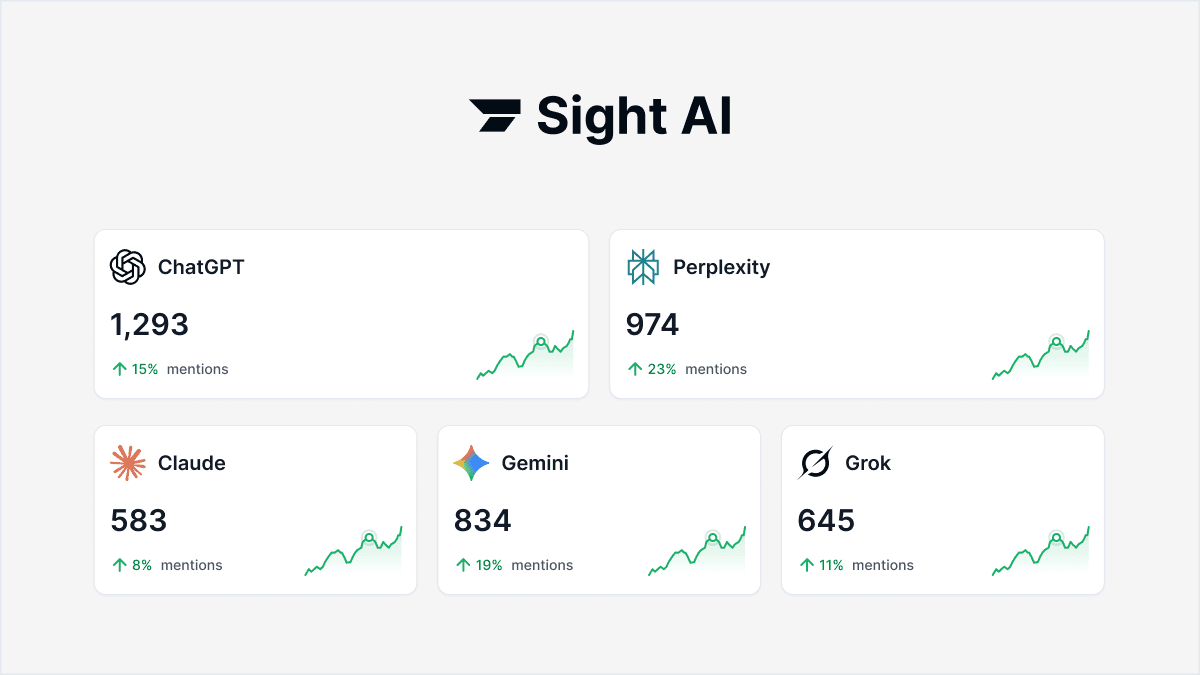
Measuring success requires tracking metrics that actually matter. AI mention frequency shows whether you're gaining visibility. Sentiment analysis reveals whether those mentions position you favorably or unfavorably. Citation tracking demonstrates whether AI models treat your content as an authoritative source worth referencing. Share of voice relative to competitors provides context for whether you're gaining or losing ground.
The most sophisticated measurement connects AI visibility to business outcomes. Track organic traffic from AI-referred users—visitors who discovered your brand through AI search and subsequently visited your site. Monitor conversion rates for this segment. Some businesses find that AI-referred traffic converts at higher rates than traditional search traffic, as users arrive with more context and often higher intent.
Build in budget flexibility for experimentation. The GEO discipline evolves rapidly as AI models change and new platforms emerge. Reserving 15-20% of your budget for testing new approaches, platforms, or content formats allows you to adapt as the landscape shifts rather than being locked into strategies that become less effective over time.
Investing in the Future of Brand Discovery
GEO pricing reflects a fundamental shift in how people discover brands and information. As AI search becomes the default starting point for research and decision-making, visibility in AI-generated responses transitions from experimental marketing tactic to essential brand infrastructure.
The pricing ranges discussed—from a few hundred dollars monthly for basic tracking to five-figure enterprise retainers—reflect different levels of commitment to this new visibility channel. Your right entry point depends on competitive pressure in your space, the maturity of your content foundation, and how quickly you need to establish AI visibility.
What remains consistent across budget levels is that GEO requires sustained investment rather than one-time optimization. AI models continuously update their knowledge bases. Competitors constantly publish new content. The visibility you build this quarter requires maintenance and refinement next quarter. Budget accordingly, treating GEO as an ongoing capability rather than a project with a defined end date.
The businesses that will dominate AI visibility in the coming years are those making informed investments now, while the discipline is still maturing and competitive intensity remains lower than it will be in 12-24 months. Understanding what drives GEO pricing—and what different investment levels actually deliver—positions you to make those informed decisions rather than either under-investing and remaining invisible or over-investing in redundant capabilities.
Stop guessing how AI models like ChatGPT and Claude talk about your brand—get visibility into every mention, track content opportunities, and automate your path to organic traffic growth. Start tracking your AI visibility today and see exactly where your brand appears across top AI platforms.