Search is changing in ways that make traditional optimization tactics look quaint. When someone asks ChatGPT for marketing software recommendations or queries Claude about SEO best practices, they're not clicking through ten blue links—they're getting a synthesized answer that mentions three or four brands, maybe yours, probably not. This shift represents more than a new search interface. It's a fundamental change in how information gets discovered, evaluated, and acted upon.
The numbers tell a stark story. Millions of users now turn to AI assistants as their primary information source, bypassing Google entirely for many queries. These generative engines don't rank websites—they synthesize answers from countless sources and either mention your brand or leave you out completely. There's no second page of results. No "click here to learn more." You're either part of the answer or you're invisible.
This creates an uncomfortable reality for companies still optimizing exclusively for traditional search. Your content might rank #1 on Google, but if ChatGPT never mentions your brand when answering relevant questions, you're missing a massive and growing audience. The brands that will dominate the next decade of search aren't just the ones with the best backlink profiles—they're the ones that AI models trust enough to cite.
A generative engine optimization strategy addresses this new landscape systematically. It's not about abandoning SEO fundamentals. It's about understanding how AI models process information, what makes them choose to mention specific brands, and how to position your content so it becomes the source AI assistants reach for when synthesizing answers. This guide breaks down the complete framework—from understanding how generative engines work to measuring your visibility and implementing a roadmap that turns AI mentions into business outcomes.
The Mechanics Behind AI-Generated Answers
Understanding generative engine optimization starts with understanding how these systems actually work. Traditional search engines crawl the web, index content, and return ranked lists based on relevance signals and authority metrics. You optimize for position. Generative engines operate completely differently—they synthesize original responses by pulling from multiple information sources simultaneously.
The process happens in three distinct layers. First, there's the training data—the massive corpus of text that the AI model learned from during its initial training. This forms the foundation of what the model "knows." When you ask ChatGPT about marketing strategies, it's drawing on patterns it learned from millions of marketing articles, books, and discussions that existed before its training cutoff date.
Second, many modern AI systems use retrieval-augmented generation, or RAG. This means the model doesn't just rely on its training—it actively searches for and retrieves current information from selected sources before generating a response. Think of it as the AI doing its own research in real-time, pulling fresh data to supplement what it already knows. This is how AI assistants can discuss recent events or current product features despite having older training data.
Third, some AI platforms have direct web access capabilities. They can browse websites, read current content, and incorporate that information into their responses. Perplexity AI built its entire value proposition around this—providing answers with explicit citations to current web sources. Understanding how AI search engines work is essential for developing an effective optimization approach.
Here's what makes this challenging: you can't directly control any of these three layers the way you control on-page SEO. You can't optimize a meta description for ChatGPT. You can't build backlinks that directly improve your "AI ranking" because there is no ranking. Instead, you're optimizing for being selected—for being the source that AI models find trustworthy, clear, and relevant enough to mention when synthesizing answers.
This is why traditional SEO metrics don't translate cleanly. Your keyword rankings don't predict AI mentions. Your click-through rate doesn't matter when users never click. Your bounce rate is irrelevant when AI models extract information without sending traffic. You need entirely different metrics to understand and improve your visibility in this new landscape.
The Four Pillars of a GEO Strategy
An effective generative engine optimization strategy rests on four interconnected pillars. Each addresses a different aspect of how AI models evaluate and select information sources. Master these four areas, and you dramatically increase the likelihood that your brand gets mentioned when it matters.
Content Authority: AI models prioritize sources they can trust. This isn't about backlinks or domain authority in the traditional sense—it's about creating content that demonstrates genuine expertise and factual accuracy. When your content consistently provides complete, accurate answers to specific questions, AI systems learn to favor it. This means going deeper than surface-level blog posts. It means publishing comprehensive guides that actually answer questions thoroughly. It means including nuance, addressing edge cases, and providing the kind of detail that makes AI models confident in citing you.
Think about how you'd evaluate a source if you were synthesizing information for someone else. You'd look for expertise signals, factual consistency, and comprehensive coverage. AI models do the same thing, just at massive scale. They're pattern-matching for reliability indicators across everything they've learned. Understanding the AI search engine ranking factors that influence these decisions helps you prioritize your optimization efforts.
Structured Clarity: AI models excel at extracting information from well-organized content. This pillar focuses on formatting your content so AI can easily understand, extract, and attribute information. Clear hierarchies matter—using proper heading structures that break down complex topics logically. Explicit definitions matter—stating things clearly rather than assuming context. Quotable statements matter—writing in a way that creates clean, extractable snippets that AI can cite directly.
When you write "Our platform helps companies track AI visibility" versus "Companies using our platform typically find it helpful for tracking how AI models mention their brand," the first version is far more extractable. It's a clear, definitive statement that AI can quote directly. The second is mushy and contextual.
Brand Signal Strength: Your visibility in AI responses correlates strongly with how often your brand appears across authoritative sources that AI models reference. This is about building consistent brand mentions in places that matter—industry publications, expert roundups, case study databases, review platforms, and authoritative content hubs. When multiple trusted sources mention your brand in relevant contexts, AI models are more likely to include you in their synthesized responses.
This isn't about gaming the system with low-quality mentions. It's about genuine presence in the conversations and publications that define your industry. When TechCrunch covers your product launch, when industry experts mention your framework in their content, when customers discuss your solution in forums—these signals accumulate and influence how AI models perceive your brand's relevance and authority. Implementing AI visibility optimization for businesses requires a systematic approach to building these signals.
Technical Accessibility: AI systems need to access and understand your content. This pillar covers the technical foundations that make your content discoverable and processable by AI crawlers and retrieval systems. It includes ensuring your site is crawlable, your content is properly structured with semantic HTML, and your information architecture is logical. It means avoiding content trapped behind complex JavaScript that AI systems struggle to process. It means using schema markup that helps AI understand what your content is about.
For platforms using real-time retrieval, technical accessibility becomes even more critical. If AI systems can't efficiently access your content or can't parse it properly when they do, you're invisible regardless of how authoritative or well-structured your information is.
Creating Content That Earns AI Citations
Writing for AI visibility requires a fundamental shift in how you approach content creation. The goal isn't to rank for keywords—it's to become the definitive source that AI models naturally cite when answering relevant questions. This changes everything about your content strategy.
Start by writing definitive answers to specific questions. When someone asks an AI assistant about your topic, what would the perfect answer look like? Write that answer. Not a 300-word blog post that circles around the topic. Not a keyword-stuffed article that technically covers the subject but lacks substance. Write the comprehensive, clear, complete answer that leaves no follow-up questions.
This often means longer content, but length isn't the goal—completeness is. If you can definitively answer a question in 800 words, don't pad it to 2,000. If it takes 3,000 words to cover all the important angles, don't cut corners at 1,500. AI models reward thoroughness and accuracy, not arbitrary word counts. Following SEO content optimization best practices ensures your content serves both traditional and AI search engines.
Include original data, unique frameworks, and expert perspectives that differentiate your content from the fifty other articles covering the same topic. When you publish original research, AI models have a reason to cite you specifically—you're the source of that data. When you create a novel framework for thinking about a problem, you become the reference point for that approach. When you share genuine expert insights rather than regurgitating common knowledge, you provide value that AI can't synthesize from generic sources.
Consider the difference between writing "Email marketing is important for businesses" versus "Our analysis of 50,000 e-commerce companies found that businesses sending at least two personalized emails per week see 34% higher customer lifetime value compared to those relying primarily on social media for customer communication." The second statement is specific, data-driven, and citeable. It gives AI models a concrete fact to reference rather than a generic platitude.
Structure your content with clear hierarchies and explicit definitions. Use descriptive headings that tell AI models exactly what each section covers. Start sections with clear topic sentences. Define terms explicitly rather than assuming context. Create quotable statements that AI can extract cleanly without requiring surrounding paragraphs for context.
Pay special attention to how you introduce key concepts. Instead of writing "This approach can help companies improve their results," write "The three-phase implementation framework helps companies systematically improve AI visibility by addressing content gaps, technical accessibility, and brand signal strength in sequence." The second version gives AI models a clear, extractable statement about what the framework does and how it works. Exploring what GEO optimization for content entails will help you refine this approach further.
Think about your content from an extraction perspective. If an AI model needed to pull a single sentence from your article to answer a specific question, which sentence would work? Make sure those sentences exist throughout your content—clear, standalone statements that convey complete thoughts without requiring extensive context.
Measuring and Tracking Your AI Visibility
You can't optimize what you don't measure. Traditional analytics tools show you traffic, rankings, and conversions, but they completely miss AI visibility—the growing segment of users who discover and evaluate your brand through AI assistants without ever visiting your website. Understanding your AI presence requires specialized tracking.
The fundamental challenge is that AI platforms don't send you analytics data. When ChatGPT mentions your brand to a user, you don't get a notification. When Claude recommends your product in a comparison, you don't see it in Google Analytics. When Perplexity cites your article, there's no dashboard alert. You're essentially invisible to your own AI visibility unless you actively monitor it.
This is where specialized AI visibility tracking becomes essential. You need tools that systematically query AI platforms with relevant prompts and track which brands get mentioned, how often, in what context, and with what sentiment. Using a dedicated generative engine optimization platform makes this monitoring process manageable and actionable.
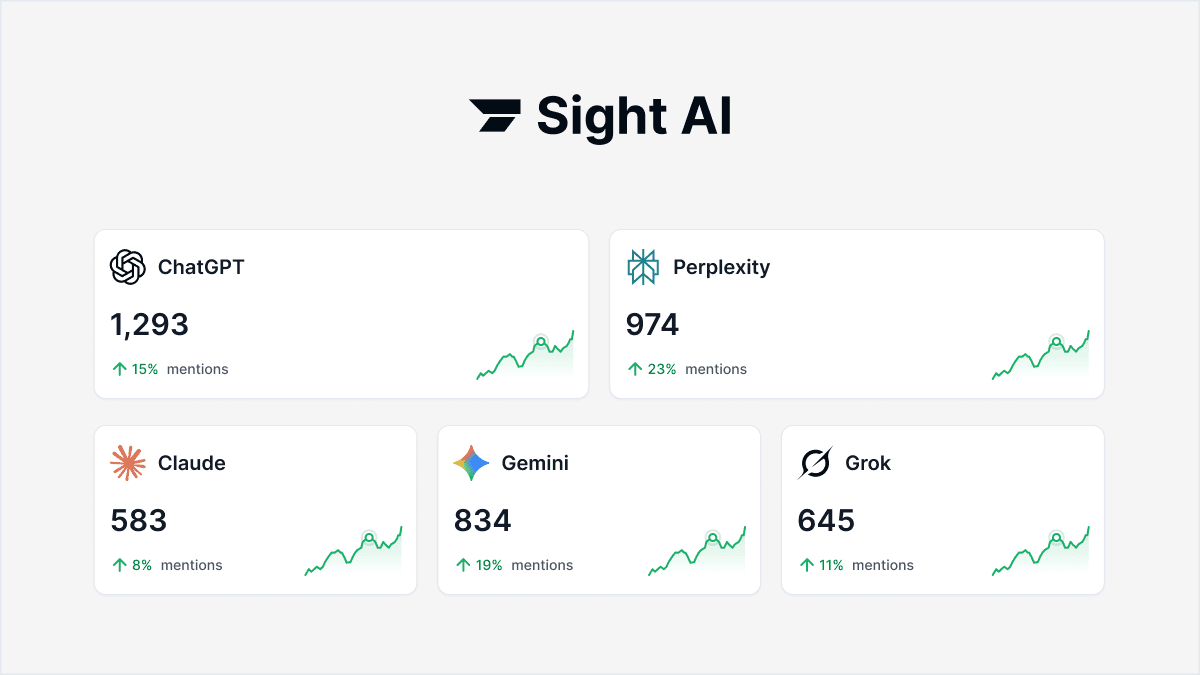
Key metrics to track include mention frequency—how often your brand appears in AI responses to relevant queries. This gives you a baseline understanding of your visibility. If you're mentioned in 15% of relevant AI responses while your main competitor appears in 60%, you have a clear gap to address.
Sentiment analysis matters because not all mentions are equal. Being mentioned negatively or in cautionary contexts obviously hurts more than it helps. Track whether AI models discuss your brand positively, neutrally, or with caveats. This helps you understand not just whether you're visible, but how you're being positioned.
Prompt coverage reveals which types of questions trigger your brand mentions and which don't. You might discover that AI models mention you consistently for implementation questions but never for strategic planning queries, or that you appear in technical comparisons but not in beginner-friendly recommendations. These gaps point directly to content opportunities.
Competitive share of voice shows your visibility relative to competitors. In traditional search, you might track keyword rankings against competitors. In AI search, you track mention share—what percentage of relevant AI responses include your brand versus competitor brands. This contextualizes your performance and helps you set realistic improvement targets.
Track changes over time to understand whether your GEO efforts are working. AI visibility can shift as models get updated, as new content gets published across the web, and as your own content and authority signals evolve. Regular monitoring helps you spot trends early—both positive momentum to accelerate and negative shifts to address. Reviewing the best GEO optimization tools available can help you select the right solution for your needs.
Implementation Roadmap: From Audit to Optimization
Building an effective generative engine optimization strategy requires a systematic approach. You can't optimize everything at once, and you can't improve what you don't understand. This three-phase roadmap takes you from baseline understanding to ongoing optimization.
Phase 1: Establish Your Baseline
Start by auditing your current AI visibility. Test relevant prompts across major AI platforms—ChatGPT, Claude, Perplexity, and others your audience uses. Don't just test your brand name directly. Test the questions your potential customers actually ask: "best marketing analytics platforms," "how to improve content ROI," "tools for tracking SEO performance." See which brands get mentioned. Track whether you appear at all, how you're described, and who else shows up in those responses.
Document everything systematically. Create a spreadsheet tracking prompts, platforms, whether you were mentioned, competitors that appeared, and the context of mentions. This baseline becomes your benchmark for measuring improvement. It also reveals your biggest gaps—the queries where competitors dominate and you're invisible. If you discover AI search engines are missing your website, you'll know exactly where to focus your initial efforts.
Phase 2: Target High-Impact Content Gaps
Analyze your baseline data to identify where you're losing visibility. Look for patterns. Are you missing from educational content queries? Do competitors get mentioned for specific use cases you also serve? Are you absent from comparison queries where you should be a clear option?
Prioritize content creation based on these gaps. If AI models never mention you for "beginner's guide" queries, create the definitive beginner's guide in your space. If you're absent from implementation questions, publish comprehensive how-to content. If you don't appear in comparison contexts, create detailed comparison resources that position your solution fairly alongside alternatives. Following proven AI search optimization strategies will accelerate your progress through this phase.
Focus on creating genuinely valuable content, not promotional material. AI models cite helpful resources, not sales pages. Your goal is to become the source that AI assistants naturally reference when they need authoritative information on your topics.
Phase 3: Monitor, Iterate, and Expand
Once you've addressed initial gaps, establish ongoing monitoring. AI visibility isn't static—it shifts as models get updated, as new content gets published, and as your competitors optimize their own presence. Regular tracking helps you maintain and improve your position.
Set up systematic testing schedules. Query AI platforms monthly with your core prompts to track visibility trends. Expand your prompt list as you identify new relevant queries. Watch for changes in how you're described—improvements in sentiment or context signal that your content and authority signals are working.
Iterate based on what you learn. If new content doesn't improve visibility for target queries, analyze why. Maybe the content needs more depth. Maybe it lacks the structured clarity that AI models need. Maybe you need stronger authority signals around that topic. Use visibility data to guide continuous improvement rather than treating GEO as a one-time project. Consulting a comprehensive GEO optimization best practices guide can help you refine your iterative approach.
Your Strategic Framework for AI Search Success
The shift from traditional search to AI-powered information discovery represents a fundamental change in how brands build visibility. The old playbook focused on rankings, click-through rates, and traffic. The new reality requires thinking about mentions, citations, and being the source that AI models trust enough to reference.
This doesn't mean abandoning SEO fundamentals. Strong technical foundations, quality content, and authoritative backlinks still matter—they support AI visibility just as they support traditional search performance. But they're no longer sufficient on their own. You need a deliberate generative engine optimization strategy that addresses how AI models evaluate, select, and cite sources.
The four pillars—content authority, structured clarity, brand signal strength, and technical accessibility—give you a framework for systematic improvement. Focus on creating comprehensive, well-structured content that demonstrates genuine expertise. Build your brand presence across authoritative sources that AI models reference. Ensure your content is technically accessible to AI systems. Do these things consistently, and your visibility improves.
Measurement makes the difference between random effort and strategic optimization. Without visibility tracking, you're guessing. You don't know if you're mentioned, how you're described, or where your biggest gaps are. With systematic monitoring, you can see exactly where you stand, track improvement over time, and identify the specific content and authority gaps holding you back.
The brands that will dominate the next era of search are the ones taking action now. They're tracking their AI visibility to understand their current position. They're creating content that AI models want to cite. They're building the authority signals that make AI assistants trust them as sources. They're measuring results and iterating based on data rather than assumptions.
The opportunity window is still open. Most companies haven't started thinking systematically about GEO. Most haven't even checked whether AI models mention them at all. This won't last. As more businesses recognize the importance of AI visibility, competition for mentions will intensify. The brands that establish strong AI presence now will be much harder to displace later.
Stop guessing how AI models like ChatGPT and Claude talk about your brand—get visibility into every mention, track content opportunities, and automate your path to organic traffic growth. Start tracking your AI visibility today and see exactly where your brand appears across top AI platforms. Understanding your current position is the first step toward building the AI visibility that will define your competitive advantage in the years ahead.