You've shortlisted three AI marketing automation platforms. The first one charges per seat. The second bills based on content volume. The third has a flat monthly fee but caps your features. All three claim they're "affordable" and "scalable," but none of them make it easy to predict what you'll actually pay six months from now.
This is the frustrating reality of AI marketing automation pricing in 2026. The landscape is fragmented, pricing models vary wildly between platforms, and what looks like a budget-friendly $49/month plan can balloon into hundreds of dollars once you hit your limits or need the features that actually matter.
Understanding how these platforms price their services isn't just about finding the cheapest option. It's about making an informed decision that aligns with your actual needs, prevents surprise bills, and delivers measurable ROI. This guide breaks down the common pricing structures, reveals what really drives your monthly costs, and gives you a framework for budgeting smartly—whether you're a solo founder testing the waters or an agency scaling your content operations.
Understanding the Three Core Pricing Models
AI marketing automation platforms typically use one of three fundamental pricing approaches, and knowing which model a tool uses tells you a lot about how costs will scale as your usage grows.
Per-Seat Pricing: This traditional SaaS model charges based on the number of users who need access to the platform. You'll see this frequently with collaboration-heavy tools where multiple team members need to create, review, or approve content. The advantage is predictability—adding a new team member means a clear, incremental cost increase. The downside is that you're paying for people, not output. If one power user generates 90% of your content while three others barely log in, you're still paying for all four seats.
Per-seat pricing makes the most sense for agencies with defined team structures or companies where content creation responsibilities are distributed across multiple roles. It becomes less attractive when you have fluctuating team sizes or when a small team produces high volumes of content.
Usage-Based Pricing: This model ties your costs directly to what you consume—whether that's articles generated, API calls made, or credits spent. Think of it like a utility bill: the more you use, the more you pay. Many AI content marketing automation platforms use this approach because it scales naturally with business growth and feels fair to customers who aren't maxing out the platform every month.
The challenge with usage-based pricing is predictability. If your content needs spike during a product launch or seasonal campaign, your bill spikes too. You need to monitor consumption carefully and understand exactly what counts as "usage"—does a regenerated paragraph consume credits? What about saved drafts you never publish? The fine print matters here.
Tiered Subscription Models: Most platforms land on tiered pricing as a middle ground—offering distinct packages (Starter, Professional, Enterprise) with set monthly fees and defined feature limits. Each tier typically bundles a certain number of articles, users, or features together. This approach gives you predictable monthly costs while offering clear upgrade paths as you grow.
The trade-off is that you might pay for capacity you don't use. If the Professional tier includes 50 articles per month but you only need 35, you're paying for 15 unused articles. Conversely, if you need 52 articles, you might get pushed into a much more expensive Enterprise tier just to exceed the Professional cap by two articles. Understanding where the tier boundaries sit relative to your actual needs is crucial.
The Real Cost Drivers Behind Your Monthly Bill
Beyond the pricing model itself, specific factors determine what you actually pay each month. These cost drivers often hide in the details until you're already committed to a platform.
Feature Access Levels: Basic automation features—like scheduling social posts or sending automated emails—typically sit in lower pricing tiers. But the AI capabilities that actually move the needle often live behind higher-priced plans. Advanced features like multi-model AI content generation, sentiment analysis, brand mention tracking across AI platforms, or sophisticated analytics dashboards frequently require premium tiers.
Here's where it gets tricky: vendors know which features drive conversions, so they strategically gate them. You might start with a basic plan only to realize that the AI visibility tracking or automated indexing you actually need costs three times more. Before committing, map your must-have features to specific pricing tiers to avoid surprise upgrades.
Content Volume and Output Limits: Whether measured in articles, words, API calls, or credits, volume caps are the most common constraint that forces upgrades. A platform might advertise "$99/month" but limit you to 10 articles. If you need 15 articles, you're suddenly looking at a $249/month tier.
Pay attention to how platforms count usage. Some charge per completed article regardless of length. Others count by word volume, meaning a 3,000-word guide costs more than a 500-word blog post. Still others use a credit system where different content types consume different amounts. A listicle might cost one credit while an in-depth explainer costs three. Understanding the math behind these limits prevents mid-month surprises when you hit your cap. Reviewing content automation platform pricing structures can help you compare these approaches.
Integration Requirements and Add-On Fees: The sticker price rarely tells the whole story. Many platforms charge extra for integrations with your existing tech stack—connecting to your CMS, analytics tools, or marketing automation platform. What looks like a $199/month plan becomes $299/month once you add Webflow auto-publishing, advanced API access, or premium support.
Watch for these common add-ons: white-label capabilities for agencies, priority customer support, additional user seats beyond the base package, API rate limit increases, custom integrations, and advanced reporting features. Some platforms bundle these into higher tiers; others charge à la carte. Either way, they impact your true monthly cost.
What You'll Actually Pay Across Different Tool Types
Pricing varies significantly based on what type of AI marketing automation you're buying. Understanding typical ranges helps you spot outliers and evaluate whether a platform's pricing is competitive.
AI Content Generation Platforms: Tools focused primarily on creating blog posts, articles, and marketing copy typically start in the $29-79/month range for individual plans with basic features and limited output. These entry-level tiers usually cap you at 5-15 articles per month and might restrict access to advanced AI models or features like SEO optimization.
Mid-tier plans, designed for small teams or agencies, typically range from $149-399/month. At this level, you're looking at 25-75 articles per month, access to multiple AI agents or writing styles, and better integration capabilities. Enterprise pricing for high-volume content operations often starts around $500/month and scales based on specific needs, with some platforms reaching $1,500+/month for unlimited or near-unlimited content generation with full feature access. You can explore AI content marketing software pricing to see detailed comparisons.
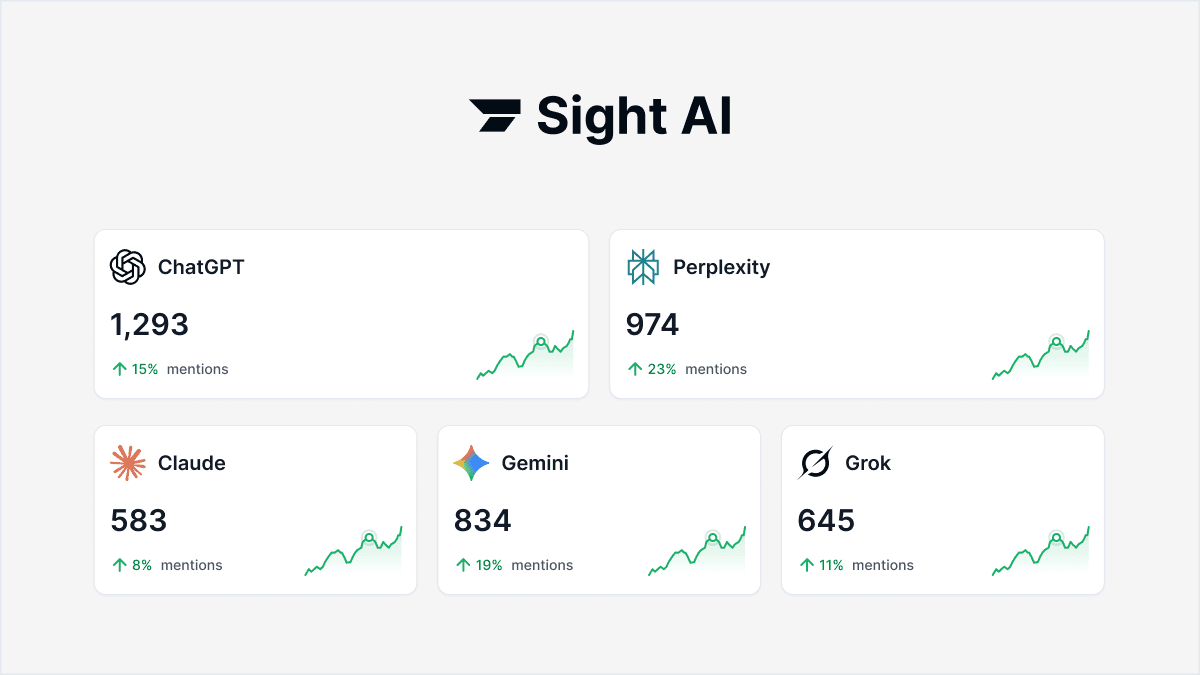
AI Visibility and Brand Monitoring Tools: Platforms that track how AI models like ChatGPT, Claude, or Perplexity mention your brand represent a newer category with less standardized pricing. Because this capability requires monitoring multiple AI platforms continuously and analyzing sentiment across thousands of prompts, costs tend to be higher than basic content tools.
Expect entry-level visibility tracking to start around $99-199/month for basic brand mention monitoring across a few AI platforms. More comprehensive solutions that track across 6+ AI models, provide sentiment analysis, prompt tracking, and competitive intelligence typically range from $299-599/month. The value proposition here is different from content generation—you're paying for continuous monitoring and insights rather than discrete content outputs.
All-in-One Platforms vs. Point Solutions: This is where budgeting gets strategic. You can either buy specialized point solutions for each need—one tool for content generation, another for visibility tracking, a third for indexing and SEO—or invest in an all-in-one platform that bundles multiple capabilities.
Point solutions typically cost less individually but add up quickly. Three separate tools at $99, $149, and $79/month total $327/month. An all-in-one platform offering equivalent functionality might cost $249-399/month while eliminating integration headaches and workflow fragmentation. The trade-off is flexibility—with point solutions, you can swap out individual tools without disrupting your entire stack. With all-in-one platforms, you're more locked in, but you gain efficiency and often better feature integration.
Calculating Real Value Beyond the Price Tag
The monthly subscription cost is just one piece of the ROI equation. Smart budgeting means understanding the total value delivered relative to what you're paying.
Time Savings and Productivity Gains: The most tangible ROI from AI marketing automation is time reclaimed. If you're currently spending 4-6 hours writing a single long-form article and an AI platform reduces that to 45 minutes of editing and refinement, you're saving 3-5 hours per article. At a typical marketing salary, that's $150-300 in labor cost savings per article.
Multiply that across 20 articles per month, and a $299/month platform that saves you 80 hours effectively pays for itself many times over. The key is measuring actual time savings in your workflow, not theoretical maximums. Track how long content creation takes before and after implementing AI tools to quantify this benefit accurately. Many AI content automation for marketing teams delivers these productivity gains consistently.
Content Quality and Performance Improvements: Beyond time savings, AI tools can improve content performance in ways that directly impact revenue. Content optimized for both traditional SEO and GEO (Generative Engine Optimization) has a better chance of appearing in AI-generated answers, which increasingly drive organic traffic.
If AI-optimized content helps you rank for three additional high-intent keywords that drive 500 monthly visitors each, and your conversion rate is 2%, that's 30 extra conversions per month. Even at a modest $100 customer lifetime value, that's $3,000 in monthly revenue—making a $399/month tool investment trivial by comparison. The challenge is attribution, but directional measurement is better than ignoring performance improvements entirely.
Hidden Costs That Eat Into ROI: Not all costs appear on the invoice. Onboarding time represents a real investment—if it takes your team 20 hours to learn a new platform, configure workflows, and integrate it with existing systems, that's significant. Some platforms offer white-glove onboarding; others leave you with documentation and hope.
Training costs matter too, especially for team-based tools. If three team members each spend 10 hours getting proficient, that's 30 hours of productivity lost during the learning curve. Workflow disruption during the transition period can temporarily slow content production before it accelerates. Factor these one-time costs into your first-year ROI calculation—they're real, even if they don't show up as line items on a bill.
Budgeting Smart for Your Team Size and Stage
The right pricing tier and platform choice depends heavily on where you are in your growth journey. What works for a solo founder looks very different from what an enterprise marketing team needs.
Solo Founders and Small Teams: When you're operating lean, every dollar counts. Start by identifying your absolute must-have features—the capabilities you cannot execute your content strategy without. For many solo founders, that's consistent content generation and basic SEO optimization. Nice-to-haves like advanced analytics, team collaboration features, or white-labeling can wait.
Look for platforms with generous entry-level tiers that don't artificially limit core functionality. A $79/month plan that gives you 15 high-quality articles with full feature access delivers more value than a $49/month plan that caps you at 5 articles and locks advanced features. Many platforms offer annual billing discounts of 15-25%—if you're confident in the tool after a trial, paying annually can save $150-300 per year. Our guide on content marketing automation for founders covers these considerations in depth.
For solo operators, all-in-one platforms often make more sense than cobbling together point solutions. Managing multiple subscriptions, integrations, and workflows becomes a tax on your time. A single platform that handles content generation, visibility tracking, and automated indexing might cost more than the cheapest content tool alone, but it eliminates integration complexity and context-switching overhead.
Growing Agencies: Agencies face a different challenge—scaling content production for multiple clients without costs spiraling out of control. Per-seat pricing becomes expensive quickly as your team grows. Usage-based pricing can work well if your monthly volume is relatively consistent, but client churn or seasonal fluctuations can make budgeting difficult.
Tiered plans with high volume caps often provide the best balance. A $399/month tier that includes 75 articles and 5 user seats might seem expensive compared to a $99 solo plan, but if you're producing content for 8-10 clients, the per-client cost is reasonable. Look for platforms that allow you to white-label output or create client-specific workspaces within a single subscription—this maximizes value without requiring separate subscriptions per client. Check out content marketing automation for agencies for specific strategies.
As you scale, negotiate. Once you're spending $400+/month consistently, many vendors will work with you on custom pricing, especially if you commit to annual contracts. Don't assume published pricing is final—agencies with proven usage patterns have leverage.
Enterprise Considerations: Enterprise teams typically need custom pricing regardless of published tiers. Your requirements—volume, security, compliance, custom integrations, dedicated support—exceed what standard plans offer. The question isn't whether to negotiate; it's how to structure the deal.
Request volume-based discounts if you're producing 100+ articles monthly. Ask about annual commit discounts for predictable long-term savings. Negotiate service-level agreements (SLAs) for uptime and support response times. Ensure the contract includes flexibility for your needs to scale—you don't want to renegotiate every time you add 20 articles to your monthly volume. Understanding enterprise content marketing automation requirements helps you ask the right questions.
Enterprise buyers should also evaluate total cost of ownership beyond the software subscription. Factor in integration costs with existing marketing automation platforms, analytics tools, and content management systems. Consider whether you'll need dedicated IT resources to maintain integrations or if the vendor provides managed integration support.
Making Your Final Decision
With pricing models decoded and cost drivers understood, you're ready to evaluate platforms systematically. Start by asking vendors these specific questions before you sign anything.
What exactly counts toward my usage limits? Get clarity on whether drafts, regenerations, or archived content consume your monthly allocation. Understand how word count limits work if applicable. Know whether team collaboration features like comments or reviews count against user seats.
What happens when I exceed my plan limits? Some platforms let you purchase additional capacity à la carte. Others automatically upgrade you to the next tier. Still others hard-stop your access until the next billing cycle. Knowing the overage policy prevents unpleasant surprises during high-volume months.
What's included in onboarding and support? Is there a dedicated account manager? Do you get white-glove setup assistance or just access to documentation? What's the expected response time for support tickets? Premium support often costs extra but can be worth it if you're betting your content strategy on the platform. Reading content marketing automation reviews can reveal what actual users experience with support quality.
Can I downgrade without penalty? Business needs change. Client churn happens. Make sure you can scale down if necessary without being locked into a higher tier for an extended period. Some contracts require 30-day notice for downgrades; others let you adjust at any billing cycle.
Build a comparison framework that weights factors based on your specific priorities. Create a simple spreadsheet with columns for pricing, features, usage limits, integrations, and support. Score each platform on a 1-10 scale for the factors that matter most to you. This removes emotional decision-making and helps you see which platform delivers the best value for your specific situation.
When to start with trials vs. committing to paid plans: If a platform offers a meaningful free trial—14 days with full feature access, not a neutered freemium version—use it. Test the actual workflows you'll run daily. Generate real content for your business. Measure time savings. Evaluate output quality. A trial that mimics real usage tells you more than any sales demo.
However, if the free trial is too limited to assess real value, consider starting with the lowest paid tier for one month. Treat it as a paid evaluation. The $79-99 you spend testing is cheap insurance against committing to an annual contract for a tool that doesn't fit your workflow. You can always upgrade if it works well; you can't easily recover time and money invested in the wrong platform.
Your Path to Smart AI Marketing Automation Investment
The right AI marketing automation investment isn't about finding the lowest price or the most features. It's about aligning cost with actual business value—the time you save, the content quality you gain, and the organic visibility you build over time.
Start with clarity on your non-negotiable needs. Understand which pricing model fits your usage patterns and growth trajectory. Calculate true ROI by factoring in time savings and performance improvements, not just the monthly subscription cost. And remember that the cheapest option often becomes expensive when it doesn't deliver results, while a higher-priced platform that drives measurable growth pays for itself many times over.
The AI marketing automation landscape will continue evolving, but the fundamentals of smart budgeting remain constant: understand what you're paying for, measure what you're getting, and adjust as your needs change. With the framework in this guide, you're equipped to evaluate platforms confidently and make decisions that support sustainable growth.
Stop guessing how AI models like ChatGPT and Claude talk about your brand—get visibility into every mention, track content opportunities, and automate your path to organic traffic growth. Start tracking your AI visibility today and see exactly where your brand appears across top AI platforms.