Something significant has shifted in how people find brands online. AI models like ChatGPT, Claude, and Perplexity are now answering the exact questions that used to funnel users through Google's search results page. A user asking "what's the best enterprise content management platform" or "which CRM integrates with Salesforce" no longer necessarily clicks through ten blue links. They read the AI's answer, trust the cited sources, and move on. For enterprise marketing teams, this creates a visibility gap that traditional SEO infrastructure was never built to address.
The tension is real. Most enterprise organizations have invested heavily in SEO tooling, technical audits, keyword tracking, and content operations built around Google's crawling and ranking signals. That infrastructure still matters. But it measures the wrong thing when it comes to AI-driven discovery. You can rank on page one for a target keyword and still be completely absent from the AI responses your prospects are actually reading. That absence is invisible to your current analytics stack.
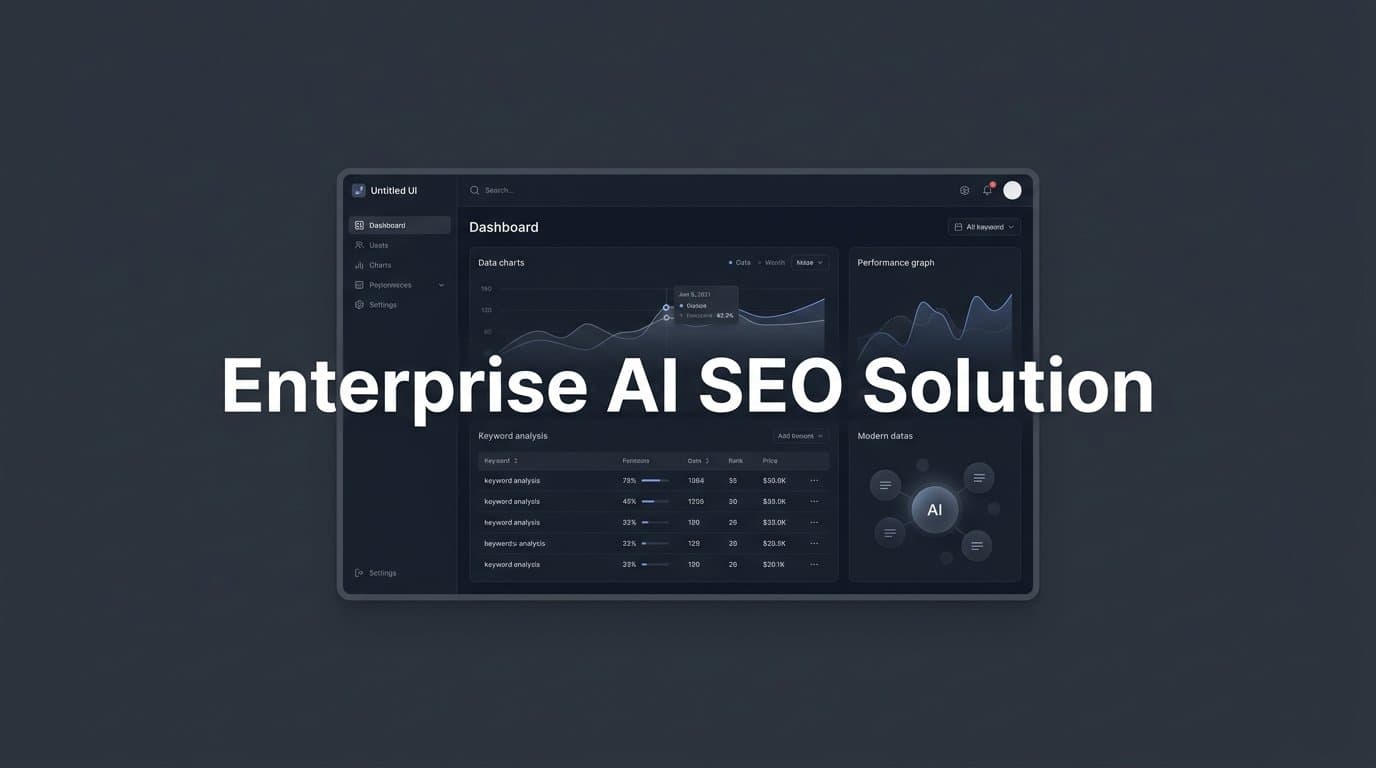
An enterprise AI SEO solution bridges both worlds. It combines traditional SEO capabilities with AI visibility tracking, GEO-optimized content generation, and automated indexing infrastructure. The result is a unified system that helps large organizations stay competitive across both conventional search results and the AI-generated answers increasingly shaping buyer behavior. This article breaks down exactly what these platforms do, how enterprise teams use them in practice, and what to look for when evaluating whether your current stack is ready for the AI search era.
Why Traditional Enterprise SEO Is No Longer Enough
For years, enterprise SEO success meant one thing: ranking well on Google. Page one visibility drove organic traffic, and organic traffic drove pipeline. The tools built around this model are sophisticated, capable, and deeply embedded in how large marketing organizations operate. The problem is that the model itself has changed.
AI-generated answers, including Google's AI Overviews, conversational responses from Perplexity, and the growing use of ChatGPT and Claude as research tools, have introduced a new layer of discovery that sits above traditional search results. When an AI model answers a question, it draws on its training data and retrieval systems to construct a response. The brands and sources it cites in that response receive visibility. The brands it ignores do not, regardless of where they rank in the SERP.
This creates a measurable gap that traditional SEO tools were never designed to capture. Keyword ranking reports tell you where you appear in a list of results. They do not tell you whether ChatGPT recommends your product when a prospect asks for category recommendations, or whether Claude cites your content when summarizing best practices in your industry. Those are distinct signals, and they require distinct measurement.
Enterprise teams face this challenge at a scale that compounds the problem. Managing thousands of URLs across multiple product lines, regional markets, and stakeholder groups is already operationally complex. Generic SEO tools handle this poorly. Crawl budget management becomes a real constraint when a site has tens of thousands of pages. Indexing delays between content publication and search engine discovery can stretch from days to weeks. Internal linking at scale becomes impossible to manage manually. These are known pain points at the enterprise level, and they directly affect how quickly new content can contribute to visibility.
The concept of AI visibility has emerged as a distinct metric that enterprise teams now need to track alongside traditional SERP performance. AI visibility refers to how prominently and positively a brand appears in AI model outputs. It is measurable through prompt-based monitoring: querying AI platforms with relevant prompts and tracking whether and how a brand is mentioned, what sentiment those mentions carry, and how a brand's share of voice compares to competitors in AI-generated responses.
This is not a replacement for keyword rankings. It is an additional signal layer that reflects a real change in how buyers discover and evaluate options. Enterprise organizations that treat AI visibility as a first-class metric are building a more complete picture of their actual search presence. Those that don't are operating with a blind spot that will only grow as AI-powered answer engines become more deeply embedded in how people research purchases.
The Core Components of an Enterprise AI SEO Solution
Understanding what an enterprise AI SEO solution actually does requires looking at its three core functional layers: AI visibility tracking, AI-powered content generation, and automated indexing infrastructure. Together, these components address the full lifecycle of enterprise content performance in an AI-driven search environment.
AI Visibility Tracking
This is the measurement layer. AI visibility tracking works by systematically querying AI platforms with prompts relevant to your brand, product category, and competitive landscape, then analyzing the responses. The goal is to understand whether your brand is being mentioned, in what context, with what sentiment, and how your share of voice compares to competitors across different prompt types.
Effective AI visibility tracking covers multiple platforms simultaneously. ChatGPT, Claude, Perplexity, and other AI models do not produce identical outputs. A brand might be prominently cited on one platform and entirely absent from another. Tracking only one AI model gives an incomplete picture of your actual AI-driven visibility. Enterprise platforms need coverage across at least the major AI answer engines to produce actionable data.
Sentiment analysis adds another dimension. Being mentioned is not the same as being recommended. A platform that tracks presence without context cannot tell you whether AI models are describing your product favorably, neutrally, or critically. Share-of-voice metrics that compare your AI mention frequency to named competitors provide the competitive context needed to prioritize content investments. Understanding how to conduct thorough competitor SEO research is essential for benchmarking your AI share of voice against the right rivals.
AI-Powered Content Generation at Scale
The second layer addresses the content production bottleneck that enterprise teams consistently face. Identifying content gaps is straightforward. Producing high-quality, optimized content at the volume needed to close those gaps is where most organizations stall.
Purpose-built AI content agents designed for SEO and GEO optimization can produce structured articles, listicles, explainers, and guides that satisfy both traditional crawler requirements and the patterns AI models use when selecting content to cite. This is not generic AI writing. It requires agents trained on content structure, internal linking logic, topical depth requirements, and the specific formatting signals that influence AI citation likelihood. Teams evaluating these capabilities should review how AI agents for SEO and marketing are reshaping content production workflows at scale.
Autopilot publishing modes take this further by enabling enterprise teams to configure content workflows that draft, optimize, and publish directly to their CMS without manual intervention at each step. This closes the gap between content strategy and content execution, which is one of the most persistent operational bottlenecks at enterprise scale.
Automated Indexing Infrastructure
The third layer ensures that content gets discovered quickly after publication. IndexNow is an industry-supported protocol backed by Microsoft Bing, Yandex, and others that allows websites to instantly notify search engines of new or updated content. Integrating IndexNow into a content publishing workflow eliminates the indexing lag that can otherwise delay organic traffic contribution by days or weeks.
At enterprise scale, where publishing volume is high and crawl budgets are finite, automated sitemap management becomes equally important. Keeping sitemaps accurate, updated, and properly structured ensures that crawlers can efficiently discover and prioritize new content. These are not glamorous capabilities, but they directly affect how quickly content investments translate into measurable visibility. Organizations looking to streamline this entire process should explore automated SEO workflow solutions that handle indexing management alongside content operations.
GEO vs. SEO: Understanding the Dual Optimization Layer
Generative Engine Optimization, or GEO, is the discipline of structuring content so that AI models are more likely to surface, cite, or recommend your brand in their responses. It is distinct from traditional SEO, which focuses on earning ranked positions in search engine results pages. Understanding the difference, and how the two interact, is central to building an effective enterprise AI SEO strategy.
Traditional SEO optimizes for crawlability, relevance signals, and ranking algorithms. The goal is a position in a list of results that a user then chooses to click. GEO optimizes for citation likelihood in AI-generated answers. The goal is to be the source an AI model references when constructing a response to a relevant query. These are different outcomes achieved through overlapping but not identical tactics.
The two disciplines are not in competition. Strong traditional SEO builds the foundation that AI models draw from. Technical health, crawlability, backlink authority, and structured data all contribute to how AI models perceive and weight a source. A site that is technically sound and well-linked is more likely to be indexed comprehensively, which increases the surface area available for AI model training and retrieval. In this sense, traditional SEO is a prerequisite for effective GEO, not an alternative to it.
GEO-specific tactics build on that foundation. Authoritative framing, meaning writing that demonstrates clear expertise and positions content as a definitive source on a topic, increases citation likelihood. Topical depth, publishing comprehensive, interconnected content across a subject area rather than isolated articles, signals to AI models that a source is authoritative on that domain. Structured data helps AI systems parse and understand content context more reliably.
For enterprise content teams, the practical implication is that publishing cadence, content architecture, and internal linking patterns all influence both SEO and GEO performance simultaneously. A content calendar designed only around keyword rankings will miss GEO opportunities. A content architecture that lacks internal linking will undermine topical authority signals that both Google and AI models use to evaluate source quality. A well-defined SEO content strategy that accounts for both ranking signals and AI citation patterns is essential for large sites navigating this dual optimization challenge.
The most effective enterprise content strategies treat SEO and GEO as a unified discipline with shared infrastructure and distinct measurement layers. The content itself serves both purposes when it is structured correctly. The difference lies in how you measure success: rankings and organic traffic on one side, AI visibility scores and prompt coverage on the other.
How Enterprise Teams Use AI SEO Solutions in Practice
The strategic case for enterprise AI SEO solutions is clear. The more interesting question is how these capabilities translate into day-to-day workflows for large marketing organizations. Three use cases define how enterprise teams are putting these platforms to work.
Content Opportunity Discovery Through AI Visibility Data
The most immediate application is using AI visibility data to identify content gaps. When prompt tracking reveals that AI models are answering questions in your product category without citing your brand, you have a specific, actionable content opportunity. The AI is already fielding the query. Your brand simply isn't in the answer.
This is more precise than traditional keyword gap analysis. Rather than identifying keywords where competitors rank above you, you are identifying the actual questions that AI models are answering with competitor citations instead of yours. The content you build to close those gaps is directly targeted at the mechanism driving your visibility deficit. A structured approach to SEO content planning that incorporates AI visibility data ensures those gaps are prioritized systematically rather than addressed opportunistically.
Enterprise teams that build a regular cadence of prompt monitoring can maintain a live content opportunity backlog derived from actual AI model behavior. This connects content strategy directly to AI visibility outcomes rather than relying on keyword volume estimates as a proxy for opportunity.
Autopilot Content Workflows
The bottleneck between content strategy and content execution is one of the most consistent frustrations in enterprise marketing. Teams can identify what needs to be written. Getting it written, reviewed, optimized, and published at the volume required to move visibility metrics is a different challenge entirely.
Autopilot content workflows address this by configuring AI agents to handle the production layer. An enterprise team can define content briefs, set optimization parameters, and establish publishing rules, then allow the system to draft, optimize, and publish content directly to their CMS without requiring manual intervention at each step. The human team focuses on strategy, quality review, and performance analysis rather than production execution.
This is particularly valuable for content types that follow predictable structures: category explainers, comparison guides, FAQ content, and listicles. These formats are high-value for both SEO and GEO purposes, and they are well-suited to systematic production at scale. Organizations looking to expand output without expanding headcount should explore how to scale SEO content production using automated workflows and AI-assisted publishing pipelines.
Performance Monitoring and Iteration Loops
The third use case is ongoing performance measurement. AI visibility scores, sentiment trends, and prompt coverage metrics need to be tracked over time to understand whether content investments are translating into increased AI model mentions. This is not a one-time audit. It is a continuous monitoring function.
Enterprise teams that establish regular reporting cadences around AI visibility data can identify which content categories are gaining traction in AI responses, which competitors are losing or gaining share of voice, and which prompts remain underserved. This feeds back into the content opportunity discovery process, creating a closed loop between measurement, strategy, and execution.
What to Look for When Evaluating an Enterprise AI SEO Platform
Not all platforms that claim to address enterprise AI SEO needs actually deliver on the full scope of the problem. Evaluating options requires asking specific questions about depth of coverage, pipeline completeness, and enterprise scalability.
Depth of AI model coverage: A platform that tracks mentions on one AI model provides limited value. Enterprise teams need visibility across multiple AI platforms because different models produce different outputs and serve different user behaviors. Ask specifically which models are covered, how frequently prompts are run, and whether the platform provides sentiment context alongside presence data. Knowing that your brand was mentioned is useful. Knowing whether it was mentioned favorably, neutrally, or critically, and how that compares to competitors, is what drives actionable decisions.
Content-to-indexing pipeline completeness: Many organizations end up stitching together separate tools for content generation, CMS publishing, and indexing management. This creates operational overhead and introduces delays at each handoff point. An enterprise AI SEO solution that handles content generation, CMS auto-publishing, automated sitemap management, and IndexNow integration within a single platform eliminates those friction points. When evaluating platforms, map out the full workflow from content brief to indexed page and identify where manual steps or tool switches are required. Reviewing enterprise AI SEO pricing structures alongside feature coverage helps teams assess total cost of ownership across integrated versus stitched-together stacks.
Enterprise scalability signals: Scalability means more than handling large URL sets. It means multi-user workflows with appropriate role and permission structures, CMS integrations that work with the platforms your organization actually uses, autopilot publishing modes that reduce manual intervention, and the ability to manage content strategy across large content estates without requiring a dedicated technical resource for each function. Ask vendors specifically how their platform handles organizations managing tens of thousands of URLs across multiple markets and stakeholder groups.
Prompt tracking granularity: The value of AI visibility tracking depends heavily on the quality of the prompt library used to query AI models. Generic prompts produce generic insights. Enterprise teams need platforms that allow custom prompt configuration aligned to their specific product categories, competitive landscape, and buyer journey stages. Ask how prompts are constructed, how frequently they are updated, and whether custom prompt sets are supported.
Platforms like Promptwatch, Profound, Peec, AirOps, and Writesonic address pieces of this problem. The more important evaluation question is whether a platform addresses the full scope in an integrated way, or whether it requires significant additional tooling to cover the complete enterprise AI SEO workflow.
The Bottom Line on Enterprise AI SEO
Enterprise AI SEO is not a replacement for traditional SEO. It is an evolution of it. The technical foundations that have always mattered, crawlability, indexing speed, backlink authority, content quality, remain foundational. What has changed is the measurement layer and the optimization targets that sit above those foundations.
Brands that treat AI visibility as a first-class metric alongside rankings and traffic are building a more complete picture of their actual search presence. They are also building the content infrastructure needed to compete in an environment where AI-generated answers increasingly shape how buyers discover and evaluate options. The organizations that will win organic and AI-driven traffic in 2026 and beyond are those that close the gap between traditional SEO infrastructure and the AI-driven discovery layer now, before that gap becomes a competitive disadvantage that is difficult to close.
The good news is that the path forward is clear. Audit your AI visibility baseline, fix your technical indexing foundation, and build content systematically against the gaps where AI models are answering questions in your category without citing your brand. An integrated enterprise AI SEO platform makes each of those steps faster and more actionable.
Stop guessing how AI models like ChatGPT and Claude talk about your brand. Start tracking your AI visibility today and see exactly where your brand appears across top AI platforms, identify the content opportunities your current stack is missing, and publish GEO-optimized content that gets your brand mentioned across AI search, all from a single platform.