Most SEO teams are running on a hamster wheel. Every week, someone is pulling keywords into a spreadsheet, briefing a writer, waiting on a draft, editing it, uploading it to the CMS, manually submitting it to Google Search Console, and then checking rankings in a separate tool. Repeat indefinitely. The work gets done, but it never compounds.
This is the core problem that end to end SEO automation solves. Not automating one task in isolation, but connecting every stage of the SEO workflow into a continuous pipeline where the output of each step automatically becomes the input of the next. No manual handoffs. No context-switching between five different tools. No bottlenecks waiting on a human to move something forward.
The difference between teams that scale organic growth and those that plateau often comes down to this: one group has built a self-running system, and the other is still doing everything by hand. And with AI-powered search now reshaping how users discover information, the stakes have never been higher. Brands need to optimize not just for Google's crawlers, but for the AI models that millions of users now query directly.
This article breaks down the five core stages of a fully automated SEO pipeline, explains why the order of operations matters, and gives you a practical framework for building or buying the stack that makes it work. Whether you're a solo founder, a growth marketer, or running an agency, this is the architecture you need to understand.
The Five Stages Every Automated SEO Pipeline Must Cover
Before you can automate anything, you need a clear map of what you're automating. A true end to end SEO automation system covers five sequential stages, and the word "sequential" is doing a lot of work here. These stages are not independent modules you can activate in any order. They are a chain, and breaking any link in that chain forces a human to step in and reconnect it manually.
The five stages are: discovery (keyword research and opportunity identification), content creation, technical optimization, indexing and distribution, and performance monitoring. Think of them as a conveyor belt. A keyword opportunity enters at Stage 1, moves through content production, gets technically optimized, gets published and indexed, and then its performance data feeds back into Stage 1 to inform the next round of discovery. The belt keeps moving.
Point-solution automation vs. true end-to-end automation: Most teams have already automated something. Maybe they use a tool to pull keyword data automatically, or they have a Slack notification when rankings drop. That is point-solution automation: a single task running on autopilot while everything around it remains manual. True end to end SEO automation is different. It means the output of Stage 1 automatically populates a content brief in Stage 2. The published content from Stage 2 automatically triggers sitemap updates in Stage 3. The indexed URL from Stage 4 automatically appears in the performance dashboard in Stage 5. Every handoff is machine-to-machine.
Why gaps break the loop: A gap between any two stages is where velocity dies. If your keyword research tool produces a list that someone has to manually copy into a content brief, you have a gap. If your CMS requires someone to click "publish" before the sitemap updates, you have a gap. Each gap introduces delay, human error, and a ceiling on how fast you can scale. Teams with three content producers and a tight pipeline will consistently outpublish teams with ten writers and a fragmented workflow.
The emerging sixth stage: AI visibility: Traditional SEO metrics track how your content performs in search engine results pages. But a growing share of search behavior is now happening inside AI interfaces like ChatGPT, Claude, and Perplexity. When a user asks one of these models a question relevant to your industry, does your brand get mentioned? With what sentiment? This is AI visibility, and it is becoming a distinct layer of the pipeline. Automated content that is indexed by Google but never referenced by AI models is leaving a significant and growing traffic source untapped.
Automating Discovery and Content Production
The first two stages are where most of the intellectual work of SEO traditionally lives, and they are also where automation delivers the most dramatic time savings. Let's look at each in turn.
Automated discovery means moving beyond manual keyword research. Modern tools can pull search volume data, cluster keywords by semantic similarity, run content gap analyses against competing domains, and map intent categories across an entire topical cluster, all without anyone opening a spreadsheet. The output is not just a list of keywords. It is a prioritized content roadmap, organized by opportunity size, intent type, and topical authority gaps.
Intent mapping is particularly important here. A keyword like "SEO automation tools" signals very different content requirements than "what is SEO automation." Automated systems can classify these intents and route them to the appropriate content format, which sets up the handoff to Stage 2 cleanly.
AI content agents and format specialization: Once a keyword brief is generated, AI content agents can take it from structured brief to fully drafted article. But not all content is the same, and the best automation systems account for this. A listicle requires a different structure than a technical explainer. A comparison guide has different SEO requirements than a how-to tutorial. Specialized agents trained on different content formats can produce drafts that match search intent at the structural level, not just the keyword level. This matters because search engines increasingly evaluate content quality based on how well the format matches what users expect to find.
The GEO layer: Here is where end to end SEO automation intersects with the future of search. GEO, or Generative Engine Optimization, is the practice of structuring content so that AI models are likely to cite or reference it when answering user questions. The factors that influence AI citation are meaningfully different from traditional ranking signals. Clear factual claims, well-structured headings, authoritative tone, and direct answers to the kinds of questions users ask conversational AI all increase the likelihood that your content gets surfaced in AI-generated responses.
This is not a separate content strategy. It is a layer that should be baked into the content production stage of your automation pipeline. When your AI content agents are generating drafts, they should be applying GEO principles by default: leading with direct answers, using structured headings that match question formats, and grounding claims in clear, citable logic. Content that satisfies both traditional search crawlers and AI model retrieval systems is the goal, and automation makes it possible to apply these standards consistently at scale.
The handoff from Stage 2 to Stage 3 should be seamless. A published draft should automatically enter a technical optimization queue, not sit in someone's inbox waiting for review.
Technical SEO on Autopilot
Technical SEO is the part of the pipeline that most teams automate last, usually because it feels less urgent than content production. That is a mistake. Technical gaps can quietly undermine everything upstream, and at scale, manual technical audits become practically impossible.
Automated internal linking: As a content library grows, maintaining a coherent internal linking structure manually becomes a losing battle. Every new article you publish creates new linking opportunities to and from existing content, but tracking those relationships by hand across hundreds of pages is not realistic. Automated internal linking systems analyze the semantic relationships between pages and either suggest or directly insert contextually relevant links. This improves crawlability by giving search engine bots clear pathways through your site, and it distributes page authority more effectively across your content graph. It also improves user experience, which search engines increasingly factor into quality assessments.
XML sitemap automation: Your sitemap should never be a static file that someone updates manually after a content sprint. Every time a new page is published, the sitemap should update automatically and be resubmitted to search engines without human intervention. This sounds basic, but a surprising number of teams are still managing sitemaps manually or relying on CMS plugins that update the file but do not trigger resubmission. In an automated pipeline, sitemap generation and submission are triggered events: publish a page, update the sitemap, notify the search engines. That sequence should happen in seconds, not days.
Crawl budget management: For larger sites, crawl budget is a real constraint. Search engine crawlers have a finite capacity for how many pages they will process in a given period. If your site is cluttered with low-value URLs, thin content pages, or parameter-heavy URLs that generate duplicate content, crawlers spend their budget on the wrong pages. Automation can help by maintaining clean URL structures, flagging and noindexing low-value pages, and ensuring that newly published high-priority content is surfaced prominently in the sitemap hierarchy. The goal is to make sure that when a crawler visits your site, it spends its time on the pages that matter most.
The technical optimization stage should operate largely invisibly. When it is working correctly, you should not have to think about it. New content gets published, internal links get updated, the sitemap refreshes, and crawlers find the right pages. The only time it should surface in your attention is when an automated audit flags an anomaly that requires a decision.
Automated Indexing and Content Distribution
Publishing a piece of content and having it indexed are two different events, and the gap between them is where many teams lose momentum. A page that is published but not yet indexed cannot rank. In a manual workflow, that gap can stretch from days to weeks depending on how frequently search engine crawlers revisit your site. In an automated pipeline, that gap should be measured in minutes.
The IndexNow protocol: IndexNow is an open-source protocol supported by Bing, Yandex, and other search engines that allows websites to instantly notify search engines the moment new or updated content is published. Instead of waiting for a crawler to rediscover your content on its own schedule, you send a direct signal: "This URL just changed. Come look at it now." Platforms that integrate IndexNow natively can trigger this notification automatically on publish, eliminating the indexing lag entirely for supported engines. For Google, the equivalent mechanism is the Indexing API, which provides similar functionality for certain content types.
CMS auto-publishing pipelines: In a fully automated system, content can move from draft to live to indexed without a human touching the publish button. The pipeline looks like this: an AI agent completes a draft, it passes through automated quality checks, it gets scheduled based on publishing cadence rules, it goes live at the designated time, and the indexing notification fires automatically. The key question for any team considering this level of automation is what safeguards to build in. Automated quality scoring, duplicate content checks, and minimum readability thresholds are all reasonable gates to include before content reaches the publish step. Automation does not mean abandoning quality standards; it means encoding those standards into the pipeline itself.
Complementary distribution signals: Beyond IndexNow and direct API submissions, automated pinging services and direct sitemap submissions to Google Search Console and Bing Webmaster Tools serve as reinforcing signals. None of these are redundant. Each one increases the probability that new content is discovered and processed quickly. In a competitive content environment, indexing speed is a genuine advantage. The team that gets indexed first has a head start on accumulating ranking signals.
Closing the Loop with Automated Reporting and AI Monitoring
A pipeline that runs automatically but reports manually is not truly closed. The final stage of end to end SEO automation is the one that makes the whole system self-correcting: automated reporting that feeds performance data back into Stage 1.
Automated SEO dashboards: The goal of automated reporting is a single view that surfaces what matters without requiring anyone to pull data manually. Rank tracking, organic traffic trends, click-through rates, engagement metrics, and crawl health indicators should all populate automatically from connected data sources. The key is not just aggregating data but surfacing actionable signals. A dashboard that shows you everything is not useful. A dashboard that alerts you when a high-value page drops in rankings, when a new content cluster is gaining traction, or when crawl errors spike is genuinely useful.
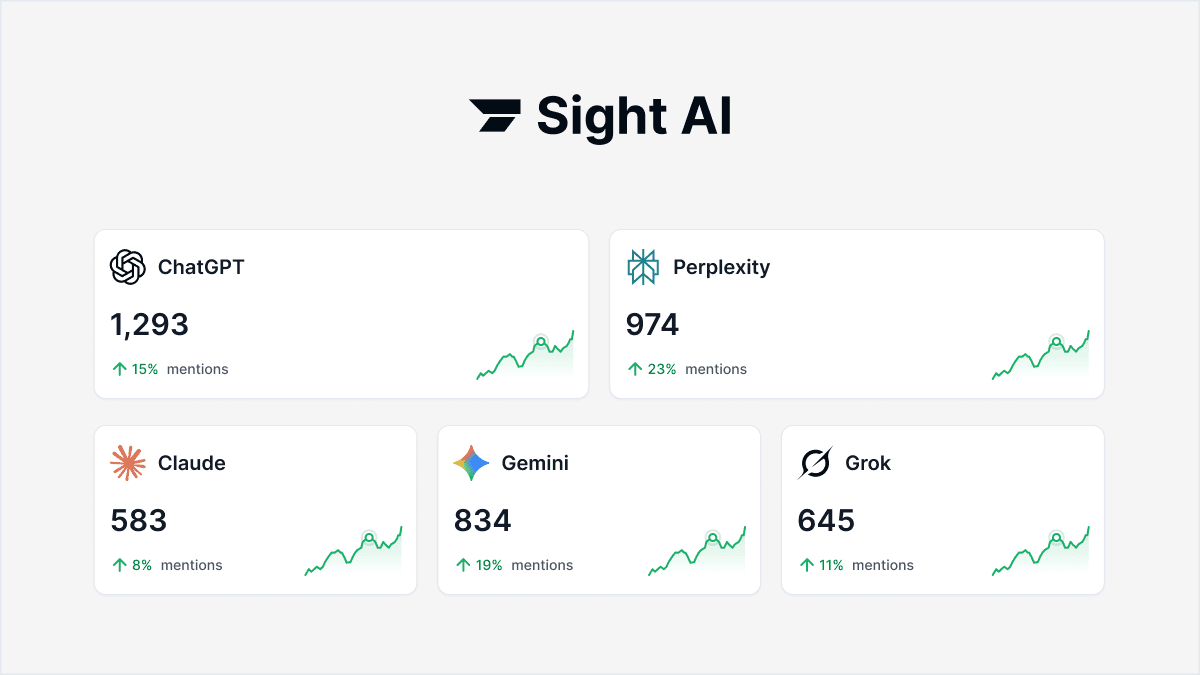
AI visibility monitoring as a distinct reporting layer: This is the part of the reporting stage that most teams are not yet tracking, and it is increasingly where competitive differentiation lives. Traditional SEO metrics do not capture how your brand is represented in AI-generated responses. When a user asks ChatGPT, Claude, or Perplexity a question relevant to your product category, is your brand mentioned? How often? With what accuracy and sentiment? These are the questions that AI visibility monitoring answers.
Sight AI's platform tracks brand mentions across major AI models, providing an AI Visibility Score alongside sentiment analysis and prompt tracking. This gives marketers and founders a clear picture of how their brand is perceived in the AI search layer, not just in traditional search results. As a growing share of discovery happens through conversational AI interfaces, this monitoring layer is moving from nice-to-have to essential.
Closing the feedback loop: Here is what makes Stage 5 the most strategically important stage in the pipeline: it should talk back to Stage 1. Underperforming content, identified automatically through rank drops or traffic declines, should trigger a content refresh workflow. New keyword opportunities surfaced by the reporting layer should automatically populate the discovery queue. Pages with strong engagement signals should inform the topical direction of future content clusters. When this feedback loop is functioning, the pipeline becomes genuinely self-improving. It does not just execute a strategy; it refines the strategy over time based on real performance data.
Building vs. Buying: Assembling Your Automation Stack
Once you understand the five-stage pipeline, the practical question becomes: do you build it yourself or buy a platform that covers it for you? Both paths are viable, but they carry very different cost profiles.
The DIY approach and its hidden costs: Stitching together a custom automation stack using APIs, workflow tools, and individual point solutions is technically possible. You might connect a keyword research API to a content briefing tool, hook that into an AI writing service, pipe the output into your CMS via webhook, trigger IndexNow through a custom script, and pull reporting data into a dashboard. Each individual integration might work well. The problem is maintenance. Every time one tool updates its API, changes its data structure, or discontinues a feature, your pipeline breaks. Someone has to fix it. That someone is usually a developer or a technically skilled marketer who could be doing higher-value work. The true cost of the DIY approach is not the initial build; it is the ongoing maintenance burden.
Minimum viable stacks by team size: For a solo founder or small agency, the priority should be automating the highest-friction stages first. Content production and indexing typically offer the fastest return on automation investment. A tool that can move from keyword to published, indexed article with minimal manual intervention will compound quickly. For larger teams, the priority shifts toward closing the feedback loop: connecting performance data back to the discovery stage so the pipeline becomes self-directing rather than just self-executing.
Common failure points to avoid: Automation without quality controls is the most common way end to end SEO automation goes wrong. Publishing thin, duplicate, or factually unreliable content at scale is worse than publishing slowly. The solution is to build quality gates into the pipeline itself: automated readability scoring, duplicate content detection, and AI-powered fact-checking agents that flag issues before content goes live.
The second failure point is neglecting the AI visibility layer. Teams that automate their traditional SEO pipeline but ignore how their content performs in AI-generated responses are optimizing for a shrinking share of total search behavior. The brands that win in the next phase of search will be those that have connected discovery through to AI visibility monitoring in a single, coherent system.
All-in-one platforms like Sight AI address this by combining AI visibility tracking, automated content generation with 13+ specialized AI agents, and instant indexing via IndexNow integration in a single platform. This eliminates the integration maintenance problem entirely and ensures that all five stages of the pipeline are connected by design rather than by duct tape.
Putting It All Together
End to end SEO automation is not a magic button that replaces SEO strategy. It is the infrastructure that allows a good strategy to scale without scaling headcount alongside it. The teams winning in organic search right now are not necessarily the ones with the biggest content budgets or the most experienced writers. They are the ones who have connected discovery through to performance monitoring in a single, self-correcting loop, and who have built the AI visibility layer into that loop from the start.
The five-stage pipeline covered in this article gives you the architecture. Discovery feeds content production. Content production feeds technical optimization. Technical optimization feeds indexing and distribution. Indexing and distribution feed performance monitoring. And performance monitoring feeds back into discovery. Every stage connected, every handoff automated, every output becoming the next input.
The brands that will dominate search over the next few years are those that treat AI visibility as a first-class metric alongside traditional rankings and traffic. That means tracking not just where you rank on Google, but how often ChatGPT recommends you, what Claude says about your product category, and whether Perplexity is citing your content when users ask the questions you want to own.
Stop guessing how AI models like ChatGPT and Claude talk about your brand. Start tracking your AI visibility today and see exactly where your brand appears across top AI platforms, uncover content opportunities your competitors are missing, and automate your path to organic traffic growth with a platform built for the way search actually works now.