If you've ever pulled up two different SEO tools to evaluate a domain and wondered why the scores look nothing alike, you're not alone. Domain Authority from Moz and Domain Rating from Ahrefs are two of the most widely cited metrics in SEO, yet they measure slightly different things, update on different schedules, and can produce dramatically different numbers for the exact same website.
That gap causes real problems. Marketers and agencies use these scores to decide which sites are worth pursuing for backlinks, guest posts, or partnerships. Founders lean on them to benchmark their own site's progress. When you don't understand what each number actually represents, you risk building your link strategy on a shaky foundation, overpaying for placements on sites that look authoritative on paper but deliver no ranking benefit, or dismissing high-quality opportunities because the score doesn't match your expectations.
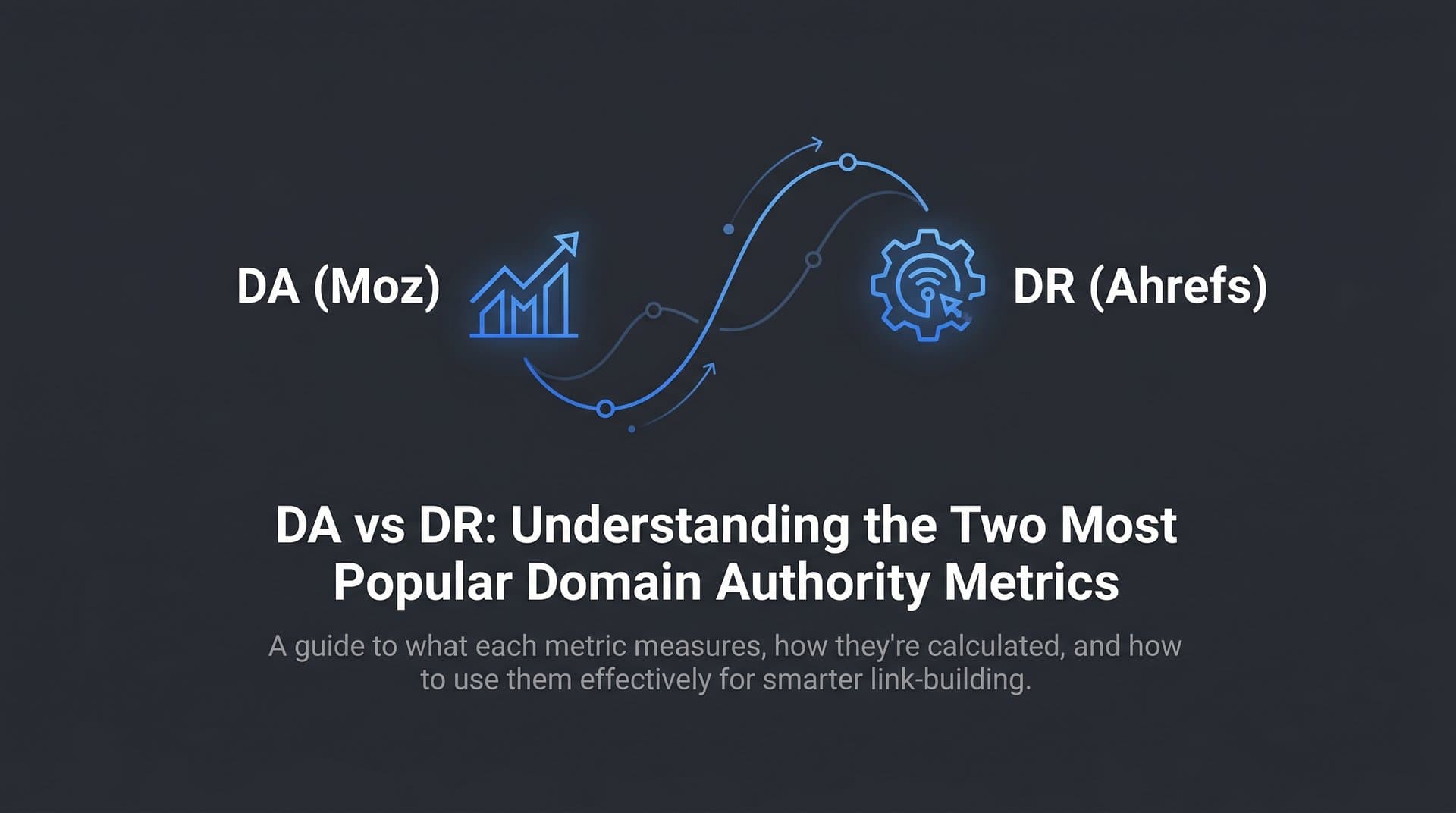
This guide breaks down DA vs DR side by side: where each metric comes from, how it's calculated, where each one shines, and where each one falls short. By the end, you'll know exactly when to reach for DA, when to use DR, and why neither score tells the whole story in a search landscape increasingly shaped by AI.
Where DA and DR Actually Come From
Before you can use these metrics intelligently, you need to know who built them and why. They didn't come from Google. They came from two competing SEO software companies with different tools, different data, and different goals.
Domain Authority (DA) is a metric developed by Moz, one of the oldest names in the SEO industry. Moz introduced DA around 2010 as a way to give SEOs a single, digestible number representing how likely a domain is to rank in search engine results. The score runs on a 0 to 100 logarithmic scale, meaning it becomes progressively harder to improve your website ranking as you move up the range. Moving from a DA of 20 to 30 is far easier than moving from 70 to 80.
Moz updated the metric significantly with the release of DA 2.0 in early 2019, incorporating a neural network and improving the system's ability to detect spam links. The underlying data comes from Moz's Link Explorer, their web crawler and backlink index.
Domain Rating (DR) is Ahrefs' proprietary equivalent. Where Moz built DA to approximate ranking probability, Ahrefs built DR to measure the raw strength of a website's backlink profile. DR also runs on a 0 to 100 logarithmic scale, but the calculation is more narrowly focused on the quantity and quality of unique domains linking to a site, weighted by how those linking domains distribute their own link equity.
Ahrefs maintains one of the largest backlink indexes in the industry and updates DR frequently, which is one reason many SEO professionals consider it a more current snapshot of a site's link profile.
Here's the critical point that trips up a lot of marketers: neither DA nor DR is a Google ranking factor. Google's own representatives, including John Mueller, have stated clearly and repeatedly that Google does not use third-party domain authority scores in its ranking algorithms. These metrics are proxy scores, created by tool companies to help SEOs benchmark and compare domains in the absence of direct access to Google's internal signals.
That doesn't make them useless. It means you need to understand what they actually measure rather than treating them as a stand-in for "how Google sees this site." Think of DA and DR the way you'd think of a credit score from two different agencies: both give you a useful signal, both use different models to calculate it, and neither is the final word on whether someone will approve your loan.
How Each Score Is Calculated (And Why They Diverge)
The reason the same domain can show a DA of 45 and a DR of 62 isn't a glitch or a sign that one tool is wrong. It's a natural result of fundamentally different methodologies. Understanding the calculation logic helps you interpret the gap without panic.
How Moz calculates DA: Moz's approach is broader and more prediction-oriented. DA factors in multiple signals, including the total number of inbound links, the number of unique linking root domains, MozRank (which measures link popularity), and MozTrust (which measures how close a domain is to trusted seed sites in the link graph). These inputs feed into a machine-learning model that Moz has trained against actual Google search results. The goal is to produce a score that correlates with real-world ranking performance across a wide range of queries.
Because DA is calibrated against SERP data, it attempts to capture something closer to "ranking potential" rather than just "link volume." A site with fewer but highly trusted links from editorially rigorous sources might score higher than a site with thousands of low-quality links. Understanding how to measure SEO success requires looking beyond any single metric.
How Ahrefs calculates DR: DR is more focused and, in some ways, more transparent. Ahrefs calculates DR based primarily on two factors: the number of unique referring domains pointing to a site, and how those referring domains distribute their outbound links. The logic is rooted in link equity dilution. A link from a site that links to only five other domains passes more equity than a link from a site that links to five thousand. DR weights these contributions accordingly and aggregates them into a single score.
Because Ahrefs' crawler is particularly aggressive and its backlink index is extensive, DR often reflects changes in a site's link profile faster than DA does. New backlinks tend to show up in Ahrefs' data more quickly, which means DR can move more responsively when you're actively building links.
Why the scores diverge: The divergence comes down to four factors. First, Moz and Ahrefs have different crawlers that discover different links. Second, their indexes are different sizes, so each tool has visibility into a different slice of the web's link graph. Third, their update frequencies differ. Fourth, and most importantly, they're measuring related but distinct things: DA is trying to predict ranking ability, while DR is measuring backlink profile strength. A site can have a strong backlink profile (high DR) without necessarily ranking well for competitive terms, and a site with a more modest link profile might rank effectively due to content quality and topical relevance (higher relative DA).
When you see a significant gap between a site's DA and DR, that gap is often telling you something useful. It might indicate that the site has many links but limited SERP presence, or that the site ranks well despite a thinner link profile. Both scenarios are worth investigating before you decide whether a site is worth pursuing.
Strengths, Weaknesses, and Common Misuses
Every metric has a job it does well and situations where it misleads you. Knowing the boundaries of DA and DR prevents the most expensive mistakes in link-building and site evaluation.
Where DA performs best: DA's core strength is its SERP-correlation model. Because Moz trained it against real ranking data, DA tends to be a reasonable predictor of whether a domain is competitive in search results. This makes it particularly useful when you're vetting guest post targets and want to know whether a placement will actually move the needle for your own rankings. It's also the metric most familiar to PR professionals and content marketers who may not live inside SEO tools daily, which makes it useful for client reporting through SEO reporting tools for agencies.
Where DA falls short: DA's main weaknesses are index size and update frequency. Moz's link index is smaller than Ahrefs', which means DA can miss recent links and may not reflect the current state of a site's backlink profile as quickly. Before the DA 2.0 update, the metric was also more susceptible to spam link inflation, where a site could artificially boost its score with low-quality links. The 2019 update improved this, but it's a reminder that any metric can be gamed if someone is motivated to try.
Where DR performs best: DR's strength is its raw backlink data. Ahrefs' massive index and frequent updates make DR the go-to metric for competitive backlink analysis, link gap audits, and tracking your own link-building progress over time. If you want to know whether a competitor is acquiring links faster than you, or which domains are linking to them but not to you, DR-based analysis in Ahrefs is typically the sharper instrument.
Where DR falls short: A high DR doesn't guarantee high organic traffic or strong ranking performance. A site can accumulate many backlinks from authoritative domains and still struggle to rank if its content is thin, its technical SEO is poor, or it's targeting keywords with misaligned intent. DR tells you about link strength, not about the full picture of why a site does or doesn't rank.
The most common misuses: The biggest mistake is treating either score as an absolute measure of site quality. A DA of 60 doesn't mean a site is trustworthy, relevant to your niche, or worth a partnership. Similarly, a DR of 30 doesn't mean a site is low-value, especially in a niche where the entire competitive landscape sits in the 20 to 40 range.
Another common error is comparing DA and DR scores as if they're on the same scale. They're not. A site with a DA of 50 and a DR of 50 is not equally "authoritative" by two different measurements. The scales are calibrated independently, and cross-tool comparisons are only meaningful when you're consistently using one metric across the domains you're comparing.
When to Use DA vs DR in Your SEO Workflow
Knowing the theory is one thing. Knowing which metric to pull up in a given situation is what actually saves you time and improves your decisions. Here's a practical framework.
Reach for DA when: You're evaluating potential ranking competitiveness for a target keyword and want to understand whether the sites currently ranking have strong SERP-predictive authority. DA is also the right choice when you're vetting guest post targets for impact on your own rankings, since its SERP-correlation model is designed for that kind of evaluation. If you're reporting to clients who are already familiar with the Moz ecosystem, DA is the language they'll understand without needing a translation.
Reach for DR when: You're conducting a backlink gap analysis and need to understand which domains are linking to competitors but not to you. DR is also the better metric when you're auditing your own link-building progress over time, since Ahrefs' frequent updates give you a more current picture of how your profile is growing. When you're comparing the raw link authority of competing domains in a specific niche, DR's backlink-focused calculation gives you a cleaner apples-to-apples comparison of link strength.
The best practice: use both. The most effective approach treats DA and DR as complementary signals rather than competing alternatives. When evaluating a potential link-building target, check both scores. If a site has high DR but low DA, investigate why: it may have many links but limited organic visibility, which could signal a content quality issue or a penalty. If a site has high DA but lower DR, it may be ranking on the strength of older, trusted links that haven't grown much recently.
Cross-reference either metric with actual organic traffic data and keyword rankings for a complete picture. Learning how to track keyword rankings alongside authority scores gives you a far more reliable evaluation. A site with a DA of 55 and 200,000 monthly organic visitors is a very different proposition from a site with a DA of 55 and 3,000 monthly visitors. The score alone doesn't tell you that. Tools like Ahrefs' organic traffic estimates or Semrush's traffic analytics add the dimension that DA and DR can't provide on their own.
Think of it like evaluating a job candidate. DA is like their academic record: a structured prediction of future performance based on historical signals. DR is like their professional network: a measure of how well-connected they are. You'd want to know both before making a decision, and you'd still want to interview them before signing an offer.
Authority Signals in the Age of AI Search
Here's where the conversation around domain authority gets more interesting, and more urgent, for marketers planning their strategies in 2026 and beyond.
AI-powered platforms like ChatGPT, Claude, and Perplexity are changing how users discover brands, products, and information. When someone asks an AI assistant for a recommendation or explanation, the response surfaces content based on training data quality, topical relevance, and source credibility. These systems don't check DA or DR before deciding whether to reference your brand. They surface content that demonstrates genuine expertise and authority on a topic.
This is the core idea behind GEO, or Generative Engine Optimization, which is emerging as a discipline alongside traditional SEO. Where traditional SEO focuses on ranking in Google's blue links, GEO focuses on ensuring your content, brand, and expertise show up when AI models generate answers. The signals that drive AI visibility are closely related to the signals that drive genuine domain authority: consistent, well-structured content, clear topical focus, and credible sourcing. Building a strong content marketing strategy is essential for both traditional and AI-driven discovery.
The practical implication is that building real topical authority through quality content doesn't just improve your DA and DR over time. It also increases the likelihood that AI platforms will reference your brand in relevant conversations. Knowing how to optimize content for SEO and AI visibility simultaneously is becoming a critical skill. These goals are aligned, not competing.
What's new is the measurement layer. Traditional SEO gives you keyword rankings and organic traffic data to track your progress. AI visibility requires a different kind of monitoring: tracking how AI platforms mention your brand, what sentiment surrounds those mentions, and which prompts are surfacing your competitors but not you. This is territory that DA and DR don't cover at all.
For marketers serious about authority building in this environment, tracking your AI visibility alongside your traditional domain metrics gives you a more complete picture of where your brand stands and where the content gaps are.
Putting It All Together
DA and DR are not rivals. They're different instruments measuring related but distinct dimensions of a domain's authority, and the smartest SEO strategies use both rather than picking a side.
Stop fixating on a single number. A well-rounded authority strategy looks at DA for SERP-predictive benchmarking, DR for backlink profile analysis, organic traffic data for real-world performance validation, and keyword rankings for competitive context. Each layer adds information the others can't provide.
And as AI search continues to reshape how users discover content, add AI visibility to that stack. Knowing how ChatGPT, Claude, and Perplexity reference your brand, what topics they associate you with, and where your competitors are being mentioned instead of you is the next frontier of authority measurement.
The brands winning in organic search over the next few years won't be the ones with the highest DA or DR. They'll be the ones building genuine topical authority through consistent, well-optimized content that earns trust from both traditional search engines and AI platforms.
Start tracking your AI visibility today and see exactly where your brand appears across top AI platforms. Sight AI helps marketers monitor brand mentions across ChatGPT, Claude, Perplexity, and more, uncover content gaps your competitors are filling, and generate SEO and GEO-optimized articles that build the kind of genuine authority both DA and DR reflect over time.