You're reviewing two competitor websites side by side. Both are in the same industry, targeting similar keywords, and publishing content at roughly the same pace. Yet one consistently dominates the first page of search results while the other lingers on page two or three. What's the difference? If you've ever found yourself in this situation, there's a good chance someone in the room pointed to Domain Authority as the answer.
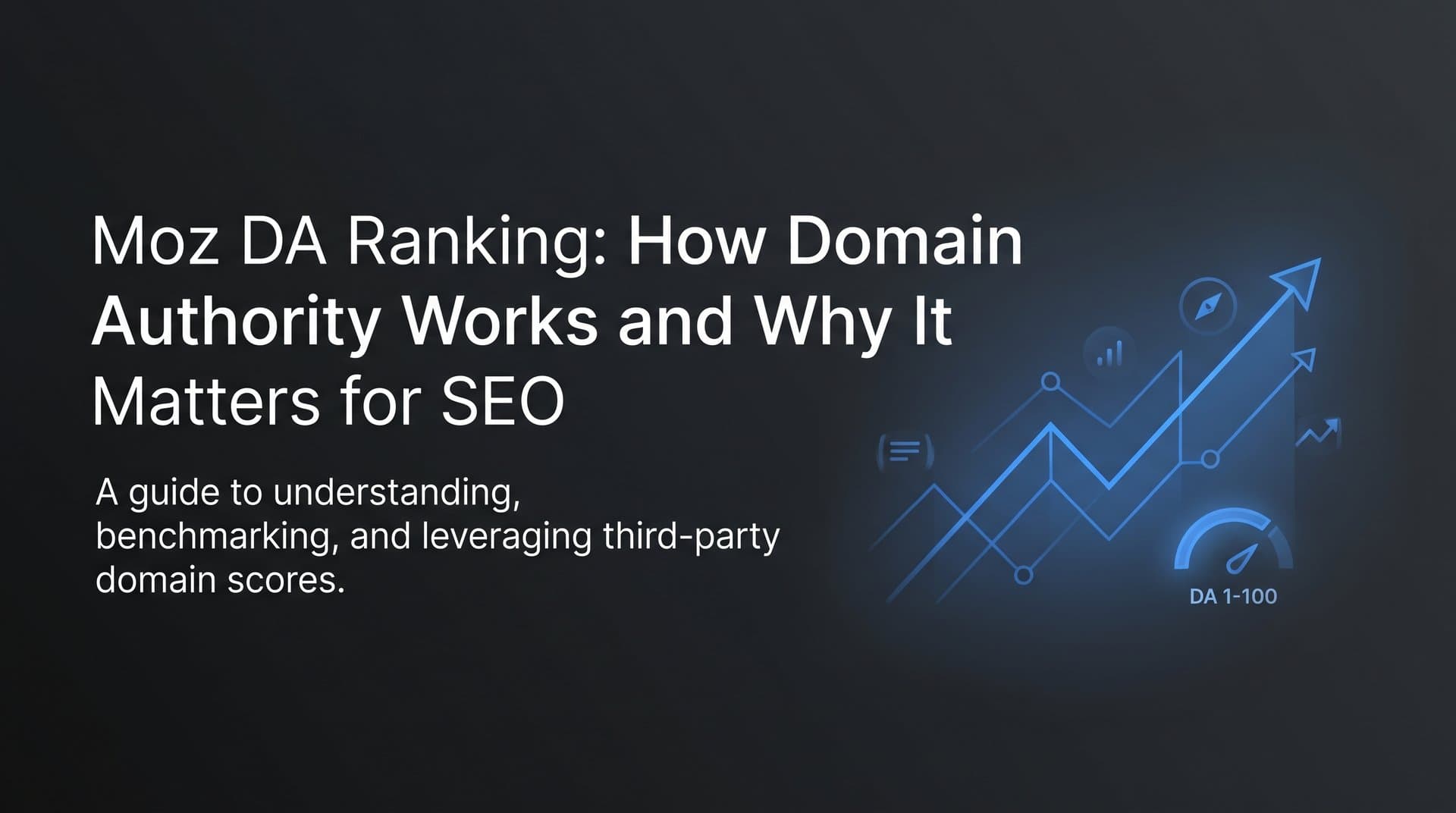
Moz's Domain Authority (DA) is one of the most widely referenced third-party metrics in SEO. It promises to distill the complex, messy world of backlinks and site credibility into a single number between 1 and 100, giving marketers a quick read on how competitive a domain is likely to be in search results. For many teams, it's become a default benchmark for evaluating link-building progress, qualifying outreach targets, and sizing up the competition.
But DA is also one of the most misunderstood metrics in the industry. Marketers chase it like a KPI, panic when it drops, and sometimes treat it as though Google itself uses the score to rank pages. None of that is accurate. This article breaks down exactly how Moz DA ranking works, what constitutes a meaningful score in your specific context, where the metric falls short, and how to use it strategically alongside the visibility metrics that are reshaping SEO in 2026, including AI search presence.
The Engine Behind the Score: How Moz Calculates Domain Authority
Domain Authority isn't a simple formula. It's a machine learning model, trained to predict the probability that a given domain will rank competitively in search engine results pages. Moz built it to approximate the kind of link-based authority signals that search engines use internally, and the output is a score on a 1 to 100 logarithmic scale.
That logarithmic scale is worth pausing on, because it changes everything about how you interpret progress. On a linear scale, moving from 20 to 30 and moving from 70 to 80 would represent equal effort. On a logarithmic scale, the higher you climb, the exponentially harder each additional point becomes. Getting from DA 20 to DA 30 might take a few months of consistent link building. Getting from DA 70 to DA 80 could take years of sustained, high-quality effort at significant scale. If you're setting improvement targets without accounting for this, you're setting yourself up for frustration.
So what actually goes into the score? Moz pulls data from its Link Explorer web index and feeds several key signals into the model:
Linking Root Domains: The number of unique domains pointing to your site. This is generally weighted more heavily than raw link count, because 500 links from 500 different domains is a stronger signal than 500 links from one domain.
Total Backlink Count: The overall volume of inbound links, including multiple links from the same domain. While not as impactful as unique linking domains, it still contributes to the model.
MozRank: A link popularity score that measures the quality and quantity of links pointing to a page or domain, similar in concept to Google's original PageRank.
MozTrust: A score that measures how closely a domain is connected to trusted seed sites, like major government or educational domains. It reflects the trustworthiness of your link neighborhood, not just the volume.
One critical thing to understand: DA is a comparative, relative metric. Every score exists in relation to all other scores in Moz's index. When Moz updates its algorithm or refreshes its link index, scores across the board can shift simultaneously. If your DA drops by three points after a Moz update, that doesn't necessarily mean your site got worse. It may simply mean the index recalibrated, and your score shifted relative to the new baseline.
This is why treating a DA change in isolation can be misleading. Always look at whether your score moved relative to your competitors. If your DA dropped from 45 to 42 but your top competitors dropped from 50 to 46, your relative position may be unchanged or even improved. Understanding how to leverage SEO ranking data in context tells you a great deal more than any single number.
What Counts as a Good DA Score (And Why Context Matters)
Here's the question every marketer eventually asks: "Is our DA good enough?" The honest answer is that it depends entirely on who you're competing against.
DA benchmarks vary dramatically by industry, niche, and competitive landscape. A DA of 30 might be genuinely competitive in a narrow B2B vertical where most players are small businesses with modest link profiles. In that same environment, a DA of 30 could give you a real edge. But in a broad consumer category dominated by major publishers, media outlets, and established e-commerce brands, a DA of 30 might place you well outside the competitive range for most target keywords.
This is why chasing an arbitrary number, like "we want to hit DA 50 by Q4," often misses the point. The more useful question is: what is the DA range of the domains currently ranking for the keywords I'm targeting? Conducting thorough SEO competitive research helps you identify the actual authority gap you need to close, not some industry-agnostic benchmark.
The logarithmic scale also has practical implications for goal-setting. Consider where you're starting from:
DA 1 to 20: New or low-authority domains. Improvement here is relatively fast with consistent effort. Even a handful of quality backlinks can move the needle meaningfully.
DA 20 to 40: Growing domains with some established link equity. Progress requires sustained link building and content investment, but gains are still achievable within a reasonable timeframe.
DA 40 to 60: Mid-tier authority. You're competing with established players. Growth slows and requires higher-quality links from more authoritative sources.
DA 60 and above: High-authority territory. Incremental gains require significant ongoing investment in digital PR, original research, and high-volume link acquisition from top-tier domains.
Set your targets based on your current range and your competitive landscape. A realistic 6-month goal for a DA 25 site is not the same as a realistic goal for a DA 55 site, and conflating the two leads to either underperformance or wasted resources.
One more nuance worth noting: a single DA score represents the entire domain. It doesn't tell you how individual pages are performing, which keywords you're likely to rank for, or whether your content strategy is aligned with search intent. A high DA site with weak content can still lose to a lower DA site with highly relevant, well-optimized pages. The score is a starting point for competitive analysis, not a verdict.
DA vs. Google's Actual Ranking Factors: Separating Myth from Reality
Let's address the most persistent misconception about Moz DA ranking directly: Google does not use Domain Authority as a ranking signal. Not even a little bit.
Google's John Mueller has confirmed this on multiple occasions. DA is a third-party metric created by Moz, based on Moz's own link index and proprietary algorithm. Google has its own internal systems for evaluating site authority and link quality, and those systems are entirely separate from anything Moz publishes. When you improve your DA, you are not directly improving your standing with Google. You may be improving the underlying factors (like link quality and domain credibility) that influence both DA and Google rankings, but the DA number itself is not what Google sees or responds to.
This distinction matters because it changes how you prioritize your SEO work. If you optimize purely for DA, you might focus heavily on link acquisition while neglecting factors that Google actually weighs heavily:
Content Quality and Search Intent: Google's systems are increasingly sophisticated at evaluating whether a page genuinely answers the query it's targeting. Understanding what search intent means in SEO is essential, because a high-DA domain with thin, misaligned content will still lose to a lower-DA competitor with a more relevant, comprehensive page.
Core Web Vitals and Page Experience: Google has formally incorporated page experience signals into its ranking systems. Load speed, interactivity, and visual stability affect rankings in ways that DA simply doesn't capture.
On-Page Optimization: Title tags, structured data, semantic relevance, heading hierarchy, and internal linking all influence how Google understands and ranks individual pages. DA says nothing about any of these.
E-E-A-T Signals: Experience, Expertise, Authoritativeness, and Trustworthiness are concepts Google uses to evaluate content quality, particularly in sensitive categories. These are assessed at the content level, not just the domain level.
The right mental model for DA is this: it's one data point in a broader SEO performance dashboard. It can help you quickly assess competitive positioning, qualify link prospects, and track the general trajectory of your link-building efforts. But it should never be the headline metric for your SEO program. Teams that optimize for DA in isolation often end up with strong link profiles and mediocre organic traffic because they've neglected the content optimization strategies that actually drive rankings.
Use DA as a compass, not a destination.
Practical Strategies to Improve Your Moz DA Ranking
With the right expectations set, improving your DA is a legitimate goal because the activities that raise your score tend to reflect genuine improvements in your site's authority and link profile. Here's how to approach it systematically.
Earn High-Quality Backlinks Through Original Content: The most durable way to build domain authority is to create content that other sites genuinely want to link to. Original research, proprietary data, industry surveys, and comprehensive guides attract natural links because they provide unique value that other content can reference. A single link from a DA 70 industry publication will move your score more than dozens of links from low-authority directories. Focus on relevance and authority of linking domains, not just volume.
Invest in Digital PR: Proactively pitching original data, expert commentary, and newsworthy content to journalists and industry publications is one of the fastest ways to earn high-authority backlinks at scale. When your brand becomes a cited source in your industry, your link profile improves in quality and diversity simultaneously.
Audit and Disavow Toxic Links: Not all backlinks help you. Links from spammy, low-quality, or irrelevant domains can dilute your link profile and, in some cases, signal manipulative link patterns to search engines. Use Moz Link Explorer to regularly audit your backlink profile, identify toxic or suspicious links, and submit a disavow file to Google for links you can't remove manually. Keeping your link neighborhood clean is as important as building new links.
Strengthen Internal Linking: A well-structured internal linking architecture distributes link equity across your site more effectively, helping important pages build authority over time. Ensure your most valuable content is linked from multiple relevant pages, and avoid orphaned pages that receive no internal links. This won't directly spike your DA, but it improves how link equity flows through your domain, which the model picks up over time.
Fix Technical SEO Foundations: Crawlability, site speed, mobile optimization, and proper indexing all affect how search engines (and Moz's crawler) interact with your site. Investing in search engine indexing optimization ensures your site is easier to crawl, index, and link to. Broken pages, redirect chains, and crawl errors can suppress the effective value of your existing backlinks. Conduct regular technical audits and address issues before they compound.
Be Patient and Consistent: DA improvement is not a campaign, it's a program. The sites with the highest DA scores have typically been building authority consistently over years, not months. Set quarterly benchmarks, track your keyword rankings alongside DA, and focus on the inputs (link quality, content value, technical health) rather than obsessing over the output score week to week.
Beyond DA: Why AI Visibility Is the Next Authority Metric
Domain Authority was built for a search landscape where Google was the dominant gateway to information. Users typed a query, Google returned ten blue links, and authority metrics like DA helped predict which domains would appear in those results. That model still exists, but it's no longer the whole picture.
AI-powered search interfaces like ChatGPT, Claude, and Perplexity are reshaping how users discover information and brands. Instead of scanning a list of links, users are asking conversational questions and receiving synthesized answers. In these interactions, the "authority" that matters isn't just which domain has the most backlinks. It's which brand gets mentioned, cited, and recommended by the AI model itself. Understanding the AI search engine ranking factors that drive these citations is becoming essential for forward-thinking marketers.
This creates a new visibility gap that traditional metrics like DA simply don't address. A brand can have a respectable DA score and strong Google rankings while being completely absent from AI-generated responses on the topics it cares about most. Conversely, a brand that consistently appears in AI answers gains exposure to users who may never click a traditional search result at all.
AI visibility, which means tracking whether and how AI models reference your brand, is becoming a critical complement to domain authority for measuring true online presence. The signals that influence AI mentions are different from pure link authority: they include content depth and relevance, structured data, brand consistency across the web, and the quality of information available about your brand in the sources AI models draw from. Learning how to approach AI SEO optimization helps you capture this emerging channel.
A combined strategy that builds domain authority through strong backlinks and technical SEO, while also optimizing for AI mentions through GEO-optimized content and structured data, creates a more resilient organic growth engine. These two approaches reinforce each other: the authoritative content that earns backlinks and raises your DA is often the same content that gets referenced by AI models. The difference is in how deliberately you optimize for both outcomes.
For marketers and founders building long-term organic strategies, tracking AI visibility alongside DA gives you a more complete picture of where your brand actually stands in the modern discovery landscape.
Putting It All Together
Moz DA ranking is a genuinely useful metric when you understand what it is and what it isn't. It's a predictive, comparative score that reflects the strength of your domain's link profile relative to other sites in Moz's index. It's not a Google ranking factor, it's not a measure of content quality, and it's not a standalone indicator of SEO health. Used correctly, it's an excellent benchmarking tool for competitive analysis and link-building strategy.
The most effective approach is to use DA as one signal among many. Compare your score against direct competitors, set realistic improvement targets based on your current range and the logarithmic scale, focus on the underlying activities (quality backlinks, technical SEO, original content) that move the score for the right reasons, and resist the temptation to treat any single number as the definitive measure of your site's authority.
And as AI search continues to reshape how users discover brands, extend your visibility strategy beyond traditional metrics. Knowing your DA is valuable. Knowing how ChatGPT, Claude, and Perplexity talk about your brand is increasingly essential.
Start tracking your AI visibility today and see exactly where your brand appears across top AI platforms. Sight AI gives you the tools to monitor brand mentions across AI models, uncover content opportunities, and publish SEO and GEO-optimized articles that build authority across both traditional and AI-driven search channels. Because in 2026, the brands that win are the ones visible everywhere their customers are looking.