If you've ever typed "Ahrefs domain authority equivalent" into a search bar, you're in good company. Marketers switching between SEO tools, agencies onboarding new clients, and founders trying to benchmark their sites against competitors all run into the same wall: different platforms use different metrics, and it's not always obvious how they relate to each other.
The confusion usually starts with Moz's Domain Authority (DA). It's been around long enough that many marketers treat it as the universal standard for measuring a website's strength. Then they open Ahrefs and find Domain Rating (DR) instead. Same scale, different name, different methodology. Is it the same thing? Close enough to swap? Or fundamentally different in ways that actually matter for your strategy?
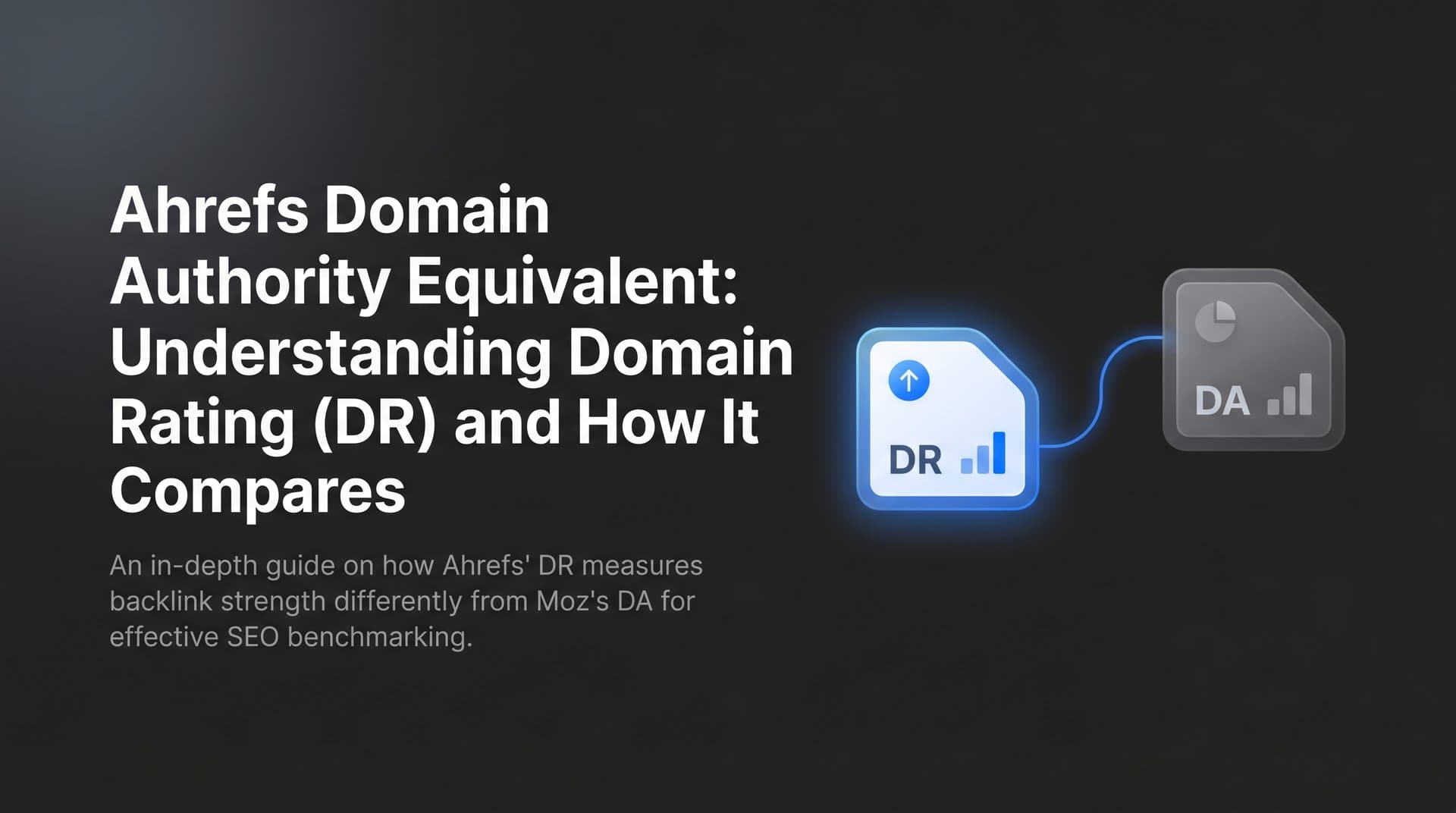
The short answer: DR is Ahrefs' proprietary equivalent to Moz's DA, but the two metrics are calculated differently and tell you slightly different things about a site's backlink profile. Understanding those differences isn't just an academic exercise. It changes how you interpret competitive analysis, evaluate link prospects, and build a measurement framework that connects authority metrics to real SEO outcomes. And increasingly, it shapes how you think about brand visibility in a world where AI-powered search tools are changing how people discover and evaluate brands.
Let's break all of it down.
Why Ahrefs Created Its Own Authority Metric
Here's something that surprises many marketers: Domain Authority is not a universal SEO standard. It's a proprietary metric created and owned by Moz. When Ahrefs built its platform, it didn't license DA or adopt it as a benchmark. Instead, it developed its own metric, Domain Rating, designed around the specific signals Ahrefs' crawler collects and the methodology its team believes best represents backlink profile strength.
Domain Rating measures the strength of a website's backlink profile on a 0-to-100 logarithmic scale. The core focus is on linking root domains: how many unique websites point to the target domain, how authoritative those linking sites are, and how that link equity is distributed across the web. A site with thousands of backlinks from a handful of high-DR domains will score differently than a site with the same number of links spread across low-quality sources.
This is worth pausing on because it clarifies what DR is actually measuring. It's not a holistic quality score for the entire website. It's specifically a backlink profile metric. Content quality, user experience, technical health, and topical relevance are not inputs into the DR calculation. Those factors matter enormously for SEO, but they're measured separately. Understanding how to measure SEO success requires looking well beyond any single authority number.
One of the most important things to understand about both DR and DA is what they are not: Google ranking factors. Google has publicly confirmed it does not use any third-party authority score in its ranking algorithm. DR and DA are third-party approximations, built by SEO tool companies to help marketers make comparative judgments about site strength. They're useful for that purpose, but treating them as direct proxies for Google's own assessment of a site is a mistake.
Think of DR and DA like credit scores from different bureaus. Both try to assess the same underlying reality using their own models and data sources. A site with a DR of 65 in Ahrefs won't necessarily have a DA of 65 in Moz. The numbers aren't interchangeable, but both are trying to answer a similar question: how strong is this site's link profile relative to others?
For SEO practitioners, this means DR is most useful as a relative benchmark within the Ahrefs ecosystem. When you're prospecting for link building targets, evaluating competitors, or assessing the authority of a potential guest post site, DR gives you a fast, consistent signal to work with. Just don't mistake it for a Google-endorsed quality seal.
Domain Rating vs. Domain Authority: The Differences That Change Your Analysis
Both DR and DA operate on a 0-100 scale, which makes them look interchangeable at first glance. But the methodologies underneath are meaningfully different, and those differences affect how you interpret the numbers.
Moz's Domain Authority uses a machine-learning model that incorporates multiple link-related signals: MozRank (a measure of link equity), MozTrust (which evaluates the trustworthiness of linking sites based on proximity to known trusted seed sites), spam analysis, and the overall link profile composition. The model is trained to correlate with Google search rankings, which means it's trying to predict ranking potential rather than purely describing the backlink profile.
Ahrefs' Domain Rating takes a more focused approach. It's built primarily around two inputs: the number of unique referring domains pointing to a site, and the DR of those linking domains, adjusted for link equity dilution. Link equity dilution is the key concept here. If a high-DR site links to 500 other domains, the link equity it passes to each of those domains is divided across all 500. A site that receives a link from a domain pointing to only 10 other sites gets more concentrated link equity than one receiving a link from a domain pointing to thousands.
This methodological difference has practical consequences. A site can have a relatively high DR but a lower DA if it has accumulated links from a concentrated set of high-authority domains but lacks the broader trust signals Moz's model evaluates. Conversely, a site with a diverse, clean link profile touching many trusted domains might score well in DA while having a more modest DR if some of those linking domains are spreading their link equity thinly. Agencies managing multiple clients often rely on SEO reporting tools for agencies to track both metrics side by side.
When DR is the better tool: Backlink analysis and link building campaigns. Because DR is built specifically around referring domain quality and equity distribution, it's the more precise instrument when you're evaluating link prospects, auditing your own backlink profile, or comparing the link strength of competing pages.
When DA is worth consulting: Broader site quality assessments and cross-platform comparisons. If you're working with clients or stakeholders who are already familiar with DA benchmarks, or if you're using Moz's suite of tools for keyword research and site audits, DA provides a consistent reference point within that ecosystem.
The practical takeaway: don't try to directly convert DR scores to DA scores or treat them as equivalent numbers. Use each metric within the context of the tool it comes from, and when comparing sites across platforms, look at the relative positioning within each metric rather than the absolute numbers.
How Ahrefs Calculates Domain Rating: The Mechanics Explained
Understanding the DR calculation mechanics helps you use the metric more intelligently and avoid common misinterpretations. Here's how it actually works.
Ahrefs starts by crawling the web and cataloging backlinks pointing to every domain in its index. For a given target domain, it identifies all unique referring domains: the distinct websites that have at least one link pointing to the target. The total count of unique referring domains is a primary input, but the raw number alone doesn't determine DR. What matters is the quality of those referring domains, which is measured by their own DR scores.
This creates a recursive relationship. A high-DR site linking to your domain contributes more to your DR than a low-DR site does. But the contribution is also adjusted for how many other domains that linking site points to. A DR 80 site that links to 10 other domains passes more concentrated link equity than a DR 80 site that links to 10,000 other domains. Ahrefs factors this dilution into the calculation, which is why earning links from sites with focused, selective linking practices is generally more valuable than earning links from sites that link out to everyone.
The logarithmic scale is the other critical piece to understand. On a linear scale, moving from DR 20 to DR 30 would require the same incremental effort as moving from DR 70 to DR 80. That's not how DR works. The logarithmic scale means that each point of improvement at the higher end of the scale requires exponentially more high-quality backlinks than the same improvement at the lower end. Going from DR 20 to DR 30 is achievable with a focused link building campaign over several months. Going from DR 70 to DR 80 is a multi-year effort requiring consistent acquisition of links from genuinely authoritative, high-DR sources.
DR is also a dynamic metric, not a static snapshot. Ahrefs continuously recrawls the web, and DR updates as new links are discovered, existing links are removed, and the DR of linking domains changes. This means your DR can drop even if you haven't lost any links directly. If several sites that link to you experience a decline in their own DR, your score can decrease as a downstream effect. Ensuring search engines can efficiently discover your content through proper crawl budget optimization is a foundational step that supports the link equity flow DR depends on.
For practical link building, this mechanics knowledge translates into clear priorities: focus on earning links from a growing number of unique referring domains with high DR scores, and prioritize domains that link selectively rather than promiscuously. Quality and diversity of referring domains will move your DR more reliably than chasing raw backlink volume.
Beyond DR and DA: Other Authority Metrics Worth Knowing
DR and DA get most of the attention, but they're not the only authority metrics available to SEO practitioners. Understanding the broader landscape helps you build a more complete picture of competitive positioning.
Ahrefs URL Rating (UR): While DR measures domain-level backlink strength, UR operates at the page level. It evaluates the link equity pointing to a specific URL rather than the entire domain. UR is particularly useful when analyzing why a specific page ranks well or when assessing the link strength of individual pieces of content you're competing against. A page with a modest DR site can still have a high UR if it's attracted a concentrated set of high-quality links.
Majestic Trust Flow and Citation Flow: Majestic's dual-metric approach separates link quality from link quantity. Citation Flow measures the volume of links pointing to a site, while Trust Flow evaluates the quality and trustworthiness of those links based on proximity to a curated set of seed sites. The ratio between the two metrics can reveal whether a site has a healthy link profile (high Trust Flow relative to Citation Flow) or a potentially spammy one (high Citation Flow, low Trust Flow). Majestic's index is particularly strong for historical link data.
Semrush Authority Score: Semrush's metric combines backlink data with organic search traffic signals and spam detection. Because it incorporates traffic data alongside link signals, Authority Score can sometimes surface discrepancies that pure link metrics miss: a site might have strong links but poor organic performance, or vice versa. Monitoring your keyword rankings alongside authority scores helps you spot these disconnects early.
Relying on any single authority metric is a common and costly mistake. Each metric reflects the data and methodology of its source tool, and each has blind spots. Using two or three metrics in combination gives you a more reliable signal when evaluating link prospects or benchmarking competitors.
Here's where the landscape is genuinely shifting: none of these traditional metrics capture brand visibility in AI-powered search. When someone asks ChatGPT, Claude, or Perplexity which tools to use for backlink analysis or which brands are most trusted in a given category, the answer isn't determined by DR or DA. It's shaped by the breadth and quality of content about your brand across the web, the consistency of your brand mentions in authoritative sources, and how AI models have indexed information about your products and expertise. Understanding brand authority in LLM responses is becoming essential for any complete competitive analysis.
This is a new dimension of authority that traditional metrics simply weren't built to measure. Tracking how AI models represent your brand, which prompts surface your competitors but not you, and where you have opportunities to improve your AI visibility is becoming as important as monitoring your DR and DA scores. Both dimensions matter, and a complete authority strategy needs to address both.
Practical Ways to Improve Your Domain Rating and Overall Authority
Understanding DR is useful. Knowing how to improve it is what actually moves the needle. Here are the strategies that consistently drive domain-level authority growth.
Earn links from high-DR referring domains through original research and data-driven content. The most reliable way to attract links from authoritative sites is to publish content those sites want to reference. Original research, proprietary data, comprehensive industry surveys, and unique analysis give other sites a reason to link to you specifically. Generic content that covers the same ground as hundreds of existing articles earns few organic links. Content that introduces new data or a genuinely differentiated perspective earns citations from sites that value accuracy and depth. A well-defined content marketing strategy is the backbone of this approach.
Prioritize unique referring domains over total backlink volume. DR is driven by the number and quality of unique domains pointing to your site, not the raw count of backlinks. A hundred links from a single domain contributes far less to your DR than a hundred links from a hundred different high-DR domains. Your link building strategy should focus on expanding the number of distinct referring domains, particularly from sites in the DR 50-plus range.
Invest in digital PR and brand mentions. Earning coverage in industry publications, news outlets, and authoritative blogs generates exactly the kind of high-DR, unique referring domain links that move your score. Digital PR campaigns built around compelling data, expert commentary, and newsworthy product developments can generate a concentrated burst of high-quality links that would take years to accumulate through traditional outreach alone.
Build topical authority through comprehensive content coverage. Publishing well-researched, comprehensive content across the full depth of your topic area signals expertise to both search engines and AI models. Learning how to build topical authority for AI is especially critical as AI-powered search reshapes discovery. This attracts natural links over time and improves the likelihood that AI systems will reference your brand when answering relevant questions.
Get your technical SEO foundations right before focusing on link building. Proper indexing, clean site architecture, and strategic internal linking are prerequisites for authority growth. If Googlebot and other crawlers can't efficiently access and understand your content, the link equity you earn won't flow where it needs to. Ensure your sitemap is current and submitted, your internal linking connects related content logically, and your pages are indexable before investing heavily in external link acquisition.
From Domain Metrics to Real SEO Results: Building a Measurement Framework That Works
Domain Rating and Domain Authority are directional indicators. They're useful for comparative analysis and link strategy, but they are not the goal. The actual objectives are organic traffic growth, keyword rankings, and increasingly, brand visibility in AI-powered search.
A measurement framework that only tracks DR or DA is missing most of the picture. Here's how to build one that connects authority metrics to business outcomes.
Start with authority metrics as your baseline. Track DR (in Ahrefs) and, if you're using Moz, DA alongside it. Monitor the number of unique referring domains and the DR distribution of those domains. A centralized SEO performance dashboard makes it far easier to visualize these trends over time and spot inflection points early.
Layer in ranking and traffic data. Authority metrics should correlate with improvements in keyword rankings and organic traffic over time. If your DR is climbing but your traffic isn't, there's a disconnect worth investigating: your content may not be targeting the right keywords, your technical SEO may have issues, or you may be earning links that aren't passing equity effectively. Diagnosing these gaps is central to understanding how to increase organic traffic beyond just building links.
Add AI visibility tracking as the third layer. This is where the measurement framework becomes forward-looking rather than just descriptive. AI-powered search tools like ChatGPT, Claude, and Perplexity are increasingly influencing how users discover brands, evaluate options, and make decisions. Brands that appear prominently in AI responses to relevant queries have a meaningful advantage that traditional authority metrics don't capture.
Tracking which prompts surface your brand, how AI models describe your products and expertise, and where competitors appear but you don't reveals a new category of content and authority opportunities. The brands that will compound their advantage over the next several years are those optimizing for both traditional search and AI platforms simultaneously, not treating them as separate strategies.
Putting It All Together
Ahrefs' Domain Rating is the direct functional equivalent of Moz's Domain Authority: a 0-100 scale metric designed to represent the strength of a website's backlink profile. But the two metrics use different methodologies, weight different signals, and shouldn't be treated as interchangeable numbers. DR is built around unique referring domain quality and link equity distribution; DA incorporates broader trust and spam signals through a machine-learning model. Each is most useful within the ecosystem of the tool that produces it.
Neither metric is a Google ranking factor, and neither should be treated as a vanity number to chase for its own sake. They're tools for competitive analysis, link prospecting, and tracking the effectiveness of your authority-building efforts over time. Used correctly, they help you make smarter decisions about where to earn links, which competitors to benchmark against, and how your site's authority profile is evolving.
The bigger picture, though, is that authority measurement is expanding. Traditional link-based metrics are necessary but no longer sufficient for understanding your brand's competitive position. AI-powered search is creating a new dimension of visibility that requires its own tracking and optimization strategy.
Stop guessing how AI models like ChatGPT and Claude talk about your brand. Get visibility into every mention, track content opportunities, and automate your path to organic traffic growth. Start tracking your AI visibility today and see exactly where your brand appears across top AI platforms.