Your Google Analytics dashboard is lying to you. Not intentionally, but by omission. It tracks every click, every session, every bounce rate with precision. What it cannot tell you is whether ChatGPT just recommended your competitor to someone who was about to become your customer.
That gap is no longer a minor inconvenience. As AI-assisted search becomes a common starting point for product research and buying decisions, the question of whether your brand appears in AI-generated responses is becoming just as important as where you rank on page one. Traditional analytics tools were built for a world where users clicked links. They have no native capability to measure what happens inside an AI response.
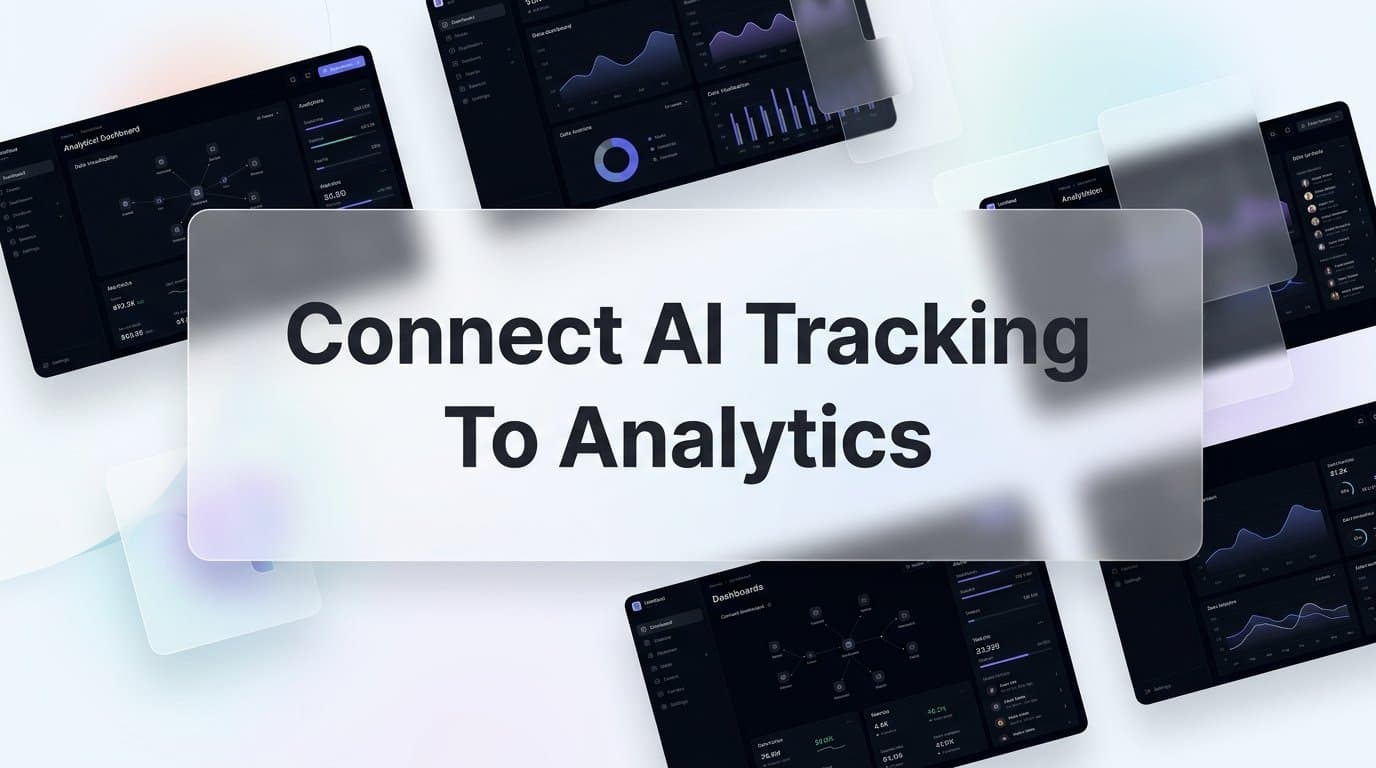
Connecting AI tracking to your analytics stack closes that gap. When you can see AI visibility data alongside your organic traffic metrics, something clicks into place: you can identify which content earns AI mentions, spot where competitors are being recommended instead of you, and prioritize content investments based on a complete picture rather than half the story.
This guide walks you through exactly how to do it. Six concrete steps, no filler. By the end, you will have a working connection between your AI visibility tracking and your existing analytics tools, a process for monitoring AI mentions alongside organic traffic, and a clear framework for turning those insights into content that keeps your brand visible across both traditional search and AI-powered search.
The teams pulling ahead on organic visibility right now are not just optimizing for Google. They are tracking how AI models talk about their brand, identifying the gaps, and publishing content that closes them. This is how you build that workflow.
Step 1: Audit Your Current Analytics and AI Visibility Baseline
Before you connect anything, you need to know what you are starting with. This step is less glamorous than the technical integration work ahead, but skipping it means you will have no way to measure whether any of this is actually working.
Start with your traditional analytics setup. Open Google Analytics 4, Google Search Console, and any third-party SEO dashboards you use, then document what each one actually captures. GA4 gives you session data, user behavior, and conversion tracking. Search Console shows you keyword impressions, click-through rates, and indexing status. Your SEO dashboard likely surfaces keyword rankings and backlink data. Write this down, even briefly. You want a clear picture of your current measurement infrastructure before layering in a new data source.
Next, establish your AI visibility baseline. Log into Sight AI or whichever AI tracking tool you are using and record your current AI Visibility Score, which AI platforms are actively mentioning your brand, and the sentiment ratings attached to those mentions. If your tool tracks competitor mentions, note those too. This baseline is your before snapshot, and it is the only way you will be able to demonstrate improvement later.
While you are in your analytics tools, identify the pages and topics already driving meaningful organic traffic to your site. Export a list of your top-performing pages by organic sessions, and note the primary topics they cover. This becomes your comparison point once AI visibility data is layered in: you want to know whether the topics earning you organic traffic are also the ones where AI models are mentioning your brand, or whether there is a disconnect worth investigating. Understanding the causes of poor AI search visibility often starts with recognizing exactly this kind of misalignment.
A common pitfall here is treating the baseline as optional. It takes about ten minutes to screenshot or export your current state. Do it before moving forward.
Success indicator: You have a documented snapshot of both your traditional analytics metrics and your AI visibility metrics, captured at the same point in time, before any integration work begins.
Step 2: Configure AI Tracking Across the Platforms That Matter
With your baseline documented, the next step is making sure your AI tracking tool is actually monitoring the right platforms with the right prompts. The quality of your setup here directly determines the quality of the data you will work with in every step that follows.
Start by selecting the AI platforms your audience is most likely using. At minimum, configure tracking for ChatGPT and Perplexity. These two platforms handle a significant share of AI-assisted search queries, particularly for product research and software comparisons. If your audience skews toward technical or research-oriented users, Claude is worth adding to your monitoring set. Understanding the differences between ChatGPT vs Perplexity monitoring can help you prioritize where to focus first based on your specific audience.
In Sight AI, the next task is adding the prompts your target audience is likely to use when searching for solutions in your category. This is where many teams underinvest. The instinct is to track branded queries, things like "what is [your brand]" or "reviews of [your brand]." Those matter, but they are not where the biggest opportunities hide. The higher-value prompts mirror real buyer intent questions: "what are the best tools for [problem your product solves]," "how do I [task your product enables]," "what should I use for [use case]." These are the queries that surface content gap opportunities and reveal where competitors are winning AI recommendations ahead of you. Understanding how ChatGPT decides brand recommendations helps you structure prompts that reflect the way AI models actually evaluate and surface brands.
Enable sentiment analysis as part of your tracking configuration. Knowing your brand appears in a response is useful. Knowing whether that appearance is positive, neutral, or negative is significantly more useful. A neutral mention in a high-intent query category is a different problem than a positive mention in a low-intent category, and your content strategy should treat them differently.
Set up competitor tracking at the same time. When a competitor earns the AI recommendation on a prompt you care about, that is a direct signal about where your content needs to improve. Tracking competitor mention frequency by platform gives you a competitive intelligence layer that traditional analytics cannot provide.
Success indicator: Your tracking dashboard is actively returning results for your target prompts across at least two AI platforms, with sentiment data attached to each mention.
Step 3: Define the Metrics You Will Actually Measure
Here is a trap that is easy to fall into: connecting two data sources and then tracking everything they produce. More data is not the same as better insight. Before you build any reports or dashboards, decide which metrics actually map to your goals.
On the AI visibility side, the core metrics worth tracking consistently are: AI Visibility Score over time, mention frequency broken down by platform, sentiment trend across your tracked prompts, and which prompt categories are triggering mentions versus which are returning competitor recommendations. These four give you a clear picture of your AI presence without creating reporting overhead that nobody will actually use. For a broader view of how to structure measurement across your organic efforts, it helps to revisit how to measure SEO success as a complementary framework.
On the traditional analytics side, the metrics to pair with AI visibility data are: organic sessions to pages that are earning AI mentions, conversion rate from organic traffic on those pages, and keyword ranking changes for topics covered in AI-mentioned content. The goal is to understand whether improving AI visibility on a topic correlates with organic traffic growth for related pages on your site.
The practical tool for connecting these two sets of metrics is a simple mapping document. For each AI prompt category you are tracking, identify the corresponding pages on your site and pull their analytics data. A spreadsheet works fine: one column for the prompt category, one for the URL of the relevant page, one for current organic sessions, one for keyword rankings, one for AI mention status and sentiment. This mapping becomes your measurement framework. It lets you answer the question that actually matters: is improving AI visibility on a topic moving the needle on organic traffic for that content?
Keep this framework to the metrics that inform decisions. If a metric does not change how you prioritize content or where you invest time, it is noise. The goal is a lean framework you will actually use every month, not a comprehensive data model that gets opened once and abandoned.
Success indicator: You have a written or spreadsheet-based framework linking AI prompt categories to specific pages and their analytics metrics, with a clear rationale for why each metric is included.
Step 4: Connect AI Visibility Data to Your Analytics Dashboard
This is where the two data streams start working together. The technical approach you take here depends on your analytics setup and your team's technical resources, but the core principle is the same regardless of method: AI visibility data and organic traffic data need to appear in the same reporting context, on the same cadence, so you can spot correlations and make decisions without toggling between disconnected tools.
If your team uses Google Analytics 4 as your primary analytics platform, GA4 supports custom data imports through its Data Import feature. This allows you to upload external metrics as custom dimensions, which then appear alongside your native session and conversion data. Exporting AI visibility metrics from your tracking tool on a weekly or bi-weekly schedule and importing them into GA4 as custom dimensions gives you a unified view within your existing reporting environment. The setup requires some configuration work on the GA4 side, but it is well within reach for most analytics teams without specialized development resources.
For teams using a dedicated SEO performance dashboard, the approach is slightly different. Create a separate view or report within that dashboard that combines organic traffic data with AI mention frequency for the same content. Most modern SEO dashboards support custom data sources or manual data entry for metrics that do not have a native integration. The goal is a single place where stakeholders can review both AI visibility trends and organic performance without switching tools.
Sight AI's platform surfaces AI visibility data in a format designed to complement existing SEO workflows, making it practical to reference both in the same reporting cycle without significant data transformation work.
For teams without custom import capabilities or dedicated dashboards, a structured shared document updated on a consistent cadence achieves similar analytical value. Pull AI visibility metrics and organic traffic data for your tracked content on the same day each week or month, paste them into a shared spreadsheet, and review them together. Consistency of reporting cadence matters more than technical sophistication of the connection method at this stage.
One practical tip: tag or annotate pages in your analytics tool that are actively earning AI mentions. In GA4, you can use custom dimensions or notes to flag these pages. This makes filtering and comparison straightforward when you are analyzing performance across a large content library.
Success indicator: You can view AI visibility trends and organic traffic data for the same content in one place, whether that is a unified dashboard or a consistently updated structured report.
Step 5: Run Your First Content Gap Analysis
With both data sources connected, you now have everything you need to identify the highest-value content opportunities available to you. This gap analysis is where the investment in the previous four steps pays off.
Start by pulling the list of prompts where competitors are being mentioned but your brand is not. These are your primary gaps. Cross-reference each one against your existing content to determine whether you have any coverage of the topic at all, and if you do, whether that content actually addresses the query with enough depth to be useful to an AI model parsing it for a recommendation.
High-value gaps follow a specific pattern. The topic drives real search volume, which you can confirm in Search Console or your keyword research tool. A competitor earns the AI mention on the relevant prompt. And you either have no content on the topic or thin content that does not address the query well enough to compete. When all three conditions are true, you have a clear, high-priority content investment.
Buyer intent alignment is the filter that separates high-priority gaps from low-priority ones. Informational queries about problems your product solves are typically the fastest path to earning AI mentions because they match the moment when someone is actively researching solutions. A prompt like "how do I track whether AI is recommending my brand" is higher priority than a generic industry awareness query, because the person asking it is closer to a buying decision.
Use your analytics data to validate priority further. If a related topic already drives organic traffic to your site, creating deeper content on the gap topic is lower risk: you have evidence the audience exists and that your site can rank for adjacent content. This is the signal that confirms the investment is worth making. For broader context on driving organic growth from content investments, how to increase organic traffic covers the complementary SEO side of this equation.
Document your gap list with three columns: the AI prompt triggering the gap, the competitor currently being mentioned, and the content action needed. That action will be one of three things: create new content on a topic you have not covered, update existing content that is too thin to earn a mention, or build supporting content that reinforces a page that is close but not quite getting the recommendation.
Success indicator: You have a prioritized list of content gaps backed by both AI visibility data and organic traffic signals, with a clear action assigned to each gap.
Step 6: Publish and Index AI-Optimized Content to Close the Gaps
A gap list is only valuable if it drives content creation. This step is where you convert the analysis into published content that can actually shift your AI visibility metrics.
When creating content to address prompts where you are not being mentioned, structure matters as much as depth. AI models parse content for clear, extractable answers. Use headings that mirror how people phrase questions to AI. Define your brand's position or methodology explicitly rather than implying it. Cover the topic comprehensively enough that an AI model can extract a meaningful, accurate summary without having to infer context you have left unstated. These are the core principles of GEO, Generative Engine Optimization, and they apply directly to content created with AI visibility as a goal. For the foundational SEO layer that supports this, how to optimize content for SEO covers the structural elements that help both search engines and AI models evaluate your content accurately.
Once content is published, indexing speed becomes a critical variable. AI models draw on indexed web content. Content that is not yet indexed cannot influence AI responses, which means slow indexing directly delays any visibility improvement you would otherwise see. This is not a theoretical concern: depending on your site's crawl frequency, new content can take days or weeks to be discovered under normal circumstances.
Sight AI's IndexNow integration and automated sitemap updates address this directly. IndexNow is an open protocol that notifies search engines and web crawlers immediately when content is published or updated, rather than waiting for a scheduled crawl. Understanding how IndexNow improves indexing speed explains why this matters specifically for AI visibility: faster indexing means AI crawlers encounter your updated content sooner, accelerating the feedback loop between publishing and visibility improvement.
After publishing, re-run the specific AI tracking prompts that identified the gap. Check whether the new content has shifted your mention status. This closes the feedback loop between content creation and AI visibility measurement, and it gives you concrete evidence of whether the content is working before you invest further in the topic.
Add internal links from high-traffic existing pages to your new content. This accelerates both crawl discovery and authority transfer, giving the new content a faster path to both search engine ranking and AI model consideration.
Success indicator: Newly published content begins appearing in AI model responses for the target prompts within your tracking cycle, and you can observe any corresponding organic traffic movement in your analytics data.
Putting It All Together: Your Repeatable AI Visibility Workflow
The six steps above are not a one-time project. They are a cycle. AI model responses shift as new content is indexed, competitors publish and update their own content, and AI platforms adjust how they evaluate and surface brands. The teams seeing compounding results from this work run the cycle consistently, typically on a monthly cadence.
Here is your quick-reference checklist for each cycle:
Baseline captured: Analytics and AI visibility metrics documented before changes are made.
AI tracking configured: Target platforms monitored with buyer-intent prompts and sentiment analysis enabled.
Metrics framework documented: AI visibility metrics mapped to corresponding pages and their analytics data.
Data connected: AI visibility trends and organic traffic data visible in the same reporting context.
Gap list created: Prioritized content opportunities identified from combined AI and SEO signals.
Content published and indexed: New or updated content live, indexed via IndexNow, and re-tested against tracking prompts.
The teams pulling ahead on organic visibility are not optimizing for Google alone. They are tracking AI visibility, connecting it to their analytics data, and publishing content that closes the gaps the combined data reveals. The data tells you what to create. The publishing process ensures it reaches both search engines and AI models. The tracking confirms it is working.
Stop guessing how AI models like ChatGPT and Claude talk about your brand. Start tracking your AI visibility today and see exactly where your brand appears across top AI platforms, which content is earning mentions, and where your next content investment will have the highest impact.