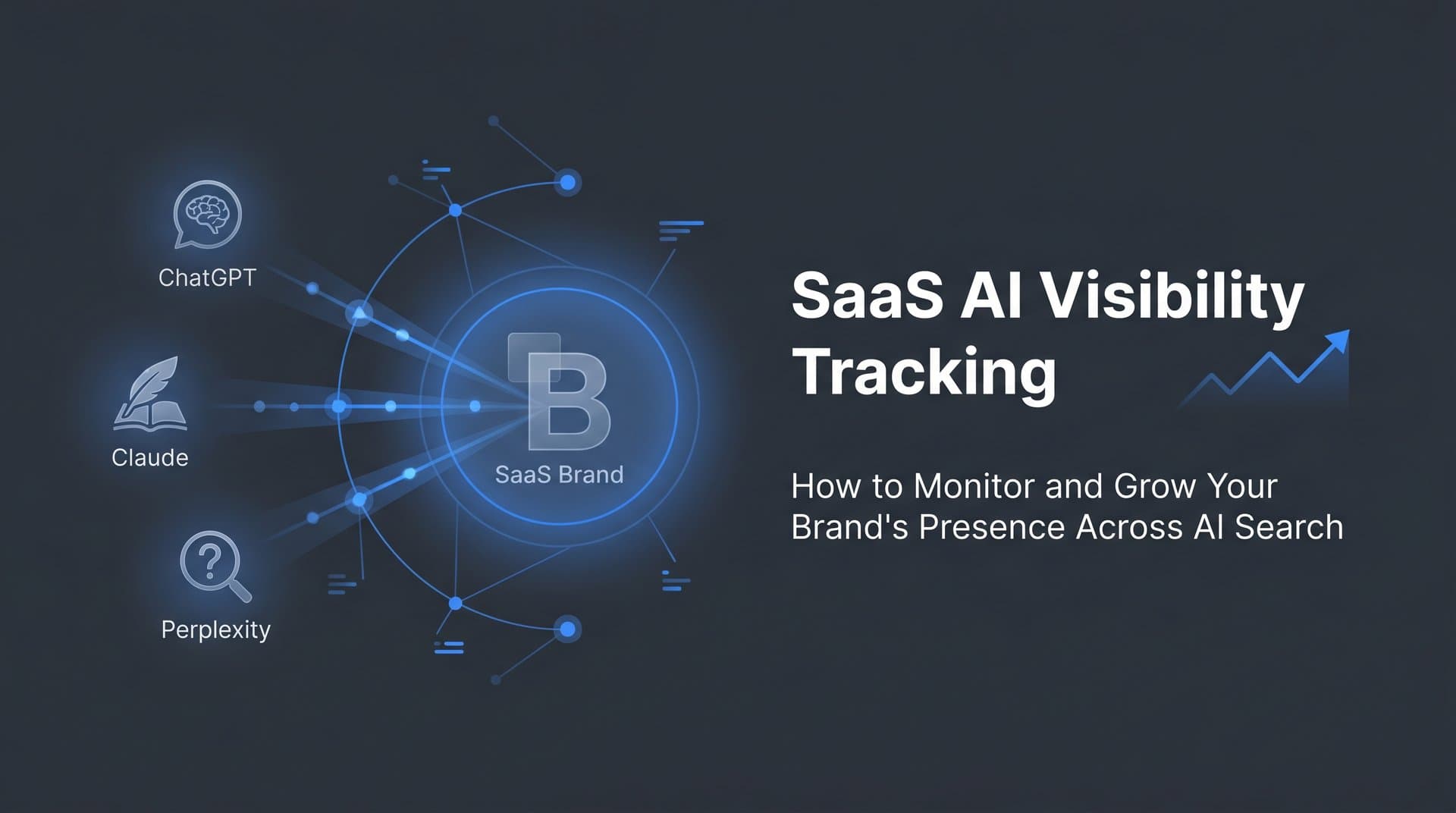
Something fundamental has shifted in how people find products, compare software, and make purchasing decisions. Instead of typing a query into a search engine and scanning through blue links, a growing number of users are simply asking ChatGPT, Claude, or Perplexity: "What's the best project management tool for a remote team?" or "Which CRM should a B2B startup use?" The AI responds with a confident, synthesized answer — and the user often acts on it without ever visiting a search results page.
For marketers, founders, and agencies who have spent years optimizing for organic search, this creates an uncomfortable blind spot. Your keyword rankings might look healthy. Your organic traffic dashboard might show steady numbers. But if an AI assistant is recommending your competitors and leaving your brand out of the conversation entirely, you have no signal that it's happening. No ranking drop. No traffic dip. Just invisible lost opportunity.
This is exactly the gap that brand tracking in conversational AI is designed to close. It's an emerging discipline that treats AI-generated responses as a new surface for brand visibility — one that requires its own monitoring methodology, its own optimization playbook, and its own set of metrics. If your team is serious about organic growth in the current environment, understanding this discipline isn't optional. It's the next layer of brand intelligence that sits on top of everything you're already doing in SEO.
The Monitoring Blind Spot Traditional Tools Can't See
Traditional brand monitoring tools are built around a simple premise: if something is published about your brand on the web, it has a URL, and that URL can be crawled, indexed, and tracked. Media monitoring platforms scan news sites and blogs. Social listening tools index public posts. Google Search Console shows you which queries led users to your pages. The entire infrastructure of brand intelligence assumes that brand mentions live somewhere on the web that a crawler can reach.
Conversational AI breaks that assumption entirely. When a user asks ChatGPT for a software recommendation and the model responds with a ranked list of tools, that response is generated dynamically in the moment. It doesn't live at a URL. It isn't indexed. It won't appear in your media monitoring dashboard or your backlink report. The response exists briefly in a conversation window and then it's gone — and there is no mechanism in traditional tooling to capture it.
This creates what you might call a structural monitoring gap. It isn't a failure of your existing tools; those tools are working exactly as designed. The problem is that the surface where brand perception is being formed and communicated to potential customers has moved somewhere those tools were never built to reach.
The stakes here are significant. Consider the purchase journey of a software buyer in 2026. They might start by asking an AI assistant for a category overview, use a follow-up prompt to compare two or three specific vendors, and then ask for a recommendation based on their team size and budget. If your brand is absent from those first two responses, you've already lost the consideration phase before the buyer ever visits a website. And because there's no referral traffic signal from that AI conversation, your analytics show nothing unusual. The loss is invisible.
There's a second dimension to this problem that goes beyond mere absence. AI models don't just mention brands — they characterize them. A model might describe your product as "enterprise-focused" when you've repositioned for SMBs, or flag a pricing tier that you changed a year ago, or associate your brand with a use case you've deliberately moved away from. These characterizations are drawn from training data and retrieval sources, and they can diverge significantly from your current positioning. Your SEO dashboard has no way to surface this kind of misrepresentation. Brand tracking in conversational AI does.
The Three Dimensions of AI Brand Visibility
Before you can build a tracking program, you need to understand what you're actually measuring. Brand tracking in conversational AI isn't a single metric — it's a combination of three distinct dimensions, each of which tells you something different about your brand's standing inside AI-generated responses.
Mention Frequency and Share of Voice: The most foundational question is simply: does your brand appear? Across a defined set of prompts — recommendation requests, category comparisons, problem-solution queries — how often does your brand surface versus how often it doesn't? And when it does appear, how does that frequency compare to your competitors running against the same prompt set? This is the conversational AI equivalent of keyword ranking position. It tells you whether you're in the game at all and where you stand relative to the field.
Sentiment and Attribute Framing: Presence alone isn't enough. When your brand does appear in an AI response, how is it characterized? Is the framing positive, neutral, or negative? What attributes does the model consistently associate with you? Pricing perception, reliability, target user, integration ecosystem, ease of use — AI models develop consistent characterizations of brands based on the signals in their training and retrieval data. Tracking these attributes over time reveals both your strengths in AI perception and the mischaracterizations you need to actively correct.
Prompt Coverage Breadth: The third dimension is about the range of questions where you appear versus where you don't. Your brand might surface reliably on direct comparison prompts but disappear entirely when users ask category-level questions or problem-framed queries. These gaps in prompt coverage are not just tracking insights — they're a direct content brief. Each type of prompt where your brand is absent represents a visibility opportunity you can address through targeted content creation.
Together, these three dimensions give you a complete picture of your brand's standing in conversational AI: whether you're present, how you're perceived, and where you're missing. Without all three, you're working with an incomplete view of a surface that is increasingly influencing purchasing decisions.
How AI Models Form Opinions About Your Brand
To improve your brand's visibility in conversational AI, it helps to understand the mechanism by which these models form and communicate brand associations in the first place. The process is different from how a search engine ranks pages, and the levers for influence are correspondingly different.
Large language models develop their base understanding of brands from training data — the vast corpus of published text they were trained on. This includes articles, reviews, documentation, forum discussions, press coverage, and authoritative content that existed before the model's knowledge cutoff date. If your brand has been consistently described in certain terms across high-authority sources, those characterizations become embedded in the model's base associations. If your brand has thin coverage, inconsistent messaging, or contradictory descriptions across sources, the model's representation of you will reflect that fragmentation.
This is why content quality and consistency across authoritative domains matters so much for AI visibility. It's not just about SEO authority in the traditional sense — it's about the coherence and clarity of the brand signal you're sending into the content ecosystem that AI models learn from.
The second mechanism is Retrieval-Augmented Generation, or RAG. Many of the leading AI platforms — Perplexity is the clearest example, and ChatGPT with browsing enabled is another — don't rely solely on their base training data. They actively retrieve recently indexed web content to supplement their responses. This is a critical insight for marketers: it means that freshly published, well-structured content can influence AI responses in near real-time, without waiting for a model to be retrained.
For brands that publish consistently and index their content quickly, RAG creates a meaningful opportunity to shape how AI models respond to prompts relevant to their category. A well-structured comparison article, a clearly written product overview, or an authoritative guide to a problem your product solves can all become sources that a retrieval-augmented model draws from when composing its response.
The practical implication: fragmented or outdated content doesn't just hurt your SEO — it actively works against your AI visibility. If your website describes your pricing one way, a third-party review says something different, and an old press release contradicts both, an AI model synthesizing those sources will produce an inconsistent or inaccurate representation of your brand. Structured, consistent messaging across high-authority domains is the foundation of strong AI brand presence.
Building a Repeatable Brand Tracking Workflow
Understanding the theory is one thing. Building a tracking program you can actually run consistently is another. The good news is that the structure maps reasonably well onto practices SEO teams already use — it's more of an extension than a reinvention.
Step 1: Define Your Prompt Library. Think of this as the conversational AI equivalent of your keyword tracking list. You need a systematically built set of prompts that covers the full range of ways a potential customer might ask an AI assistant about your category. This should include direct recommendation requests ("What's the best tool for X?"), competitor comparison prompts ("How does [your brand] compare to [competitor]?"), category-level questions ("What are the leading platforms for Y?"), and problem-solution queries ("I need to solve Z — what should I use?"). This prompt library becomes your repeatable test suite. The consistency of the prompts over time is what makes the data meaningful.
Step 2: Select Your AI Platforms. ChatGPT, Claude, Perplexity, Gemini, and other platforms each have different training data, different retrieval mechanisms, and meaningfully different user bases. A brand that appears prominently in Perplexity's responses might be handled very differently by Claude. Coverage across multiple models gives you a complete picture of AI-driven brand perception rather than a single platform's view. Prioritize the platforms your target audience actually uses for research and purchasing decisions.
Step 3: Establish a Baseline and Run on Cadence. Run your full prompt library across your selected platforms, log the responses systematically, and record your mention rate, sentiment characterization, and positioning relative to competitors. This baseline is your starting point. From there, run the same process on a consistent schedule — weekly or bi-weekly for active campaigns, monthly for ongoing monitoring. The cadence transforms one-off spot checks into a structured visibility intelligence program. You can observe how changes in your content strategy translate into changes in AI mention patterns over time.
Step 4: Automate Where Possible. Manual prompt testing at scale across multiple platforms and a large prompt library is time-consuming. Platforms like Sight AI automate this process — running your defined prompt set across multiple AI platforms, logging responses, scoring sentiment, and tracking changes in mention frequency and positioning over time. This is the difference between a research project and an operational capability.
From Tracking Gaps to Content That Wins AI Mentions
Tracking your AI visibility is only valuable if it drives action. The most direct path from tracking insights to improved visibility runs through content strategy — specifically, through Generative Engine Optimization (GEO), the emerging practice of creating content designed to be cited, mentioned, and recommended by AI-generated responses.
The most actionable output of your tracking program is a map of prompt coverage gaps. When your brand consistently fails to appear in responses to a specific type of query — "best [category] tool for [use case]," for example — that absence is a content brief. It tells you that authoritative, well-structured content targeting that exact framing doesn't exist in the sources AI models are drawing from. Creating it is the most direct lever you have for improving your mention rate on those prompts.
GEO-optimized content shares a lot of DNA with high-quality SEO content: it's authoritative, well-structured, clearly written, and published on credible domains. But it adds specific considerations. Direct answer formatting matters — AI models favor content that clearly and concisely answers the question being asked. Entity clarity matters — your brand, its use cases, its differentiators, and its target audience should be described explicitly and consistently. Attribute specificity matters — content that clearly articulates what your product is best for, what it costs, and who it serves gives AI models the signal they need to characterize you accurately.
Sentiment drift is another area where tracking insights translate directly into content action. If your AI visibility tracking reveals that models are consistently describing your brand as expensive, enterprise-only, or associated with a feature set you've deprecated, that's not just a perception problem — it's a content gap. Publishing clear, authoritative, frequently updated content on those specific topics helps recalibrate the signals AI models draw from over time.
Content indexing speed is the final piece of this loop. Because retrieval-augmented AI platforms can draw from recently indexed content, the faster your new content is discovered and indexed, the sooner it can begin influencing AI responses. This is where technical infrastructure intersects with content strategy. Pairing your content creation workflow with rapid indexing capabilities — IndexNow integration, automated sitemap updates — shortens the feedback loop between publishing and seeing improvements in your AI visibility tracking data. Sight AI's platform combines content generation with IndexNow integration specifically to close this loop as quickly as possible.
The Metrics That Actually Tell the Story
Any new discipline needs a measurement framework that stakeholders can understand and that teams can act on. Brand tracking in conversational AI is no different. Here are the metrics that provide genuine signal rather than noise.
AI Visibility Score: A composite metric that combines mention rate, average sentiment, and prompt coverage breadth into a single number. This is your north-star metric for stakeholder reporting — the equivalent of domain authority or share of voice in traditional brand tracking. It gives you a single trend line to watch over time and a clear way to communicate progress to leadership without requiring them to understand the underlying methodology. Sight AI's platform generates this score automatically across the AI platforms it monitors.
Share of Voice vs. Competitors: Measuring your mention frequency relative to named competitors on the same prompt set is where competitive intelligence gets genuinely interesting. Which rivals are appearing in AI responses where you aren't? How are they being characterized compared to you? This data reveals competitive positioning inside AI that simply doesn't exist in traditional SEO tooling. It can surface competitors gaining AI-driven recommendation traffic before that shift shows up in your organic traffic trends.
Prompt Coverage Rate: The percentage of your defined prompt library where your brand appears at least once. This metric tracks whether your content efforts are actually expanding the range of queries where you're visible — it's a direct measure of GEO progress over time.
Downstream Correlation: As AI-referred traffic grows as a category, connecting improvements in your AI visibility metrics to changes in branded search volume, organic traffic trends, and pipeline contribution is how you build the business case for ongoing investment in GEO-focused content programs. The correlation won't be perfect in the early stages, but establishing the tracking infrastructure now means you'll have the data to demonstrate ROI as AI-driven discovery becomes a larger share of the purchase journey.
Your Next Move in the AI Visibility Race
The core insight of this entire discipline is straightforward: the surface where brand perception is formed and communicated to potential customers has expanded, and traditional SEO monitoring only covers part of it. Brand tracking in conversational AI isn't a replacement for what you're already doing — it's the next layer of brand intelligence that sits on top of your existing program.
The action path is clear. Define a prompt library that covers the full range of queries relevant to your category. Monitor consistently across the AI platforms your audience uses. Identify the gaps in your prompt coverage and the sentiment drift in your characterizations. Publish targeted, GEO-optimized content that addresses those gaps. Index it fast so retrieval-augmented platforms can find it. Track the changes. Repeat.
This is the workflow that Sight AI's platform is built to operationalize. From AI Visibility Score and sentiment analysis across 6+ AI platforms to the AI Content Writer with GEO-optimized article generation and IndexNow integration for rapid indexing, the platform connects every step of this workflow into a single system. You don't need to stitch together separate tools or run manual prompt tests to get started.
Stop guessing how AI models like ChatGPT and Claude talk about your brand. Start tracking your AI visibility today and see exactly where your brand appears, how it's characterized, and where your biggest opportunities for growth are hiding across the top AI platforms.