As AI-powered search becomes a primary discovery channel, knowing how AI models like ChatGPT, Claude, and Perplexity talk about your brand is no longer optional. It's a competitive necessity. Yet most marketers are still relying on traditional SEO dashboards that were never designed to track AI-generated responses, brand mentions inside conversational queries, or sentiment across large language models.
Here's the problem: ChatGPT and similar tools don't expose their recommendation logic through standard analytics. You can't see referral traffic from a ChatGPT response. You can't track when your brand gets mentioned — or worse, when a competitor gets recommended instead of you.
This gap has created demand for a new category of tools and strategies specifically built around AI visibility monitoring. Whether you're a founder trying to understand how AI models perceive your brand, a marketer building GEO-optimized content, or an agency managing AI presence for multiple clients, this guide covers the seven most effective ChatGPT tracking alternatives available today.
Each strategy below goes beyond simply checking if ChatGPT mentions you. They help you build a systematic, repeatable process for tracking AI visibility, diagnosing gaps, and taking action to improve how AI models represent your brand across platforms.
1. Use a Dedicated AI Visibility Tracking Platform
The Challenge It Solves
Manual spot-checks of ChatGPT responses are time-consuming, inconsistent, and impossible to scale. Without a structured system, you're essentially guessing at your AI presence. You might run a few queries on a Tuesday afternoon and feel reassured, only to miss the fact that your brand dropped out of AI recommendations entirely by Thursday. Ad-hoc monitoring creates a false sense of security rather than genuine insight.
The Strategy Explained
A dedicated AI visibility tracking platform replaces guesswork with continuous, automated monitoring. Instead of manually querying ChatGPT, Claude, and Perplexity yourself, the platform runs structured prompts across multiple AI models on a regular cadence and records how your brand appears in each response.
The output is an AI Visibility Score: a benchmarkable metric that reflects how frequently your brand is mentioned, in what context, and with what sentiment. This gives you a baseline to measure against, a trend line to track over time, and a clear signal when something changes in how AI models represent your brand.
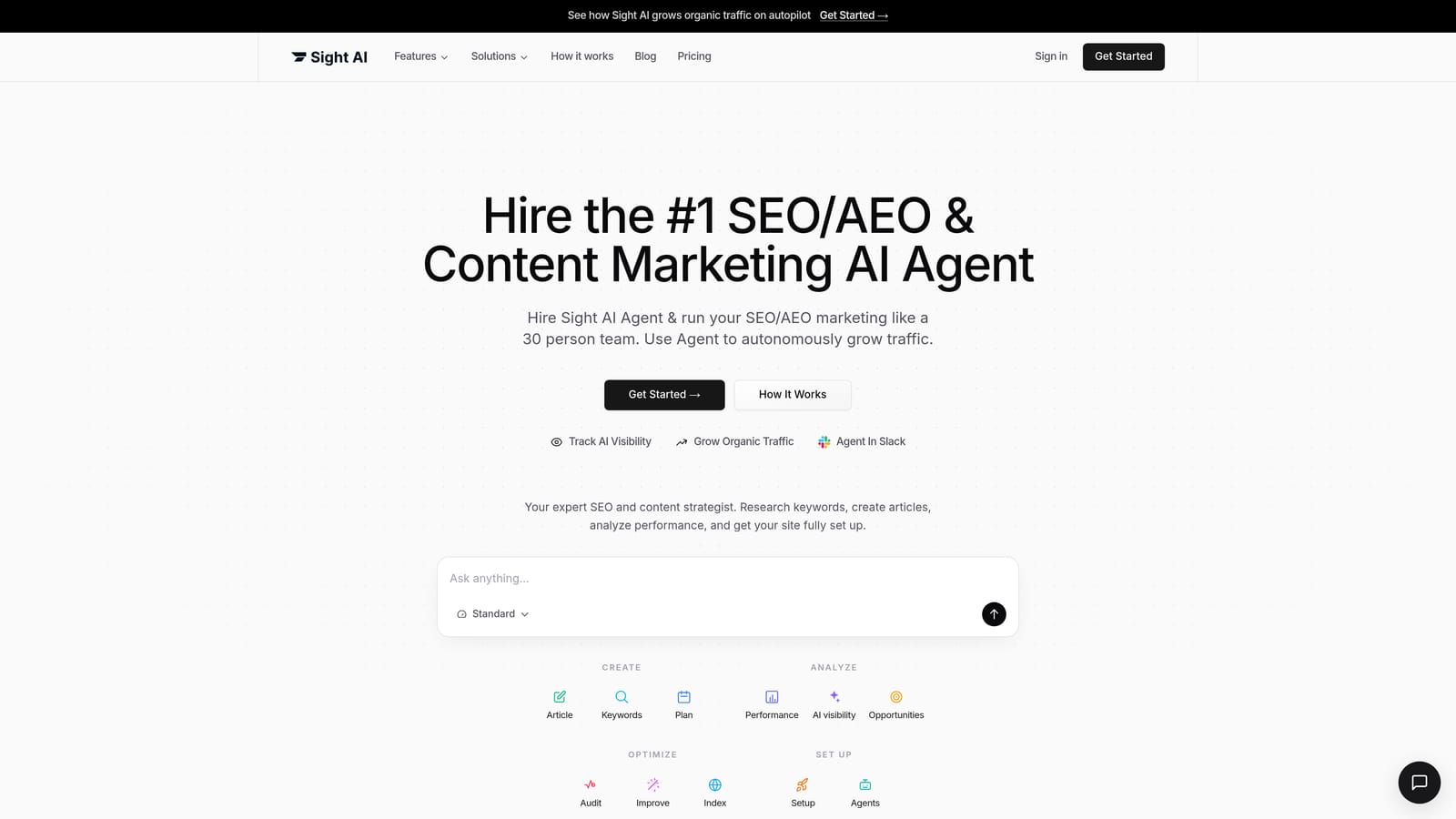
Platforms like Sight AI are built specifically for this use case, tracking brand mentions across ChatGPT, Claude, Perplexity, and additional AI platforms from a single dashboard.
Implementation Steps
1. Identify the AI platforms most relevant to your audience and industry, prioritizing those your buyers are most likely to use for product research.
2. Set up automated prompt tracking across those platforms, covering discovery, comparison, and recommendation query types relevant to your category.
3. Establish your baseline AI Visibility Score in week one, then monitor weekly or monthly trends to detect meaningful shifts.
Pro Tips
Don't just track your own brand. Include your top two or three competitors in the same monitoring setup from day one. Competitive AI visibility data is often more actionable than your own score in isolation because it tells you exactly where you're losing ground and where the content opportunity lies.
2. Build a Systematic Prompt Monitoring Framework
The Challenge It Solves
Most teams that do monitor AI visibility run the same one or two queries repeatedly. This creates a narrow, unrepresentative picture. Real buyers use AI tools in varied, unpredictable ways: some ask broad category questions, others compare specific vendors, and others describe a problem and ask for a solution. If your prompt library doesn't reflect this diversity, you're missing large portions of your actual AI exposure.
The Strategy Explained
A prompt monitoring framework is a structured library of queries organized by intent type. Rather than running random checks, you define a repeatable set of prompts that mirrors the full range of ways buyers use AI tools to research your category. This library becomes the consistent measurement instrument for your AI visibility program.
Think of it like keyword tracking in traditional SEO: you don't just track one keyword. You build a comprehensive set that covers different stages of intent. Prompt monitoring works the same way, but for conversational AI queries.
Implementation Steps
1. Build four prompt categories: discovery prompts ("What are the best [category] tools?"), comparison prompts ("How does [Brand A] compare to [Brand B]?"), problem-solution prompts ("What tool should I use to [solve specific problem]?"), and use-case prompts ("[Brand name] — what is it used for?").
2. Write five to ten specific prompts within each category, varying the phrasing to capture different query styles and user contexts.
3. Run this full prompt library across your target AI platforms on a consistent schedule — weekly for active campaigns, monthly for baseline tracking — and log the results systematically.
Pro Tips
Rotate prompt phrasing every quarter to account for how AI model behavior evolves with updates and retraining. A prompt that surfaces your brand reliably today may behave differently after a model update, so maintaining phrasing variations helps you distinguish true visibility changes from prompt sensitivity.
3. Expand Coverage Across Multiple AI Platforms Simultaneously
The Challenge It Solves
Many brands focus their monitoring exclusively on ChatGPT because it's the most recognized AI tool. But this creates significant blind spots. Claude, Perplexity, and Gemini each retrieve and present brand information differently, and a brand that appears prominently in one platform's responses may be virtually absent from another's. Tracking only one platform gives you a partial and potentially misleading picture of your total AI presence.
The Strategy Explained
Each major AI platform has a distinct retrieval architecture that affects how your brand gets surfaced. Perplexity is built around real-time web retrieval and tends to cite sources explicitly, meaning freshly indexed, well-structured content has a direct path to appearing in responses. Claude relies primarily on training data, so authority signals and entity clarity in your existing content matter more. ChatGPT combines training data with real-time web browsing for certain query types, creating a hybrid dynamic.
These differences mean that your brand can perform well in Perplexity responses but barely register in Claude, or vice versa. A multi-platform monitoring approach captures the full picture and reveals platform-specific gaps you can address with targeted content strategies.
Implementation Steps
1. Run your prompt library across at least three platforms: ChatGPT, Claude, and Perplexity as a minimum starting set.
2. Document platform-specific patterns in how your brand is described, what sources are cited, and where competitors appear instead of you.
3. Use platform-specific gaps to inform content priorities: if Perplexity rarely cites you, focus on indexing speed and source authority; if Claude underrepresents you, focus on entity clarity and training-data-quality signals in your content.
Pro Tips
Don't assume that performing well on one platform means you're covered. Buyer behavior varies by audience segment: some research-heavy buyers heavily use Perplexity for its cited sources, while others rely on ChatGPT for conversational discovery. Know which platforms your specific buyers prefer and weight your monitoring accordingly.
4. Publish GEO-Optimized Content That AI Models Actually Cite
The Challenge It Solves
Traditional SEO content is optimized for search engine crawlers and click-through rates. But AI models don't rank blue links — they synthesize responses from sources they deem authoritative, structured, and directly relevant to the query. Content that performs well in Google search rankings doesn't automatically perform well as an AI citation source. Without a deliberate GEO strategy, your content may be invisible to the very AI tools your buyers are using.
The Strategy Explained
Generative Engine Optimization (GEO) is an emerging discipline focused on creating content that AI models are more likely to surface in their responses. GEO-optimized content is structured to be authoritative, entity-rich, and directly answer the types of questions AI models are trained to respond to.
This means writing content that clearly defines what your brand does, who it serves, and what problems it solves — in plain, unambiguous language. It means using structured formats that AI models can parse easily: clear headings, direct answers, and factual specificity. It also means building topical authority across a content cluster rather than relying on isolated articles.
Tools like Sight AI's AI Content Writer use 13+ specialized AI agents to generate SEO and GEO-optimized content, including listicles, guides, and explainers, structured specifically to improve AI citation potential.
Implementation Steps
1. Audit your existing content library against GEO criteria: Does each piece clearly define your brand's entity, use case, and differentiation? Does it directly answer common buyer questions in a format AI models can retrieve?
2. Identify content gaps by cross-referencing your prompt monitoring results with your existing content. If AI models answer a common category question without mentioning you, that's a content gap to fill.
3. Publish new GEO-optimized content systematically, prioritizing the query types where competitors currently appear in AI responses and you do not.
Pro Tips
Write content that answers specific, well-formed questions directly in the first paragraph. AI models that synthesize responses tend to pull from content that gets to the point quickly. Long preambles and keyword-stuffed introductions work against you in AI retrieval contexts.
5. Accelerate Content Indexing So AI Models Discover You Faster
The Challenge It Solves
Publishing great GEO-optimized content is only half the equation. For AI tools that use real-time web retrieval — like Perplexity — content that isn't indexed simply doesn't exist in their response pool. Traditional indexing can take days or weeks, creating a lag between when you publish and when AI models can actually surface your content. In a fast-moving competitive landscape, that lag has real costs.
The Strategy Explained
IndexNow is a publicly documented protocol supported by Microsoft Bing, Yandex, and other search engines that allows websites to instantly notify search engines when content is published or updated. Instead of waiting for a crawler to discover your new article on its own schedule, IndexNow pushes a notification the moment you publish, dramatically reducing the time between publication and discovery.
For AI tools that rely on real-time web retrieval, faster indexing means faster inclusion in the response pool. Combined with automated sitemap updates, this creates a pipeline where new GEO-optimized content moves from publication to AI-discoverable as quickly as technically possible.
Sight AI's website indexing tools integrate IndexNow natively with automated sitemap updates, so every article published through the platform is immediately submitted for indexing without any manual steps.
Implementation Steps
1. Implement IndexNow on your website by adding the protocol to your CMS or using a platform that handles it automatically. Microsoft's documentation provides the technical specification.
2. Set up automated sitemap updates so your sitemap reflects new content immediately upon publication, supporting both IndexNow submissions and standard crawler discovery.
3. Verify indexing status for new content within 24-48 hours of publication using Google Search Console or Bing Webmaster Tools, and flag any indexing failures for manual review.
Pro Tips
Indexing speed matters most for content targeting time-sensitive queries or responding to emerging trends in your category. If a competitor publishes a comparison article and it gets indexed before yours does, they capture that AI citation window first. Treat fast indexing as a competitive advantage, not just a technical housekeeping task.
6. Track Sentiment and Competitive Brand Positioning in AI Responses
The Challenge It Solves
Being mentioned by an AI model is not inherently a win. AI responses can describe your brand favorably, neutrally, or in ways that raise doubts — depending on the training data and sources the model draws from. A brand that gets mentioned frequently but consistently described as "expensive" or "complex to implement" may be losing deals at the AI-influence stage without ever knowing it. Mention frequency alone is an incomplete metric.
The Strategy Explained
Sentiment tracking in AI responses involves systematically analyzing the language AI models use when describing your brand: the adjectives, the qualifications, the comparisons, and the context in which your brand appears. Is your brand described as a leader, a challenger, or an afterthought? Is it mentioned first or last in a list of recommendations? Are the descriptions aligned with your positioning, or do they reflect outdated information or competitor-influenced narratives?
Competitive positioning analysis adds another layer: not just how AI models describe you, but how they describe you relative to competitors. If a competitor is consistently described as "the easiest to use" in your category and you're described as "feature-rich but complex," that's a positioning gap that content strategy can address.
Implementation Steps
1. Log the specific language AI models use when describing your brand across your prompt library, categorizing responses as positive, neutral, or negative and noting recurring descriptors.
2. Run the same analysis for your top two or three competitors, building a comparative sentiment map that shows how AI models position each brand relative to the others.
3. Use sentiment gaps to inform content priorities: if AI models consistently associate a competitor with an attribute you also have but aren't credited for, create authoritative content that establishes your brand's ownership of that attribute.
Pro Tips
Pay close attention to how AI models handle comparison queries specifically. When a buyer asks "How does [your brand] compare to [competitor]?" the framing of that response has outsized influence on purchase decisions. These comparison prompts often reveal the most actionable sentiment and positioning gaps in your AI visibility program.
7. Integrate AI Visibility Data Into Your Broader SEO Reporting Workflow
The Challenge It Solves
AI visibility metrics that live in a separate dashboard, reviewed occasionally by one person, rarely drive meaningful action. When AI mention data is siloed from your broader organic performance reporting, it's treated as a curiosity rather than a core channel metric. This disconnect means that insights from your AI monitoring don't flow into content decisions, and content performance data doesn't inform your AI tracking priorities.
The Strategy Explained
The most effective approach treats AI visibility as a measurable channel within your existing organic performance framework, not a separate initiative. This means connecting AI mention frequency, sentiment trends, and prompt performance data to the same reporting layer where you track keyword rankings, organic traffic, and content engagement.
When these data streams are unified, patterns emerge that neither dataset reveals alone. A page that ranks well in traditional search but never gets cited in AI responses points to a GEO optimization gap. A topic where AI models mention you frequently but organic traffic is low suggests an opportunity to capture the non-AI traffic that should accompany that AI presence.
Sight AI is designed to support this unified view, combining AI visibility tracking with content generation and indexing tools so that insights from monitoring flow directly into content action without requiring multiple disconnected platforms.
Implementation Steps
1. Define the AI visibility KPIs you'll report alongside traditional SEO metrics: AI Visibility Score, mention frequency by platform, sentiment trend, and share of AI mentions relative to competitors.
2. Establish a monthly reporting cadence that includes both traditional organic performance and AI visibility data, reviewed by the same team that owns content strategy decisions.
3. Use the combined dataset to prioritize content investments: identify topics where AI visibility is low but traditional search demand is high, and vice versa, then allocate content resources accordingly.
Pro Tips
Build a simple content opportunity matrix that maps traditional keyword difficulty against AI mention gap (topics where competitors appear in AI responses and you don't). The intersection of high search demand, low traditional competition, and high AI mention gap represents your highest-leverage content opportunities across both channels simultaneously.
Putting It All Together: Your AI Visibility Implementation Roadmap
Monitoring how AI models talk about your brand is quickly becoming as foundational as tracking keyword rankings or backlink profiles. The seven strategies above give you a layered approach that builds on itself: each layer makes the next one more effective.
Start with a dedicated AI visibility platform to establish your baseline. Layer in a structured prompt monitoring framework to ensure your tracking is comprehensive and consistent. Expand coverage across ChatGPT, Claude, Perplexity, and additional platforms to eliminate blind spots. Then feed those insights into a GEO-optimized content strategy that gives AI models something worth citing.
Accelerate discovery with fast indexing so your new content enters the AI retrieval pool as quickly as possible. Track sentiment and competitive positioning to move beyond mention counting toward genuine brand intelligence. And integrate everything into your existing SEO reporting workflow so AI visibility becomes a managed, measurable channel rather than an occasional experiment.
The brands that will win in AI-driven search are those that treat AI visibility as a manageable channel, not a black box. That means publishing content AI models want to cite, ensuring that content gets indexed quickly, and continuously monitoring how AI sentiment around your brand evolves over time.
If you're ready to move beyond guesswork, Start tracking your AI visibility today with Sight AI: track your AI Visibility Score across ChatGPT, Claude, Perplexity, and more, generate SEO and GEO-optimized content with 13+ specialized AI agents, and ensure every new article gets discovered fast with automated IndexNow integration. Stop guessing how AI models talk about your brand and start building a brand presence that AI consistently recommends.