The best AI brand monitoring tools in 2026 are Sight AI, Promptwatch, Profound, Peec, AirOps and Writesonic. The first four track how ChatGPT, Claude, Perplexity and other AI models mention your brand, while AirOps and Writesonic focus on producing the content that earns those mentions. Choose Sight AI for monitoring, content and indexing in one platform. Choose Promptwatch for prompt-level alerts, Profound for enterprise share-of-voice reporting and Peec for competitor benchmarking.
Traditional brand monitoring covers social media and the open web. It misses AI-generated answers, where buyers increasingly ask which product to use and click whichever brands get named. The tools below are evaluated on depth of AI platform coverage, how actionable their insights are, content features and overall value.
How to Evaluate an AI Brand Monitoring Tool
AI responses are non-deterministic. The same prompt can name different brands from one run to the next, and results vary by model, region and whether web search is enabled. Before comparing vendors, check these criteria:
- Model coverage: Look for at least ChatGPT, Perplexity, Claude, Gemini and Google AI Overviews or AI Mode. Coverage of a single model gives you a skewed picture.
- Sampling method and frequency: Accurate data comes from running each prompt several times on a regular schedule, such as daily or weekly, and reporting mention rates. A single snapshot is not reliable. Ask vendors how often they query and how many runs each data point represents. This tells you more about real-time accuracy than marketing claims do.
- Historical trend analysis: You need stored time series to tell whether a content push or PR event actually moved your visibility, or whether you are just looking at normal variance.
- Citation and source tracking: Knowing which URLs AI models cite shows you which pages to update or which third-party sites to target.
- Competitor share of voice: Mention counts mean little without a benchmark against named rivals on the same prompts.
- Multi-brand workspaces: Agencies and multi-brand marketers need separate projects, client-ready reports and exports. This keeps tracking organized in one place.
- Actionability: Check whether the tool helps you fix gaps, through content creation, indexing or recommendations, or only reports them.
For a step-by-step method of turning these metrics into a reporting process, see our 6-step framework for measuring AI visibility performance.
Quick Comparison
| Tool | Primary focus | Best for | Content creation |
|---|---|---|---|
| Sight AI | Monitoring, content and indexing | All-in-one teams, agencies, founders | Yes (13+ agents) |
| Promptwatch | Prompt-level monitoring and alerts | Brand managers, SEO specialists | No |
| Profound | Enterprise share-of-voice analytics | Enterprise brand teams | No |
| Peec | Competitive benchmarking | Growth and competitive intelligence teams | No |
| AirOps | LLM content workflows | Content operations teams | Yes |
| Writesonic | High-volume AI writing with GEO | Content marketers | Yes |
1. Sight AI
Best for: Teams that need an all-in-one platform covering AI monitoring, content creation and indexing.
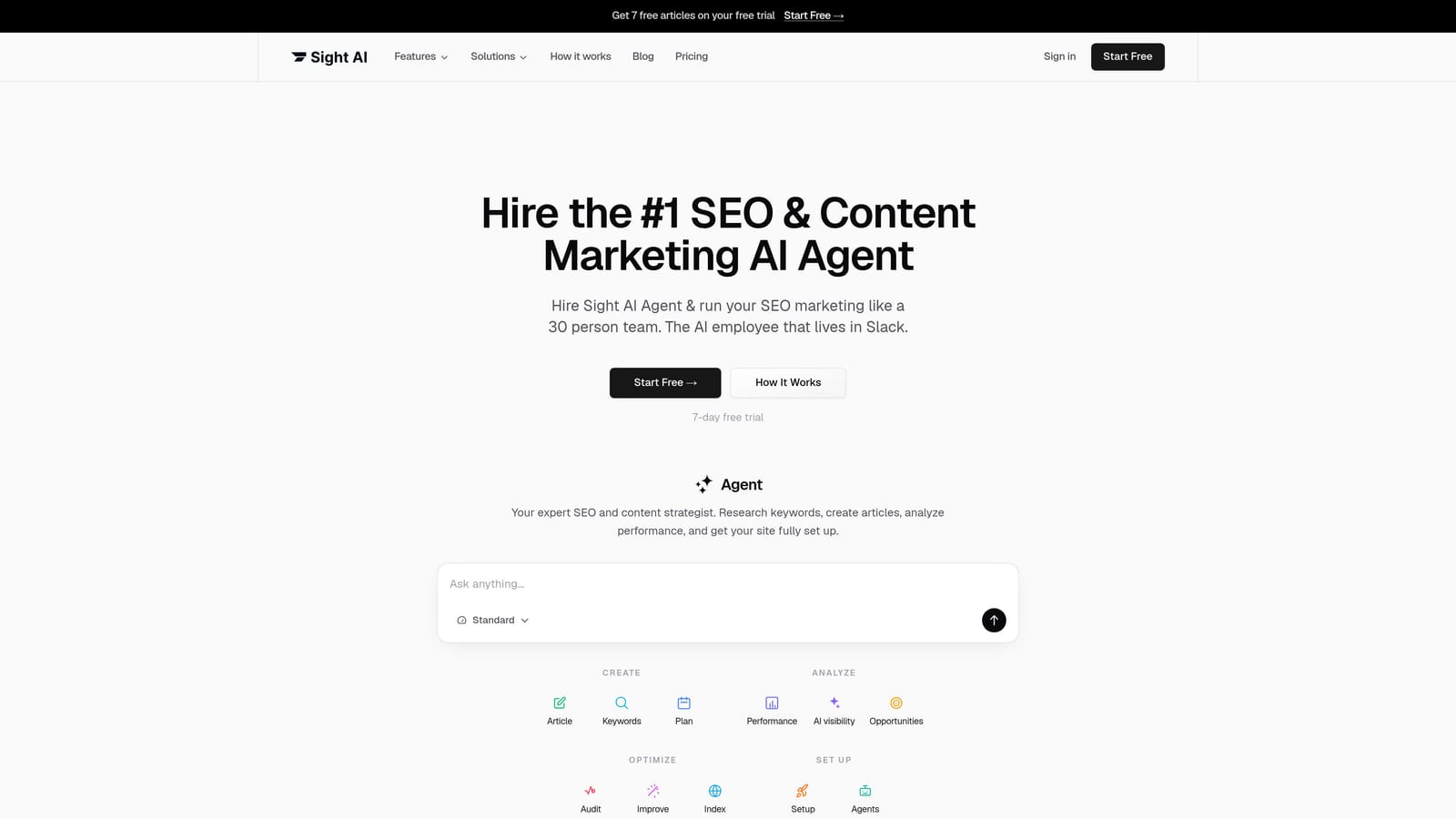
Sight AI is an end-to-end AI visibility platform. It tracks brand mentions across 6+ AI models, generates GEO-optimized content with 13+ specialized AI agents and automatically indexes new content via IndexNow. That closes the full loop from monitoring to publishing.
Where This Tool Shines
Most AI brand tracking tools stop at the data. Sight AI is built on the idea that visibility data is only useful if you can act on it. Once you see where your brand appears (or doesn't) in AI-generated responses, the platform gives you the tools to create content that improves those mentions and to get it indexed fast.
That closed-loop approach sets it apart. You don't export data to one tool, write content in another and manually submit URLs somewhere else, because Sight AI handles the entire workflow in a single platform. For agencies managing multiple clients or founders running lean, that consolidation has real operational value.
Key Features
AI Visibility Score: Tracks how frequently and how positively your brand appears across ChatGPT, Claude, Perplexity and other major AI platforms, with sentiment analysis built in.
Prompt Tracking: Monitors specific queries to identify which questions trigger brand mentions in AI responses and which ones don't.
13+ Specialized AI Agents: Generates listicles, guides and explainers optimized for Generative Engine Optimization (GEO). Each agent is purpose-built for a specific content format.
Autopilot Mode: Schedules and automates content publishing so your pipeline keeps moving without manual intervention.
IndexNow Integration: Automatically submits new content to search engines and updates your sitemap, reducing the lag between publishing and discovery.
Best For
Sight AI is the strongest fit for marketers and agencies that want to track AI visibility and act on it without managing a stack of separate tools. Founders trying to get into AI-generated recommendations will also find the content generation side useful for building topical authority quickly. You can see how the prompt-level monitoring works on the Sight AI prompt tracking feature page.
Pricing
See trysight.ai for current pricing and plan details.
2. Promptwatch
Best for: Teams that need deep, prompt-level monitoring of brand appearances in AI responses.
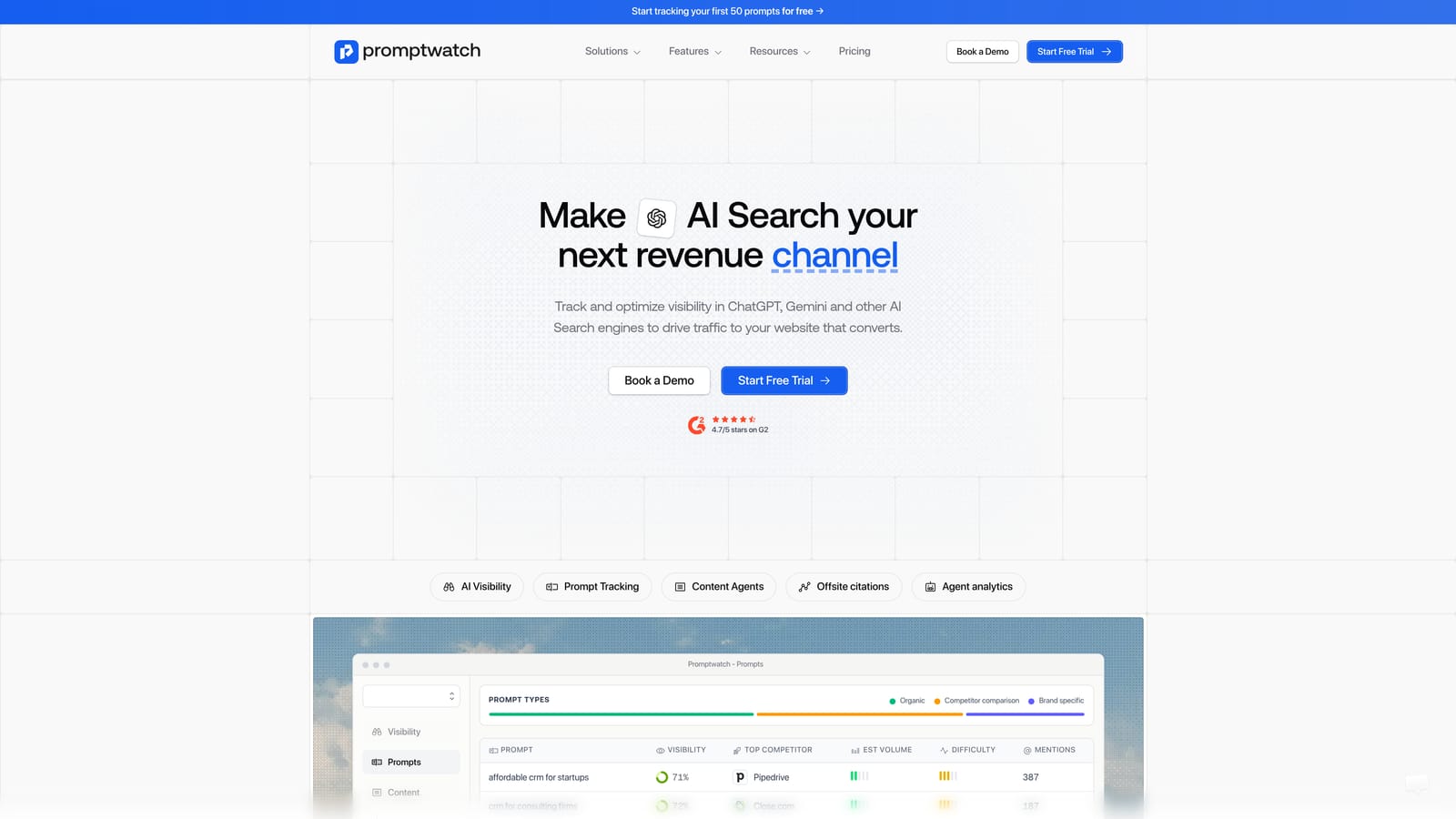
Promptwatch is a specialized AI brand monitoring tool. It tracks how and when your brand appears in AI model responses at the individual prompt level.
Where This Tool Shines
Promptwatch takes a focused, specialist approach. It doesn't try to be an all-in-one platform. Instead it goes deep on a single problem: understanding exactly which prompts trigger your brand to appear in AI-generated answers, and alerting you when that changes.
This granularity helps brand managers who need to know whether a specific product category query mentions them, or whether a recent PR push has shifted how AI models describe the company. The historical tracking layer adds context that point-in-time snapshots can't provide.
Key Features
Prompt-Level Tracking: Set up specific queries and monitor whether your brand appears in AI responses to those exact prompts over time.
Brand Mention Alerts: Get notified when your brand appears in or disappears from AI-generated responses to tracked queries.
Historical Trend Analysis: Identify patterns in AI model behavior over time to understand how your visibility is shifting.
Specialist Interface: A focused, clean experience designed for teams whose main workflow is monitoring rather than content creation.
Best For
Promptwatch works best for brand managers and SEO professionals who want precise, query-level visibility data and don't need content generation in the same platform. It pairs well with a separate content tool if you want to act on what you find.
Pricing
See promptwatch.io for current pricing details.
3. Profound
Best for: Enterprise marketing and brand teams that need deep analytics on AI share of voice.
Profound is an enterprise-grade AI answer monitoring platform. It provides detailed analytics on brand positioning and share of voice within AI-generated responses.
Where This Tool Shines
Profound is built for teams that need to present AI visibility data to stakeholders and leadership. The platform leans into reporting depth, giving brand and marketing teams structured dashboards and competitive comparisons that hold up in a quarterly review.
Many tools show you whether you appear in AI responses. Profound focuses on how your positioning compares to competitors across multiple AI platforms at the same time. That competitive layer is especially valuable for brands in crowded categories, where share of voice in AI search is a strategic concern.
Key Features
AI Share-of-Voice Analysis: Compares your brand's presence against named competitors in AI-generated responses across multiple platforms.
Enterprise Reporting Dashboards: Structured, presentation-ready reports for marketing and brand teams reporting upward.
Multi-Platform Monitoring: Tracks brand positioning across several AI answer engines simultaneously.
Competitive Positioning Insights: Shows how AI models frame your brand relative to alternatives in the same category.
Best For
Profound suits enterprise marketing teams, brand strategists and agencies whose clients require formal reporting on AI visibility. If your team needs to defend or demonstrate AI brand positioning to leadership, Profound's reporting depth is a strong fit.
Pricing
See profound.io for current pricing and enterprise plan details.
4. Peec
Best for: Growth marketers and competitive intelligence teams benchmarking AI visibility against rivals.
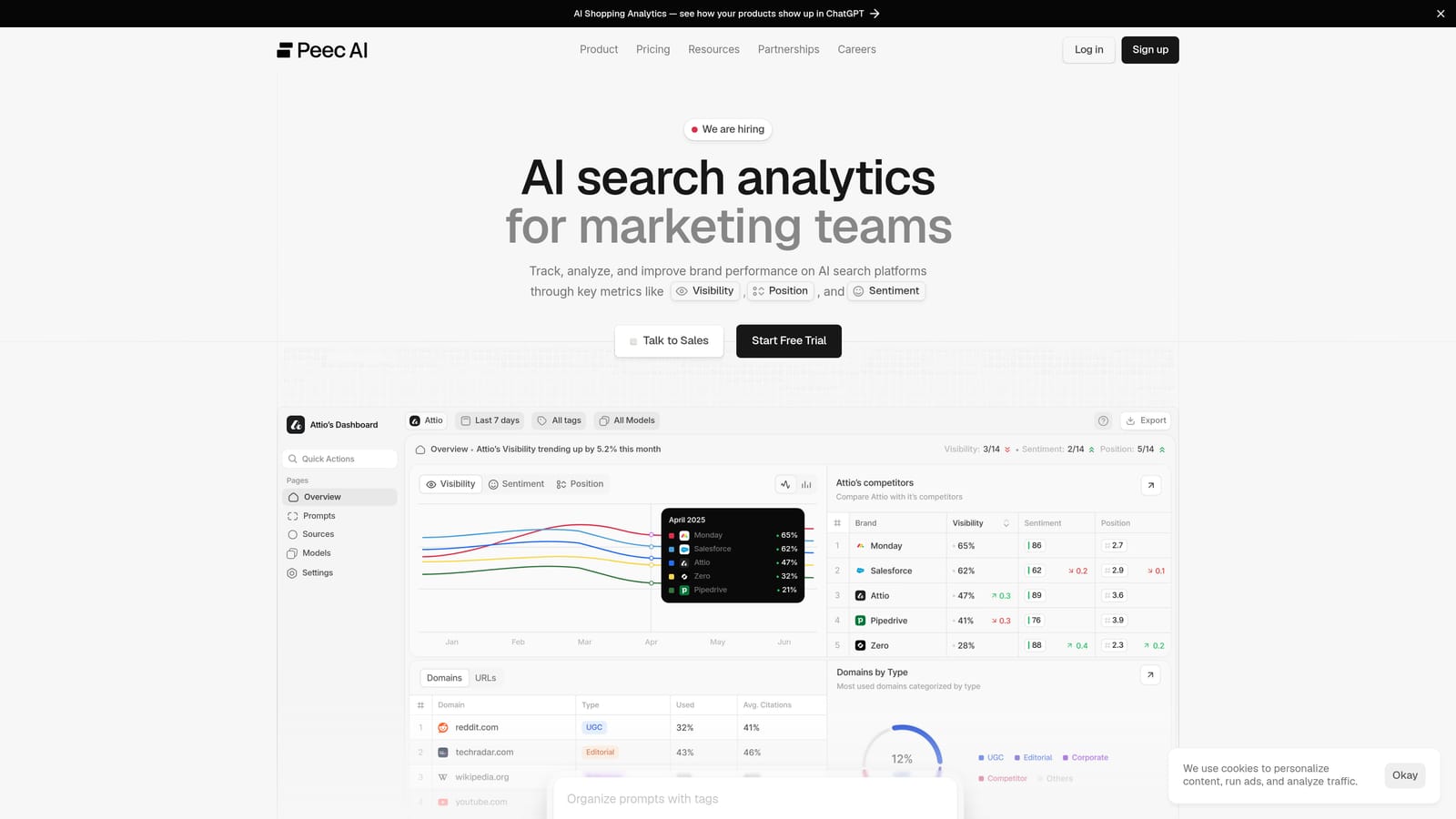
Peec is a competitive AI visibility benchmarking tool. It lets you compare how your brand and competitors appear side by side in AI-generated responses.
Where This Tool Shines
Peec is purpose-built for competitive intelligence in the AI search era. You don't just learn how often your brand appears in AI responses. You see exactly how that compares to specific competitors on the same queries.
That side-by-side view is hard to get from general monitoring tools, and it changes how teams prioritize content and positioning. If a competitor consistently appears in AI responses to a category query where you don't, Peec surfaces that gap directly.
Key Features
Side-by-Side AI Visibility Comparison: Benchmark your brand against named competitors across specific query sets in AI-generated responses.
Benchmarking Dashboards: Track your relative share of AI mentions over time to measure whether your competitive position is improving.
Query-Based Analysis: Identify which topics and queries consistently drive competitor mentions so you can prioritize content accordingly.
Competitive Intelligence Workflow: Designed for teams that use AI visibility data to inform growth and positioning strategy.
Best For
Peec is the right choice for growth marketers and competitive intelligence professionals who need to see their AI visibility in context. If your main question is "how do we compare to competitors in AI search?" rather than "do we appear at all?", Peec is built for that workflow.
Pricing
See peec.ai for current pricing details.
5. AirOps
Best for: Content and marketing operations teams building scalable, LLM-driven content workflows.
AirOps is an AI-powered content workflow platform that helps teams build scalable LLM-driven content operations. Its capabilities aim to improve AI discoverability and GEO performance.
Where This Tool Shines
AirOps approaches AI visibility from the content operations side. It doesn't lead with monitoring dashboards. Instead it gives content teams the infrastructure to build repeatable, scalable AI content workflows that produce the kind of material AI models are more likely to cite.
For agencies running content programs for multiple clients, or in-house teams with high-volume content operations, the workflow builder lets you standardize processes and scale output without rebuilding your process each time.
Key Features
LLM Workflow Builder: Create repeatable, scalable content workflows using large language models tailored to your content types and brand requirements.
GEO Optimization Features: Content optimization targeting AI search and generative engine discoverability.
Team Collaboration Tools: Built for agencies and content teams managing multiple workflows and clients at once.
CMS and Data Integrations: Connects with popular content management systems and data platforms to fit existing tech stacks.
Best For
AirOps suits content operations teams and agencies that need scalable, repeatable AI content workflows. It fits teams that already have monitoring tools and need to operationalize content production better than it fits teams starting from zero on AI visibility tracking.
Pricing
See airops.com for current pricing and plan details.
6. Writesonic
Best for: Teams that need high-volume AI content production with SEO and GEO optimization built in.
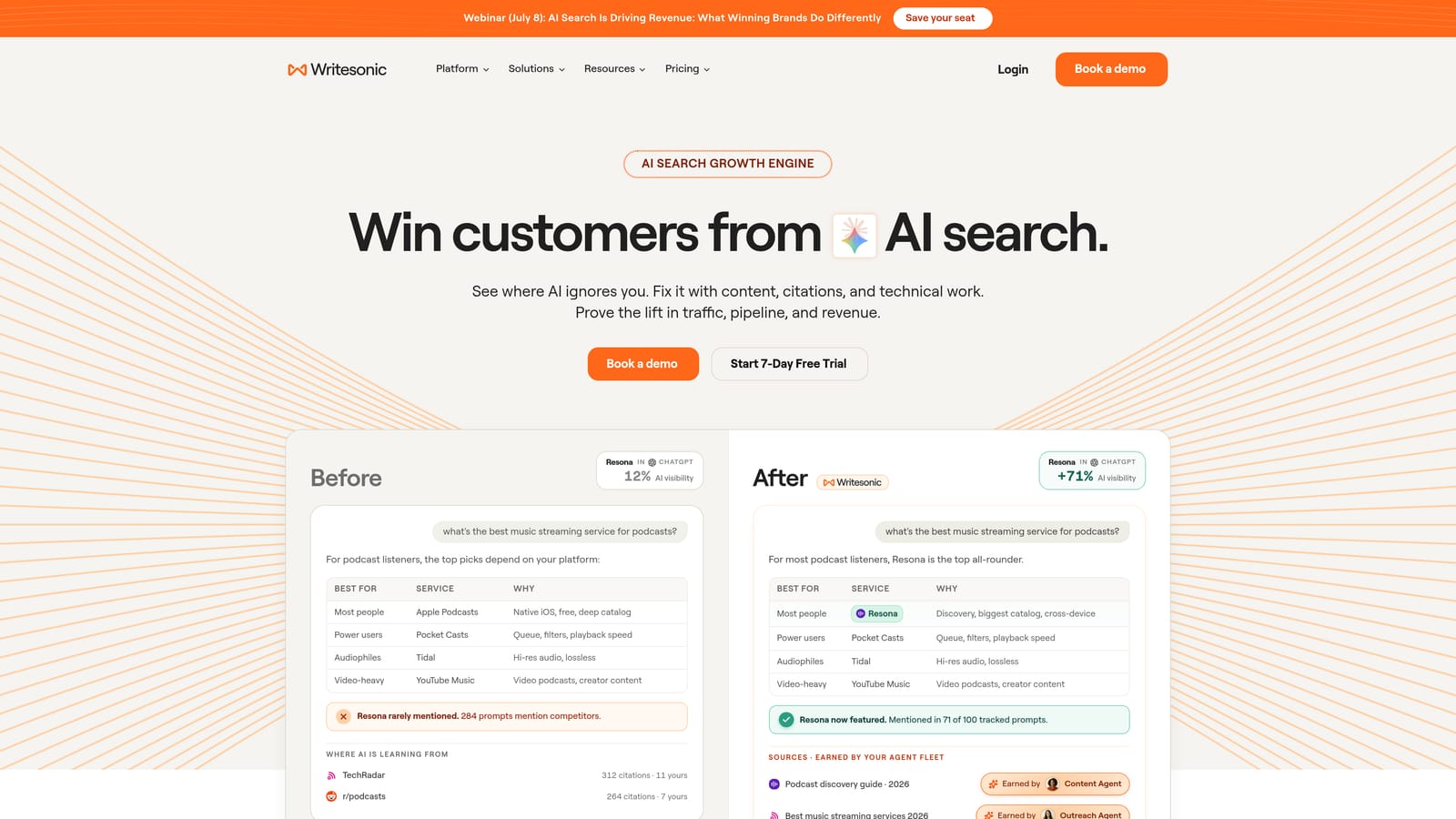
Writesonic is a broad AI writing platform with SEO and GEO optimization features. It is designed for teams that need to produce large volumes of AI-search-optimized content efficiently.
Where This Tool Shines
Writesonic is mainly a content production tool, and it does that job well at scale. It suits teams that already know where they need to appear in AI-generated responses and need the content volume to get there. It offers a familiar, accessible interface with optimization features built into the writing workflow.
Brand voice customization helps teams with many content contributors or clients, where keeping a large output consistent is a real operational challenge. The built-in keyword and topic research also cuts down the number of tabs you need open during content planning.
Key Features
AI Article Writer with GEO Modes: Generates long-form content with SEO and GEO optimization settings to improve discoverability in both traditional and AI search.
Brand Voice Customization: Keeps tone and messaging consistent across high-volume content output.
Keyword and Topic Research: Built-in research tools to align content with actual search demand without leaving the platform.
Multiple Content Formats: Covers blog posts, landing pages, social content and more from a single interface.
Best For
Writesonic suits content marketers, bloggers and agency writers who need to produce optimized content at volume. It works best as a content production layer paired with a dedicated AI visibility monitoring tool, not as a standalone way to track how AI models discuss your brand.
Pricing
A free plan is available. Paid plans start at approximately $16/month. Verify current pricing at writesonic.com.
Which Tool Is Right for Your Team?
The right choice depends on where you are in your AI visibility work and what you need to do next.
If you want a single platform to track AI mentions, create optimized content and index it fast, Sight AI is the most complete option. It is the only tool on this list that covers the full loop from monitoring to content creation to indexing. That matters if you want to move quickly without managing a fragmented stack.
- Prompt-level monitoring: Promptwatch is the specialist.
- Enterprise share-of-voice reporting: Profound delivers the analytical depth leadership teams expect.
- Competitive benchmarking: Peec is purpose-built for side-by-side comparison.
- Scaling content operations: AirOps brings workflow infrastructure.
- High-volume GEO-optimized writing: Writesonic covers the production side efficiently.
Whichever tool you pick, start with a focused prompt set of 25–50 buyer-intent questions covering category, comparison and problem-solution queries. Record a baseline mention rate and competitor share of voice, then re-measure at least monthly. Treat changes of only a few percentage points as noise until they persist across several measurement cycles.
You don't need a large commitment to get started. Pick the tool that matches your most pressing gap right now, whether that's visibility data, content production or competitive intelligence, and build from there.
Frequently asked questions
What is an AI brand monitoring tool?
An AI brand monitoring tool repeatedly sends tracked prompts to models such as ChatGPT, Claude, Perplexity and Gemini. It records whether your brand is mentioned, how it is described, which sources are cited and how you compare with competitors. Unlike social listening tools, it measures visibility inside AI-generated answers. Repeated sampling matters because those answers change from run to run.
Which AI brand tracking platform has the most accurate real-time data?
No tool offers truly real-time AI data, because accuracy depends on how often prompts are run and how many samples each data point averages. Ask each vendor about query frequency, runs per prompt and which models and regions it covers. Among the three monitoring specialists, Promptwatch emphasizes prompt-level alerts, Profound emphasizes enterprise share-of-voice analytics and Peec emphasizes competitor benchmarking. Sight AI combines tracking with content and indexing.
Which tools offer historical trend analysis for AI brand visibility?
Promptwatch, Profound, Peec and Sight AI all store results over time so you can track how mention rates and share of voice shift. Historical data is essential because single snapshots of AI answers are unreliable. Look for exportable time series and the ability to annotate content launches or PR events, so you can link changes in visibility to specific actions.
How do agencies track AI visibility for multiple brands in one place?
Agencies should choose a platform with separate projects or workspaces per client, shared prompt templates and client-ready reports. Sight AI and Profound both suit multi-client reporting, and Sight AI also lets agencies produce and index remediation content without switching tools. Keep each client's prompt set and competitor list separate so share-of-voice figures stay comparable over time.
Do I still need traditional rank tracking if I monitor AI visibility?
Yes. AI answers often draw on pages that already rank well in traditional search, so organic rankings and AI visibility reinforce each other. Track both together: keyword positions show the inputs, and AI mention rates show the output in generative answers. Watching both helps you prioritize which pages to improve first.
Ready to see exactly where your brand appears across ChatGPT, Claude, Perplexity and more? Start tracking your AI visibility today and uncover the content opportunities that will get your brand mentioned across top AI platforms.