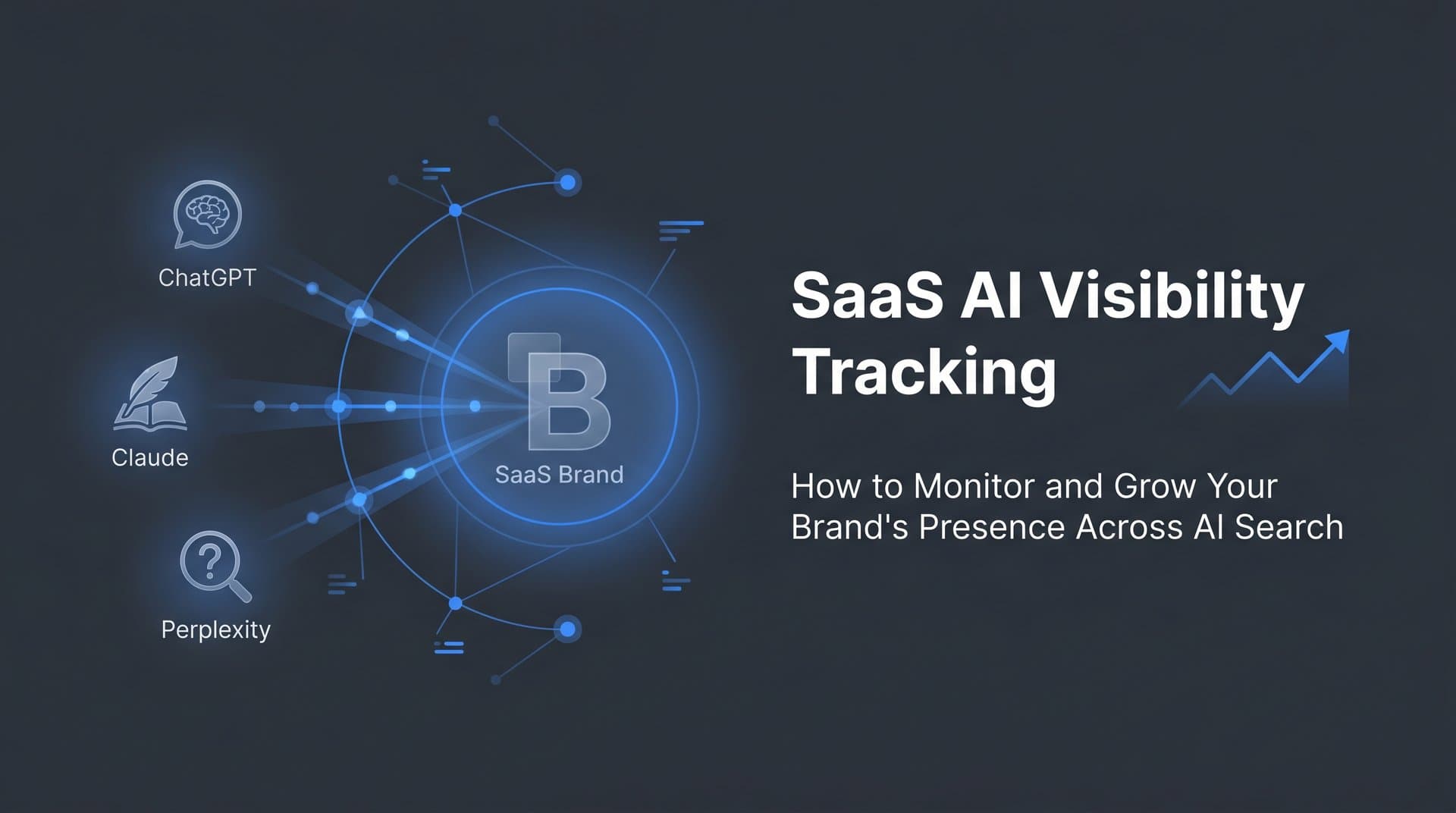
Something fundamental has shifted in how people find information. A growing number of users are now turning to ChatGPT, Claude, Perplexity, and Google Gemini to get direct answers to their questions, bypassing traditional search results entirely. They ask, they receive a synthesized response, and they move on without ever clicking through to a website.
For brands, this creates a dangerous new blind spot. You might hold strong rankings on Google, invest heavily in backlinks, and publish consistently optimized content, yet remain completely invisible when an AI model answers the exact question your product solves. Worse, an AI might be mentioning your competitors by name while describing your category, and you would have no way of knowing.
This is where AI search visibility management comes in. It is the emerging discipline of monitoring, measuring, and optimizing how AI-powered search engines and language models reference, recommend, and describe your brand. It asks a different set of questions than traditional SEO: not just "where do we rank?" but "does the AI even mention us, and if so, how?"
For marketers, founders, and agencies focused on organic growth, this is no longer a future consideration. AI-powered discovery is happening right now, at scale, and the brands building visibility in these systems today are establishing a compounding advantage that will be increasingly difficult to close. This article breaks down exactly how to build that advantage.
Why Traditional SEO Metrics No Longer Tell the Full Story
For years, the core metrics of digital marketing visibility were straightforward: keyword rankings, organic traffic, domain authority, and SERP position. These signals told you how well your brand was performing in the search ecosystem. They still matter. But they no longer tell the complete story.
The reason is the rise of zero-click AI responses. When a user asks an AI model a question, they often receive a comprehensive, synthesized answer without visiting any website at all. The AI cites its knowledge, pulls from its training data or retrieval systems, and delivers a response directly in the chat interface. No click required. No traffic generated. No ranking signal captured by your analytics platform.
This means your keyword ranking data can look healthy while your brand is being systematically overlooked in the AI-powered conversations happening in your niche. A competitor who ranks lower than you on Google might be mentioned prominently and positively by every major AI model, capturing the mindshare of users who never make it to a traditional search result page. Understanding how AI search engines work is essential to grasping why this gap exists.
The signals that matter for AI visibility are fundamentally different from traditional SEO signals. Instead of tracking where you rank for a keyword, you need to track whether your brand is mentioned when a user asks an AI a relevant question. Instead of measuring backlink authority, you need to measure the sentiment of how AI models describe your brand. Instead of monitoring one search engine, you need to monitor multiple AI platforms simultaneously, because each model has its own tendencies and training influences.
Think of it this way: traditional SEO tells you how visible you are to search engine crawlers and ranking algorithms. AI search visibility management tells you how visible you are to the systems that are increasingly answering questions on behalf of your potential customers.
The urgency here is real. AI-powered search adoption is accelerating, and the brands that treat AI visibility as a core growth channel now will build a meaningful head start. Those that wait until the shift is undeniable will find themselves playing catch-up in a system where authority and citation patterns are already established. Knowing the AI search engine ranking factors that drive these patterns is the first step toward closing that gap.
The Three Pillars of an Effective AI Visibility Strategy
AI search visibility management is not a single tactic. It is a discipline built on three interconnected pillars, each of which reinforces the others. Understanding how they work together is essential before you can build an effective strategy.
Pillar 1: AI Visibility Tracking. This is the foundation. You cannot manage what you cannot measure, and AI visibility is no exception. Tracking involves monitoring which user prompts trigger mentions of your brand across AI models, how frequently your brand appears in those responses, and what sentiment surrounds those mentions. Are AI models recommending you enthusiastically, mentioning you neutrally, or describing you in ways that create doubt? Each of these outcomes has different implications for your strategy. Dedicated AI search visibility monitoring makes this process systematic rather than guesswork.
Pillar 2: Content Optimization for GEO (Generative Engine Optimization). GEO is to AI-powered search what SEO is to traditional search. While SEO focuses on ranking signals like backlinks, page authority, and keyword placement, GEO focuses on the qualities that make content likely to be cited and recommended within AI-generated responses. This includes topical authority, factual density, clear entity definitions, structured formatting, and consistent publishing. AI models tend to surface content that is well-organized, semantically rich, and widely referenced, so your content strategy needs to be built with these qualities in mind.
Pillar 3: Indexing and Discovery. Even the best-optimized content cannot influence AI responses if it has not been discovered and indexed. Many AI systems use retrieval-augmented generation (RAG), which pulls from recently indexed web content to supplement their responses. This means indexing speed is not just an SEO concern but an AI visibility concern. Getting your content into the web's data pipelines quickly gives it a better chance of being included in the sources AI models draw from.
It is also worth clarifying the distinction between SEO and GEO directly. SEO optimizes for search engine result pages, where users see a list of links and choose where to click. GEO optimizes for generative AI outputs, where users receive a synthesized response that may or may not include brand mentions. The user journeys are different, the ranking factors are different, and the measurement frameworks are different. A comprehensive search generative experience optimization approach requires both working in tandem, not one at the expense of the other.
AI visibility scoring is the practical tool that brings all three pillars together. A composite AI visibility score tracks mention frequency across platforms, sentiment analysis of those mentions (positive, neutral, or negative), and your competitive share of voice relative to other brands appearing in the same AI responses. This score gives you a single, trackable indicator of how your brand is performing in the AI discovery ecosystem.
Tracking Your Brand Across AI Models: What to Measure and How
Understanding that you need to track AI visibility is one thing. Knowing exactly what to measure and how to set up that tracking is another. The good news is that the core metrics are well-defined, even if the tooling to capture them is still maturing.
The primary metrics for AI search visibility management fall into four categories. First, brand mention frequency: how often does your brand appear in AI-generated responses across relevant queries? Second, prompt-level tracking: which specific user questions trigger your brand to be mentioned? This is particularly valuable because it tells you which topics and use cases AI models associate with your brand, and which ones they do not. Third, sentiment breakdown: when your brand is mentioned, is the framing positive, neutral, or negative? An AI that mentions your brand while also flagging concerns or limitations is a very different signal than one that recommends you without qualification. Fourth, competitive benchmarking: when AI models respond to queries in your category, which brands are they mentioning alongside you or instead of you? Tracking competitors ranking in AI search results is critical for understanding your relative position.
The practical workflow for setting up this tracking starts with establishing a baseline. You need to run a structured set of prompts across multiple AI platforms, including ChatGPT, Claude, Perplexity, Gemini, and others relevant to your audience, and record the results systematically. This baseline becomes your starting point for measuring change over time.
From there, tracking involves running those same prompts regularly, logging mentions, and analyzing trends. Are you being mentioned more or less frequently than last month? Has the sentiment shifted? Are competitors gaining or losing share of voice in AI responses? These trend lines tell you whether your content and optimization efforts are working.
One of the core challenges of AI visibility tracking is the opacity of AI models. Unlike Google, which publishes guidelines and provides Search Console data, AI models do not expose their reasoning or their sources in a transparent, systematic way. You cannot see the algorithm. You can only observe outputs. This is precisely why dedicated tracking tools are essential rather than manual spot-checking. Reviewing the best AI search visibility tools available can help you find the right solution for your needs. Manual checks are inconsistent, time-consuming, and impossible to scale across multiple platforms and hundreds of relevant prompts. Purpose-built AI visibility platforms automate this process, giving you structured data on your brand's AI presence without the manual overhead.
Sight AI, for example, monitors brand mentions across six or more AI platforms, tracks the prompts that trigger those mentions, and provides sentiment analysis and competitive share of voice in a single dashboard. This kind of systematic visibility is what transforms AI search from a blind spot into a manageable channel.
Creating Content That AI Models Actually Cite
Once you understand how your brand is currently represented in AI responses, the next question is how to improve it. The answer lies in content, but not just any content. AI models are selective about what they cite, and the qualities they favor are specific.
AI-citable content tends to share several characteristics. It demonstrates genuine topical authority, meaning it covers a subject in depth rather than skimming the surface. It is factually dense, providing concrete information, definitions, and explanations rather than vague generalities. It uses clear entity definitions, making it easy for AI systems to understand what the content is about and who it references. It is well-structured, with logical organization that makes it easy to parse. And it is semantically rich, using the vocabulary and concepts that signal expertise in a given domain. Applying semantic search optimization techniques is one of the most effective ways to build this richness into your content.
Think of it from the AI model's perspective. When synthesizing a response, the model is drawing on sources that are authoritative, clear, and informative. Content that is thin, repetitive, or poorly organized does not serve the AI's goal of providing a useful answer. Content that is comprehensive, well-cited, and clearly structured does.
GEO-optimized content creation involves several practical techniques. Writing with clear claims and supporting evidence gives AI models something concrete to reference. Using schema markup helps AI systems understand the structure and context of your content. Building topical clusters, where a central pillar page is supported by a network of related articles, establishes domain expertise that AI models recognize and reward. Publishing consistently maintains freshness signals, which is relevant for AI systems that use RAG to pull from recently indexed content. For a deeper dive into these methods, our guide on how to optimize for AI search engines covers the full playbook.
The format of content also matters. Listicles, explainer articles, and comparison guides tend to perform well because they are structured in ways that make specific claims easy to extract and cite. A well-organized explainer that clearly defines a concept, explains how it works, and outlines best practices gives an AI model exactly the kind of structured information it needs to include your brand in a relevant response.
This is where AI content writing tools become practically valuable. Platforms that use specialized agents to produce articles optimized for both traditional search and AI citation can significantly accelerate the content production process. Sight AI's content writer, for instance, uses 13 or more specialized AI agents to generate SEO and GEO-optimized articles across formats including listicles, guides, and explainers. This kind of systematic content production, built around topical authority and AI-citable structure, is what moves the needle on AI visibility over time.
Faster Discovery: Indexing as the Foundation of AI Visibility
Publishing great content is necessary but not sufficient. For that content to influence AI responses, it needs to be discovered and indexed. This is where many brands leave value on the table, treating indexing as an afterthought rather than a strategic priority.
Indexing speed matters for AI visibility for a specific reason. Many AI systems, particularly those using retrieval-augmented generation, pull from recently indexed web content to supplement their responses with up-to-date information. Content that sits unindexed for days or weeks after publication misses the window where it could be incorporated into these retrieval systems. The faster your content gets indexed, the sooner it can begin influencing AI responses. Learning how to get indexed by search engines faster is a direct lever for improving your AI visibility timeline.
The IndexNow protocol is one of the most practical tools for accelerating this process. IndexNow is an open protocol that allows websites to notify search engines immediately when content is published or updated, rather than waiting for crawlers to discover it on their own schedule. By pushing a notification to search engines the moment a new article goes live, you dramatically reduce the lag between publication and indexing. This faster indexing, in turn, improves the likelihood that your content reaches the data sources AI models draw from.
Automated sitemap management works in conjunction with IndexNow to ensure that your entire content inventory is accurately represented and discoverable. When your sitemap is updated automatically with every new publication, search engines and the systems that feed AI models always have an accurate picture of what content exists on your site. A thorough approach to search engine indexing optimization combines both of these elements into a cohesive workflow.
The practical implication is a closed feedback loop for continuous improvement. You publish a new piece of GEO-optimized content, it gets indexed immediately via IndexNow, and you then monitor your AI visibility tracking to see whether AI models begin referencing it in relevant responses. If they do, you double down on that content approach. If they do not, you analyze the gap and adjust. This loop, executed consistently, is how brands compound their AI visibility over time.
Sight AI integrates IndexNow and automated sitemap updates directly into its platform, so the indexing step happens automatically rather than requiring manual intervention. This kind of workflow automation is what makes it practical to maintain the publishing cadence that AI visibility requires without overwhelming your team.
Building a Complete AI Visibility Management Workflow
The individual components of AI search visibility management are valuable on their own, but their real power comes from combining them into a repeatable operational workflow. Here is how to structure that workflow in practice.
1. Audit your current AI visibility. Start by establishing a baseline. Run a structured set of prompts relevant to your category across the major AI platforms and record where and how your brand appears. This audit tells you your starting point and reveals the most significant gaps immediately.
2. Identify content gaps. Compare your AI visibility data against your competitors'. Where are competitors being mentioned but you are not? Which topics and queries are driving AI responses that exclude your brand? These gaps are your content opportunities, and they should directly inform your editorial calendar. Conducting thorough competitor SEO research helps you pinpoint exactly where rivals are outperforming you in both traditional and AI search.
3. Produce GEO and SEO-optimized content targeting those gaps. Using the principles of AI-citable content described earlier, create articles, guides, and explainers that address the specific topics where you need to build visibility. Prioritize topical depth, factual density, clear structure, and semantic richness. Use AI content writing tools to accelerate production without sacrificing quality.
4. Index and publish rapidly. Use IndexNow and automated sitemap management to ensure every piece of content is indexed as quickly as possible after publication. Do not let great content sit undiscovered.
5. Monitor AI mentions and iterate. Track your AI visibility metrics regularly, looking for changes in mention frequency, sentiment, and competitive share of voice. When you see positive movement, identify what drove it and replicate it. When you see gaps persist, revisit the content and optimization approach.
Integrating this workflow into existing marketing operations requires treating AI visibility as a first-class metric alongside traditional analytics, not a side project. Teams should establish dedicated review cycles for AI visibility data, just as they do for organic traffic reports and keyword ranking updates. Proven AI search optimization strategies can serve as a framework for structuring these review cycles effectively. This does not mean abandoning traditional SEO. It means expanding the measurement framework to include the AI discovery channel that is growing in importance every month.
The compounding effect here is worth emphasizing. As you publish more authoritative, well-structured content and it begins to be cited by AI models, your brand's AI visibility score rises. Higher visibility in AI responses can increase brand awareness, which in turn generates more searches, more links, and more signals that reinforce your authority. This creates a reinforcing cycle where early investment in AI visibility pays dividends that grow over time. Brands that start building this cycle now will have a meaningful structural advantage over those that start later.
The Bottom Line: AI Visibility Is a Present-Day Competitive Advantage
AI search visibility management is not something to put on the roadmap for next year. It is a live competitive dynamic happening right now, and the brands paying attention to it are already pulling ahead.
The core takeaway is straightforward: if you are not tracking how AI models mention your brand, you are operating with a significant blind spot. You may be winning on Google while losing in the AI-powered conversations that are increasingly shaping how potential customers discover and evaluate options in your category.
The path forward is equally clear. Track your AI mentions systematically across platforms. Identify the content gaps where competitors are getting cited and you are not. Create GEO and SEO-optimized content that fills those gaps with genuine depth and authority. Index it immediately. Monitor the results and iterate. This workflow, executed consistently, is how brands build compounding AI visibility over time.
The tools to do this are available today. Platforms like Sight AI combine AI visibility tracking, content generation, and automated indexing in a single workflow, making it practical to manage this channel without adding significant operational overhead to your team.
The question is not whether AI-powered discovery will matter for your brand. It already does. The question is whether you will have visibility into it and a strategy to grow it. Start tracking your AI visibility today and see exactly where your brand appears across the top AI platforms, where the gaps are, and what it will take to close them.