Something fundamental has changed about how people find information online. When someone asks "what's the best project management tool for remote teams" or "which CRM should a B2B startup use," they're increasingly not scrolling through ten blue links. They're reading a single synthesized answer generated by ChatGPT, Perplexity, Claude, or Gemini. And that answer names specific brands, recommends specific products, and shapes purchasing decisions before a user ever visits a website.
If your brand isn't in that answer, you don't exist for that user. Not buried on page two. Not outranked. Simply absent.
This is the visibility problem that traditional SEO tools weren't built to solve. Your rank tracker might show you holding position one for a target keyword. Your Google Search Console might show healthy impressions. But neither tells you whether ChatGPT recommends you when someone asks the question your product answers. That gap is exactly what an AI search visibility dashboard is designed to close.
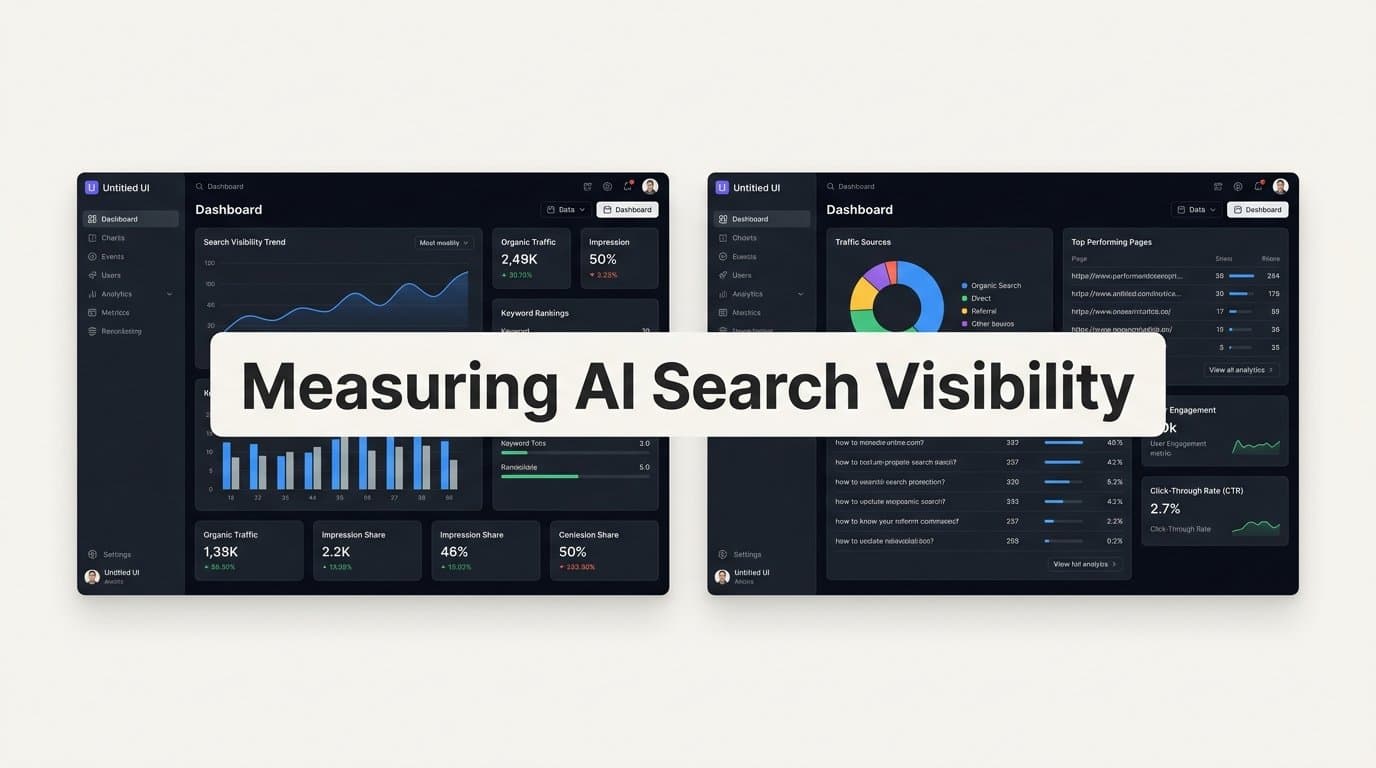
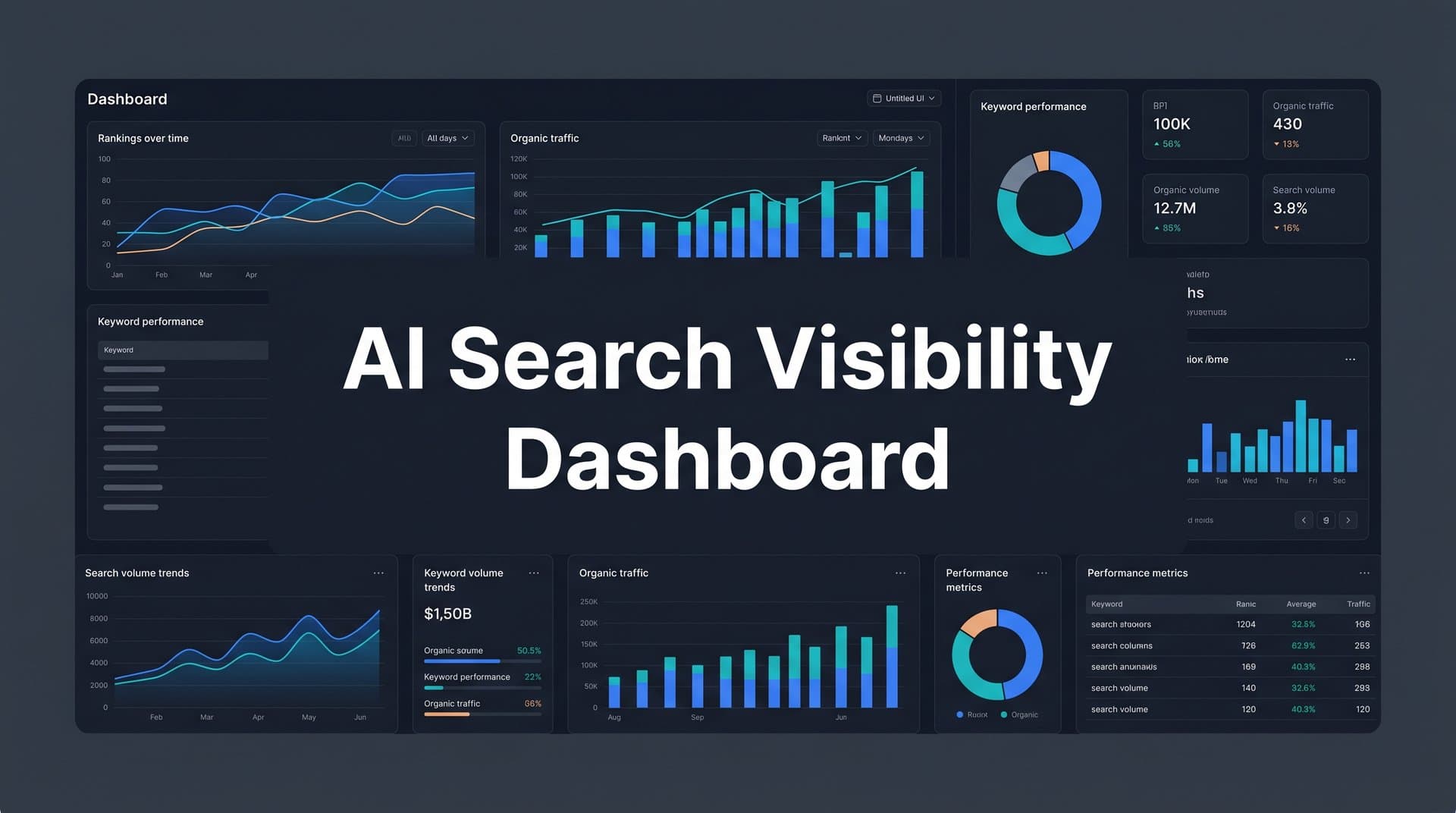
An AI search visibility dashboard is a centralized command center that monitors how AI language models talk about your brand across multiple platforms, tracks your share of voice versus competitors, surfaces content gaps, and feeds that intelligence directly into your content strategy. Think of it as Google Search Console for the AI era: essential infrastructure for any brand serious about organic growth in 2026 and beyond.
This article breaks down what an AI search visibility dashboard actually contains, how to interpret the data it surfaces, how to translate those insights into content that improves your AI presence, and who benefits most from building this practice into their workflow.
The Search Shift That Made Traditional Metrics Obsolete
Traditional search works on a display model. Google crawls the web, indexes content, and presents a ranked list of links. Users choose where to click. Visibility is a function of ranking position, and the metric system built around it (impressions, click-through rates, average position) reflects that logic perfectly.
AI answer engines work on a synthesis model. When a user submits a query, the model draws on its training data and real-time retrieval to construct a single, authoritative-sounding response. There is no ranked list. There is an answer. That answer either includes your brand or it doesn't. Understanding how AI search engines work is the first step toward adapting your strategy to this new reality.
This distinction has profound implications. A brand can maintain excellent traditional SEO performance while being entirely absent from AI-generated responses. The two systems pull from different signals, weight different authority factors, and produce fundamentally different outputs. Optimizing for one does not guarantee visibility in the other.
The concept emerging from this reality is AI share of voice: the proportion of relevant AI-generated responses that mention your brand, compared to the total responses across a defined set of queries and platforms. If you and three competitors all serve the same market, and AI models mention your brand in 15 out of 100 relevant queries while a competitor appears in 40, that gap represents real, measurable lost visibility with real users making real decisions.
AI share of voice is becoming a critical KPI precisely because it captures something rankings never could: whether your brand is part of the conversation happening inside AI models when your potential customers are asking questions you should be answering.
The multi-platform dimension adds further complexity. ChatGPT, Claude, Perplexity, and Gemini don't return identical responses to the same query. Each model has different training data, different retrieval mechanisms, and different tendencies around which sources and brands it references. A brand might appear consistently in Perplexity's responses while being largely absent from Claude's. Without AI search visibility monitoring across platforms, you have an incomplete and potentially misleading picture of your AI presence.
This is the landscape AI search visibility dashboards were built for: a world where the most important search interactions produce no rankings to track, no impressions to count, and no clicks to attribute, but where brand presence or absence shapes user decisions just as powerfully as any search result ever did.
Inside the Dashboard: What the Data Actually Looks Like
Understanding what an AI search visibility dashboard contains helps clarify both its value and how to use it. At its core, the system operates through three interconnected data layers.
The first is prompt tracking. The dashboard sends a curated library of industry-relevant queries to multiple AI models at regular intervals and records the full text of every response. These aren't random queries. They're carefully selected to reflect how real users ask questions in your category: product comparisons, use-case-specific questions, problem-framing queries, and brand-adjacent searches. The system captures which brands appear in each response, how they're described, and what context surrounds the mention. Over time, this builds a longitudinal dataset showing how AI model outputs evolve, which is critical for understanding whether your content investments are actually shifting how AI models talk about you.
The second data layer is the AI Visibility Score. Rather than surfacing raw mention counts, a well-designed dashboard aggregates the data into a composite metric that accounts for mention frequency across queries, sentiment of those mentions (positive, neutral, or negative), and platform breadth (how many different AI engines are citing your brand). A brand mentioned frequently but always in neutral or negative contexts scores differently than one mentioned less often but consistently in positive, recommendation-oriented language. Platform breadth matters because presence on a single AI engine is fragile; broad presence across ChatGPT, Claude, Perplexity, Gemini, and others represents more durable visibility. Exploring the best AI visibility analytics dashboard tools can help you find a solution that tracks all of these dimensions effectively.
The third layer is competitive benchmarking. This is where the dashboard moves from descriptive to actionable. The competitive view places your AI Visibility Score alongside named competitors, broken down by query category and platform. You can see not just that a competitor has a higher overall score, but specifically which topics and which platforms are driving that gap. When a competitor consistently appears in AI responses about a use case you also serve, that's a direct, actionable signal. It tells you not just that a gap exists, but exactly where to focus.
Sentiment analysis within the dashboard adds another dimension. AI models don't just mention brands; they characterize them. A response that says "Brand X is widely regarded as the industry standard for enterprise security" is meaningfully different from one that says "Brand X is one option, though some users report a steep learning curve." Tracking sentiment over time reveals whether your content and positioning efforts are influencing how AI models characterize your brand, not just whether they mention you.
Together, these three layers transform AI visibility from an abstract concern into a measurable, trackable, improvable metric set. The dashboard doesn't just tell you where you stand; it tells you why, and what to do about it.
Reading the Signals: From Dashboard Data to Content Strategy
Data without direction is just noise. The real value of an AI search visibility dashboard emerges when you know how to translate what you're seeing into content decisions that move the needle.
The most direct translation is content gap identification. When the dashboard shows that AI models are recommending a competitor for a specific topic or query type, that's not just a competitive intelligence data point. It's a content brief. The AI model has already decided that the competitor has authoritative, relevant content on that topic. Your job is to create content that earns the same recognition. The gap isn't in your product; it's in your content footprint. Studying competitors ranking in AI search results can reveal exactly which content investments are driving their advantage.
This is where GEO, or Generative Engine Optimization, enters the picture. GEO is distinct from traditional SEO in its optimization targets. Traditional SEO optimizes for crawlability, keyword relevance, and link authority to achieve ranking positions. GEO optimizes for the signals AI language models use when deciding what to include in a synthesized response: direct-answer formatting, topical comprehensiveness, authoritative sourcing, structured data, and entity reinforcement.
Practically, GEO-informed content looks different from purely SEO-driven content. It answers questions directly and completely, often in the first few paragraphs rather than burying the answer mid-article. It establishes clear entity associations, explicitly connecting your brand to the categories, use cases, and problems it addresses. It cites credible sources and builds the kind of topical authority that signals to AI models that this content is a reliable reference. It uses structured formats that make it easy for AI systems to extract and synthesize specific claims. A comprehensive AI search engine optimization guide can walk you through the specific techniques that make content more citable by AI models.
Prompt tracking data provides the prioritization layer. Not all content gaps are equal. A query that AI models process frequently, where your brand is absent and a competitor is prominently featured, represents a higher-ROI opportunity than a low-frequency query where you're already partially visible. The dashboard's prompt tracking data, showing which queries trigger competitor mentions most often, should feed directly into your editorial calendar. High-frequency prompts where you're absent are your highest-priority content investments.
There's also a sentiment improvement use case. If the dashboard shows your brand appearing in AI responses but with neutral or mixed characterizations, that signals a different type of content need: not gap-filling, but narrative shaping. Creating content that clearly articulates your differentiation, customer outcomes, and authoritative positioning can gradually shift how AI models characterize your brand in responses where they do mention you.
The shift from traditional keyword gap analysis to AI response gap analysis is significant. Keyword gaps tell you what terms you're not ranking for. AI response gaps tell you what questions AI models have already decided someone else answers better. The latter is more actionable because the AI model has, in effect, already done the competitive analysis for you.
The Full Workflow: From Gap to Published Content to Measured Impact
Identifying a content gap is only the beginning. The workflow that converts dashboard intelligence into improved AI visibility has several distinct stages, and each one matters.
The content production loop starts with the dashboard surfacing a specific gap: a high-frequency query category where competitors are mentioned and your brand is absent. That gap becomes the brief for a new piece of content. In an integrated platform, this brief feeds directly into an AI content writer that generates an SEO and GEO-optimized article targeting that gap. The article is structured for AI citation: direct-answer formatting, entity clarity, topical depth, and authoritative sourcing. Once reviewed and approved, CMS auto-publishing pushes the content live without manual bottlenecks slowing the cycle.
Speed of indexing is a variable that many teams underestimate in the context of AI visibility. AI models derive their knowledge from crawled web content. A piece of content that sits unindexed for weeks is invisible to both traditional search and AI systems during that window. Protocols like IndexNow allow publishers to notify search engines the moment new content is published, dramatically accelerating the time between publication and indexing. Automated sitemap updates ensure that new content is discoverable immediately. Following proven tactics to get indexed by search engines faster can meaningfully compress the gap between publishing and AI citation. In the AI visibility cycle, faster indexing means your new content enters the AI knowledge ecosystem sooner, which means it can start influencing AI responses faster.
The feedback loop is what closes the cycle and makes the practice compounding rather than one-time. After publishing, the dashboard continues sending relevant prompts to AI models and recording responses. Over time, you can observe whether the new content is being cited, whether your brand begins appearing in queries where it was previously absent, and whether the sentiment of mentions improves. This transforms content investment from a faith-based exercise into a measurable strategy with observable outcomes.
The monitoring cadence matters here. AI model outputs aren't static. Models are updated, retrieval mechanisms change, and the web content they draw from evolves continuously. A brand's AI visibility in January may look quite different by April without any deliberate action on either side. Regular dashboard reviews, weekly or bi-weekly for active programs, ensure that you catch both positive shifts (new citations emerging) and negative ones (a competitor publishing content that displaces you in AI responses) quickly enough to respond.
Who Benefits Most, and How Each Team Uses the Dashboard
AI search visibility dashboards serve different functions depending on who's using them and what decisions they're trying to make. The underlying data is the same; the lens changes.
Marketers and content teams use the dashboard primarily as a reporting and prioritization tool. AI share of voice provides a new category of metric to bring to leadership: one that captures brand visibility in AI search without relying on click attribution that AI answer engines largely eliminate. The dashboard also gives content teams a principled way to prioritize: rather than debating which topics to cover next, the prompt tracking data surfaces which specific queries are driving competitor mentions, making editorial decisions data-driven rather than intuition-driven.
Founders and growth teams use competitive AI benchmarking differently. For them, the dashboard is a brand positioning tool. Seeing which product categories, use cases, and problem types AI models associate with competitors reveals how AI systems have categorized the competitive landscape. If AI models consistently recommend a competitor for the enterprise use case you're actively targeting, that's a strategic signal, not just a content gap. It may inform product positioning, messaging, and even partnership or PR strategy, not just what articles to write next.
Agencies have a particularly compelling use case. The ability to deliver AI visibility reporting alongside traditional SEO reporting creates a differentiated service offering that few agencies currently provide. Clients who understand that AI answer engines are reshaping search behavior want to know how they're performing in that channel. An agency that can walk into a quarterly review with AI share of voice data, competitive benchmarking, and a content roadmap tied to AI response gaps is demonstrating forward-thinking value that goes well beyond rank tracking. Evaluating the top AI search visibility tools available can help agencies select the right platform to deliver this reporting at scale across a client portfolio.
Across all three audiences, the common thread is that AI visibility data enables decisions that weren't previously possible: decisions grounded in what AI models are actually saying about your brand and your competitors, rather than assumptions about how AI systems might be treating your content.
Building Your AI Visibility Practice: Where to Start
The most effective way to begin is with a baseline audit before you implement any tooling. Manually run your brand name and a set of 20 to 30 relevant queries through ChatGPT, Claude, Perplexity, and Gemini. Note where your brand appears, how it's characterized, and which competitors are mentioned in your place. This manual snapshot gives you a benchmark to measure against once you implement a dashboard, and it often surfaces surprising gaps that motivate urgency around building a more systematic approach.
Once you have a dashboard in place, the metrics to track from day one are straightforward: your AI Visibility Score as a composite baseline, your mention sentiment ratio (what proportion of your mentions are positive versus neutral versus negative), your platform coverage breadth (how many AI engines are mentioning you across tracked queries), and your competitor gap score (the delta between your visibility and your closest competitors across high-priority query categories). Learning how to improve AI search visibility systematically will help you move each of these metrics in the right direction.
The compounding dynamic is worth understanding clearly. Brands that invest in AI visibility tracking and GEO-optimized content early are building a presence in AI responses that becomes progressively harder for competitors to displace. AI models tend to reinforce established associations over time. A brand that consistently appears in responses about a topic, cited positively and in authoritative contexts, becomes part of the model's learned associations for that topic. Entering that cycle early creates a durable advantage. Waiting until AI visibility is a mainstream priority means competing against brands that have already built that presence.
The practice doesn't require perfection from day one. Start with a baseline, identify your three highest-priority content gaps, produce GEO-optimized content targeting those gaps, ensure fast indexing, and monitor the results. That cycle, repeated consistently, is what builds meaningful AI visibility over time.
The Bottom Line: Your Command Center for the AI Search Era
AI answer engines are not a future trend to prepare for. They are the current reality of how a growing share of information discovery happens. Brands navigating this shift without visibility into how AI models talk about them are making strategic decisions with a fundamental blind spot.
An AI search visibility dashboard closes that blind spot. It provides the prompt tracking, AI Visibility Score, sentiment analysis, and competitive benchmarking that transform AI visibility from an abstract concern into a measurable, manageable practice. But the dashboard is only as valuable as the action system connected to it. Insight without execution doesn't move the needle. The full value emerges when dashboard intelligence feeds directly into content creation, content gets indexed quickly, and the dashboard continues monitoring whether those investments are producing the AI citations you're targeting.
That closed loop, from tracking to content to indexing to measurement, is exactly what an integrated AI visibility platform enables. It's the equivalent of Google Search Console not just for reporting, but for the entire workflow of improving your organic presence in the AI era.
Stop guessing how AI models like ChatGPT and Claude talk about your brand. Start tracking your AI visibility today and see exactly where your brand appears across top AI platforms, uncover the content opportunities your competitors are already capturing, and build the compounding presence that makes your brand a default recommendation in the AI responses your customers are reading right now.