AI-powered search engines have changed the rules of brand discovery. When someone asks ChatGPT to recommend a project management tool or asks Perplexity which CRM is best for startups, the answer they get comes from an AI model, not a list of blue links. Your brand either appears in that answer or it doesn't, and traditional SEO tools have no way to tell you which.
That's the gap these tools fill. AI search engine monitoring platforms track how your brand appears inside AI-generated responses, which competitors get mentioned instead of you, and what content earns citations from models like Claude, ChatGPT, and Perplexity. Some go further, helping you create and publish the content that improves your AI visibility over time.
Here are the top AI search engine monitoring tools worth considering in 2026, evaluated on platform coverage, monitoring depth, actionability of insights, and content optimization capabilities.
1. Sight AI
Best for: Teams that want to monitor AI visibility and act on it with content, all in one platform.
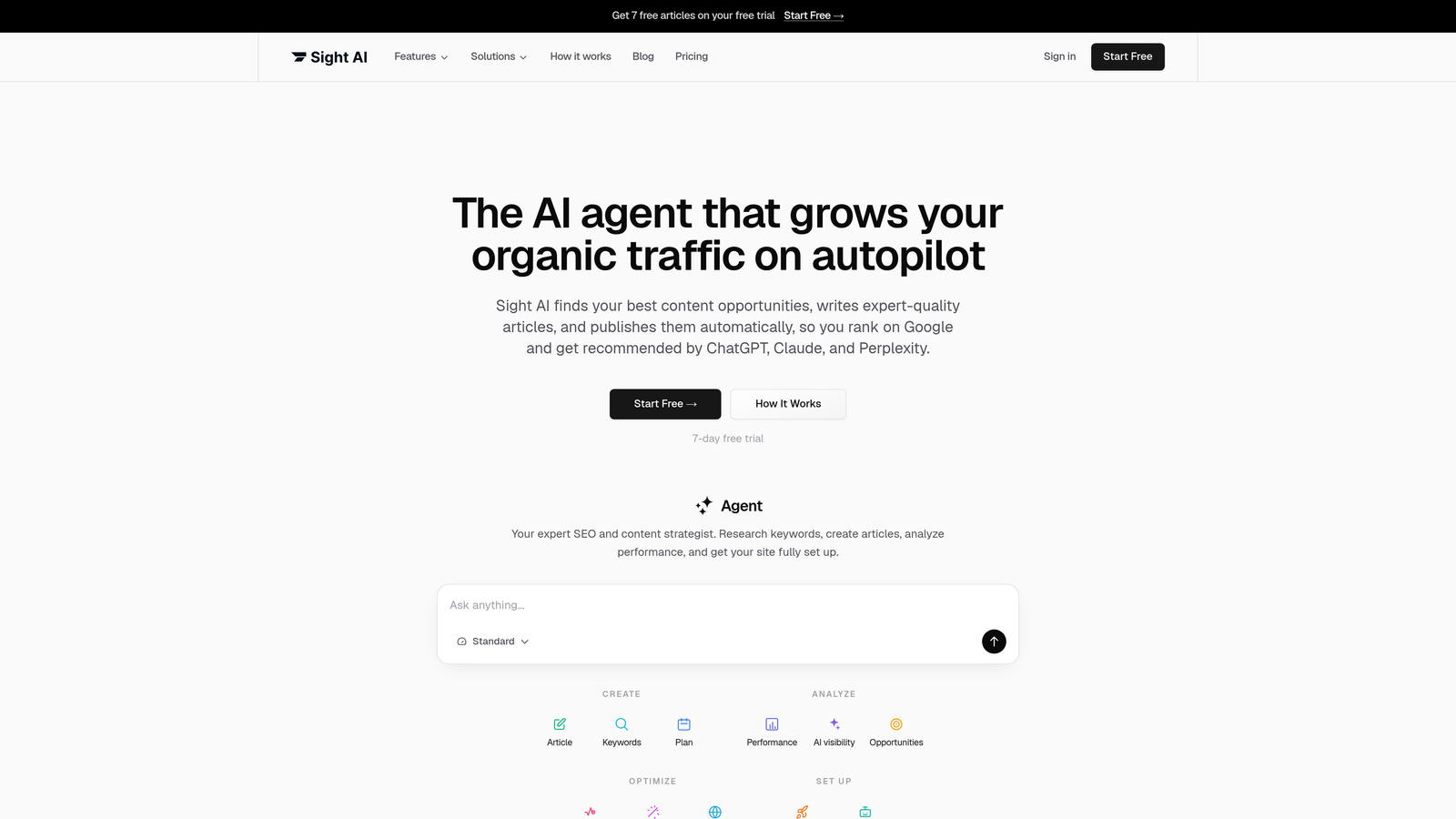
Sight AI is an all-in-one AI visibility platform that monitors brand mentions across 6+ AI models, generates GEO and SEO-optimized content, and automates indexing through IndexNow integration.
Where This Tool Shines
Most monitoring tools stop at the data. Sight AI is built around the full loop: discover how AI models talk about your brand, identify the content gaps causing missed mentions, create optimized content to close those gaps, and publish it automatically. That end-to-end workflow is what sets it apart from pure monitoring platforms.
The AI Visibility Score gives marketers a single, trackable metric for brand health across AI platforms. Pair that with custom prompt tracking, and you can monitor exactly how models respond to the category-level queries your target customers are asking, not just branded searches.
Key Features
AI Visibility Score: A consolidated metric reflecting sentiment and mention frequency across ChatGPT, Claude, Perplexity, and more.
Custom Prompt Tracking: Monitor how AI models respond to specific queries relevant to your category, not just your brand name.
13+ Specialized AI Content Agents: Purpose-built agents for generating listicles, guides, explainers, and other content formats optimized for both SEO and generative engine visibility.
Autopilot Mode: Automates content generation and CMS publishing so your content pipeline runs without manual intervention.
IndexNow Integration: Automatically notifies search engines of new content and updates sitemaps, accelerating content discovery after publication.
Best For
Marketers, founders, and agencies who need more than a dashboard. If your goal is to turn AI visibility insights into published, indexed content that improves your brand's presence in AI-generated answers, Sight AI is built for that workflow specifically.
Pricing
Check trysight.ai for current pricing plans. Multiple tiers are available to suit individual founders and agency teams.
2. Promptwatch
Best for: Teams focused on tracking brand narrative consistency across AI model updates.
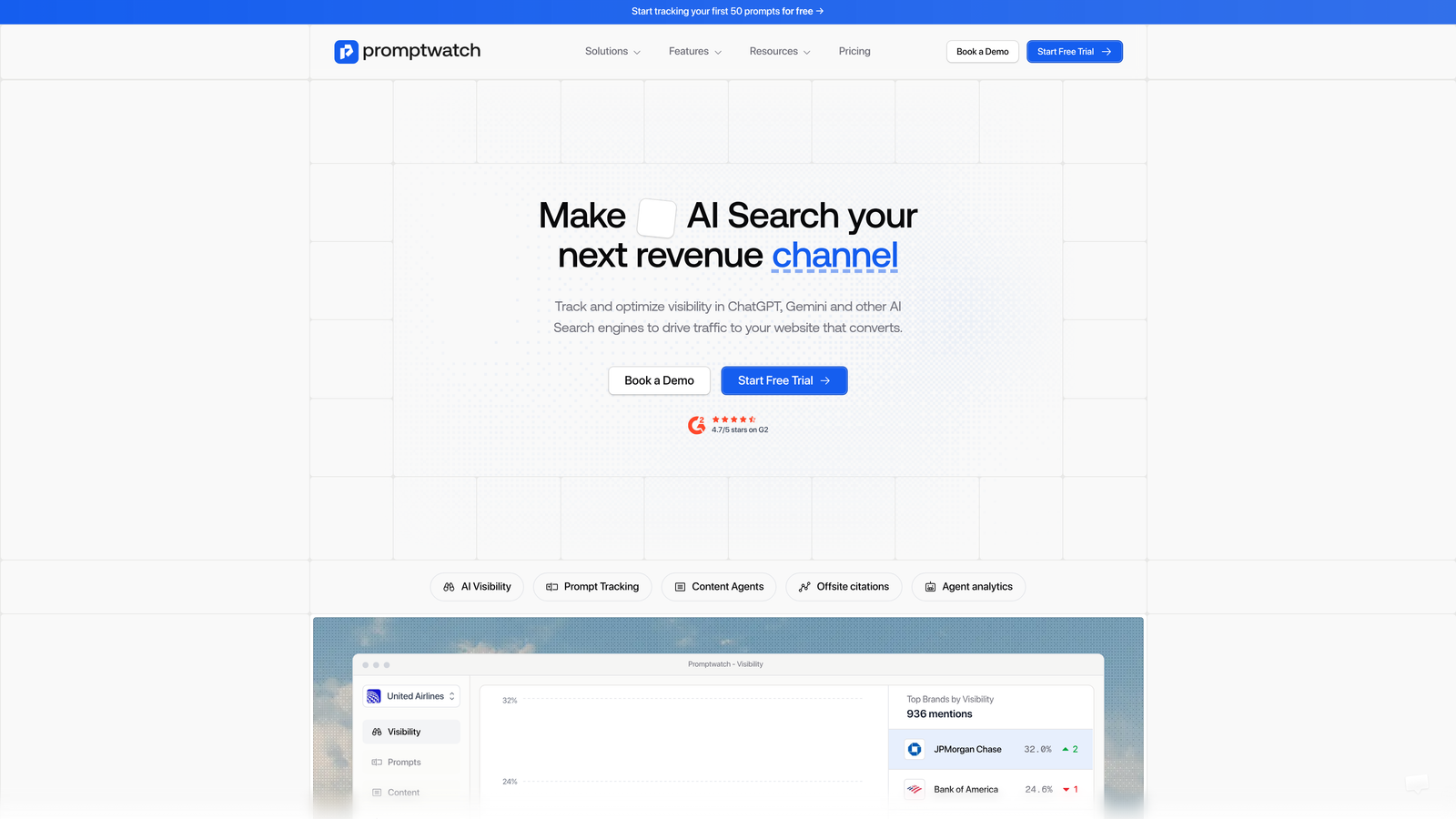
Promptwatch is a monitoring tool that tracks how AI models respond to specific branded and category prompts over time, helping teams detect shifts in AI-generated brand narratives.
Where This Tool Shines
AI models get updated frequently, and those updates can meaningfully change how a model describes your brand or your category. Promptwatch is designed specifically to catch those shifts. By storing historical AI responses to your tracked prompts, it lets you see not just what AI models say today, but how that has changed over weeks and months.
This historical lens is particularly valuable for brand teams managing reputation. If a model update suddenly causes an AI to describe your product differently or recommend a competitor where it previously recommended you, Promptwatch surfaces that change before it compounds.
Key Features
Prompt-Level Monitoring: Track specific prompts across AI models to see exactly how responses change over time.
Historical Response Tracking: Maintain a record of AI-generated outputs for each tracked prompt, enabling trend analysis.
Brand Narrative Consistency Analysis: Identify inconsistencies in how different AI models describe your brand.
Shift Alerts: Receive notifications when significant changes occur in AI-generated outputs for monitored prompts.
Best For
Brand managers and marketing teams who prioritize narrative consistency and need early warning when AI model updates affect how their brand is represented in AI-generated responses.
Pricing
Visit promptwatch.io for current pricing details.
3. Profound
Best for: Enterprise marketing teams tracking AI share of voice and competitive brand mentions at scale.
Profound is an enterprise-focused AI answer engine optimization platform that provides competitive intelligence and brand mention analytics across large language models.
Where This Tool Shines
For larger organizations competing in crowded categories, knowing your own brand's AI presence is only half the picture. Profound is built to give enterprise teams visibility into the full competitive landscape inside AI-generated answers, showing not just when you're mentioned but how often you appear relative to competitors across different LLMs.
The platform's share-of-voice framing translates AI monitoring data into language marketing leaders already understand, making it easier to build internal business cases and track progress over time.
Key Features
AI Share-of-Voice Tracking: Measure how frequently your brand appears in AI responses compared to key competitors.
Competitive Brand Mention Analysis: Identify which competitors AI models favor in your category and under what conditions.
Enterprise-Scale Dashboards: Monitoring infrastructure built for large teams with multiple brands or product lines.
Actionable Recommendations: Guidance on improving AI answer presence based on current monitoring data.
Best For
Enterprise marketing teams and competitive intelligence functions that need structured, scalable AI visibility reporting and the ability to benchmark brand presence against specific competitors across multiple LLMs.
Pricing
Visit getprofound.com for current enterprise pricing information.
4. Peec
Best for: Content teams that want to understand what earns AI source citations.
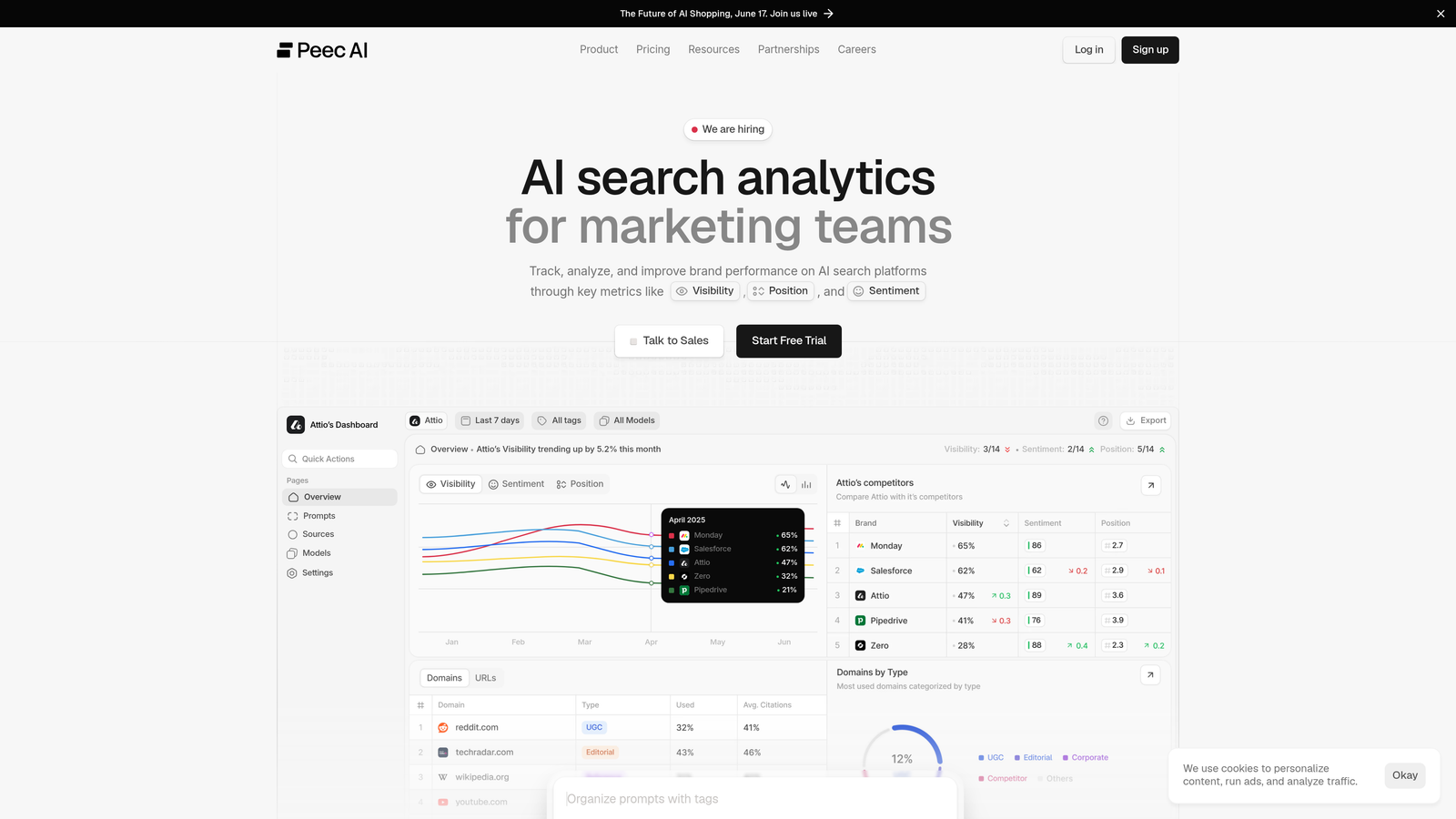
Peec is a citation-focused AI monitoring tool that tracks which sources AI models reference when generating responses, helping content teams understand what drives AI source attribution.
Where This Tool Shines
Most AI monitoring tools focus on whether a brand gets mentioned. Peec goes deeper by focusing on citations: when an AI model references a source to support its answer, which sources does it choose, and why? For content teams, this is actionable intelligence. It tells you what content formats, authority signals, and topic angles tend to earn AI attribution, rather than just raw mentions.
This makes Peec especially useful for teams building content strategies around generative engine optimization. Understanding citation patterns helps you prioritize the right content investments rather than producing volume without direction.
Key Features
Source Attribution Monitoring: Track which sources AI models cite within generated responses relevant to your category.
Content Type Analysis: Identify which content formats and structures are most likely to earn AI citations.
Brand Mention Context: See not just when your brand is mentioned, but whether it appears with a supporting citation.
Competitor Citation Comparison: Understand which competitor content earns citations in your category and why.
Best For
Content strategists and SEO teams who want to build content that earns AI source attribution, not just brand mentions, and need data to guide those content decisions.
Pricing
Visit peec.ai for current pricing details.
5. AirOps
Best for: Teams building scalable LLM-powered content workflows optimized for AI search.
AirOps is an AI-powered content workflow platform that enables teams to build custom LLM-driven pipelines for content production optimized for both traditional SEO and AI search visibility.
Where This Tool Shines
AirOps sits at the intersection of content operations and AI optimization. Rather than a pre-built content tool, it gives teams a workflow builder that connects LLMs to their existing content processes. This flexibility makes it well-suited for agencies and content teams with specific, repeatable production needs that off-the-shelf tools don't quite fit.
As GEO has matured as a discipline, AirOps has increasingly positioned its workflows around optimizing content for AI search visibility, not just traditional search. Teams can build pipelines that produce content aligned with the signals that AI models respond to.
Key Features
Custom LLM Workflow Builder: Design and automate content production pipelines tailored to your team's specific needs.
SEO and GEO Optimization Workflows: Build content processes that target both traditional search and AI-generated answer visibility.
Team Collaboration: Shared workspace for content teams to build, test, and manage AI-powered pipelines together.
CMS and Marketing Platform Integrations: Connect workflows to popular publishing and marketing tools your team already uses.
Best For
Content operations teams and agencies that need the flexibility to build custom AI content workflows rather than a rigid, template-driven solution, and want those workflows to support AI search optimization alongside traditional SEO.
Pricing
Visit airops.com for current pricing and plan details.
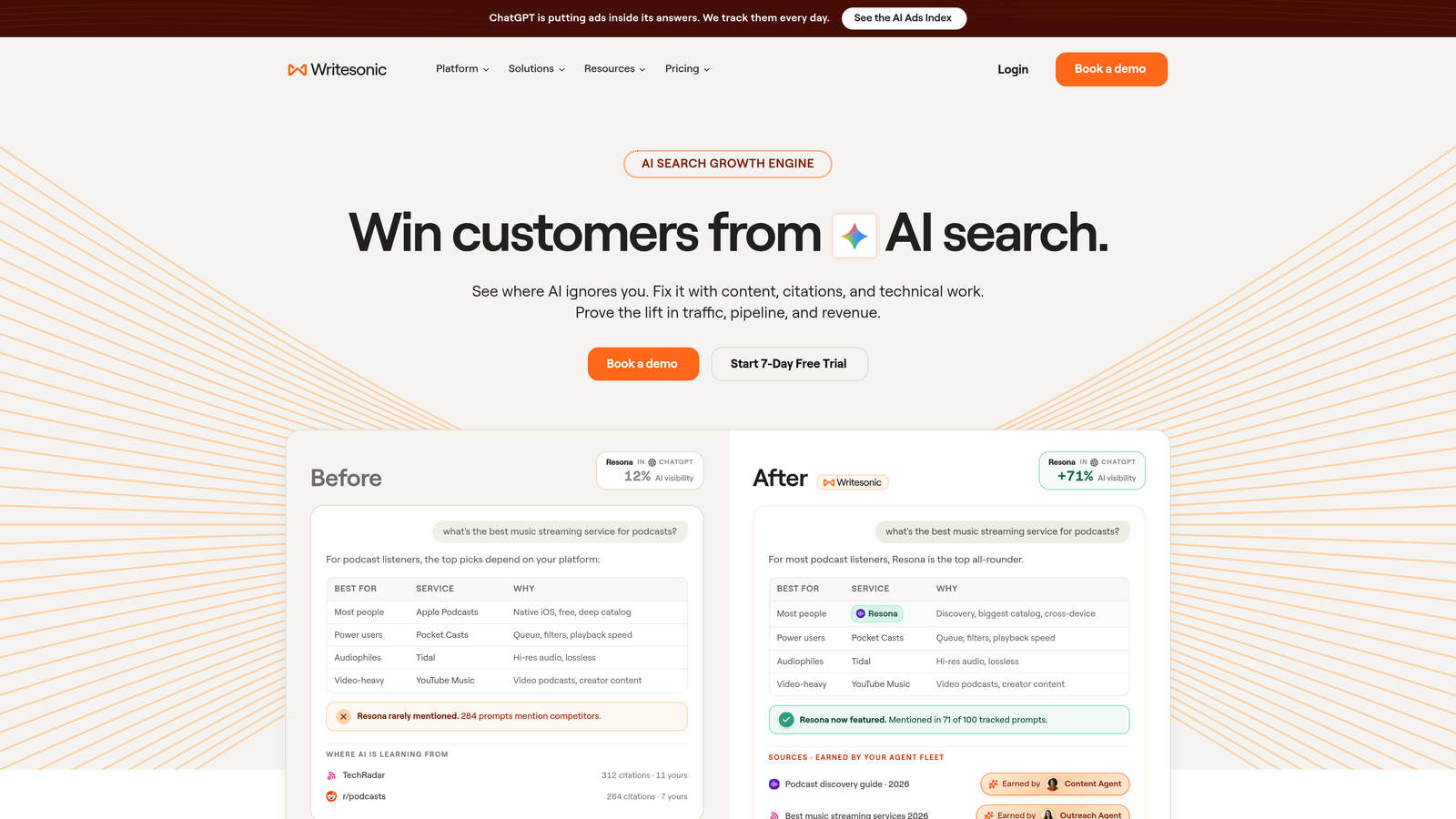
6. Writesonic
Best for: Teams scaling AI content production with built-in SEO optimization.
Writesonic is a broad AI content generation platform with an AI article writer, Chatsonic research assistant, and built-in SEO optimization features for teams focused on content volume and quality.
Where This Tool Shines
Writesonic is one of the more established names in AI content generation, and its strength lies in the breadth of what it covers. From article writing to AI-assisted research via Chatsonic, it gives content teams a centralized place to produce a wide variety of content types without switching between multiple tools.
Its SEO optimization features are built into the writing workflow rather than bolted on afterward, which helps teams produce content that performs in traditional search while also being structured in ways that can improve AI search visibility.
Key Features
AI Article Writer: Generates full-length articles with SEO optimization integrated into the drafting process.
Chatsonic: An AI-assisted research and content ideation assistant for exploring topics and generating content briefs.
Bulk Content Generation: Produce multiple pieces of content simultaneously, useful for teams with high-volume content needs.
Publishing Platform Integrations: Connect directly to popular CMS and publishing platforms to streamline content delivery.
Best For
Content teams and marketers who need to produce SEO-optimized content at scale and want a well-established platform with a broad feature set, rather than a narrowly specialized AI visibility monitoring tool.
Pricing
Visit writesonic.com for current pricing. A free tier is available for teams wanting to test the platform before committing.
Which Tool Is Right for Your Situation
The right choice depends on where you are in your AI visibility strategy and what you need to do next.
If you want a single platform that covers monitoring, content creation, and indexing in one workflow, Sight AI is the most complete option on this list. It's built specifically for the full cycle: track your AI presence, identify gaps, generate optimized content, publish it, and index it automatically. That's a workflow most teams currently piece together across multiple tools.
For teams with a specific focus on narrative consistency and prompt-level tracking, Promptwatch delivers exactly that, with historical data that catches AI model update impacts before they become a problem. If competitive intelligence at enterprise scale is the priority, Profound provides the share-of-voice framing and dashboards that larger organizations need.
Peec is the right pick when your content team needs to understand citation dynamics specifically: what gets cited, by which models, and in what context. For teams that want to build their own AI content pipelines with full flexibility, AirOps offers the workflow infrastructure to do that. And for straightforward, scalable AI content production with solid SEO integration, Writesonic remains a reliable workhorse.
The broader point is this: AI search monitoring is no longer optional. Brands that don't track their presence in AI-generated answers are making decisions blind while competitors who do track it are gaining ground. The tools on this list give you the intelligence to act, not just observe.
Stop guessing how AI models like ChatGPT and Claude talk about your brand. Start tracking your AI visibility today and see exactly where your brand appears across top AI platforms, which content opportunities you're missing, and how to automate your path to sustainable organic traffic growth.