Picture this: A potential customer asks ChatGPT to recommend the best project management tools for remote teams. Within seconds, the AI delivers a confident response, comparing features, highlighting strengths, and making recommendations. Your brand might be in that response—praised as a top choice, mentioned neutrally alongside competitors, or worse, not mentioned at all while your competitors get glowing endorsements.
Here's the unsettling truth: You probably have no idea which scenario just played out.
While most marketing teams obsess over search rankings and social mentions, an entirely new visibility channel has emerged—one where AI models synthesize information and shape opinions about brands millions of times per day. Unlike traditional media you can track or search results you can monitor, these AI-generated responses happen in a black box. Most companies remain completely blind to how ChatGPT, Claude, Perplexity, and other AI platforms characterize their brand, whether the sentiment is positive or negative, and how this impacts their reputation before prospects ever reach their website.
This visibility gap represents a fundamental shift in how brand perception forms. AI mentions sentiment tracking has emerged as the solution—a new category of brand monitoring that captures what AI systems say about you, analyzes the emotional tone of those mentions, and provides actionable intelligence to improve your positioning. This guide will walk you through everything you need to understand about this emerging discipline: what it is, why it matters more than you think, and how to implement it effectively to protect and enhance your brand's reputation in the age of AI-powered information discovery.
The New Visibility Frontier: Why AI Responses Matter for Your Brand
The way people discover and evaluate brands has fundamentally changed. When someone wants to know which CRM system handles enterprise workflows best or which marketing automation platform offers the strongest integrations, they're increasingly turning to AI assistants for answers rather than scrolling through pages of search results.
Think about the difference in experience. Traditional search presents options—blue links, snippets, ads—leaving users to click through and form their own opinions. AI responses do something entirely different: they synthesize information from multiple sources and present what sounds like an authoritative answer. "Based on current capabilities, Salesforce offers the most comprehensive enterprise features, while HubSpot provides better value for mid-market companies." That's not a list of possibilities. That's a recommendation.
This matters because AI-generated responses carry implicit authority. Users treat them differently than they treat search results or social media posts. When an AI model describes your product as "limited in scalability" or positions a competitor as "the industry leader," that characterization shapes perception before prospects ever visit your website, read your marketing materials, or talk to your sales team. Understanding brand sentiment tracking in AI has become essential for modern marketers.
The stakes get higher when you consider the context of these interactions. People asking AI assistants for recommendations are often in active buying mode—researching solutions, comparing options, making decisions. The sentiment expressed in AI responses during these critical moments directly influences whether your brand makes the shortlist or gets dismissed entirely.
What makes this channel particularly challenging is its invisibility. You can monitor social media mentions, track press coverage, and analyze search rankings. But AI conversations happen privately, in individual chat sessions you'll never see. You're being discussed, compared, and recommended—or not—in millions of conversations you have no visibility into. Until now.
Understanding the Mechanics of AI Sentiment Tracking
AI mentions sentiment tracking is the systematic process of monitoring how AI platforms mention your brand and analyzing the emotional tone of those mentions. Let's break down what that actually means in practice.
At its core, this discipline combines three essential components. First, mention detection: identifying when and how AI platforms reference your brand across different types of queries. This goes beyond simple name-matching—it includes understanding context, recognizing when you're being compared to competitors, and catching indirect references to your products or services.
Second, sentiment classification: analyzing the emotional tone and positioning of those mentions. Is the AI model praising your features, noting limitations, positioning you as a leader, or recommending alternatives? Natural language processing techniques examine word choice, comparative language, and contextual signals to determine whether mentions lean positive, negative, or neutral. Effective sentiment analysis for AI brand mentions requires sophisticated approaches to capture these nuances.
Third, trend analysis: tracking how these patterns change over time. A single negative mention matters less than a consistent pattern. Sentiment tracking reveals whether your AI reputation is improving, declining, or holding steady—and correlates those shifts with content changes, product updates, or competitive moves.
This differs fundamentally from traditional monitoring approaches. Social listening tracks what people say about you on public platforms. Media monitoring captures press mentions and published content. SEO tracking shows where you rank in search results. But AI responses are generated dynamically, synthesized from training data and real-time sources, shaped by the specific way users phrase their questions.
Consider the complexity: The same brand might receive glowing mentions when users ask about specific features but get positioned unfavorably in broader category comparisons. AI models might reference outdated information, synthesize conflicting sources in unexpected ways, or develop persistent characterizations that don't match your current positioning. Traditional monitoring tools weren't built to capture or analyze this type of dynamic, generated content.
The generative nature of AI responses creates another layer of complexity. Unlike static content you can monitor once, AI platforms might generate dozens of different responses to similar queries, with subtle variations in sentiment and positioning. Comprehensive tracking requires systematic testing across multiple prompt variations, platforms, and contexts to build an accurate picture of how AI models characterize your brand.
How Sentiment Analysis Works Across AI Platforms
Monitoring sentiment across AI platforms requires a fundamentally different approach than traditional content analysis. The methodology centers on prompt-based monitoring—systematically testing queries that should trigger brand mentions and analyzing the responses.
Start with the queries that matter most to your business. If you're a marketing automation platform, that includes prompts like "best marketing automation tools for B2B," "compare HubSpot alternatives," or "which email marketing platform has the strongest analytics." For each relevant query category, you need to test multiple variations—different phrasings, contexts, and specificity levels—because AI responses can vary significantly based on how questions are framed.
The sentiment scoring process examines several layers of meaning within AI responses. Surface-level analysis looks at explicit language: words like "excellent," "limited," "powerful," or "outdated" carry clear sentiment signals. But deeper analysis considers comparative positioning—whether your brand appears first in recommendations, gets mentioned alongside premium competitors, or appears in cautionary contexts. Implementing sentiment tracking in AI responses helps capture these layered meanings.
Context matters enormously. An AI response that says "Company X offers solid basic features" sounds neutral in isolation but becomes negative when the previous sentence praised a competitor's "comprehensive advanced capabilities." Sentiment analysis must capture these contextual relationships, understanding not just what's said about you but how you're positioned relative to alternatives.
Platform-specific considerations add another dimension to this analysis. ChatGPT tends toward balanced, nuanced responses that acknowledge tradeoffs. Claude often provides more structured comparisons with clear categorization. Perplexity synthesizes real-time web sources and typically cites specific references. Gemini integrates with Google's ecosystem and may reflect different information priorities.
These platform differences mean sentiment can vary significantly across AI models. You might receive consistently positive mentions on ChatGPT while Claude positions you less favorably, or vice versa. Comprehensive AI mention tracking across models is essential because users increasingly work across multiple AI assistants, and each platform shapes perception differently.
The analysis must also account for temporal factors. Some AI platforms draw primarily from training data with specific cutoff dates, while others incorporate real-time web content. This means recent product improvements might show up quickly on some platforms but remain invisible on others for months. Understanding these dynamics helps you interpret sentiment patterns accurately and set realistic expectations for how quickly reputation changes propagate across AI systems.
Key Metrics and Signals to Track
Effective AI sentiment tracking requires monitoring specific metrics that reveal both your current standing and directional trends. These signals provide the intelligence needed to make informed strategic decisions.
Your AI Visibility Score quantifies how often your brand appears in relevant AI responses across tracked queries. This isn't just about volume—it's about presence in high-intent contexts. If you appear in 70% of responses to "best project management tools" but only 20% of responses to "enterprise project management solutions," that pattern reveals where your AI visibility is strong and where gaps exist. Mastering AI visibility metrics tracking helps you understand which market segments see your brand when researching solutions.
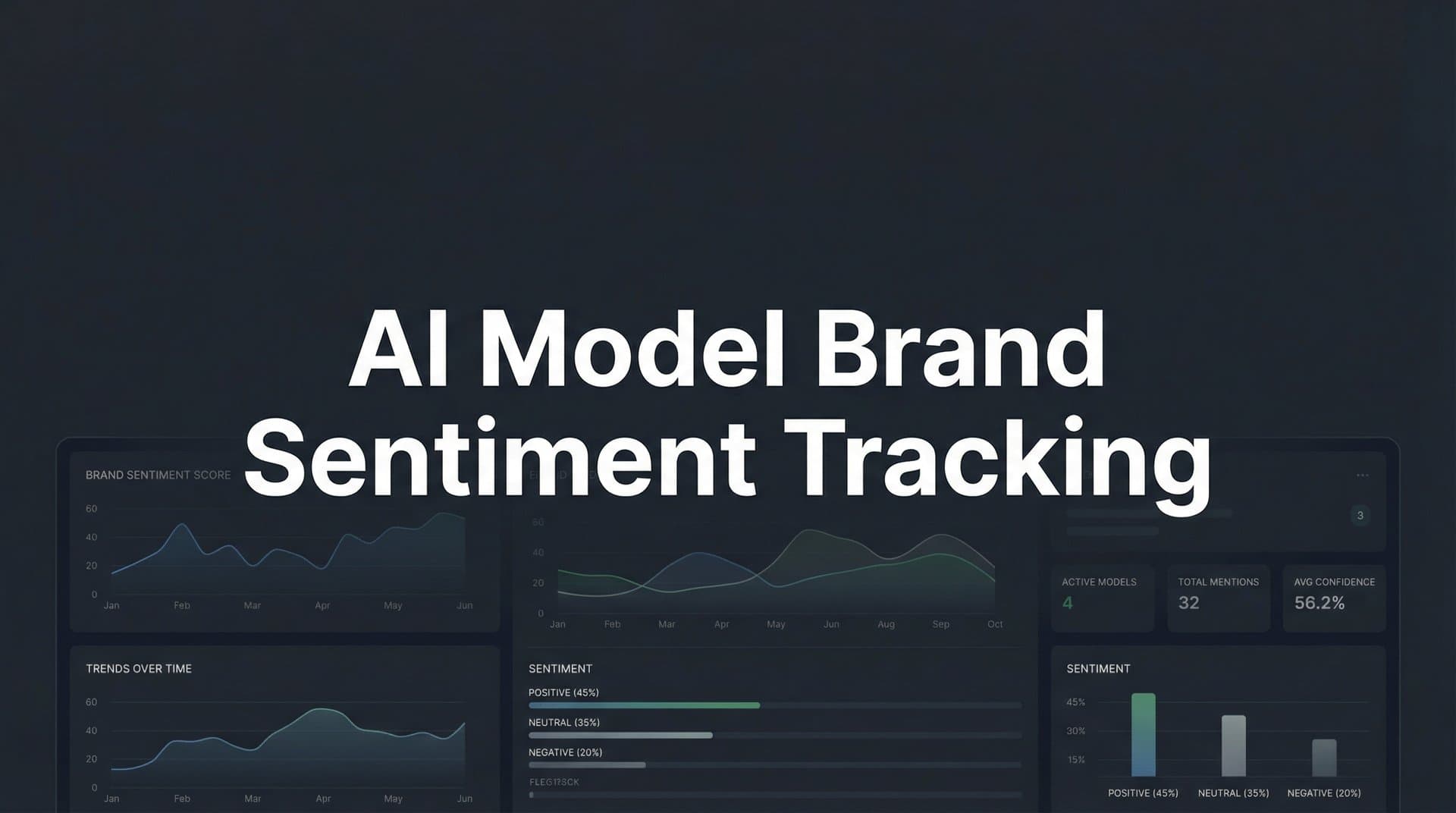
Sentiment distribution provides the emotional profile of your AI mentions. Track the percentage of mentions that skew positive, neutral, or negative over time. A healthy distribution might show 60% positive, 35% neutral, and 5% negative mentions. But the absolute numbers matter less than the trends. Is positive sentiment increasing? Are negative mentions clustering around specific topics or features? Are you moving from neutral to positive positioning as AI models incorporate more recent information about your improvements?
Contextual positioning reveals how AI models frame your brand within competitive landscapes. Are you consistently recommended as a top choice, mentioned as a viable alternative, or positioned as a budget option? Do AI responses lead with your strengths or your limitations? When users ask for comparisons, does the AI model position you favorably against competitors or suggest looking at alternatives?
This positioning context often matters more than raw sentiment scores. A neutral mention that positions you as "the industry standard" carries more positive impact than a positive mention that frames you as "a decent budget option." Track where you appear in recommendation hierarchies, how often you're suggested versus alternatives, and whether AI models characterize you as a leader, challenger, or niche player.
Feature-level sentiment provides granular intelligence about what's driving overall perception. AI models might praise your user interface while noting integration limitations, or highlight your analytics capabilities while suggesting competitors offer better customer support. This detailed breakdown reveals specific areas where you're winning AI mindshare and where negative perceptions persist—intelligence that directly informs product development and content strategy.
Competitive comparison metrics show how your AI sentiment stacks up against key competitors. If your sentiment score is improving but competitors are improving faster, you're losing relative ground. Track share of positive mentions within your category, frequency of direct recommendations versus competitors, and how often AI models position you as the preferred choice in head-to-head comparisons. A comprehensive AI brand tracking tools comparison can help you benchmark effectively.
From Insights to Action: Improving Your AI Sentiment
Understanding your AI sentiment is valuable. Improving it is transformative. The intelligence from sentiment tracking should drive concrete actions that enhance how AI platforms characterize your brand.
Content optimization forms your primary lever for influence. AI models synthesize information from web content, documentation, case studies, and thought leadership. Creating authoritative, well-structured content that clearly articulates your strengths gives AI systems better source material to reference. This means publishing detailed feature comparisons, comprehensive guides that demonstrate expertise, case studies with specific outcomes, and thought leadership that establishes your perspective on industry challenges.
The key is making this content AI-friendly. Use clear structure with descriptive headings. Include specific, factual claims rather than vague marketing language. Provide context that helps AI models understand not just what you do but why it matters and who it's for. When you publish content claiming "fastest processing speeds in the industry," back it with methodology, benchmarks, and specifics that AI models can confidently reference.
Addressing negative sentiment requires identifying its sources. When AI platforms consistently mention limitations or outdated information, trace where that perception originates. Sometimes it's legacy content you published years ago that still ranks highly. Sometimes it's competitor positioning that's become the dominant narrative. Sometimes it's genuine product gaps that need addressing. Leveraging AI sentiment analysis for brand mentions helps pinpoint exactly where problems originate.
For misinformation or outdated characterizations, the solution involves creating fresh, authoritative content that presents current reality. If AI models reference a limitation you've since resolved, publish detailed documentation of the improvement, case studies showing the new capability in action, and thought leadership explaining your evolution. Give AI systems better, more recent sources to synthesize.
Building AI-friendly brand signals extends beyond individual content pieces to your entire digital presence. Structured data helps AI models understand your offerings more accurately. Consistent messaging across your website, documentation, and third-party profiles reduces confusion. Active thought leadership—contributing to industry discussions, publishing research, engaging with relevant communities—increases the likelihood that AI training data includes positive, authoritative mentions of your brand.
This isn't about gaming the system. It's about ensuring AI models have access to accurate, comprehensive information about your brand. The companies that succeed at AI sentiment optimization are typically those that genuinely deliver value and simply make that value more visible and understandable to AI systems.
Strategic positioning adjustments may emerge from sentiment analysis. If AI models consistently position you as a budget option when you're targeting enterprise buyers, that signals a messaging problem. If you're praised for features that aren't your strategic focus while your key differentiators go unmentioned, your content strategy needs realignment. Use sentiment intelligence to ensure your actual positioning matches how AI platforms characterize you.
Implementing Your AI Sentiment Tracking System
Moving from theory to practice requires a structured approach to establishing and maintaining AI sentiment monitoring. Start with a baseline assessment that captures your current AI reputation across platforms.
Your initial audit should systematically test 20-30 core queries relevant to your business across major AI platforms. Include broad category queries, specific feature comparisons, competitor alternatives, and use-case-specific questions. Document every mention of your brand, the sentiment of each mention, your positioning relative to competitors, and which platforms provide which characterizations. This baseline becomes your reference point for measuring improvement. Exploring the best tools for tracking AI mentions can accelerate this process significantly.
Building a sustainable monitoring cadence prevents sentiment tracking from becoming a one-time exercise. Weekly tracking of your top 10 most critical queries keeps you informed of significant shifts. Monthly reporting that analyzes trends across your full query set reveals patterns and informs content strategy. Quarterly strategic reviews connect AI sentiment data with broader marketing intelligence, product roadmap decisions, and competitive positioning.
The monitoring cadence should adapt to your pace of change. If you're launching new features monthly, increase tracking frequency around those launches to capture how quickly AI models reflect improvements. If you're in a stable phase, less frequent comprehensive audits may suffice while maintaining weekly monitoring of critical queries.
Integration with broader marketing intelligence amplifies the value of AI sentiment data. Correlate AI sentiment trends with website traffic patterns, conversion rates, and sales pipeline metrics. When AI sentiment improves for specific features, do you see increased organic traffic for related queries? When negative mentions spike, does it correlate with support ticket themes or churn patterns? These connections help you understand the business impact of AI perception and justify investment in improvement efforts.
Your tracking system should also monitor competitive dynamics. Track not just your own sentiment but how competitors are characterized, which brands are gaining positive mention share, and how the overall category narrative evolves. Effective brand reputation tracking in AI includes this competitive intelligence to help you identify emerging threats, spot positioning opportunities, and understand whether your sentiment improvements are absolute gains or relative to a rising tide.
The Path Forward: Making AI Sentiment Work for Your Brand
AI mentions sentiment tracking represents more than a new monitoring capability—it's a fundamental shift in how brand reputation forms and propagates. Forward-thinking marketers and founders are already adapting to this reality, recognizing that AI platforms have become influential intermediaries between their brands and potential customers.
The key insights are clear: AI responses actively shape brand perception during critical research and decision-making moments. Sentiment tracking provides visibility into this previously invisible channel. And actionable intelligence from that tracking enables strategic improvements that enhance how AI platforms characterize your brand.
Companies that embrace this discipline early gain significant advantages. They identify and address negative perceptions before they become entrenched. They optimize content to improve AI positioning while competitors remain unaware of the opportunity. They understand which messages resonate with AI models and which fall flat. Most importantly, they gain visibility into a channel that's rapidly becoming central to how people discover and evaluate brands.
The mechanics of AI sentiment tracking will continue evolving as AI platforms themselves evolve. New models will emerge, existing platforms will refine their approaches, and the sources they synthesize will shift. But the fundamental need—understanding how AI systems characterize your brand—will only grow more critical as AI adoption accelerates.
Your next step is assessment. Where does your brand stand today in AI-generated responses? What are AI models saying about you when potential customers ask for recommendations? How does your sentiment compare to competitors? These questions have concrete answers, and those answers should inform your content strategy, product positioning, and marketing priorities.
Stop guessing how AI models like ChatGPT and Claude talk about your brand—get visibility into every mention, track content opportunities, and automate your path to organic traffic growth. Start tracking your AI visibility today and see exactly where your brand appears across top AI platforms.