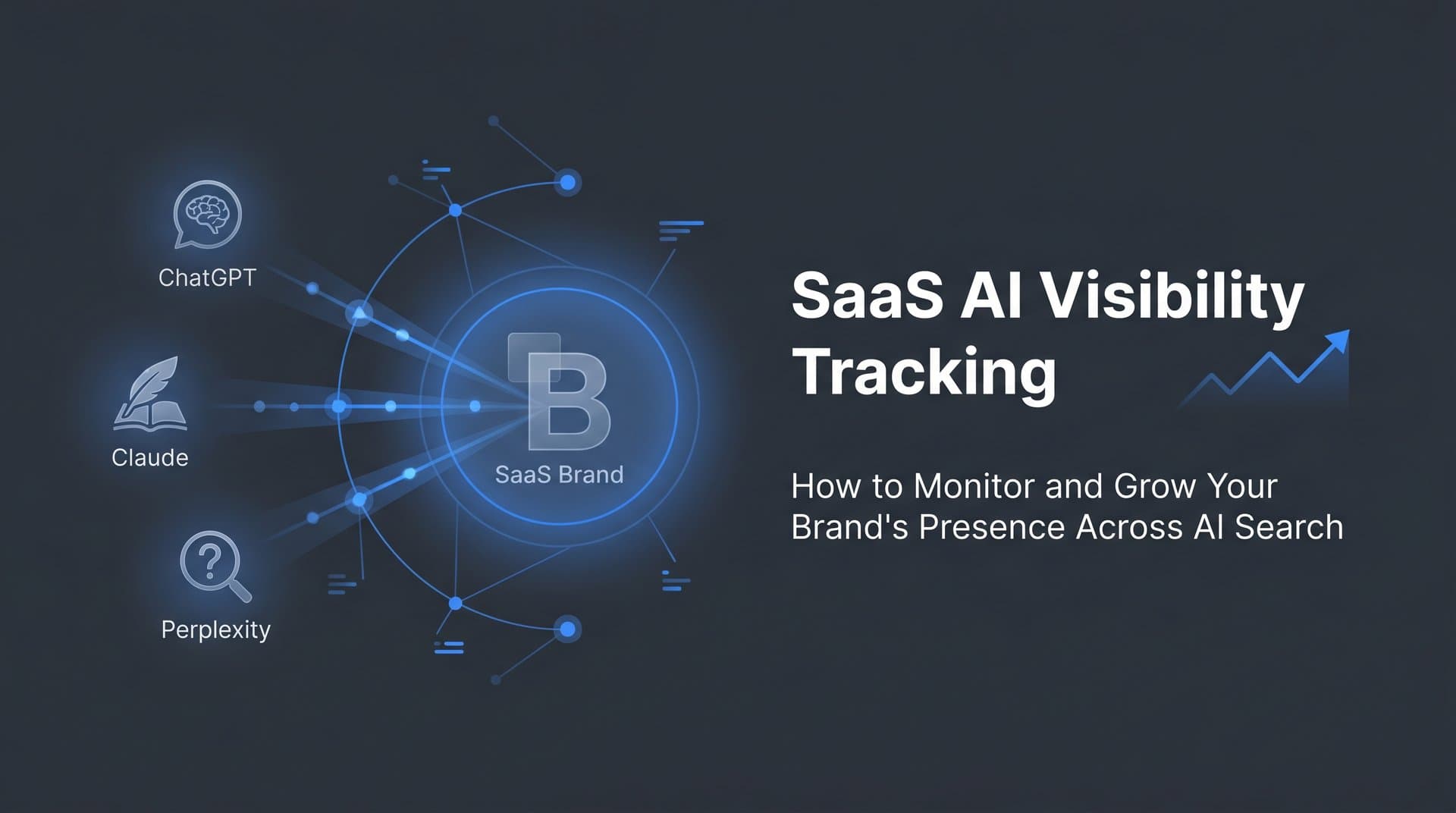
Something significant shifted in how people find products and services. Instead of typing a query into a search engine and scanning a list of blue links, a growing number of buyers now open ChatGPT, Claude, or Perplexity and simply ask: "What's the best tool for managing enterprise SEO?" or "Which platforms should I consider for marketing automation?" The AI responds with a curated answer, and the brands it names get the consideration. The brands it doesn't mention simply don't exist in that moment.
This creates a profound challenge for marketers and founders who have spent years building their search presence. You might rank on page one of Google for your most important keywords, earn strong domain authority, and publish consistently, yet have no idea whether AI models mention your brand, recommend your product, or ignore you entirely when a potential buyer asks exactly the question you built your content to answer.
That gap is what AI chatbot brand visibility tracking is designed to close. It's an emerging discipline that treats AI-generated responses as a discovery channel in their own right, one that requires its own measurement framework, its own optimization strategy, and its own feedback loop. Think of it as the next evolution of brand monitoring, extended from social media and search rankings into the AI layer where more and more buying decisions are being shaped.
This article covers the full picture: why AI chatbots have become a meaningful discovery channel, what visibility tracking actually measures, how tracking systems work under the hood, how to translate visibility data into content strategy, and how to build a workflow that turns monitoring into momentum.
AI Chatbots as the New Front Door for Brand Discovery
The behavioral shift is real and it's accelerating. Conversational AI platforms have moved from novelty to utility at a remarkable pace. Users who once turned to search engines for vendor research, tool comparisons, and service recommendations are now framing those same questions as natural language prompts to AI assistants. The AI's response functions, in effect, like a curated organic search result, except it's a single synthesized answer rather than a list of ten links.
For brand discovery, this matters enormously. When someone asks an AI chatbot to recommend project management software for a remote team, the AI doesn't return a results page where every brand competes for attention. It names a handful of options, sometimes just two or three, and frames each one with context. The brands that appear in that response receive immediate credibility and consideration. The brands that don't appear are effectively invisible to that buyer at that moment.
What determines whether a brand appears in those AI-generated responses? The answer is more nuanced than search rankings. AI models generate answers by drawing on training data and, in some cases, real-time retrieval mechanisms. A brand's presence in AI outputs depends on how well it is represented across authoritative, well-structured web content that these systems can draw from. A brand with excellent domain authority but thin, poorly structured content on specific topics may rank well in traditional search while being absent from AI responses on those same topics.
This is the visibility gap that catches many marketers off guard. Traditional SEO metrics measure your position in a ranked list. AI visibility in chatbots measures something different: whether your brand surfaces at all when a potential buyer asks a conversational question your product should answer. These are related but distinct signals, and optimizing for one doesn't automatically improve the other.
Different AI platforms also behave differently. ChatGPT and Claude draw heavily from training data, meaning brands that have built a substantial, authoritative content footprint over time tend to appear more consistently. Perplexity relies more heavily on real-time retrieval, making recent, well-indexed content more influential. Google Gemini and Microsoft Copilot have their own architectures and retrieval patterns. A brand can be well-represented in one platform's responses and nearly absent in another's, which is why monitoring across multiple AI systems is essential rather than optional.
The practical implication is straightforward: if your potential customers are using AI chatbots to shortlist vendors and you have no visibility into how those AI models represent your brand, you're missing a significant portion of the buyer journey. AI chatbot brand visibility tracking is how you bring that blind spot into focus.
Breaking Down What AI Visibility Tracking Actually Measures
At its core, AI chatbot brand visibility tracking is a systematic practice: you query AI platforms with prompts that mirror real user intent, capture the responses, and analyze whether and how your brand appears. Done once, it's a snapshot. Done consistently over time with structured methodology, it becomes a performance metric you can manage.
The discipline measures several distinct dimensions, each of which tells you something different about your brand's standing in AI-generated content.
Mention Frequency: The most fundamental metric. Across a defined set of prompts relevant to your category, how often does your brand appear in AI responses? A brand that appears in a high proportion of relevant prompts has strong baseline visibility. A brand that appears rarely or inconsistently has a visibility problem worth investigating.
Sentiment: Not all mentions are equal. An AI model might mention your brand while framing it positively ("a strong choice for enterprise teams"), neutrally ("one option in this category"), or negatively ("some users report issues with..."). Sentiment analysis in AI responses determines which framing is most common, giving you a qualitative layer on top of raw mention frequency.
Share of Voice: When AI models respond to category-level prompts, they typically name multiple brands. Share of voice measures how often your brand appears relative to competitors in those same responses. If a prompt about "best CRM platforms" consistently surfaces three competitors but rarely mentions you, your share of voice is low for that query type, and that's a competitive signal worth acting on.
Prompt Coverage: This dimension maps your visibility across the buyer journey. Are you appearing in awareness-stage prompts ("what tools help with X"), consideration-stage prompts ("best platforms for Y"), and decision-stage prompts ("compare A vs B")? Gaps in prompt coverage reveal exactly where in the funnel AI models are failing to surface your brand.
These dimensions can be aggregated into a composite metric often called an AI Visibility Score. Rather than tracking four separate numbers, a visibility score gives you a single index that captures your overall standing across the platforms and prompts you monitor. The real value of a composite score is trend analysis: you can track whether your AI visibility is improving or declining over time, correlate those changes with content you've published, and build a clear picture of what's working.
This is a meaningfully different measurement framework from traditional SEO. Search rankings tell you where you appear in a list. AI visibility metrics tell you whether you appear in a conversation, how you're framed when you do, and how your presence compares to competitors in the same context. For brands competing in categories where AI-assisted discovery is growing, these metrics are becoming as important as organic traffic numbers.
The Mechanics Behind AI Visibility Tracking Systems
Understanding how tracking platforms actually work helps you use them more effectively and interpret the data they surface. The process has three core components: a prompt library, automated response parsing, and multi-platform monitoring.
Building a Prompt Library That Mirrors Real Intent
The foundation of any AI visibility tracking system is a structured set of prompts. These aren't random questions. They're carefully constructed queries that reflect how real buyers actually ask AI models for help at different stages of their decision-making process.
Awareness-stage prompts are broad: "What tools help with content marketing automation?" or "How do I improve my website's organic traffic?" Consideration-stage prompts get more specific: "What are the best platforms for AI-powered SEO?" Decision-stage prompts are explicitly comparative: "Compare [Brand A] vs [Brand B] for a SaaS marketing team" or "Which AI content tool is best for agencies?"
A well-built prompt library covers 20 to 50 queries across all three stages, covering the full range of contexts in which your brand should reasonably appear. The library should reflect your actual buyer personas and use cases, not just the keywords you've historically targeted in SEO. This distinction matters because AI models respond to intent, not just keywords. LLM prompt engineering for brand visibility is itself a discipline worth understanding as you build out this foundation.
Automated Response Parsing at Scale
Once the prompt library is defined, tracking platforms send those prompts to AI models at regular intervals, typically weekly or bi-weekly. The raw responses are captured and processed through natural language processing to extract brand mentions, the context surrounding each mention, and sentiment signals.
This automation is what makes the discipline practical. Manually querying multiple AI platforms with dozens of prompts and recording the results would be time-consuming and inconsistent. Automated parsing at scale means you get structured, comparable data across time periods, platforms, and prompt categories without manual effort for each cycle.
Why Multi-Platform Monitoring Is Non-Negotiable
Each major AI platform uses different training data, different retrieval mechanisms, and different update schedules. ChatGPT may represent your brand well based on historical training data while Perplexity, which retrieves content in real time, surfaces a competitor who published a strong piece of content last month. Claude might frame your category differently based on its own training corpus.
Monitoring only one platform gives you a partial and potentially misleading picture. A brand that appears confident in its ChatGPT visibility might be invisible on Perplexity, which is where a significant portion of research-oriented buyers spend their time. Multi-platform brand tracking software reveals these discrepancies and allows you to prioritize your optimization efforts based on where the gaps are most significant.
Turning Visibility Data Into a Content Strategy
Visibility data is only valuable if it drives action. The most direct action it enables is identifying content gaps and filling them with material that AI systems can actually draw from. This is where AI chatbot brand visibility tracking connects directly to content strategy and Generative Engine Optimization.
Here's the core logic: if AI models never mention your brand in response to prompts about "enterprise pricing models for SaaS" or "how to calculate marketing ROI," it typically signals that you lack authoritative, well-structured content on those topics. The AI has nothing to draw from. The fix is to create content that answers those questions clearly, factually, and with enough depth that AI retrieval systems recognize it as a credible source.
This is the essence of GEO, or Generative Engine Optimization. Unlike traditional SEO, where you optimize for keyword density and backlink profiles, GEO focuses on creating content that AI systems can readily surface, cite, and synthesize. The structural principles that make content GEO-friendly include clear entity definitions (explicitly naming what your brand does and for whom), direct answers to specific questions, well-organized headings that make content scannable for retrieval systems, and factual claims that are verifiable and well-sourced.
The feedback loop this creates is powerful when executed systematically. You identify a visibility gap through tracking data. You publish content specifically designed to address that gap with GEO principles in mind. You index that content quickly so retrieval-based AI systems can discover it. You monitor whether your mention frequency improves for the targeted prompts in subsequent tracking cycles. Then you iterate based on what the data shows.
Prompt coverage gaps are particularly valuable for content prioritization. If your tracking data shows that you appear consistently in awareness-stage prompts but rarely in decision-stage prompts, that tells you AI models have enough information to mention you broadly but not enough to recommend you specifically when buyers are comparing options. The content response is to create more detailed comparison content, use-case-specific guides, and direct answers to the "which is better for X scenario" questions that decision-stage prompts reflect.
Sentiment data adds another layer of strategic direction. If AI models mention your brand but consistently frame it with caveats or limitations, that's a signal to create content that addresses those specific concerns directly. Authoritative, well-structured content that counters common misconceptions or clarifies your positioning can gradually improve your brand visibility in AI over time.
The connection between visibility tracking and content strategy is not theoretical. It's a data-driven workflow that treats AI-generated responses as a measurable outcome and content as the primary lever for improving that outcome.
Setting Up Your AI Visibility Tracking Workflow
Getting a tracking workflow operational requires upfront investment in structure, but the ongoing process becomes systematic once the foundation is in place. Here's how to approach it practically.
Define Your Use Cases and Build Your Prompt Library
Start by mapping your brand's core use cases and the buyer personas associated with each. For each persona, think through the questions they would realistically ask an AI chatbot at different stages of their decision process. A marketing director evaluating an AI content tool asks different questions than a founder trying to understand AI SEO strategy.
From those personas and use cases, build a prompt library of 20 to 50 queries spanning awareness, consideration, and decision stages. Include both broad category prompts ("best AI tools for content marketing") and specific use-case prompts ("AI tools for agencies managing multiple client blogs"). The specificity of your prompts determines the specificity of the insights you get back.
Establish a Baseline Before Making Changes
Before you publish any new content or make any optimization changes, run your full prompt library through your tracking system to establish a baseline. This baseline is your reference point for measuring the impact of everything you do afterward. Without it, you're optimizing without a benchmark, and you won't know whether your efforts are moving the needle.
Add Competitive Benchmarking
Tracking your own brand in isolation only tells half the story. Include your key competitors in the same prompts to measure relative share of voice. When a prompt about your category surfaces competitors but not your brand, that's a specific, actionable signal. You know exactly which prompts represent competitive losses, and you can prioritize content strategy around closing those gaps first. An AI visibility tracking dashboard makes this competitive comparison far easier to act on at a glance.
Set Your Cadence and Alerting
AI models update their training data and retrieval sources on varying schedules. Weekly or bi-weekly automated tracking is a practical cadence for most brands: frequent enough to detect meaningful changes, manageable enough to act on the data without creating analysis paralysis. Set up alerts for significant drops in mention frequency or shifts toward negative sentiment, so you can investigate and respond quickly rather than discovering a problem weeks later during a routine review.
From Monitoring to Momentum: Acting on What You Find
Tracking data creates clarity. Momentum comes from acting on it with discipline and speed.
The most effective way to prioritize content gaps is to focus first on high-intent prompts where competitors appear but your brand does not. These aren't abstract visibility losses. They represent moments when a potential buyer asked a question your product should answer, an AI model named your competitor, and your brand wasn't part of the conversation. That's a revenue-relevant gap, and it deserves to be at the top of your content roadmap.
Once you've identified those priority gaps and created content to address them, indexing speed becomes critical. An AI system that uses real-time retrieval, like Perplexity, can only surface content it can actually find. Content that sits unindexed for days or weeks after publication is invisible to those systems during that window. Tools like IndexNow enable near-instant notification to search engines when new content is published, dramatically shortening the time between publishing and discoverability. Automated sitemap updates ensure your full content library remains current in retrieval pools. These aren't minor technical details. They're a meaningful part of the GEO workflow for any brand serious about brand visibility in AI search.
Here's where the framing matters: AI visibility tracking is not a one-time audit. It's an ongoing practice. AI models update. Competitor content strategies evolve. New prompts become relevant as your product and market develop. Brands that monitor consistently develop an early warning system for algorithm shifts and content changes in AI models, allowing them to adjust strategy before visibility erodes rather than after.
The brands that will build durable AI visibility are the ones that treat it as a continuous discipline, the same way strong SEO teams treat search rankings: as a living signal that requires regular attention, systematic analysis, and consistent content investment. The measurement framework, the content strategy, and the indexing workflow all work together. Each element reinforces the others, and the compound effect over time is a brand presence in AI search that competitors who are ignoring this channel simply won't be able to match.
The Bottom Line: Measure, Optimize, Index
AI chatbots are now a primary discovery channel for buyers across virtually every B2B and B2C category. The brands that appear in those conversations earn consideration. The brands that don't are invisible at a critical moment in the buyer journey. Without a tracking system, you have no way to know which side of that line you're on.
The framework this article has laid out comes down to three interconnected practices. Measure your AI visibility systematically across platforms and prompt categories to understand your current standing and identify gaps. Optimize your content with GEO principles in mind, creating authoritative, well-structured material that AI retrieval systems can surface and cite. Index that content quickly so it enters retrieval pools without delay, maximizing the speed at which your optimization efforts translate into improved AI mentions.
AI search is not a future trend you can monitor from a distance. It's a present reality that's shaping buying decisions right now, and its influence will only grow. The brands building systematic AI visibility practices today will have a meaningful head start as this channel matures.
Stop guessing how AI models like ChatGPT and Claude talk about your brand. Get visibility into every mention, track content opportunities, and automate your path to organic traffic growth. Start tracking your AI visibility today and see exactly where your brand appears across top AI platforms.