You're running three different dashboards. One tracks your Google rankings. Another monitors your content performance. A third—if you're ahead of the curve—tries to figure out whether ChatGPT or Perplexity ever mentions your brand. Between them, you're copying data into spreadsheets, reconciling conflicting insights, and wondering why your content strategy feels like it's held together with digital duct tape.
This is the fragmentation problem that's quietly draining resources from marketing teams everywhere. Traditional SEO tools weren't built for a world where AI models answer questions directly. AI monitoring tools don't talk to your content systems. Your publishing workflow exists in yet another silo. The result? Blind spots in your visibility strategy and inefficiencies that compound with every new tool you add.
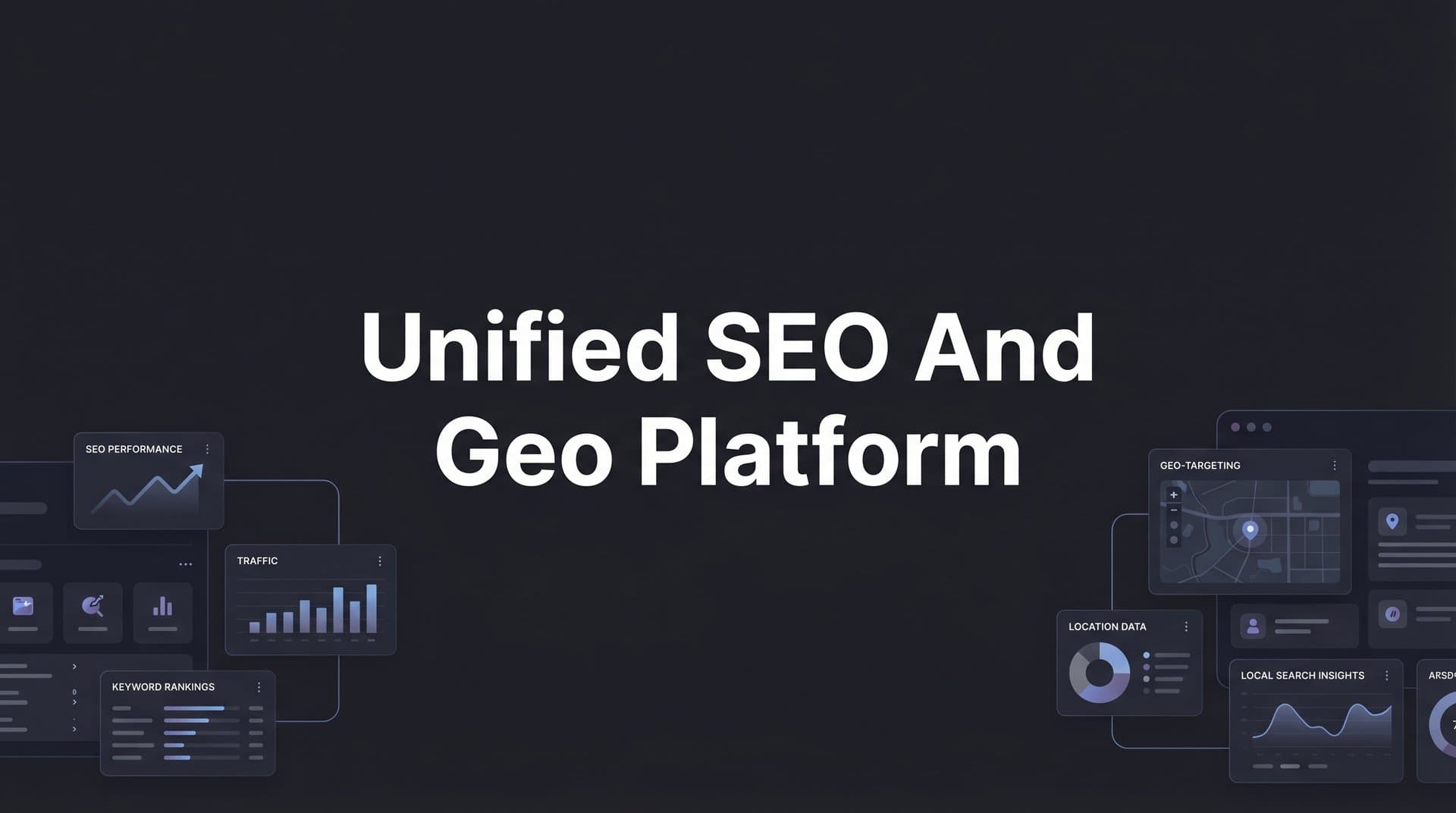
The concept of a unified SEO and GEO platform addresses this head-on by bringing search optimization, AI visibility tracking, content generation, and publishing automation into a single integrated system. This matters now because AI-powered search engines are fundamentally reshaping discovery. When someone asks Claude for marketing software recommendations or queries Perplexity about SEO best practices, your brand either gets mentioned or it doesn't. Managing these channels separately creates gaps where opportunities slip through—and where competitors gain ground you can't even measure.
The Convergence of Traditional Search and AI Discovery
GEO—Generative Engine Optimization—represents a fundamental shift in how content gets discovered and recommended. Unlike traditional SEO, which focuses on ranking your pages in search results, GEO targets how AI models reference, cite, and recommend your brand when generating responses to user queries.
Think of it this way: SEO is about being found when someone searches. GEO is about being mentioned when someone asks.
The distinction matters because these systems evaluate content differently. Google's algorithm looks at backlinks, page speed, keyword relevance, and hundreds of other ranking signals. When ChatGPT decides whether to mention your product in a response about marketing tools, it's drawing from patterns in its training data, evaluating authority signals, and assessing how well your content answers specific questions. Understanding the difference between SEO and GEO is essential for modern marketers.
This creates a dual visibility challenge. Your brand needs to appear in Google's top results for relevant searches—that's table stakes. But increasingly, it also needs to be the answer AI models provide when users ask questions in your category. Miss either channel, and you're invisible to a significant portion of your potential audience.
The operational complexity multiplies when you try to manage these channels separately. Your SEO team optimizes for keywords and builds backlinks. Meanwhile, someone else tries to figure out how to get mentioned by AI models—often without clear metrics or proven strategies. The content team produces articles optimized for one channel or the other, but rarely both. Your analytics show Google traffic but provide zero insight into AI visibility.
Many companies have found that this fragmented approach creates strategic blind spots. You might rank well for a keyword in Google while competitors dominate the AI-generated responses for the same query. Or your brand gets mentioned frequently by Claude but never appears in ChatGPT's recommendations. Without unified visibility, you can't see these patterns—let alone address them.
The convergence of SEO and GEO isn't just about adding another channel to monitor. It's about recognizing that modern search optimization requires a fundamentally integrated approach. Users don't distinguish between "traditional search" and "AI search"—they just want answers. Your visibility strategy needs to reflect that reality.
Core Components of a Unified Platform Architecture
A truly unified SEO and GEO platform rests on three foundational pillars that work together rather than in isolation. Each component addresses a specific gap in traditional toolsets, but their real power emerges from how they interconnect.
AI Visibility Tracking: This goes beyond simple mention monitoring. Effective platforms track how your brand appears across multiple AI models—ChatGPT, Claude, Perplexity, Google's AI Overviews, and others. But the depth matters as much as the breadth. Look for systems that capture sentiment analysis (is the mention positive, neutral, or negative?), prompt tracking (what questions trigger mentions of your brand?), and comparative positioning (which competitors get mentioned alongside you?). The best multi-platform brand tracking software provides this comprehensive coverage.
The value here isn't just knowing you were mentioned. It's understanding the context. When Perplexity recommends your product, what specific features does it highlight? When ChatGPT suggests a competitor instead, what attributes drove that choice? This granular visibility transforms AI monitoring from a vanity metric into actionable intelligence.
Integrated Content Generation: The second pillar involves AI agents specifically designed to produce content that performs across both optimization paradigms. This isn't about choosing between SEO-focused articles and GEO-friendly content—it's about creating pieces that satisfy both simultaneously.
Specialized AI agents handle different content formats: explainer articles that establish authority, listicles that AI models love to cite, how-to guides that answer specific queries. The key is that these agents understand both the ranking signals that matter to search engines and the citation patterns that influence AI recommendations. They optimize for keyword relevance while ensuring the content provides the kind of authoritative, well-structured information that language models confidently reference.
This dual optimization happens at the structural level. Headings that serve SEO also create the clear information hierarchy that AI models parse effectively. Internal linking strategies that boost domain authority also help AI systems understand topic relationships. Citation of credible sources satisfies both Google's E-E-A-T guidelines and the verification patterns that make AI models more likely to reference your content.
Automated Indexing and Publishing: The third component ensures your content actually reaches both traditional crawlers and AI training pipelines. Tools like IndexNow integration notify search engines the moment new content goes live, dramatically accelerating discovery. Automated sitemap updates ensure comprehensive coverage. CMS auto-publishing capabilities eliminate manual bottlenecks.
This matters more than many marketers realize. Traditional SEO often involves a waiting game—publish content, wait for Google to crawl it, hope it gets indexed promptly. In a unified platform, indexing automation removes that friction. Your content becomes discoverable faster, which means it starts contributing to both search rankings and AI visibility sooner.
The architecture's real strength emerges from how these components share data. AI visibility tracking reveals which topics and formats generate the most mentions. Content generation tools use those insights to prioritize high-impact pieces. Indexing automation ensures those optimized articles reach their targets quickly. The feedback loop creates continuous improvement across your entire search presence.
How Unified Platforms Eliminate the Tool Sprawl Problem
Tool sprawl isn't just an organizational annoyance. It carries hidden costs that compound over time and create strategic vulnerabilities most teams don't recognize until they're already bleeding efficiency.
Consider the data silo problem. Your SEO platform shows keyword rankings and organic traffic. Your content analytics reveal engagement metrics and conversion rates. Your AI monitoring tool—if you have one—tracks brand mentions across language models. But these systems don't talk to each other. You can't easily correlate an increase in AI mentions with changes in organic traffic. You can't identify which content pieces drive both search rankings and AI citations. Every insight requires manual data export, spreadsheet wrangling, and educated guesswork.
The strategic cost is even steeper. When your tools operate independently, your optimization strategies inevitably fragment. The SEO team focuses on rankings without considering AI visibility. Content creators optimize for one channel without understanding how their work performs in the other. Your publishing workflow doesn't account for the different indexing requirements of search engines versus AI training systems. An all in one SEO automation platform solves this by consolidating these functions.
This fragmentation creates duplicated effort that's easy to miss. You might research keywords for SEO, then separately analyze which topics AI models discuss most frequently—even though these insights should inform a single content strategy. You publish an article optimized for Google, then later realize you need a different version optimized for AI citations. You manually check how different AI models respond to queries about your brand because your monitoring tools don't cover all the platforms that matter.
Workflow consolidation through a unified platform addresses these inefficiencies at their source. A single dashboard becomes your command center for tracking visibility across all channels, creating optimized content, and publishing it efficiently. You see how the same piece of content performs in Google rankings and AI mentions side-by-side. You identify patterns—certain content formats might drive strong search traffic but weak AI citations, signaling an optimization opportunity.
Centralized data enables smarter decision-making because you can finally see the complete picture. When you notice competitors getting mentioned frequently by Claude for queries where you rank well in Google, you've identified a specific GEO gap to address. When an article generates strong AI visibility but weak search rankings, you know to strengthen its SEO elements. These insights only emerge when your data lives in a unified system rather than scattered across disconnected tools.
The operational benefits extend beyond analytics. Team collaboration improves when everyone works from the same platform with shared visibility into performance metrics. Budget allocation becomes more strategic when you can measure the combined impact of SEO and GEO efforts rather than treating them as separate line items. Your content calendar can prioritize pieces that serve both channels instead of forcing you to choose.
Practical Applications: From Tracking to Publishing
Let's walk through how a unified platform approach transforms your day-to-day optimization workflow with concrete applications that deliver measurable impact.
Start with AI visibility scores—these become your diagnostic tool for identifying content gaps. When you see competitors consistently mentioned by ChatGPT for queries where you have strong domain authority, you've found a GEO weakness to address. The unified platform shows you not just that you're being mentioned less, but which specific prompts trigger competitor citations instead of yours. This granularity turns vague awareness into actionable strategy.
Picture this scenario: You track visibility for "marketing automation software" across six AI platforms. Your brand appears in 40% of relevant ChatGPT responses but only 15% of Claude responses. The platform's prompt tracking reveals that Claude tends to cite brands that emphasize integration capabilities, while ChatGPT favors those highlighting ease of use. Now you know exactly what content to create—pieces that showcase your integration strengths, optimized for the citation patterns Claude prefers.
Content generation becomes strategically targeted rather than speculative. Instead of guessing what topics might improve your AI visibility, you're creating articles that directly address documented gaps. Your unified platform shows that Perplexity frequently mentions competitors when users ask about "email marketing best practices" but rarely surfaces your brand. You generate an SEO/GEO-optimized guide on email marketing that targets both the keyword for search rankings and the authoritative, citation-friendly structure that AI models prefer. Leveraging SEO GEO content writing tools makes this process significantly more efficient.
The content itself benefits from dual optimization. Your AI agents structure the piece with clear, hierarchical headings that both search engines and language models parse effectively. They include specific examples and data points that AI models can confidently cite. They optimize for featured snippet formats that serve both Google's SERP features and the concise answer formats AI responses often use. The same article serves multiple masters without compromise.
Publishing automation ensures your optimized content reaches its targets efficiently. The moment your article goes live, IndexNow integration notifies major search engines. Your automated sitemap updates immediately, ensuring comprehensive crawler coverage. If you're publishing to a CMS, auto-publishing capabilities eliminate manual upload steps. The content that took strategic effort to optimize doesn't sit in a queue waiting for someone to remember to publish it.
The measurement loop closes when you track how that content performs across channels. Your unified dashboard shows its search rankings climbing for target keywords while simultaneously monitoring whether it generates new AI mentions. You see which sections AI models cite most frequently, informing how you structure future pieces. You identify whether the content drives more value through traditional search traffic or AI-driven discovery, helping you refine your optimization balance.
This workflow—tracking gaps, generating targeted content, automating publication, measuring unified results—becomes repeatable and scalable. You're not managing separate processes for SEO and GEO. You're executing an integrated strategy where each component enhances the others.
Evaluating Unified Platforms: What to Look For
Not all platforms claiming to unify SEO and GEO actually deliver on that promise. When evaluating options, focus on capabilities that indicate genuine integration rather than just bundled tools.
Multi-Model Tracking Coverage: The platform should monitor at least six AI systems—ChatGPT, Claude, Perplexity, Google's AI Overviews, and others. But coverage alone isn't enough. Look for tracking that captures the nuances that matter: sentiment analysis, prompt variations, competitive positioning, and citation frequency. A platform that simply tells you "your brand was mentioned" provides minimal value compared to one that reveals how you were mentioned, in what context, and compared to which competitors.
Ask specific questions during evaluation: Can the platform track how mentions change over time? Does it alert you when competitors gain visibility in areas where you're weak? Can you drill down into specific prompts to understand exactly what triggers citations of your brand versus others? The depth of tracking intelligence separates sophisticated platforms from basic monitoring tools. A thorough AI SEO platform comparison can help you identify which solutions offer this level of depth.
Content Agent Specialization: Unified platforms should offer multiple AI agents, each specialized for different content types and optimization goals. Look for agents that handle explainer articles, how-to guides, listicles, comparison pieces, and other formats. The specialization matters because different content types serve different purposes in your SEO and GEO strategy.
Evaluate how these agents actually optimize content. Do they simply insert keywords, or do they understand the structural elements that influence both search rankings and AI citations? Can they adapt their output based on your AI visibility data, creating content that addresses documented gaps? The best platforms create a feedback loop where tracking insights directly inform content generation priorities. Exploring AI powered SEO content platforms will reveal which tools offer this sophisticated capability.
Integration Depth with Existing Workflows: A truly unified platform doesn't force you to abandon your existing CMS or publishing infrastructure. Instead, it integrates deeply enough to enhance your current workflow. Look for native CMS connections that enable auto-publishing. Verify that indexing automation works with your domain setup. Confirm that the platform can push content to your existing systems rather than requiring you to rebuild your entire publishing stack.
The integration should feel seamless. If you're constantly exporting data, copying content between systems, or manually triggering processes that should be automated, the platform isn't truly unified—it's just another tool in your sprawl.
Also consider the platform's approach to data consolidation. Can you create custom dashboards that combine SEO metrics, AI visibility scores, and content performance in views that match your specific reporting needs? Does it support the measurement frameworks you've already established, or does it force you to adopt entirely new metrics?
Building Your Unified SEO and GEO Strategy
Implementing a unified approach requires more than just adopting new tools. It demands a strategic framework that aligns your optimization efforts across both channels while respecting their distinct characteristics.
Begin with comprehensive visibility auditing. Before you can optimize, you need baseline understanding of where your brand currently appears—and critically, where it doesn't. Track your presence across major AI models for queries relevant to your category. Document which competitors get mentioned when you don't. Identify patterns in the prompts that trigger citations of other brands but not yours.
This audit reveals your strategic priorities. You might discover that you have strong traditional search visibility but minimal AI presence. Or you might find the inverse—decent AI mentions but weak search rankings. Some companies find their visibility is strong in certain AI models but completely absent in others. Each pattern suggests different optimization priorities. A SEO content platform with analytics provides the data foundation you need for this assessment.
Next, align your content production with both keyword targets and AI mention opportunities. This doesn't mean creating separate content for each channel. Instead, develop pieces that serve dual purposes. When planning an article, consider both the keywords it should rank for and the types of AI queries it should address. Structure the content to satisfy search engine ranking factors while providing the authoritative, citation-friendly information that AI models prefer.
Your content calendar should reflect this integrated thinking. Prioritize topics where you can capture value across both channels. If you have strong domain authority for a keyword but weak AI visibility, that's a high-priority content opportunity. If competitors dominate AI mentions for queries related to your core offerings, those topics deserve immediate attention. Mastering GEO SEO content optimization ensures your content performs across both discovery channels.
Establish measurement frameworks that track progress across both dimensions. Traditional metrics—keyword rankings, organic traffic, conversion rates—remain important. But supplement them with AI visibility scores, mention frequency across models, sentiment analysis, and competitive positioning in AI responses. Create dashboards that show how these metrics correlate and influence each other.
The goal isn't to achieve perfect balance between SEO and GEO performance. Different businesses will find different optimal mixes based on their audience behavior, competitive landscape, and strategic priorities. What matters is having visibility into both channels so you can make informed allocation decisions.
Build feedback loops into your process. When content performs well in search but generates minimal AI mentions, analyze why. When AI models frequently cite certain pieces, identify the elements that made them citation-worthy and replicate those patterns. Let your unified data inform continuous optimization rather than treating SEO and GEO as static, separate disciplines.
The Integrated Future of Search Optimization
The fragmentation that defines most marketing toolstacks today isn't sustainable. As AI-powered discovery channels continue growing in influence, managing them separately from traditional search creates compounding inefficiencies and missed opportunities that no amount of manual coordination can overcome.
Unified SEO and GEO platforms represent more than workflow consolidation. They embody a fundamental shift in how we think about visibility optimization—not as separate disciplines requiring different tools and strategies, but as interconnected channels that demand integrated approaches. Your content doesn't exist in isolation for search engines or AI models. It serves both simultaneously. Your tools and strategies should reflect that reality.
The companies gaining ground in this evolving landscape aren't the ones with the most tools or the biggest budgets. They're the ones who recognized early that fragmented approaches create blind spots—gaps where competitors capture visibility you can't even measure. They've moved beyond juggling disconnected dashboards to implementing systems that provide unified intelligence across all discovery channels.
Consider your current toolstack honestly. How many separate systems do you use to track search rankings, monitor AI mentions, generate content, and publish it? How much time do you spend reconciling data between platforms? How many optimization opportunities slip through the cracks because you lack visibility into how your SEO and GEO efforts interact?
The path forward involves evaluating whether your current approach serves your actual needs or simply perpetuates the tool sprawl you've accumulated over time. A unified platform approach streamlines workflows, yes—but more importantly, it enables the kind of strategic visibility that turns optimization from guesswork into data-driven decision-making.
Stop guessing how AI models like ChatGPT and Claude talk about your brand—get visibility into every mention, track content opportunities, and automate your path to organic traffic growth. Start tracking your AI visibility today and see exactly where your brand appears across top AI platforms.