Publishing teams are drowning in SEO tasks. Every new article demands keyword research, meta tag optimization, internal linking decisions, and technical checks before it can go live. What used to work for publishing ten articles a month becomes unsustainable when you're producing fifty. And here's the twist: even if you manage to keep up with traditional SEO, there's an entirely new challenge waiting—making sure AI models like ChatGPT and Perplexity actually reference your content when users ask questions in your domain.
The math simply doesn't work anymore. Publishers need more content to maintain visibility, but manual SEO processes create bottlenecks at every stage. Your editorial team can write brilliant articles, but if each one requires hours of optimization work, you're limiting your output to whatever your SEO team can manually process. Meanwhile, competitors who've embraced automation are publishing daily, claiming topic territory you should own.
SEO automation isn't about cutting corners or sacrificing quality. It's about systematizing the repetitive, technical tasks that bog down your workflow so your team can focus on strategy, storytelling, and editorial excellence. This guide explores how publishers are building automated SEO operations that scale content production while maintaining standards—and how you can implement the same systems to compete in today's AI-driven search landscape.
The Breaking Point: Why Manual SEO Can't Keep Up
Let's be honest about what's happening in the publishing industry right now. To maintain the same organic visibility you had two years ago, you need to produce significantly more content. Search engines reward freshness and depth, which means your competitors are publishing comprehensive guides, regular updates, and topic clusters that push your older content down in rankings.
The volume problem is real. Many publishers report needing three to five times more content just to hold their current traffic levels steady. If you were publishing twenty articles monthly in 2024, you might need sixty to a hundred articles now to achieve the same impact. And that's before considering the AI search revolution.
Think about the manual processes your team repeats for every single article. Someone researches keywords and search intent. Another person optimizes title tags and meta descriptions. Someone else handles internal linking, deciding which existing articles should link to this new piece and where those links should appear. Then there's the technical checklist: submitting to search engines, updating sitemaps, checking for crawl errors.
Each task might only take fifteen to thirty minutes, but multiply that across dozens of articles and you've consumed entire workdays on repetitive optimization. Your SEO specialists—the people who should be developing strategy and analyzing competitive gaps—are instead manually updating meta tags and submitting URLs to Google Search Console. Understanding the differences between SEO automation and manual optimization helps clarify why this approach is unsustainable.
But here's where it gets more complicated. Traditional SEO optimization alone isn't enough anymore. When someone asks ChatGPT or Perplexity a question in your niche, will your content be cited? AI models don't just crawl and rank like search engines—they synthesize information and make decisions about which sources to reference. You need visibility into how these AI platforms talk about your brand, which topics they associate with you, and where content gaps exist.
This dual optimization challenge—satisfying both traditional search algorithms and AI model training—is breaking manual workflows entirely. You can't scale human effort fast enough to compete on both fronts simultaneously.
Essential Tools: What Belongs in Your Automation Stack
Building an effective SEO automation system requires the right combination of tools working together seamlessly. Think of your automation stack as having three core pillars: content operations, technical SEO, and visibility tracking. Each pillar addresses different bottlenecks in your publishing workflow.
Content Generation and Optimization Engines: Modern AI content systems go far beyond simple text generation. The most effective platforms use multiple specialized AI agents—some focused on research, others on structure, still others on brand voice consistency. These systems can generate SEO-optimized articles that maintain your editorial standards while dramatically reducing production time.
The key is finding tools that understand publisher requirements. You need systems that can produce different content types—explainer articles, listicles, how-to guides—while maintaining a consistent voice across all output. Look for platforms offering quality controls and customization options that let you set brand guidelines, tone preferences, and editorial standards that every generated piece follows. Exploring the best SEO content automation platforms can help you identify the right fit for your publishing operation.
Technical SEO Automation: This is where publishers often see the fastest return on automation investment. Technical SEO tasks are highly repetitive, rule-based, and perfect for systemization. Your automation stack should handle indexing notifications, sitemap updates, and crawl optimization without manual intervention.
IndexNow integration is particularly valuable for publishers. Instead of waiting for search engines to discover your new content through regular crawls, IndexNow lets you notify Google, Bing, and other search engines instantly when you publish. For high-volume publishers, this can mean the difference between content getting indexed within hours versus days or weeks.
Automated internal linking is another game-changer. Smart systems can analyze your content library, identify relevant connection points, and suggest or implement internal links that strengthen your topic authority. This becomes exponentially more valuable as your content library grows—manually finding linking opportunities across thousands of articles is practically impossible.
AI Visibility Tracking: Here's the component most publishers are still missing. You need visibility into how AI models reference your brand and content. When someone asks ChatGPT about topics in your domain, does it mention your company? What sentiment does it express? Which competitors get cited instead?
AI visibility tracking monitors brand mentions across platforms like ChatGPT, Claude, and Perplexity. It shows you which prompts trigger mentions of your brand, tracks sentiment, and reveals content gaps where competitors appear but you don't. This intelligence is crucial for understanding your position in the AI-powered search landscape.
The most sophisticated systems provide an AI Visibility Score—a quantifiable metric showing how prominently AI models feature your brand compared to competitors. This becomes your north star for content strategy, revealing exactly where to focus creation efforts for maximum AI search impact.
Designing Your Automated Content Pipeline
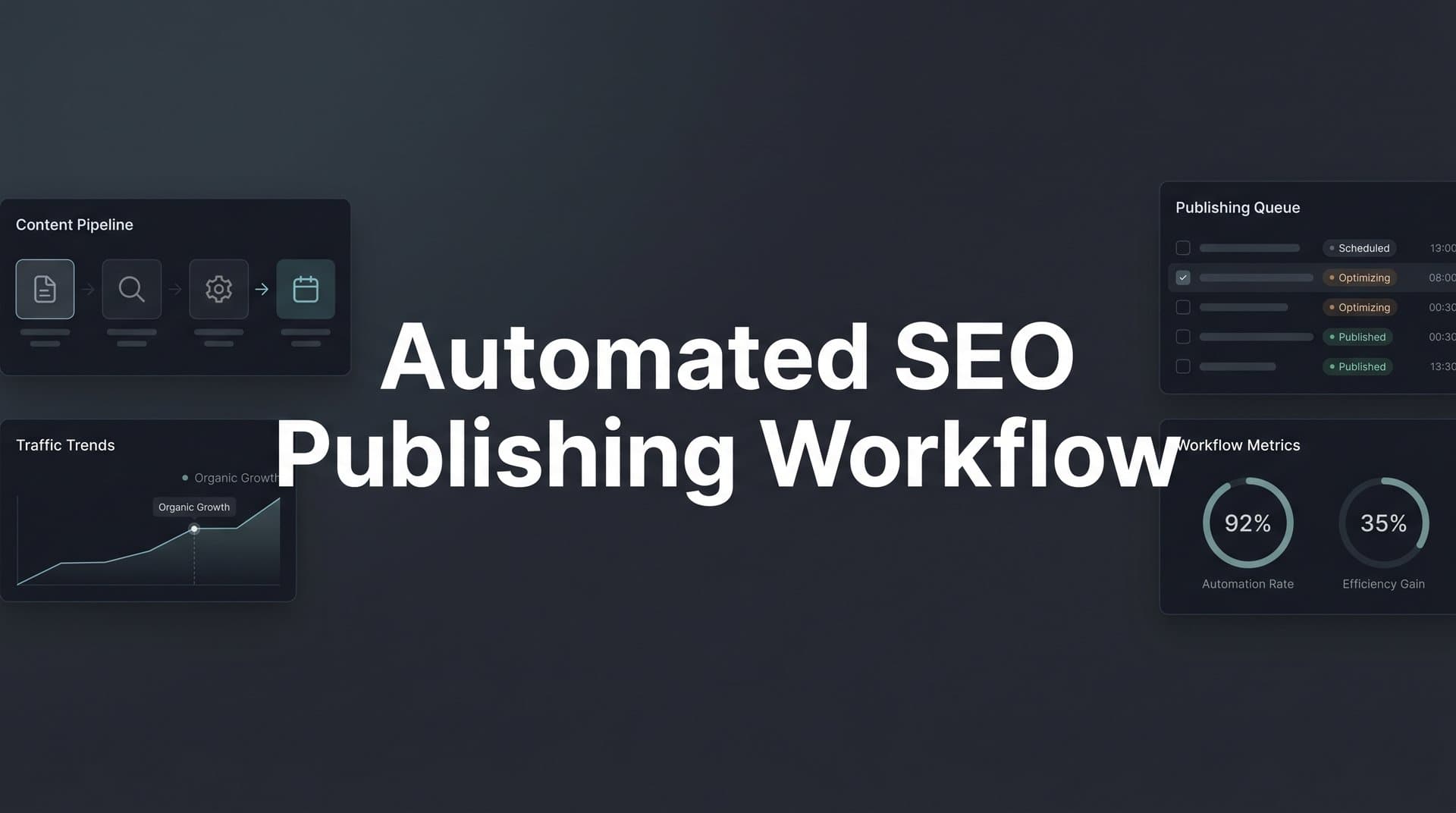
The most successful publisher automation strategies map out the entire content journey—from initial topic identification through final publication and indexing. Let's walk through how this automated pipeline actually works in practice.
Stage 1: Topic Discovery and Validation: Your pipeline starts with identifying what to write about. Automated systems can monitor trending topics in your niche, analyze competitor content gaps, and track questions appearing in AI search platforms. Instead of brainstorming sessions that produce a handful of ideas, automation surfaces dozens of validated opportunities weekly.
The validation piece is crucial. Not every trending topic deserves an article. Smart systems evaluate search volume, competition levels, and alignment with your content strategy before flagging topics for production. This filtering prevents your team from wasting resources on low-value content.
Stage 2: Content Creation with Quality Gates: Once a topic is approved, automated content generation begins. This is where those specialized AI agents come into play—research agents gather information, structure agents organize the narrative flow, and writing agents produce the actual content following your brand guidelines. Publishers exploring content automation for publishers find this stage transforms their production capacity.
But here's the critical part: automation should include quality checkpoints, not bypass them. The best pipelines build in human review stages where editors can refine AI-generated content, add unique insights, and ensure accuracy. Think of it as "automation with guardrails"—the system handles the heavy lifting, but human expertise guides the final output.
Some publishers implement a tiered approval system. Straightforward content types like news updates or product roundups might require minimal editing, while in-depth guides get more thorough editorial review. This flexibility lets you scale production while maintaining standards where they matter most.
Stage 3: SEO Optimization and Enhancement: As content moves through the pipeline, automated systems handle technical optimization. Meta descriptions get generated based on article content and target keywords. Title tags follow SEO best practices while remaining compelling. Header structures ensure proper hierarchy and keyword placement.
Internal linking happens automatically at this stage too. The system analyzes your existing content library, identifies relevant articles, and either suggests linking opportunities or implements them directly based on your configuration. This ensures every new article strengthens your overall topic authority from day one.
Stage 4: Publishing and Indexing: When content reaches the end of your pipeline, CMS auto-publishing can push it live on schedule. The moment it publishes, automated systems notify search engines via IndexNow, update your sitemap, and trigger any configured distribution channels.
This seamless handoff from creation to publication eliminates the coordination overhead that typically slows down publishing operations. Your editorial calendar stays on track because technical tasks happen automatically rather than depending on someone remembering to execute them manually.
Set It and Forget It: Technical SEO on Autopilot
Technical SEO is perhaps the most automation-friendly aspect of publisher operations. These tasks follow consistent rules, require no creative judgment, and must happen reliably for every piece of content. Let's examine which technical processes should run completely on autopilot.
Instant Indexing with IndexNow: Traditional search engine discovery relies on crawlers periodically visiting your site and finding new content. For publishers producing multiple articles daily, this creates an indexing lag that can delay traffic by days or weeks. IndexNow solves this by letting you notify search engines the moment new content goes live. Publishers with extensive content libraries benefit significantly from SEO indexing automation for large sites.
Implementation is straightforward—once configured, your CMS automatically pings IndexNow endpoints whenever you publish, update, or delete content. Google, Bing, and other participating search engines receive immediate notification and can prioritize crawling your new pages. For time-sensitive content like news articles or trending topic coverage, this speed advantage is significant.
The automation aspect is crucial here. Manual submission processes are error-prone and easy to forget during busy publishing days. Automated IndexNow integration ensures consistent, reliable notification for every content change without requiring anyone to remember to submit URLs.
Dynamic Internal Linking Systems: As your content library grows, identifying relevant internal linking opportunities becomes increasingly complex. An article published today might be highly relevant to twenty existing articles, but manually finding those connections is impractical.
Automated internal linking systems analyze semantic relationships between articles, identify contextually appropriate linking opportunities, and either suggest or implement links based on your preferences. These systems get smarter over time, learning which types of connections drive engagement and which feel forced.
The most sophisticated approaches use topic clustering—grouping related content around pillar pages and ensuring appropriate link structures that signal topical authority to search engines. This strategic linking happens automatically as you publish, building a stronger content ecosystem without manual intervention.
Sitemap Management and Crawl Optimization: For publishers with large content libraries, sitemap management becomes unwieldy fast. Implementing sitemap automation for publishers ensures search engines always have current information about your content structure.
Crawl budget optimization matters more as your site grows. Search engines allocate limited crawling resources to each site, and publishers need to ensure crawlers focus on valuable content rather than wasting time on low-priority pages. Automated systems can manage robots.txt files, set crawl priorities in sitemaps, and monitor crawl statistics to identify issues before they impact indexing.
Tracking What Matters: KPIs for Automated Operations
Automation without measurement is just overhead. Publishers need clear metrics showing whether their automated systems are actually driving results. Let's examine the KPIs that matter most for evaluating SEO automation effectiveness.
Content Velocity Metrics: One of automation's primary benefits is speed. Track the time from topic identification to published, indexed content. Before automation, this might take days or weeks. Effective automation can compress it to hours. Monitor your average time-to-publish and watch it decrease as your systems mature.
Production volume is another telling metric. How many articles can your team publish monthly with automation versus without? Many publishers see three to five times increases in output without adding headcount. This scalability is the whole point—track it to justify your automation investment. Teams looking to improve collaboration should explore SEO workflow automation for teams to streamline their processes.
Organic Traffic Growth at Scale: Ultimately, SEO automation should drive more organic traffic. But don't just track overall traffic—segment by content type and publication date. Are automated articles performing comparably to manually optimized content? Are newer articles achieving rankings faster thanks to IndexNow integration?
Look at ranking improvements across your content library. Automated internal linking should lift rankings for both new and existing content as topic clusters strengthen. Track keyword rankings for automated content specifically to ensure quality isn't suffering in pursuit of quantity.
AI Visibility Scores: This is where forward-thinking publishers are focusing attention now. Traditional SEO metrics tell you how you're performing in Google and Bing, but what about ChatGPT, Claude, and Perplexity? Your AI Visibility Score quantifies how often AI models reference your brand when answering questions in your domain.
Track this metric over time as you publish more content. Are AI models citing your articles more frequently? What topics trigger brand mentions versus competitor mentions? This intelligence reveals whether your content strategy is positioning you for success in AI-powered search, not just traditional SERPs.
Monitor sentiment alongside visibility. Being mentioned frequently with negative context isn't helpful. Quality AI visibility tracking shows not just how often you're referenced, but what AI models say about your brand and whether that messaging aligns with your positioning.
Implementation Roadmap: Building Your Automation System
Knowing what to automate is one thing—actually implementing it is another. Publishers often stumble by trying to automate everything simultaneously or by choosing the wrong starting point. Here's a phased approach that minimizes risk while building momentum.
Phase 1: Start with Technical SEO Foundations: Begin your automation journey with technical tasks that carry minimal risk and deliver immediate value. IndexNow integration, automated sitemap updates, and basic crawl monitoring are perfect starting points. These systems operate in the background, require little ongoing management, and immediately improve your indexing efficiency.
This foundation phase builds confidence in automation while freeing up technical resources. Your SEO team stops manually submitting URLs and updating sitemaps, gaining time to focus on strategy and analysis. Success here creates organizational buy-in for more ambitious automation. Reviewing integrated SEO automation tools helps you select solutions that work together seamlessly.
Phase 2: Layer in Content Optimization: Once technical automation is running smoothly, expand to content-level optimization. Start with automated meta description generation, title tag optimization, and internal linking suggestions. These tools augment human decision-making rather than replacing it—editors can review and refine automated suggestions before implementation.
This phase is about finding the right balance between automation and editorial control. Some publishers prefer full automation for routine content types while maintaining manual control for flagship articles. Others want suggestions for everything but automate nothing without review. Configure systems to match your team's comfort level and gradually increase automation as trust builds.
Phase 3: Scale Content Production: With technical and optimization automation established, you're ready to tackle content generation at scale. Implement AI content systems with clear quality controls and editorial workflows. Start with content types that are more formulaic—product roundups, news updates, FAQ articles—before expanding to complex guides and thought leadership.
Build feedback loops where editors rate AI-generated content quality. Use this data to refine prompts, adjust brand guidelines, and improve output over time. The goal is reaching a point where AI-generated drafts require minimal editing to meet your standards.
Common Mistakes to Avoid: Don't automate without monitoring. Publishers sometimes set up systems and assume they're working correctly without validating output. Regular audits of automated content, indexing status, and internal linking patterns catch issues before they compound.
Avoid over-automation that removes necessary human judgment. Not every decision can or should be automated. Maintain editorial oversight for brand-sensitive content, controversial topics, or anything requiring nuanced expertise your automation systems can't replicate.
Don't ignore AI visibility while optimizing for traditional search. The publishers winning in 2026 are those tracking and optimizing for both. If you're only measuring Google rankings, you're missing half the picture of how audiences discover your content.
Future-Proofing Your Stack: Choose automation tools that evolve with the search landscape. AI search is still developing rapidly—the platforms and algorithms dominant today will change. Work with systems that update regularly, add new AI platform tracking, and adapt to algorithm changes without requiring you to rebuild your entire stack.
Build flexibility into your workflows. Hardcoded automation that can't adapt to new content types or SEO best practices becomes technical debt quickly. Modular systems where you can swap components or adjust workflows age better than monolithic platforms that lock you into specific approaches.
The Automation Advantage: Competing in the AI Search Era
SEO automation isn't about replacing your editorial team's judgment or cutting corners on quality. It's about freeing talented people from repetitive tasks so they can focus on strategy, storytelling, and the creative work that actually differentiates your publication. When your systems handle technical optimization, indexing, and routine content production automatically, your team can concentrate on the high-value activities that drive real competitive advantage.
The publishers thriving right now are those who've embraced this shift. They're producing more content, maintaining higher quality standards, and competing effectively in both traditional search and AI-powered discovery. Meanwhile, competitors stuck in manual workflows are falling behind, unable to match the volume and velocity that modern search visibility requires.
The AI search revolution adds urgency to this transformation. It's no longer enough to rank well in Google—you need visibility across ChatGPT, Claude, Perplexity, and whatever platforms emerge next. Automation gives you the capacity to create the comprehensive, high-quality content that AI models reference while simultaneously tracking your visibility across these platforms.
Start where you are. You don't need to automate everything immediately. Begin with technical SEO tasks that deliver quick wins and build from there. Each automated process compounds the value of others, creating a publishing operation that scales efficiently without sacrificing the editorial excellence your audience expects.
The future of publishing belongs to teams that combine human creativity with automated efficiency. Stop guessing how AI models like ChatGPT and Claude talk about your brand—get visibility into every mention, track content opportunities, and automate your path to organic traffic growth. Start tracking your AI visibility today and see exactly where your brand appears across top AI platforms.