You've just spent three hours crafting the perfect blog post. The research is solid, the insights are sharp, and the SEO is dialed in. Now comes the part that somehow always takes longer than it should: formatting it for your CMS, scheduling the publish time, updating your sitemap, pinging search engines, and crossing your fingers that Google actually finds it sometime this month. By the time you're done, half your afternoon has evaporated into the mechanical tedium of getting words from your document to the internet.
This is the publishing bottleneck that's quietly draining productivity from marketing teams everywhere. While content creation has evolved with AI assistance and collaborative tools, the publishing process itself remains stubbornly manual for most organizations. The result? Content that could be driving traffic sits in drafts, publishing schedules that slip by days or weeks, and marketing teams spending more time on logistics than strategy.
An automated SEO publishing workflow changes this equation entirely. It's a connected system that takes content from creation through optimization, formatting, publishing, and indexing without the constant human handoffs that create delays and errors. For teams competing in an era where AI search engines expect fresh, authoritative content at scale, automation isn't just a convenience anymore. It's becoming the baseline for staying visible.
Breaking Down the Modern Content Publishing Bottleneck
Let's walk through what most content teams experience as their "normal" workflow. Someone researches a topic, writes a draft, passes it to an editor, who sends it back for revisions. Once approved, it goes to whoever handles CMS formatting. They wrestle with heading tags, add internal links, upload images, and set metadata. Then comes scheduling—coordinating with other content, social posts, and email campaigns. After publishing, someone manually submits the URL to Google Search Console, updates the sitemap, and maybe pings Bing if they remember.
Each handoff in this chain creates friction. The writer waits for editorial feedback. The editor waits for revisions. The CMS person waits for final approval. Meanwhile, the content sits in limbo instead of working for your business. Understanding these content publishing workflow inefficiencies is the first step toward solving them.
The hidden costs compound faster than most teams realize. Context switching alone—the mental overhead of jumping between writing, formatting, and technical SEO tasks—can consume up to 40% of productive time according to productivity research. Approval delays stretch timelines from days to weeks. Technical handoffs introduce formatting errors that require additional rounds of fixes.
Here's where it gets more urgent: AI search engines like ChatGPT, Claude, and Perplexity are fundamentally changing the publishing stakes. These platforms prioritize recent, authoritative content when generating responses. If your competitor published a comprehensive guide yesterday and you're still formatting yours from last week, guess whose brand gets mentioned when users ask questions in your space?
The gap between content creation and search engine discovery has become a competitive liability. Traditional crawl-and-index cycles can take days or weeks. During that window, your content might as well not exist. You're paying for creation but not capturing the value because the mechanics of publishing create an artificial delay between "done" and "discoverable."
This bottleneck isn't just about speed. It's about the opportunity cost of having your marketing team focused on repetitive tasks instead of strategic work. Every hour spent manually formatting, scheduling, and indexing is an hour not spent analyzing performance, refining strategy, or creating the next piece of content. The workflow itself has become the constraint on growth.
Core Components of an Automated SEO Publishing Workflow
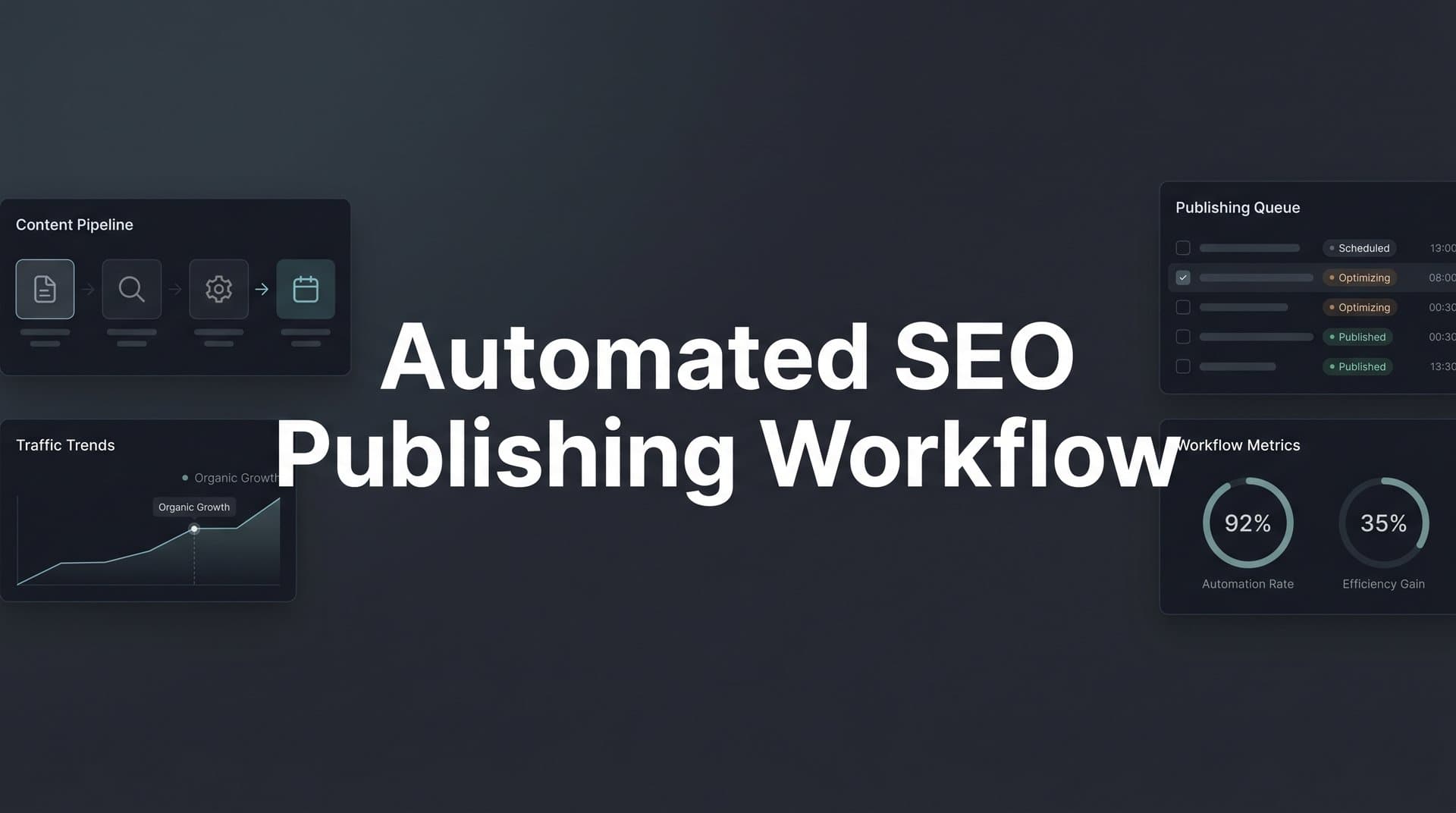
An effective automated publishing system operates across four distinct layers, each handling a specific phase of getting content from concept to indexed and discoverable. Think of it like an assembly line where each station performs its specialized function without requiring manual intervention to move to the next stage.
The content generation layer is where automation begins. Modern AI content platforms use specialized agents—distinct AI models trained for specific content formats. One agent handles listicles, another manages explainer articles, and a third focuses on how-to guides. This multi-agent approach produces higher-quality output than single-model systems because each agent understands the structural and tonal requirements of its format. When you input a brief, the appropriate agent generates a draft that already follows SEO best practices and matches your brand voice parameters. An automated SEO article generator can handle this entire process seamlessly.
The optimization layer runs parallel to generation, applying real-time SEO scoring as content takes shape. This includes keyword density analysis, readability checks using established frameworks, heading structure validation, and meta description optimization. The key difference from manual optimization? These checks happen automatically during creation rather than as a separate review step afterward. The system flags issues immediately—like keyword stuffing or weak headings—so they're corrected before the content reaches human review.
Next comes the publishing layer, where CMS integrations eliminate the formatting nightmare. Direct connections to WordPress, Webflow, and headless CMS platforms mean content flows from the generation system into your website's backend with proper HTML structure, heading tags, and metadata already in place. Scheduling queues let you set publication calendars weeks in advance. One-click deployment replaces the tedious copy-paste-format-preview-fix-republish cycle that eats up hours.
The indexing layer is where automated workflows deliver their most dramatic time savings. Instead of waiting for search engine crawlers to eventually discover new content, IndexNow protocol integration sends instant notifications to search engines the moment something publishes. Your sitemap updates automatically through automated sitemap updates for SEO. Search engines receive immediate pings with the new URL. What used to take days or weeks now happens in minutes.
These four layers work in sequence but operate as a unified system. A content brief enters at the top, triggers the appropriate generation agent, passes through optimization checks, flows into your CMS with proper formatting, and notifies search engines upon publish—all without manual intervention at each transition point.
The result is a workflow where human effort concentrates on strategic decisions—what to write about, how to position it, and whether the output meets quality standards—while automation handles the mechanical execution. You're not removing humans from the process. You're removing humans from the repetitive tasks that don't require human judgment.
Building Your Automation Stack: Essential Tools and Integrations
Assembling an automated SEO publishing workflow requires choosing tools that integrate smoothly and handle their specific functions reliably. The goal is creating a connected pipeline where each component talks to the next without requiring manual data transfer or format conversion.
Start with an AI content platform that offers multi-agent capabilities. Single-model AI writers produce generic output that requires heavy editing. Platforms with specialized agents for different content types—listicles, explainer articles, comparison guides, how-to tutorials—generate drafts that already match the structural requirements of each format. Look for systems that let you define brand voice parameters, set SEO requirements, and input target keywords as part of the brief. The best automated SEO content writing platforms include built-in optimization scoring so you see SEO performance metrics before content ever reaches your CMS.
Your CMS connection is the linchpin of the entire workflow. WordPress users benefit from direct API integrations that push content with proper formatting, categories, tags, and featured images already configured. Teams using WordPress should explore WordPress auto publishing for SEO content to maximize efficiency. Webflow integrations require platforms that understand Webflow's CMS structure and can map content fields correctly. If you're running a headless CMS like Contentful or Strapi, prioritize content platforms with flexible API connections that can adapt to custom content models.
The publishing automation layer needs scheduling intelligence. Basic tools just queue content for future dates. Advanced systems analyze your existing content calendar, identify optimal publishing times based on audience activity patterns, and space content to avoid clustering too many posts in short windows. Some platforms integrate with social media schedulers, triggering coordinated promotion the moment content goes live.
Indexing acceleration is where many workflows fall short because teams don't realize faster indexing tools exist. IndexNow integration should be non-negotiable in your automation stack. This protocol—supported by Microsoft Bing and Yandex, with growing adoption elsewhere—lets you notify search engines instantly when new content publishes. Instead of waiting for crawlers, you're proactively announcing new URLs. Consider implementing an automated indexing service for SEO to handle this automatically.
Integration compatibility matters more than individual tool features. A powerful AI writer that doesn't connect to your CMS creates a new manual step. A great CMS that can't trigger indexing notifications leaves you manually submitting URLs. The strongest automation stacks use platforms that bundle multiple functions—content generation, CMS publishing, and indexing automation—into unified systems rather than forcing you to connect disparate tools through custom integrations.
Look for platforms that offer what's sometimes called "Autopilot Mode"—end-to-end automation where a content brief triggers the entire chain from generation through indexing without manual checkpoints. Human review still happens, but as a quality gate rather than a required step for each mechanical transition.
From Manual to Automated: A Step-by-Step Implementation Framework
Transitioning from manual publishing to automated workflows works best as a phased approach rather than an overnight switch. Trying to automate everything at once usually creates more chaos than efficiency because you haven't identified which parts of your workflow are automation-ready and which require human judgment.
Phase 1: Audit Your Current Workflow and Identify Automation-Ready Touchpoints
Map your existing process from content brief to indexed article. Document every step, who handles it, and how long it typically takes. You'll likely discover steps you didn't realize existed—like the time content sits waiting for someone to remember to format it, or the manual checking of whether Google has indexed last week's posts. Comparing automated publishing vs manual workflow approaches helps clarify where automation delivers the most value.
Categorize each step as either judgment-dependent or mechanical. Judgment-dependent tasks require human decision-making: deciding what topic to cover, evaluating whether the tone matches your brand, determining if claims are accurate. Mechanical tasks are repetitive and rule-based: formatting headings, setting metadata, uploading to CMS, updating sitemaps, submitting URLs to search consoles.
Your automation-ready touchpoints are the mechanical tasks. These are where automation delivers immediate value without quality risks. Start with the most time-consuming mechanical steps—typically CMS formatting and indexing notifications—because they offer the biggest time savings.
Phase 2: Connect Your Content Generation, CMS, and Indexing Tools into a Unified Pipeline
Begin by establishing your CMS integration. Test it with a few pieces of content to ensure formatting translates correctly, images upload properly, and metadata populates as expected. Fix any mapping issues before scaling up.
Add your content generation layer next. Configure your AI platform with brand voice guidelines, SEO parameters, and output formatting requirements. Run several test pieces through the system and compare them to your manually created content. Adjust settings until the automated output meets your quality baseline. Understanding how to integrate AI in your SEO workflow makes this transition smoother.
Layer in indexing automation last. Configure IndexNow integration to trigger automatically when content publishes. Set up automatic sitemap updates. Test the full pipeline with a single article: brief → generation → CMS publish → indexing notification. Verify each step completes without manual intervention.
Once the pipeline works reliably for individual articles, scale to batch processing. Schedule a week's worth of content and confirm the system handles queuing, publishing, and indexing without failures.
Phase 3: Establish Quality Gates and Human Review Checkpoints Without Creating New Bottlenecks
Automation fails when it removes necessary human oversight or creates new approval bottlenecks that slow things down as much as manual processes did. The goal is strategic review points, not bureaucratic checkpoints.
Set up content review queues where drafts await approval before publishing rather than blocking the entire pipeline. Editors can review multiple pieces in batches rather than stopping to approve each one individually. Establish clear quality criteria so reviewers know what warrants rejection versus minor edits that can happen post-publish.
Implement automated quality checks that flag content for human review only when specific issues appear: unusually low SEO scores, readability problems, or keyword density outside acceptable ranges. Content that passes automated checks can flow straight to the publishing queue.
Create feedback loops where editor changes get incorporated back into your AI platform's learning. If editors consistently adjust tone or restructure certain content types, those patterns should inform future automated generation.
Measuring Success: KPIs for Automated Publishing Operations
Time-to-Publish Metrics: From Brief Creation to Live Indexed Content
Measure the total elapsed time from when a content brief enters your system to when search engines have indexed the published article. Many teams find their manual workflows take 7-14 days for this complete cycle. Effective automation typically compresses this to 24-48 hours, with some high-velocity teams achieving same-day brief-to-indexed cycles.
Track this metric separately for different content types because complexity varies. A 500-word listicle should move faster than a 3,000-word comprehensive guide. If your automation handles simple content quickly but bogs down on complex pieces, you've identified where the workflow needs refinement.
Also measure time savings per article. Calculate the human hours required under your old manual process versus your automated workflow. Teams commonly report 60-75% time reduction on mechanical tasks, freeing those hours for strategic work. Implementing complete SEO workflow automation maximizes these efficiency gains.
Content Velocity Benchmarks: Articles Per Week/Month With Consistent Quality
Publishing volume matters, but only if quality remains consistent. Track how many articles you publish per week or month, then monitor quality metrics alongside volume. Are SEO scores staying stable as you publish more? Is engagement holding steady? If volume increases but quality drops, your automation is moving faster than your quality controls can handle.
Establish baseline benchmarks before automation, then track how velocity changes. A team publishing 8 articles per month manually might scale to 20-30 with automation while maintaining the same quality standards. The goal is sustainable velocity—a pace you can maintain indefinitely without burning out your team or degrading output.
AI Visibility Tracking: Monitoring How Your Content Performs Across AI Search Platforms
Traditional SEO metrics like rankings and organic traffic remain important, but they don't capture how your content performs in AI search engines. When someone asks ChatGPT or Perplexity a question in your domain, does your brand get mentioned? Does the AI cite your content as a source?
Track your AI visibility score—a measure of how frequently and favorably AI models reference your brand across different platforms. Monitor which content pieces generate AI citations and which get ignored. This reveals what types of content and topics resonate with AI search algorithms. Using automated SEO reporting tools helps you track these metrics consistently.
Pay attention to sentiment in AI responses. Are mentions positive, neutral, or negative? Automated publishing workflows should increase your visibility, but if the content quality isn't there, you might generate more mentions with unfavorable context.
Track prompt patterns that trigger your brand mentions. Understanding which questions and search intents lead to AI citations helps inform your content strategy. If certain topics consistently generate visibility while others don't, adjust your publishing priorities accordingly.
Common Pitfalls and How to Avoid Workflow Automation Failures
The Over-Automation Trap: Where Human Oversight Remains Essential
The biggest mistake teams make is automating away human judgment entirely. AI can generate content, but it can't verify factual accuracy, ensure claims align with your brand positioning, or catch subtle tone problems that might alienate your audience. Content that's technically correct but strategically wrong still fails.
Maintain human review for brand voice consistency, factual verification, and strategic alignment. Automation should handle the mechanical execution—formatting, publishing, indexing—while humans focus on the judgment calls that actually require human intelligence. Exploring different automated SEO workflow solutions helps you find the right balance for your team.
Integration Fragility: Building Redundancy Into Your Publishing Pipeline
Automated workflows break when integrations fail. API changes, platform updates, or temporary service outages can halt your entire publishing operation if you've built a fragile system with no backup options.
Build redundancy by maintaining manual override capabilities. If your automated CMS publishing fails, you should be able to manually upload content without rebuilding your entire workflow. Keep backup indexing methods available—manual sitemap submission, direct Search Console access—so a failed IndexNow integration doesn't leave new content undiscoverable.
Monitor your integrations actively rather than assuming they'll keep working. Set up alerts that notify you when any part of the pipeline fails so you can address issues before they create publishing backlogs.
Quality Degradation Signals: Early Warning Signs That Automation Needs Recalibration
Automation can drift over time, producing output that gradually diverges from your quality standards. Watch for these warning signs: increasing editor rejection rates, declining engagement metrics on published content, more frequent reader complaints about accuracy or tone, or falling SEO scores despite consistent publishing volume.
Set up regular quality audits where you sample published content and evaluate it against your standards. If you notice degradation, recalibrate your AI platform's settings, update your brand voice guidelines, or adjust your quality gates to catch issues earlier in the workflow.
Don't ignore reader feedback. If comments or support inquiries suggest content quality problems, investigate immediately rather than assuming the automation is working fine because it's publishing on schedule.
The Path Forward: From Publishing Chaos to Strategic Content Operations
The transformation from manual publishing bottlenecks to streamlined automated workflows isn't about replacing humans with AI. It's about reclaiming human time for the work that actually requires human creativity, judgment, and strategic thinking. When your team spends hours formatting content and manually pinging search engines, they're not doing marketing—they're doing data entry.
Automated SEO publishing workflows restore the proper balance. AI and automation handle the repetitive mechanics: generating structured drafts, optimizing for search engines, formatting for CMS platforms, and notifying indexing services. Humans focus on what they do best: understanding audience needs, crafting strategic positioning, ensuring accuracy and brand alignment, and analyzing performance to inform future decisions.
The competitive landscape makes this shift increasingly urgent. AI search engines like ChatGPT, Claude, and Perplexity are fundamentally changing how people discover information. These platforms expect fresh, authoritative content published consistently. Teams stuck in manual workflows can't maintain the velocity required to stay visible across both traditional and AI-powered search.
The businesses winning this transition aren't necessarily the ones with the biggest content teams. They're the ones who've automated the mechanical aspects of publishing so their teams can focus on strategic content operations—identifying opportunities, creating genuinely valuable content, and monitoring how that content performs across every channel where audiences might discover it.
Your automated workflow should feel like it's working in the background, handling the logistics while you focus on strategy. When you can move from content brief to indexed article in 24 hours instead of two weeks, you can respond to market changes, capitalize on trending topics, and maintain the publishing velocity that keeps you visible in an increasingly competitive content landscape.
The question isn't whether to automate your SEO publishing workflow. It's whether you can afford to keep running manual processes while your competitors automate their way to higher velocity, better visibility, and more strategic use of their marketing resources. Start tracking your AI visibility today and see exactly where your brand appears across top AI platforms—because understanding your current visibility is the first step toward improving it through smarter, faster, automated content operations.