Something significant has shifted in how people find products, services, and answers. A growing share of users no longer type a query into Google and scan a list of blue links. Instead, they open ChatGPT, Claude, or Perplexity, ask a conversational question like "What's the best project management tool for a remote team?" and act directly on the answer they receive. No search results page. No clicking through to compare options. Just a synthesized recommendation from an AI model they trust.
For marketers and founders, this behavioral shift creates a problem that most teams haven't fully reckoned with yet: your existing analytics infrastructure is completely blind to it. Google Search Console, your rank tracker, your traffic dashboards — none of them can tell you whether ChatGPT is recommending your brand, whether Claude describes you accurately, or whether Perplexity even knows you exist.
This is where prompt tracking comes in. Prompt tracking is the practice of systematically querying AI models with the questions your target audience is asking, then recording and analyzing how each model responds. It's the foundational measurement discipline for what's increasingly being called AI visibility, or GEO (Generative Engine Optimization). If you're a marketer, founder, or agency professional trying to understand how to compete in an era where AI models are becoming a primary discovery channel, this article will give you a clear, practical understanding of how prompt tracking works, why it matters, and how to turn the data into action.
The Blind Spot Your Current Analytics Can't See
Traditional SEO metrics are built around a specific architecture: a user types a query, a search engine returns a ranked list of URLs, and analytics tools measure impressions, clicks, and position. Every metric in your current stack assumes this structure exists. When it doesn't, the tools simply have nothing to report.
AI-generated answers break this architecture entirely. When a user asks Perplexity "What are the best SEO tools for agencies?" and receives a synthesized response naming three platforms, there is no search results page, no impression recorded in your analytics, and no click to track. The entire interaction is invisible to conventional measurement tools. There is no equivalent of Google Search Console for AI model outputs.
Think about what that means practically. A potential customer could ask ChatGPT about your product category every week for a year, receive recommendations that never include your brand, and you would have no idea. Your dashboards would look completely normal. Traffic might even be growing from other channels, masking the fact that you're being systematically excluded from an increasingly important discovery pathway.
This isn't a minor measurement gap. It's a strategic blind spot. Brands that don't know how AI models represent them cannot make informed decisions about content, messaging, or competitive positioning. If a competitor is consistently recommended by AI models for the queries your ideal customers are asking, and you have no visibility into that dynamic, you're operating with fundamentally incomplete information.
The new discovery journey looks like this: a user has a problem, they prompt an AI model with a natural language question, the model synthesizes an answer that may include brand recommendations, and the user acts on that answer. Sometimes they'll visit a brand's website afterward. Sometimes they won't. Either way, the AI model's response was the pivotal moment of influence, and it happened entirely outside the channels you're currently measuring.
Establishing visibility into this channel isn't optional for brands that want to compete in 2026 and beyond. It requires a purpose-built approach, starting with prompt tracking.
What Prompt Tracking Actually Means
Prompt tracking sounds technical, but the core concept is straightforward. You identify the questions your target audience is likely asking AI models, you submit those questions to multiple AI platforms on a regular schedule, and you systematically record and analyze how each model responds.
More precisely: prompt tracking is the practice of maintaining a curated library of industry-relevant queries, submitting them to AI models like ChatGPT, Claude, Perplexity, and Gemini at regular intervals, and parsing the responses to extract structured data about brand mentions, descriptions, and sentiment.
Here's what the core mechanics look like in practice. A tracked prompt might be something like "What are the best SEO tools for marketing agencies?" or "Which platforms help with AI-generated content optimization?" That prompt gets submitted to each AI model you're tracking. The responses are captured and analyzed for several key dimensions.
Brand mention frequency: Is your brand mentioned at all in the response? Across how many models and how many prompt variations?
Mention position: When your brand is mentioned, does it appear first in a list, third, or buried at the end? Position matters because AI model responses, like search results, carry implied hierarchy. Being named first signals stronger association with the query.
Sentiment tone: How does the model describe your brand? Is the language enthusiastic, neutral, or hedged? Does it accurately reflect your key differentiators, or does it describe you in generic terms that could apply to any competitor?
Cross-model consistency: Does your brand appear consistently across ChatGPT, Claude, Perplexity, and Gemini, or does visibility vary dramatically between platforms? Inconsistency reveals which models have strong associations with your brand and which represent gaps.
What makes prompt tracking a discipline rather than a one-time exercise is the recurring cadence. AI models update. Competitors publish new content. The web's data ecosystem evolves. A snapshot of how AI models respond today tells you something useful, but tracking the same prompts over time tells you something much more valuable: whether your AI visibility is improving, declining, or staying flat, and what's driving the change.
This is the foundation of what practitioners now call an AI Visibility Score: a structured metric that combines mention rate, sentiment quality, and position data across all tracked models and prompts into a single, trackable number. Think of it as the AI-era equivalent of domain authority, except instead of measuring how search engines perceive your site, it measures how AI models represent your brand.
Why the Same Prompt Produces Different Results Across Models
One of the first things practitioners notice when they start tracking prompts across multiple AI models is how dramatically the results can differ. Submit the same question to ChatGPT and Perplexity and you may get entirely different brand recommendations. This isn't random noise. It reflects real architectural differences between the models.
Perplexity AI uses real-time web retrieval alongside its language model. When a user asks a question, Perplexity actively fetches and synthesizes current web content as part of generating its answer. This makes it more responsive to recent changes: if you publish a strong, well-indexed piece of content today, Perplexity can potentially incorporate it into responses relatively quickly. It also means Perplexity's answers tend to reflect the current state of the web more closely than models relying purely on training data.
ChatGPT (GPT-4o and later versions) and Anthropic's Claude operate differently. Both rely more heavily on their training data, which has periodic knowledge cutoffs. While some configurations include optional web browsing, the core model responses are shaped significantly by what was in the training corpus. This means brand visibility in these models is more closely tied to how well-represented your brand was in the web content they were trained on: the quality, quantity, and authority of content that mentioned or discussed your brand at training time.
Gemini and other models have their own training approaches, update schedules, and retrieval architectures. The practical implication is that no single model gives you a complete picture of your AI visibility. A brand could be well-represented in Perplexity because it publishes frequent, well-indexed content, while being underrepresented in Claude because its training data skewed toward different sources. Tracking across all major models is the only way to understand the full landscape.
Prompt phrasing adds another layer of complexity. Large language models are fundamentally sensitive to how a question is worded. "Best SEO software" and "top SEO platforms for agencies" might seem like near-synonyms, but they can activate different associations in a model and produce different brand mentions. This isn't a quirk to be frustrated by; it's a signal. The variance tells you something about how strongly your brand is associated with different framings of the same concept.
This is why standardized prompt sets are essential for reliable tracking. If you change the phrasing of your tracked prompts between measurement periods, you can't distinguish between genuine changes in AI visibility and artifacts of prompt variation. Consistency in your prompt library is what makes the data meaningful over time.
Building a Prompt Tracking System: The Key Components
Understanding prompt tracking conceptually is one thing. Building a system that produces actionable data is another. There are three foundational components to get right.
Prompt library design: Your tracked prompts should map directly to the questions your target audience is likely asking AI models. Start with your product categories and use cases, then think about the different ways a potential customer might phrase a question at different stages of awareness. "What tools help with AI search visibility?" targets someone already familiar with the concept. "How do I know if my brand appears in ChatGPT?" targets someone earlier in their discovery journey. Both are worth tracking. You should also include prompts that explicitly name competitors or your category, so you can benchmark your mention rate against the brands you're competing with for AI visibility. The goal is a prompt library that's comprehensive enough to give you a real picture of the landscape, but focused enough to be manageable.
Cadence and consistency: AI model responses have natural variability. Submit the same prompt twice to the same model and you may get slightly different answers. This is a fundamental property of probabilistic language models, not a data quality problem. The way to normalize for this variability is through repeated measurement over time. Weekly or bi-weekly tracking cycles allow you to identify genuine trends rather than reacting to single-instance noise. A one-time audit tells you where you stand today. Recurring tracking tells you whether your efforts are working.
Data structure and scoring: Raw AI responses need to be translated into structured metrics to be useful at scale. This means parsing each response to record whether your brand was mentioned (yes/no), where in the response it appeared (position 1, 2, 3, etc.), and how it was described (positive, neutral, negative sentiment). Aggregating these data points across all tracked prompts and all tracked models gives you an AI Visibility Score: a composite metric that captures the breadth and quality of your brand's presence in AI-generated answers. This score becomes your primary KPI for measuring progress over time, and it's the metric that lets you connect content investments to AI visibility outcomes.
Building this infrastructure manually is possible but labor-intensive. Platforms designed specifically for prompt tracking automate the querying, parsing, and scoring so your team can focus on interpreting the data and acting on it.
From Tracking Data to Content and Positioning Decisions
Prompt tracking data is only valuable if it drives action. Here's where the discipline connects directly to your content strategy and competitive positioning.
The most immediate use of tracking data is gap analysis. When you review your prompt tracking results and find that competitors consistently appear in AI responses for queries where your brand is absent, those prompts are telling you something specific: there's a content gap. AI models don't recommend brands arbitrarily. They surface brands that are well-represented in their training data or retrievable web content. If a competitor appears for "best tools for AI content optimization" and you don't, it's likely because they have more authoritative, discoverable content on that topic than you do. The prompt becomes a content brief.
Sentiment analysis opens a different kind of opportunity. Sometimes your brand does appear in AI responses, but the language the model uses is generic or underwhelming. "Brand X is a tool that helps with SEO" is technically a mention, but it doesn't reinforce your key differentiators or give a potential customer a compelling reason to investigate further. When tracking data reveals this pattern, it signals that the content AI models are drawing on to describe you doesn't adequately communicate what makes you distinctive. Publishing content that clearly articulates your differentiators, in language that's likely to be picked up by AI training pipelines and retrieval systems, can shift how models describe you over time.
The feedback loop between tracking and content production is where the real compounding value emerges. Your prompt tracking data should directly inform your editorial calendar. The prompts where you're underrepresented become the topics your content team prioritizes. The sentiment gaps become the messaging angles you develop. Instead of publishing content based on keyword volume alone, you're publishing content based on direct evidence of where AI models are failing to represent your brand accurately.
This is the practice of GEO, Generative Engine Optimization, applied in a systematic, data-driven way. And it's only possible if you have the tracking infrastructure to generate the data in the first place.
From Monitoring to Sustained AI Visibility Growth
Let's pull the full workflow together. The end-to-end process looks like this: define your tracked prompt library, query AI models on a regular schedule, analyze the mention data to calculate your AI Visibility Score, identify the gaps and sentiment weaknesses, produce optimized content targeting those gaps, ensure that content is indexed quickly and discoverable, then re-track to measure whether visibility has improved.
Each cycle through this loop generates better data and better content. As you publish more authoritative content on the topics where AI models underrepresent you, your mention rate on those prompts should improve. As it improves, your AI Visibility Score rises. The compounding effect is real: brands that start this discipline early build a data advantage that's difficult for later entrants to close.
It's worth emphasizing that this is not a one-time audit. AI models update their training data. Competitors publish new content that shifts how models perceive the competitive landscape. Industry terminology evolves, and the prompts your audience is using to discover solutions change with it. Your brand's AI visibility can shift significantly without any action on your part, for better or worse. Ongoing tracking is the only way to stay ahead of those shifts rather than discovering them after the fact.
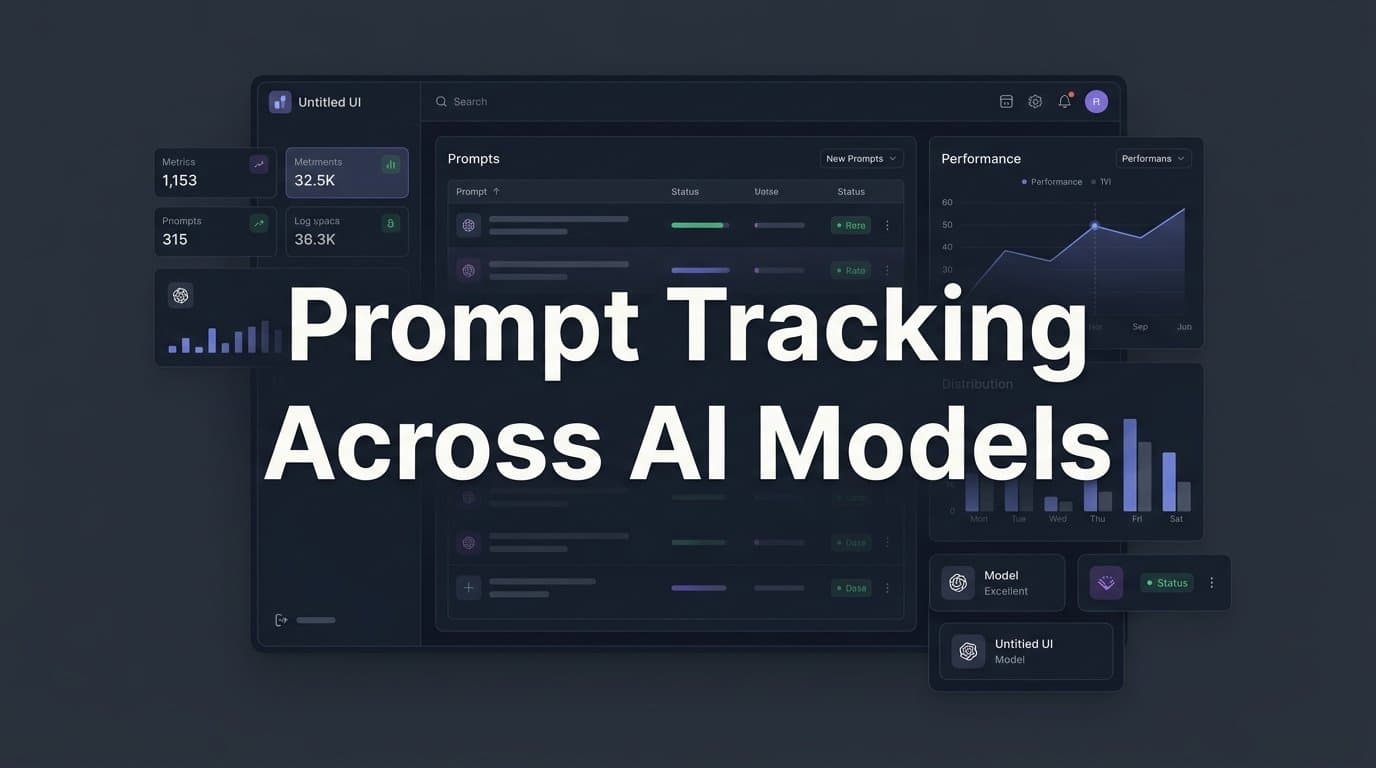
This is precisely what Sight AI's platform is built to automate. Sight AI tracks brand mentions across 6+ AI models, including ChatGPT, Claude, and Perplexity, and surfaces the data through a prompt tracking dashboard and AI Visibility Score that makes the analysis immediately actionable. When the data reveals a content gap, Sight AI's AI Content Writer (powered by 13+ specialized AI agents) can generate SEO and GEO-optimized articles targeting that gap. And when content is published, Sight AI's IndexNow integration and automated sitemap tools ensure it's indexed quickly, maximizing its chances of being picked up by retrieval-augmented models like Perplexity. The entire loop, from tracking to insight to content to indexing, runs on a single platform.
The Measurement Practice That Defines the Next Era of Organic Growth
The shift toward AI-mediated discovery is not a future trend to prepare for. It's a present reality that's already affecting how brands are found, evaluated, and recommended. For marketers and founders, prompt tracking is the foundational measurement practice that makes it possible to compete in this environment with the same rigor you've always applied to SEO.
The brands building this discipline now are accumulating something valuable: a longitudinal dataset of how AI models represent them, a content strategy informed by direct evidence of AI visibility gaps, and a feedback loop that compounds over time. As AI search continues to grow as a discovery channel, that compounding advantage will only become more significant.
The good news is that the infrastructure to do this well now exists. You don't need to build a custom querying system or manually parse AI responses in a spreadsheet. Purpose-built platforms handle the tracking, scoring, and analysis so your team can focus on the strategic decisions the data enables.
Stop guessing how AI models like ChatGPT and Claude talk about your brand. Get visibility into every mention, track content opportunities, and automate your path to organic traffic growth. Start tracking your AI visibility today and see exactly where your brand appears across top AI platforms.