If your brand isn't showing up when users ask Perplexity AI questions in your niche, you're missing a discovery channel that's growing faster than most marketers realize. Perplexity has become a go-to research tool for professionals, founders, and consumers who want cited, conversational answers — and the brands that appear in those answers gain a form of credibility and traffic that traditional SEO alone can't deliver.
Here's the uncomfortable truth: poor visibility in Perplexity AI isn't random. It stems from a handful of fixable issues. Your content may not be indexed or authoritative enough for Perplexity to cite. Your brand might lack the third-party mentions that AI systems use as trust signals. Or your content simply isn't structured in the way AI models prefer to retrieve and synthesize information.
Understanding why this matters requires a quick look at how Perplexity works. It's a retrieval-augmented generation (RAG) system, meaning it pulls from web-crawled sources in real time and synthesizes answers with citations. Unlike a traditional search engine that ranks pages, Perplexity selects sources it can confidently attribute and quote. That changes everything about how you need to approach content and authority building.
This guide walks you through six concrete steps to diagnose the root cause of your Perplexity AI visibility gap and systematically fix it. You'll go from auditing your current AI presence to publishing content optimized for generative engine retrieval. By the end, you'll have a repeatable process for improving how AI models like Perplexity discover, reference, and recommend your brand.
Step 1: Audit Your Current Perplexity AI Visibility
You can't fix what you haven't measured. Before making any changes, you need a clear baseline of where your brand currently stands in Perplexity's answers.
Start manually. Open Perplexity AI and run 10 to 15 prompts that reflect how your target audience searches for solutions in your niche. Think about the different query types your prospects actually use: question-style prompts ("What is the best tool for tracking AI brand mentions?"), comparison prompts ("X vs. Y for content marketing"), and outcome-based prompts ("best platforms for organic traffic growth in 2026"). Note whether your brand appears in the answers themselves, in the cited sources, or not at all.
This manual audit reveals something critical: which competitors are appearing consistently in Perplexity answers. That's not frustrating information — it's a roadmap. The sources Perplexity cites for your competitors tell you exactly what content types, publication outlets, and authority signals Perplexity trusts in your space.
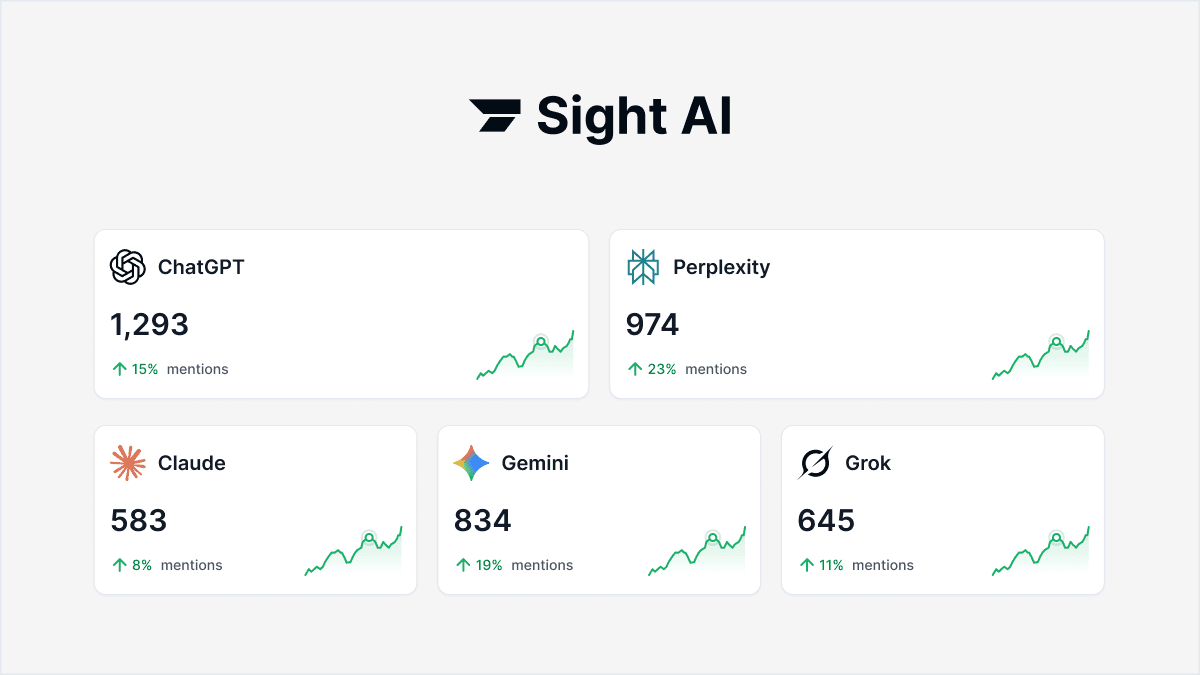
Manual querying has real limits, though. Prompt phrasing variations, query volume, and the sheer number of relevant topics make it impossible to get comprehensive coverage by hand. This is where an AI visibility tracking tool becomes essential. Platforms like Sight AI automate brand mention monitoring across Perplexity and other AI models, capturing sentiment analysis and prompt-level data at a scale that manual checking simply can't match.
Record your baseline AI Visibility Score before making any changes. This number becomes your north star for measuring whether the steps you take in this guide are actually working. Without it, you're optimizing blind.
Common pitfall: Only checking one or two queries and concluding your brand "doesn't appear in Perplexity." Perplexity's retrieval varies significantly by prompt phrasing. A brand might appear in answers to one phrasing and be completely absent from another. Comprehensive prompt testing across question formats, comparison formats, and category-level queries gives you an accurate picture.
Success indicator: You have a documented list of 15+ prompts, a record of which competitors appear and in which sources, and a baseline visibility score you can track over time.
Step 2: Fix Your Indexing and Crawlability Foundations
Perplexity AI retrieves content from the web. That sounds obvious, but the implication is significant: if your pages aren't properly indexed by major search engines, they are effectively invisible to Perplexity's retrieval system too. Indexing isn't just an SEO concern — it's the foundation of AI visibility.
Start with your XML sitemap. Audit it to confirm that all your priority pages are included: cornerstone content, product pages, comparison articles, and any guides or explainers you've published. Once verified, make sure the sitemap is actively submitted to both Google Search Console and Bing Webmaster Tools. Bing's index, in particular, is worth prioritizing because Perplexity has historically drawn from Bing's search infrastructure.
Speed up the indexing process with IndexNow. This open protocol, supported by Bing, Yandex, and other search engines, allows publishers to instantly notify search engines when new or updated content is available rather than waiting for a crawl cycle that could take days or weeks. Sight AI's indexing tools include IndexNow integration with automated sitemap updates, which means every piece of content you publish gets pushed for indexing immediately. Faster indexing translates directly to faster potential retrieval by AI systems.
Next, audit for technical issues that block crawlers. Check your robots.txt file to ensure you're not inadvertently blocking AI crawlers or search engine bots from accessing important pages. Scan for noindex tags on pages that should be publicly visible. Review your crawl error reports in Google Search Console and address any 404 errors or redirect chains that could be preventing proper indexing.
Page performance matters here too. Slow or unstable pages are deprioritized by both search engines and AI retrieval systems. Run your priority pages through Core Web Vitals testing and address any significant performance issues. A page that loads slowly or fails intermittently is a page that may not make it into the retrieval pool. Understanding how to measure AI visibility metrics alongside technical health gives you a complete picture of what's holding your brand back.
Common pitfall: Publishing great content and assuming it will be indexed quickly. Without active submission and IndexNow, new pages can sit unindexed for weeks, meaning Perplexity simply can't find them regardless of how well-written they are.
Success indicator: All priority pages appear in Google's index within 48 to 72 hours of publishing or updating, confirmed via the URL Inspection tool in Google Search Console.
Step 3: Restructure Content for AI Retrieval and Citation
Even perfectly indexed content can be invisible in Perplexity if it isn't structured in the way AI systems prefer to extract and cite information. This is where many brands have a significant gap: their content is written to rank in traditional search, not to be retrieved and attributed by a generative AI.
The single most impactful change you can make is leading with direct answers. Perplexity favors content that immediately addresses the question being asked, then elaborates. If your articles bury the key answer three paragraphs deep after a lengthy introduction, AI retrieval systems may skip over your content in favor of a source that gets to the point faster. Audit your existing articles and restructure them so the first paragraph directly answers the core question the article addresses.
Rethink your heading structure. Question-based H2 and H3 headings that mirror how users phrase prompts in Perplexity are significantly more retrieval-friendly than feature-focused or brand-centric headings. "What is the best way to track AI brand mentions?" performs better for AI retrieval than "Our Platform Features." This isn't just about keywords — it's about matching the conversational query format that Perplexity users actually type.
Add structured data markup to your priority pages. FAQ schema, HowTo schema, and Article schema all help AI systems understand the context and authority of your content. These markup types signal to retrieval systems what your content is about and how it should be interpreted, making it easier for Perplexity to confidently attribute and cite your pages. A deeper look at how to optimize for Perplexity AI covers the full range of structural changes that move the needle most.
Adjust your writing tone toward factual and citation-friendly language. Perplexity surfaces content it can confidently attribute, which means vague marketing language works against you. Replace phrases like "our powerful solution transforms your workflow" with specific, verifiable claims about what your product does and how. Concrete, factual writing is more citable than promotional prose.
Prioritize the content formats Perplexity answers most frequently: step-by-step guides, comparison articles, definition and explainer content, and "best tools for X" listicles. These formats map directly to the query types users bring to Perplexity, making them your highest-value publishing targets.
Common pitfall: Over-optimizing for keyword density while ignoring the conversational, answer-first structure AI models prefer. A keyword-stuffed article that doesn't directly answer a question will consistently lose to a well-structured, conversational piece that does.
Step 4: Build the Third-Party Authority Signals AI Models Trust
Perplexity doesn't just retrieve any indexed content — it cites sources it deems authoritative. And authority, in Perplexity's framework, is heavily influenced by what the broader web says about your brand. If your brand only exists on your own website, you have a significant authority gap that no amount of on-site optimization can fully close.
Editorial coverage is the most valuable third-party signal you can build. Pursue placements in industry publications, niche blogs, and news sites that are relevant to your category. These citations carry significant weight in AI retrieval because Perplexity already trusts these outlets and frequently cites them. A well-placed article in a recognized industry publication can do more for your Perplexity visibility than dozens of optimized blog posts on your own domain.
Ensure your brand is listed and accurately described across high-authority directories and review platforms. For SaaS and software brands, this means G2, Capterra, and Product Hunt at minimum. For other categories, identify the dominant directories and review sites in your space. These platforms are consistently cited by Perplexity because they aggregate trusted, user-generated information about products and services.
Contribute guest articles and expert quotes to established publications in your niche. Perplexity frequently surfaces expert commentary from recognized outlets, and being quoted or bylined in those sources builds the kind of distributed authority that AI models use to assess credibility. This isn't just about backlinks — it's about appearing in the sources Perplexity already trusts.
Audit your professional profiles for completeness and consistency. Your LinkedIn company page, Crunchbase profile, and any relevant knowledge base entries should accurately describe your brand, products, and value proposition. Inconsistent information across these sources can create confusion for AI systems trying to build an accurate picture of your brand. If your brand has a Wikipedia presence, review it for accuracy and completeness.
Common pitfall: Focusing exclusively on on-site content optimization while neglecting the third-party authority signals that Perplexity uses to validate sources. On-site optimization without off-site authority building produces limited results in AI visibility.
Success indicator: When you search your brand name directly in Perplexity, it returns accurate, positive descriptions sourced from third-party sites rather than only from your own domain.
Step 5: Publish a Consistent Stream of GEO-Optimized Content
GEO — Generative Engine Optimization — is the practice of creating content specifically designed to be retrieved and cited by AI models. It builds on traditional SEO principles but adds a layer of intentionality around how AI systems extract, synthesize, and attribute information. For brands serious about Perplexity visibility, GEO isn't optional: it's the engine of compounding AI presence.
Start by identifying content gaps. Go back to the manual audit you completed in Step 1 and look specifically at the questions Perplexity is answering in your niche without citing your brand. Each of those is a publishing opportunity. These gaps represent queries where Perplexity has demonstrated it will engage with the topic — you just need to give it a better source to cite.
Match your content formats to what Perplexity retrieves most frequently. Step-by-step guides, how-to articles, comparison pieces, and explainers consistently appear in Perplexity's answers because they directly address the informational queries users bring to the platform. Listicles that answer "best X for Y" questions are particularly effective because they map to one of Perplexity's most common query patterns.
Optimize for long-tail, conversational queries that mirror how professionals actually phrase questions in Perplexity. The difference between "AI visibility software" and "how do I track where my brand appears in AI search results" is significant. The conversational version matches the natural language queries that Perplexity users type, making your content far more likely to be retrieved for those prompts. Reviewing LLM prompt engineering for brand visibility can sharpen your understanding of exactly how to phrase content for maximum retrieval.
Publishing consistency matters more than most brands expect. AI models update their retrieval pools as new content is indexed, which means a steady publishing cadence keeps your brand in active consideration rather than fading from relevance as fresher content displaces older material. This is where AI visibility optimization tools become practically essential. Sight AI's content writer uses 13+ specialized AI agents to produce SEO and GEO-optimized articles at scale — listicles, guides, and explainers that match the formats Perplexity prefers, published through CMS auto-publishing capabilities that eliminate manual bottlenecks.
Autopilot Mode takes this further by maintaining your publishing cadence automatically, ensuring that content freshness and volume compound over time without requiring constant manual intervention. AI visibility isn't built in a single publishing sprint — it accumulates through consistent, optimized output over months.
Common pitfall: Publishing a burst of GEO-optimized content and then going quiet. Perplexity favors fresh, comprehensive sources. A brand that publishes consistently will outperform one that publishes sporadically, even if the sporadic publisher produces higher individual article quality.
Step 6: Monitor, Iterate, and Scale What Works
The brands that win in AI search aren't the ones who execute a strategy once — they're the ones who build a feedback loop that continuously improves their visibility over time. Monitoring isn't the final step; it's the mechanism that makes every other step more effective.
Set up ongoing AI visibility monitoring across Perplexity and other major AI platforms including ChatGPT, Claude, and Gemini. Visibility improvements in one platform often correlate with improvements across others because the underlying signals — indexed content, third-party authority, structured data — influence multiple retrieval systems simultaneously. Tracking across platforms gives you a more complete picture of your AI presence and helps you identify which actions are producing the broadest impact.
Track which specific content pieces are generating AI citations. This is where prompt-level data becomes invaluable. When you can see that a particular guide or comparison article is being cited in Perplexity answers, you have a clear signal to double down: publish more content in that format, on adjacent topics, with the same structural approach. Scaling what's already working is consistently more efficient than experimenting from scratch.
Review your AI Visibility Score on a monthly cadence and correlate changes with specific actions you've taken. Did your score improve after publishing a batch of GEO-optimized guides? After securing editorial coverage in an industry publication? After fixing crawl errors and resubmitting your sitemap? Building this correlation between actions and outcomes is what transforms AI visibility from a vague goal into a manageable, improvable metric. Tools that provide an AI visibility tracking dashboard make this monthly review process significantly more actionable.
Update and expand high-performing content regularly. Perplexity favors fresh, comprehensive sources over outdated ones. An article that was comprehensive six months ago may now be missing recent developments, new tools, or updated best practices. A regular content refresh cadence keeps your best-performing pieces competitive in AI retrieval.
Expand your prompt tracking library over time. Add new query variations, competitor comparison prompts, and category-level questions as your market evolves. The queries your prospects use in Perplexity will shift as the platform grows and as your category matures — your tracking should grow with it.
Success indicator: Your brand appears consistently in Perplexity answers for your core category queries, with positive sentiment and accurate descriptions sourced from a mix of your own content and third-party citations.
Your AI Visibility Action Plan
Fixing poor visibility in Perplexity AI isn't a one-time task. It's a compounding strategy that rewards brands who invest in indexability, content quality, and third-party authority simultaneously. The good news is that each step builds on the last, and progress tends to accelerate once the foundations are in place.
Here's a quick checklist to track your progress as you work through this guide:
Baseline audit complete: Prompt tracking is in place and your AI Visibility Score is documented.
Indexing foundations fixed: All priority pages are indexed, your sitemap is submitted, and IndexNow is active for new content.
Content restructured: Key articles lead with direct answers, use question-based headings, and include FAQ or HowTo schema markup.
Third-party authority building: Editorial coverage, directory listings, and professional profiles are secured and consistent.
GEO content cadence established: You're publishing optimized guides, comparisons, and explainers on a consistent schedule.
Monthly review scheduled: AI Visibility Score reviews are on the calendar with a process for correlating changes to specific actions.
The brands winning in AI search right now are treating Perplexity and other AI platforms as a distinct discovery channel, not an afterthought of traditional SEO. That shift in thinking — from "how do we rank?" to "how do we get cited?" — is what separates brands with growing AI visibility from those stuck wondering why they don't appear.
Sight AI's platform gives you the visibility tracking, content generation, and indexing tools to execute every step in this guide from one place. Start tracking your AI visibility today and see exactly where your brand appears across top AI platforms — then build systematically from there.