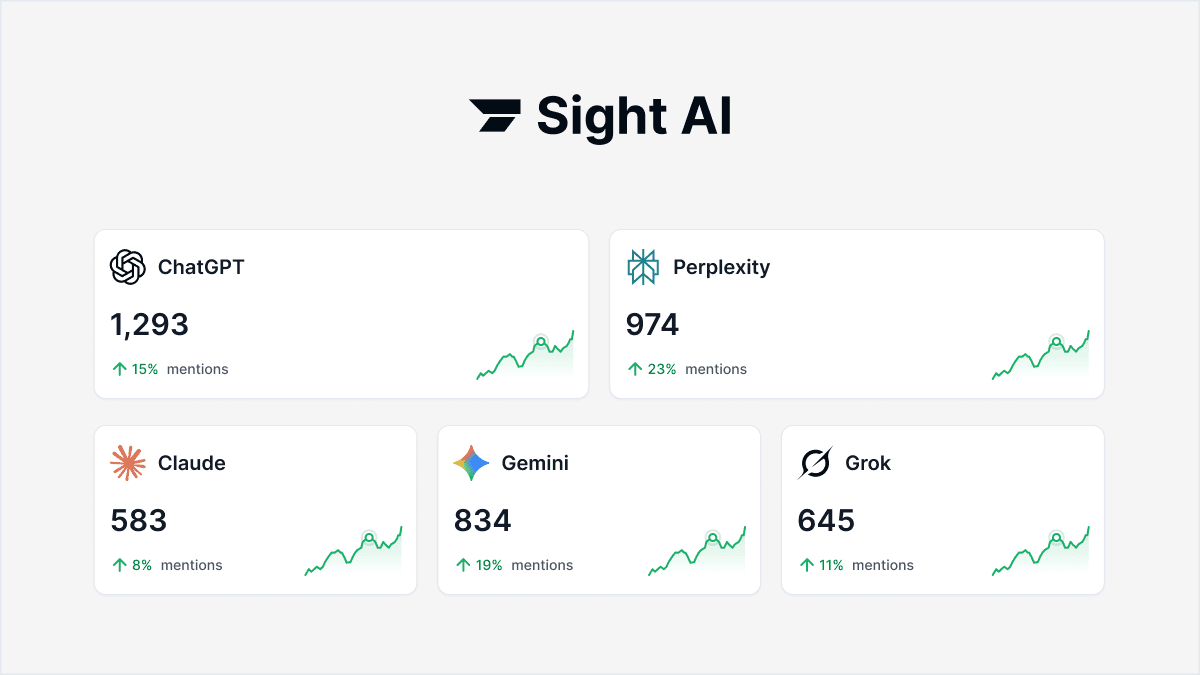
As AI-powered search fragments across ChatGPT, Claude, Perplexity, Gemini, and emerging models, brands face a new challenge: understanding how each LLM represents them differently. A single customer query about your product might yield glowing recommendations from one model and complete omission from another. This inconsistency creates blind spots that traditional brand monitoring tools simply cannot detect.
Multi-LLM brand monitoring has emerged as the practice of systematically tracking, analyzing, and optimizing how your brand appears across multiple AI language models simultaneously. For marketers, founders, and agencies focused on organic growth, mastering this discipline is no longer optional—it's essential for maintaining visibility in an AI-mediated discovery landscape.
This guide presents seven proven strategies to build a comprehensive multi-LLM monitoring system that surfaces actionable insights and drives measurable improvements in AI visibility.
1. Establish Baseline Visibility Scores Across All Major LLMs
The Challenge It Solves
You cannot improve what you cannot measure. Most brands approach AI visibility reactively, discovering gaps only when customers mention they couldn't find them through AI search. Without baseline measurements across ChatGPT, Claude, Perplexity, and other platforms, you're essentially flying blind. Different LLMs have distinct training data cutoffs, retrieval mechanisms, and ranking algorithms, which means your brand might rank prominently in one model while being completely absent from another. Establishing baselines creates the foundation for all subsequent optimization efforts.
The Strategy Explained
Begin by selecting 10-15 core queries that represent how your target audience discovers solutions in your category. These should range from broad category terms to specific problem-solution queries. Run each query across all major LLM platforms and document whether your brand appears, in what position, and within what context. Create a scoring system that accounts for mention frequency, positioning, and context quality. This becomes your benchmark against which all future measurements are compared.
The key is consistency in methodology. Use identical phrasing across platforms, test at the same time of day to minimize variability, and document the exact model versions being queried. Think of this as your AI visibility audit—a snapshot of your current state before optimization begins. Effective LLM brand visibility monitoring requires this systematic approach from day one.
Implementation Steps
1. Identify your 10-15 most important customer discovery queries through search data, customer interviews, and competitive analysis.
2. Create a standardized testing protocol that includes exact query phrasing, testing schedule, and documentation format for responses.
3. Execute baseline tests across ChatGPT, Claude, Perplexity, Gemini, and any other relevant platforms, recording brand mention presence, position, and surrounding context.
4. Develop a visibility scoring framework that assigns numerical values to different mention types—direct recommendations score higher than passing mentions, for example.
5. Document all findings in a centralized dashboard that allows for time-series comparison as you implement optimization strategies.
Pro Tips
Run baseline tests multiple times over a week to account for model variability and potential updates. Some LLMs introduce slight randomness in responses, so a single test might not represent typical behavior. Additionally, segment your queries by customer journey stage—awareness, consideration, decision—to understand where visibility gaps are most critical. The patterns you uncover often reveal which content types need immediate attention.
2. Implement Unified Prompt Tracking Across Platforms
The Challenge It Solves
Customer queries evolve constantly, and the prompts that trigger brand mentions today might change tomorrow as user behavior shifts. Without systematic tracking of which specific queries generate visibility across different LLMs, you're missing crucial intelligence about discovery patterns. A query that consistently triggers your brand mention in ChatGPT might yield competitor recommendations in Claude. Understanding these platform-specific response patterns allows you to prioritize content optimization efforts where they'll have the greatest impact.
The Strategy Explained
Build a centralized prompt library that captures every query variation you want to monitor, then create a systematic testing cadence across all platforms. This isn't about running hundreds of random queries—it's about identifying the high-value prompts that represent actual customer discovery behavior and tracking them consistently. The goal is to understand not just whether your brand appears, but which specific question formulations trigger mentions and how those patterns differ between models.
Modern AI visibility tracking requires treating prompts as strategic assets. Just as SEO professionals track keyword rankings, multi-LLM monitoring demands tracking prompt performance. The difference is that AI responses are contextual and conversational, so you need to account for semantic variations and related query clusters. Learning how to track LLM brand mentions effectively starts with this prompt-centric approach.
Implementation Steps
1. Build your core prompt library by analyzing customer support tickets, search console data, and social listening to identify how real users phrase discovery queries.
2. Organize prompts into thematic clusters based on customer intent—problem identification, solution comparison, implementation guidance, and so forth.
3. Establish a weekly testing schedule where each prompt in your library is run across all monitored LLM platforms, with results logged in a structured database.
4. Create response categorization tags that capture mention type, competitive context, and recommendation strength for each prompt-platform combination.
5. Analyze patterns monthly to identify which prompt formulations consistently generate visibility and which represent optimization opportunities.
Pro Tips
Pay special attention to conversational follow-up prompts, not just initial queries. Users often refine their questions based on initial AI responses, and these follow-up interactions can reveal whether your brand maintains visibility throughout a discovery conversation. Additionally, track prompts that mention competitors by name—understanding when users ask "alternatives to [Competitor]" helps you identify content gaps where you should be appearing but aren't.
3. Develop Sentiment Analysis Frameworks for AI Responses
The Challenge It Solves
Brand mentions alone tell an incomplete story. An LLM might mention your brand frequently but characterize it negatively, position it as a budget option when you're premium, or describe outdated features that no longer represent your offering. Traditional monitoring tools count mentions without evaluating the quality of those references. This creates a false sense of security—you think you have visibility when in reality the AI is actively steering users away from your solution or misrepresenting your value proposition.
The Strategy Explained
Create a structured evaluation framework that scores not just mention frequency but the quality and accuracy of how LLMs characterize your brand. This framework should assess whether mentions are positive, neutral, or negative, whether positioning aligns with your intended market position, and whether the information presented is current and accurate. Think of this as moving from quantitative to qualitative AI visibility measurement.
The most effective frameworks use a rubric approach where each mention receives scores across multiple dimensions. This allows you to identify specific issues—perhaps Claude consistently positions you accurately but ChatGPT references outdated pricing, or Perplexity mentions you positively but in the wrong category. Tools designed to monitor LLM brand sentiment can automate much of this analysis.
Implementation Steps
1. Define your ideal brand positioning across key dimensions—price tier, feature set, target customer, primary use cases, and competitive differentiation.
2. Create a scoring rubric that evaluates each AI mention against these dimensions, assigning numerical scores for accuracy, positivity, and strategic alignment.
3. Review all brand mentions from your prompt tracking efforts using this rubric, documenting specific language used by each LLM to describe your offering.
4. Identify patterns in mischaracterization—common inaccuracies, outdated information, or positioning misalignments that appear consistently across models or specific to certain platforms.
5. Connect sentiment findings to content gaps, creating a prioritized list of topics where new or updated content could correct LLM understanding of your brand.
Pro Tips
Pay particular attention to how LLMs describe your differentiators compared to competitors. If AI models consistently highlight competitor strengths while mentioning your brand generically, you've identified a critical content gap. Also track temporal patterns—newly launched features often take months to appear in LLM responses, revealing the lag between content publication and AI model knowledge updates. This timing intelligence helps you set realistic expectations for optimization efforts.
4. Build Competitive Intelligence Dashboards for AI Visibility
The Challenge It Solves
Your AI visibility exists in a competitive context. Understanding that you appear in 40% of relevant prompts means little without knowing whether competitors appear in 60% or 20%. Many brands focus exclusively on their own mentions while missing the bigger picture of how AI models compare and contrast solutions in your category. This tunnel vision prevents you from identifying the specific competitive gaps that matter most—the queries where competitors consistently win AI recommendations while you're absent.
The Strategy Explained
Expand your monitoring system to track not just your brand but your top 3-5 competitors across the same prompt library. This creates a competitive visibility matrix that reveals relative positioning across different LLMs and query types. The goal is to identify patterns: which competitors dominate which types of queries, which LLMs favor which brands, and where white space opportunities exist for your brand to gain ground.
Competitive intelligence in the AI visibility context differs from traditional search monitoring because LLMs often provide explicit comparisons and recommendations. When a user asks "what's the best solution for X," the AI might recommend three specific brands. Understanding how LLMs choose brands to recommend provides invaluable strategic intelligence for positioning your content.
Implementation Steps
1. Identify your 3-5 primary competitors based on market positioning, target audience overlap, and solution similarity rather than just company size.
2. Expand your prompt tracking system to capture competitor mentions alongside your own, documenting position, context, and recommendation strength for each.
3. Create visualization dashboards that show competitive visibility across different dimensions—by LLM platform, by query category, by customer journey stage.
4. Analyze competitive mention patterns to identify where competitors are consistently recommended and what language LLMs use to describe their strengths.
5. Reverse-engineer competitor content strategies by examining which topics and formats appear to drive their AI visibility, then identify gaps in your own content portfolio.
Pro Tips
Focus particularly on queries where competitors appear but you don't—these represent your highest-value content opportunities. Additionally, track how LLMs position competitors relative to each other. If ChatGPT consistently recommends Competitor A for enterprise use cases while suggesting Competitor B for startups, understanding this segmentation helps you identify positioning opportunities. Some brands discover they're competing in the wrong category entirely based on how AI models cluster solutions.
5. Create Content Feedback Loops from LLM Monitoring Data
The Challenge It Solves
The most sophisticated monitoring system delivers no value if insights don't translate into action. Many teams collect extensive data on AI visibility gaps but struggle to connect those findings to content creation workflows. The result is a disconnect between what monitoring reveals and what content teams produce. Meanwhile, visibility gaps persist because the feedback loop never closes. Without systematic processes for translating monitoring insights into content briefs, optimization remains theoretical rather than practical.
The Strategy Explained
Build a structured workflow that converts monitoring findings into prioritized content opportunities, then tracks whether that content successfully improves AI visibility. This creates a closed-loop system where monitoring informs creation, creation is measured for impact, and learnings refine future content strategy. The key is making the connection between visibility gaps and content production systematic rather than ad hoc.
Think of this as treating your monitoring data as a continuous content needs assessment. Every time you identify a query where competitors appear but you don't, that becomes a content brief. Every time sentiment analysis reveals mischaracterization, that becomes an update priority. The feedback loop ensures monitoring drives action rather than just generating reports. Comparing AI brand monitoring vs manual tracking reveals why automated systems are essential for maintaining this continuous loop.
Implementation Steps
1. Establish a monthly content planning meeting where monitoring insights are reviewed and translated into specific content briefs addressing identified gaps.
2. Create a prioritization framework that ranks content opportunities based on query volume potential, competitive gap size, and strategic importance to your business.
3. Develop content brief templates that include specific LLM visibility objectives—which prompts the content should target, which models need improved representation, what positioning the content should establish.
4. Implement post-publication tracking that measures whether new content improves visibility for targeted prompts, typically requiring 4-8 weeks for LLM knowledge to potentially update.
5. Document learnings about which content types and approaches most effectively improve AI visibility, building an internal playbook of proven tactics.
Pro Tips
Don't wait for perfect data before taking action. If monitoring reveals a significant gap, create content addressing it even if you haven't fully quantified the opportunity. The goal is rapid iteration, not analysis paralysis. Additionally, consider creating content specifically designed to be cited by AI models—comprehensive guides, comparison frameworks, and implementation resources tend to be referenced more frequently than promotional material. The content that helps LLMs provide better answers to users naturally improves your visibility.
6. Automate Alerts for Brand Mention Changes and Anomalies
The Challenge It Solves
AI models update their knowledge and behavior continuously, and significant changes to your brand visibility can happen without warning. A competitor might publish content that shifts LLM recommendations, a model update might change how your brand is characterized, or a new platform might launch where you have zero visibility. Manual monitoring catches these changes weeks or months after they occur, by which time you've lost significant discovery opportunities. Without automated alerting, you're always reacting to yesterday's problems rather than addressing today's shifts.
The Strategy Explained
Implement threshold-based monitoring that automatically alerts you when significant changes occur in your AI visibility metrics. This includes visibility score drops, sentiment shifts, competitive positioning changes, and the emergence of new high-value prompts where you're absent. The goal is to compress the time between a visibility change and your response from weeks to days or even hours. Investing in real-time brand monitoring across LLMs makes this level of responsiveness possible.
Effective alerting requires balancing sensitivity with noise. Alert on everything and your team ignores notifications. Alert on too little and you miss critical changes. The solution is tiered alerting where critical changes trigger immediate notifications while moderate shifts are batched into weekly summaries.
Implementation Steps
1. Define alert thresholds for critical metrics—visibility score drops exceeding 15%, sentiment shifts from positive to neutral or negative, new competitor appearances in top recommendations.
2. Configure automated testing that runs your core prompt library across all LLMs on a defined schedule, comparing results against baseline and previous measurements.
3. Set up notification channels that match urgency levels—Slack or email for critical alerts, weekly dashboard summaries for trend monitoring.
4. Create response protocols for different alert types so your team knows exactly what actions to take when specific thresholds are triggered.
5. Review alert effectiveness quarterly, adjusting thresholds based on false positive rates and missed significant changes to optimize signal-to-noise ratio.
Pro Tips
Pay special attention to sudden visibility drops that coincide with LLM model updates, as these often indicate changes in how models retrieve or rank information. Additionally, set up alerts for competitor content publication—when competitors launch major content initiatives, proactively test whether this impacts their AI visibility relative to yours. Early detection allows you to respond with your own content before the gap widens significantly.
7. Integrate Multi-LLM Monitoring with Broader SEO Strategy
The Challenge It Solves
Many teams treat AI visibility and traditional search optimization as separate disciplines with separate tools, separate workflows, and separate success metrics. This siloed approach misses the fundamental reality that both channels serve the same goal: helping potential customers discover your solution when they need it. Content that ranks well in traditional search often lacks the depth and structure that LLMs prefer for citations. Meanwhile, content optimized solely for AI visibility might miss basic on-page SEO fundamentals that drive traditional search traffic.
The Strategy Explained
Create a unified organic discovery strategy where AI visibility monitoring informs traditional SEO efforts and vice versa. This means using LLM monitoring data to identify content gaps that also represent keyword opportunities, and using search console data to understand which existing high-performing pages could be enhanced for better AI visibility. The goal is compound growth where improvements in one channel reinforce the other.
The most sophisticated approach treats content as serving both human searchers and AI models simultaneously. This requires understanding the overlapping and diverging needs of each audience—both benefit from comprehensive, well-structured information, but LLMs particularly value clear comparisons, implementation steps, and factual accuracy while traditional SEO also prioritizes elements like internal linking and meta optimization. Exploring the best LLM monitoring tools can help you find platforms that bridge both disciplines.
Implementation Steps
1. Map your LLM monitoring prompt library against your traditional keyword tracking to identify overlaps and gaps in coverage across both channels.
2. Create unified content briefs that include both traditional SEO requirements and AI visibility objectives, ensuring every piece of content serves both discovery channels.
3. Analyze your top-performing traditional search content for AI visibility—pages ranking well in Google might have poor LLM representation, revealing optimization opportunities.
4. Implement technical SEO fundamentals that also benefit AI discovery, particularly structured data, clear heading hierarchies, and comprehensive internal linking that helps both search crawlers and LLM knowledge retrieval.
5. Track unified organic discovery metrics that combine traditional search traffic with AI-referred visitors, creating a complete picture of content performance across all discovery channels.
Pro Tips
Focus particularly on bottom-of-funnel content where both SEO and AI visibility deliver high-intent traffic. Implementation guides, comparison pages, and solution-specific resources tend to perform well in both channels when properly optimized. Additionally, use tools that combine traditional search indexing with AI visibility tracking—platforms like Sight AI integrate IndexNow for faster traditional search discovery alongside multi-LLM monitoring, creating a unified workflow rather than forcing you to manage separate systems.
Putting It All Together
Building effective multi-LLM brand monitoring requires a systematic approach that starts with baseline measurement and evolves into a continuous optimization cycle. Begin with strategies one and two—establishing visibility scores and unified prompt tracking—as these form the foundation for all subsequent efforts. Without reliable baseline data and consistent prompt monitoring, you're building on sand.
Once you have reliable data flowing, layer in sentiment analysis and competitive intelligence to contextualize your position. Understanding not just whether you appear but how you're characterized and how that compares to competitors transforms raw data into strategic intelligence. This is where monitoring shifts from measurement to insight.
The most successful teams then close the loop by connecting monitoring insights directly to content creation, ensuring every piece of content addresses identified visibility gaps. Combine this with automated alerting so you catch changes quickly, and integrate everything with your broader SEO strategy for compound growth across all organic discovery channels.
As AI models continue to evolve and new platforms emerge, the brands that invest in robust multi-LLM monitoring infrastructure today will maintain the visibility advantage tomorrow. The question is no longer whether to monitor your AI presence, but how quickly you can build the systems to do it effectively.
Stop guessing how AI models like ChatGPT and Claude talk about your brand—get visibility into every mention, track content opportunities, and automate your path to organic traffic growth. Start tracking your AI visibility today and see exactly where your brand appears across top AI platforms.