You've just landed on a competitor's website. You pull up a quick SEO check, see their Moz grade, and immediately have a rough sense of how formidable they are in search. Sound familiar? For marketers, founders, and agency strategists, this kind of gut-check has become second nature. But how many of us actually understand what that number represents, what drives it up or down, and where it falls short?
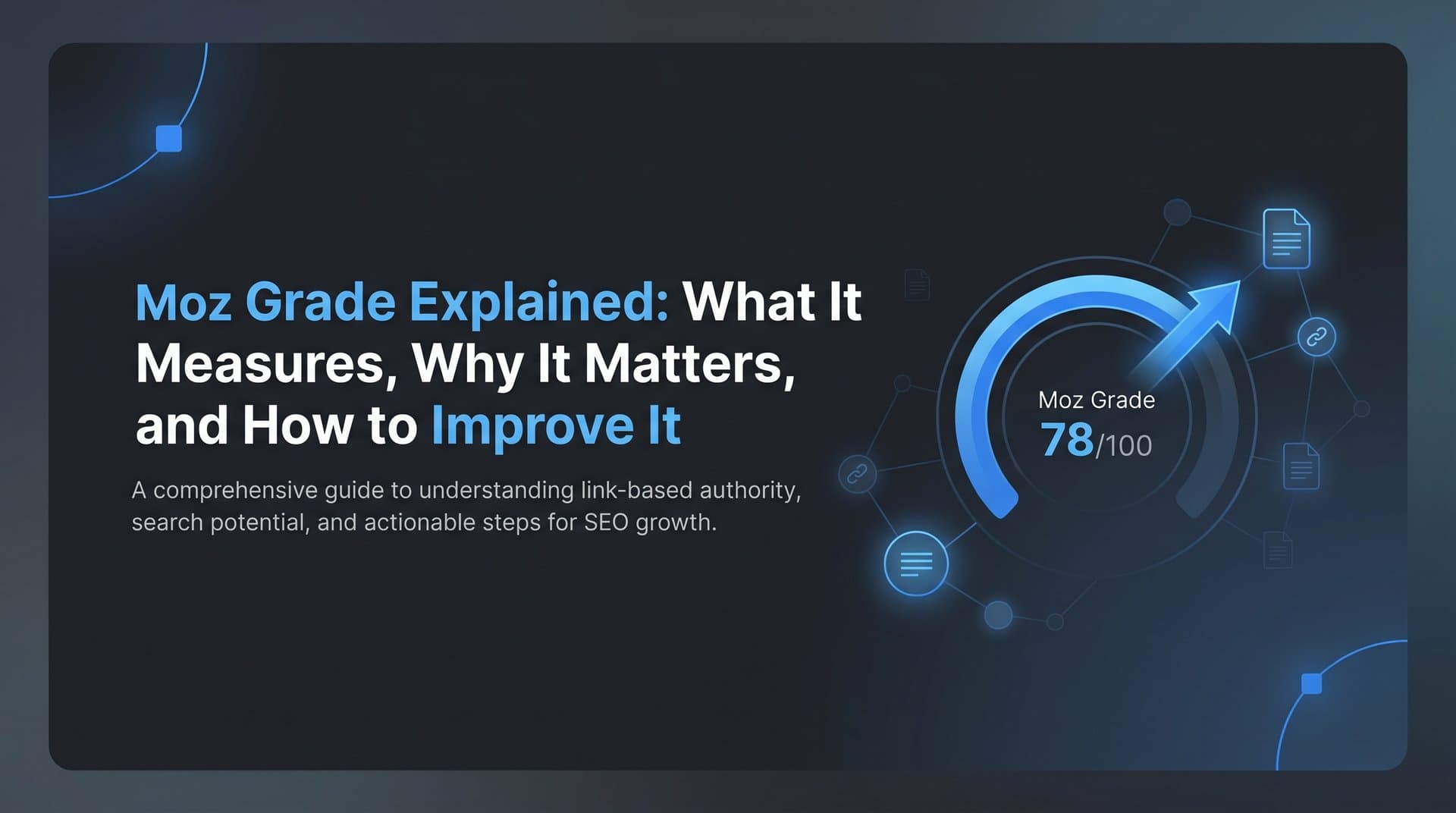
Moz grade, built around metrics like Domain Authority and Page Authority, has become one of the most recognized benchmarks in the SEO industry. It gives you a fast, comparative read on a site's link-based authority and its likelihood of performing well in search results. That's genuinely useful. But like any single metric, it tells only part of the story.
This article breaks down exactly what Moz grade evaluates, how the underlying scoring model works, and what you can do to move the needle. More importantly, it puts Moz grade in context: as the search landscape expands to include AI platforms like ChatGPT, Claude, and Perplexity, traditional authority metrics need to be paired with a new layer of visibility measurement. By the end, you'll have a clear framework for using Moz grade as one powerful instrument in a much larger strategy.
Breaking Down the Moz Grading System
When people refer to a "Moz grade," they're typically talking about a cluster of related metrics that Moz has developed to evaluate a website's authority and health. The two headline metrics are Domain Authority (DA) and Page Authority (PA), but Spam Score rounds out the picture in an important way.
Domain Authority (DA) is a score from 1 to 100 that predicts how likely a domain is to rank in search engine results pages. A higher score means a stronger, more authoritative domain relative to others in Moz's index. New domains typically start near 1. Established, heavily linked sites can reach scores in the 80s and 90s.
Page Authority (PA) works on the same 1-100 scale but applies to individual pages rather than entire domains. A high-DA site can still have individual pages with modest PA scores if those pages haven't attracted many inbound links. Conversely, a single viral piece of content can earn a high PA even on a lower-DA domain.
Spam Score functions differently. Rather than measuring authority, it flags risk. Moz's Spam Score indicates the percentage of sites with characteristics similar to yours that have been penalized or banned by Google. Scores fall into three categories: low risk (1-30%), medium risk (31-60%), and high risk (61-100%). A high Spam Score doesn't automatically mean your site is penalized, but it signals that your backlink profile or site patterns resemble those of problematic sites.
Together, these metrics form what most practitioners think of as a site's overall Moz grade. DA drives the headline number, PA informs page-level strategy, and Spam Score acts as a quality filter on the whole picture.
One of the most important things to understand about this system is the logarithmic scale. Moving from a DA of 20 to 30 is a very different challenge than moving from 70 to 80. The scale is designed so that improvements become exponentially harder at higher levels. This reflects reality: the competition for top-tier authority is intense, and the marginal effort required to gain each additional point increases dramatically as you climb.
What counts as a "good" Moz grade depends heavily on context. A local service business competing in a single city might be highly competitive with a DA of 25-35. A national publisher or SaaS company competing for broad, high-volume keywords may need to be in the 50s or 60s just to be in the conversation. The most useful frame is always comparative: how does your DA stack up against the sites currently ranking for your target keywords? Learning how to measure SEO success beyond a single metric is essential for putting these numbers in proper perspective.
Critically, Moz grade is a predictive and comparative metric, not a Google ranking factor. Google has confirmed publicly that it does not use third-party authority scores in its ranking algorithm. DA is Moz's model for estimating how well a site is likely to perform based on patterns Moz has observed across its index. It's a useful proxy, not an official signal.
The Ranking Signals Behind Your Score
If DA is the output, what goes into the input? According to Moz's own documentation, Domain Authority is calculated using a machine learning model that evaluates over 40 signals. But a handful of factors carry the most weight.
Linking root domains is arguably the single most influential factor. This counts the number of unique domains linking to your site. One hundred links from ten different domains carries far less weight than one hundred links from one hundred different domains. Diversity of your backlink sources matters enormously.
Total backlink count also contributes, but with diminishing returns. More links are generally better, but the quality and diversity of those links matter more than sheer volume. A single link from a high-authority, editorially relevant source can outweigh dozens of links from low-quality directories.
MozRank measures the link popularity of a page or domain, taking into account the quality of the pages linking to it. It's a recursive metric: links from high-MozRank sources pass more value than links from low-MozRank sources. Think of it as a weighted measure of link popularity.
MozTrust adds another dimension by evaluating how close a site is to trusted seed sites on the web. Sites that are linked to by highly trusted sources, such as government domains, major universities, and established publications, earn higher MozTrust scores. This metric helps distinguish genuine authority from manipulated link profiles.
The machine learning model takes these signals and correlates them with actual search engine indexing patterns across Moz's index. The goal is to produce a score that predicts real-world ranking performance, not just to count links. This is why DA isn't simply a link counter but a more nuanced estimate of overall link equity and its likely impact on visibility.
Here's where Spam Score re-enters the picture as a negative modifier. If your backlink profile includes a high proportion of links from spammy, penalized, or low-quality domains, your Spam Score rises. This signals that your link equity may be diluted or even harmful. While Spam Score doesn't directly subtract from DA in a simple arithmetic way, a problematic link profile will naturally produce weaker DA inputs, because those low-quality links contribute little positive signal and may introduce noise into the model's assessment of your site's trustworthiness.
Moz updates its link index and DA calculations regularly, which means your score can fluctuate even if you haven't changed anything about your site. A competitor earning significant new links, or Moz recalibrating its model, can shift your relative position. This is another reminder that DA is comparative: it measures your standing within an ecosystem, not an absolute property of your domain.
Where Moz Grade Fits in Your SEO Toolkit
Understanding what Moz grade measures is useful. Understanding where it belongs in your workflow is where it becomes genuinely actionable.
The clearest use case is competitive benchmarking. When you're entering a new market, targeting a new keyword cluster, or evaluating a content investment, checking the DA of the sites currently ranking gives you an immediate sense of the authority gap you're working against. If the top three results all have DA scores in the 70s and you're at 35, you know you're fighting uphill and need a differentiated content strategy, not just more of the same.
Moz grade is also essential for link-building prospecting. When evaluating potential link partners, guest post opportunities, or digital PR targets, DA and PA give you a fast filter. A link from a DA 60 site in your niche is worth pursuing. A link from a DA 12 directory with a high Spam Score is not. This kind of triage saves significant time in outreach workflows.
Tracking your own DA over time gives you a longitudinal view of your authority-building progress. If you've been executing a link-building strategy for six months, a rising DA trend confirms that your efforts are compounding. A flat or declining DA is a signal to investigate: are you losing links? Is your Spam Score creeping up? Using an SEO performance dashboard alongside Moz grade helps you correlate authority trends with actual traffic and ranking outcomes.
That said, Moz grade has real limitations that every practitioner should keep front of mind.
It doesn't measure on-page content quality. A site with mediocre content but strong backlinks can have a high DA. A site with exceptional content but few links will have a low one. DA tells you nothing about whether your pages actually answer user intent well.
It doesn't reflect technical SEO health. Core Web Vitals, crawlability, site architecture, page speed, structured data: none of these show up in a Moz grade. A technically broken site can still have a respectable DA.
It doesn't capture user experience signals. Engagement metrics, bounce rates, and session quality influence how search engines assess page relevance over time, but they're invisible to Moz's model.
And critically, it doesn't measure AI visibility. As AI-powered search platforms become a significant source of brand discovery, whether ChatGPT recommends you, whether Perplexity cites your content, whether Claude surfaces your brand in a relevant conversation: none of this is captured by DA. This gap is becoming more significant by the month.
The practical takeaway is to use Moz grade as one input among several. Pair it with organic traffic trends from your analytics platform, keyword ranking data, technical crawl reports, indexing status monitoring, and increasingly, AI visibility tracking. No single metric gives you the full picture.
Practical Steps to Raise Your Moz Grade
Improving your Moz grade is fundamentally about improving your backlink profile. There's no shortcut around this. But the strategies that move the needle are also the ones that build genuine, durable authority.
Earn high-authority backlinks through original research. Publishing proprietary data, surveys, or industry benchmarks gives other sites a reason to cite you. Original research tends to attract links from journalists, bloggers, and analysts who want to reference primary sources. A well-executed research piece can earn dozens of high-quality inbound links over its lifetime, and each one contributes to your linking root domain count.
Invest in data-driven, linkable content assets. Comprehensive guides, tools, calculators, and visual explainers attract links organically over time. The key is creating something genuinely useful that others want to reference. Thin content rarely earns links from authoritative sources. Deep, well-structured content that solves a real problem is far more link-worthy. Reviewing strong content marketing strategy examples can help you identify the formats that consistently earn editorial links.
Execute targeted digital PR campaigns. Pitching story angles to journalists and publications in your niche, especially when tied to timely news or original data, is one of the fastest ways to earn high-DA editorial links. This requires investment in relationship-building and media outreach, but the links earned through genuine editorial coverage are among the most valuable for DA growth.
Pursue strategic guest contributions. Writing for respected publications in your industry, where you can include a relevant contextual link back to your site, remains a legitimate and effective link-building tactic when done with genuine editorial intent. Focus on sites with strong DA and real editorial standards, not link farms disguised as blogs.
Audit and clean your backlink profile regularly. Use Moz's Link Explorer or similar tools to identify toxic or spammy links pointing to your domain. A high Spam Score is a drag on your overall authority profile. When you identify genuinely harmful links, reach out to request removal, and use Google's Disavow Tool as a last resort for links you can't get removed. Keeping your link profile clean protects the authority you've built.
Optimize your internal link architecture. Internal links distribute page authority across your site. If all your external links point to your homepage but your most valuable content lives deep in your site architecture, you're leaving authority on the table. A deliberate internal linking strategy ensures that link equity flows to the pages you most want to rank, improving PA scores across your key content.
Maintain technical foundations that support crawlability. While technical SEO doesn't directly factor into DA, a site that's difficult to crawl or index will struggle to accumulate the kinds of links and engagement that drive authority growth. Clean site architecture, fast load times, and proper canonicalization create the conditions for your content to be discovered, shared, and linked to.
Publish consistently and authoritatively. Regular publication of high-quality content signals an active, growing site to both search engines and potential linking partners. It also gives you more pages to earn links to, more opportunities to rank for long-tail queries, and more content to promote through digital PR and outreach.
Beyond Domain Authority: Measuring Visibility in the Age of AI Search
Here's a reality that every modern marketer needs to sit with: a significant and growing portion of brand discovery is now happening outside of traditional search engine results pages entirely.
When someone asks ChatGPT for the best project management tools, or asks Claude to recommend a content marketing platform, or uses Perplexity to research SEO software options, the brands that get mentioned in those responses are winning visibility that doesn't show up in any DA score. Moz grade was designed to predict performance in traditional search. It has no mechanism for measuring how AI models perceive, cite, or recommend your brand.
This isn't a criticism of Moz grade. It's a recognition that the measurement landscape has expanded. Traditional SEO metrics like DA remain valuable for understanding link-based authority and competitive positioning in search engines. But they're now just one layer of a more complex visibility picture.
AI platforms like ChatGPT, Claude, Perplexity, and Google AI Overviews are increasingly the first touchpoint for users researching products, services, and solutions. These platforms synthesize information from across the web and generate recommendations. Whether your brand appears in those recommendations depends on factors that go beyond backlink profiles: the quality and breadth of your published content, how clearly you've established your brand's expertise and positioning in publicly available sources, and whether the content you produce aligns with the kinds of queries these AI systems are fielding. Understanding how to optimize content for SEO and AI discoverability simultaneously is becoming a critical skill.
This is where the concept of AI Visibility Scores and Generative Engine Optimization (GEO) comes in. Just as DA gives you a benchmark for traditional search authority, AI visibility metrics give you a benchmark for how prominently your brand appears in AI-generated responses. Tracking which AI platforms mention your brand, in what context, with what sentiment, and for which types of queries gives you actionable intelligence that traditional SEO tools simply can't provide.
GEO, as a discipline, focuses on creating content that AI models are likely to cite and recommend. This means publishing clear, authoritative, well-structured content that directly addresses the questions AI systems are being asked. It means building a content footprint broad enough that AI models encounter your brand across multiple contexts and sources. Leveraging AI content creation tools can help you scale this kind of authoritative content production without sacrificing quality.
The marketers and founders who are winning in this environment aren't choosing between traditional SEO and AI visibility. They're doing both, using tools that give them a complete view of their digital authority across every channel where their audience is searching.
Building a Complete Authority Strategy
Think of your authority strategy as a three-layer stack. Each layer is necessary. None is sufficient on its own.
The first layer is link-based authority, measured by Moz grade. Use DA for competitive benchmarking, link prospecting, and tracking the growth of your backlink profile over time. Keep your Spam Score low, build links through legitimate editorial means, and ensure your internal architecture distributes authority effectively. This layer tells you how search engines are likely to perceive your domain's credibility.
The second layer is technical and content performance. Complement your Moz grade with regular technical SEO audits, keyword ranking tracking, organic traffic analysis, and indexing status monitoring. Tools like IndexNow integration and automated sitemap updates ensure your new content gets discovered and indexed quickly, giving your link-building efforts a faster path to impact. This layer tells you whether your site is technically sound and whether your content is actually performing.
The third layer is AI visibility. Track how AI platforms like ChatGPT, Claude, and Perplexity mention and recommend your brand. Monitor the sentiment and context of those mentions. Identify the content gaps that are preventing you from appearing in AI-generated responses for your most valuable queries. This layer tells you whether you're winning the growing share of discovery that happens outside traditional SERPs.
The brands building durable authority in this environment are those that resist single-metric thinking. Moz grade is a valuable diagnostic, a genuinely useful benchmark for link health and competitive positioning. But it's one instrument in an orchestra that now needs to play across a much wider range.
Track your link authority. Audit your technical foundations. Publish content that earns both backlinks and AI citations. And monitor your visibility across every platform where your audience is searching for solutions you provide.
If you're ready to add that third layer, start tracking your AI visibility today and see exactly where your brand appears across top AI platforms. Stop guessing how AI models like ChatGPT and Claude talk about your brand. Get the visibility, the data, and the content opportunities you need to grow across every channel that matters.