AI search engines are quietly reshaping how buyers discover brands, compare tools, and make decisions. While you've been optimizing title tags and tracking keyword rankings, your competitors may already be showing up in ChatGPT conversations, Claude recommendations, and Perplexity summaries that your target customers are reading right now.
The challenge is that AI-generated responses don't come with a rank tracker. There's no position one to chase, no impressions dashboard to check. Instead, AI models surface brands through conversational outputs that most marketers have never thought to audit systematically.
Think of it like this: traditional search is a billboard highway where you can see exactly which signs are up and who paid for them. AI search is more like word-of-mouth at scale. The AI is the trusted friend recommending tools, and if your competitors are the ones getting recommended, you're losing influence in a channel that's growing fast in B2B and consumer contexts alike.
This guide gives you a practical, repeatable process for monitoring how your competitors appear in AI search. You'll learn which prompts trigger their mentions, how to analyze the sentiment and context around those mentions, and how to use that intelligence to build content that closes the gap. By the end, you'll have a working system to track competitor AI visibility, identify the content gaps they're exploiting, and position your brand as the recommended answer across AI platforms.
Let's get into it.
Step 1: Define the AI Search Landscape You're Competing In
Before you can monitor competitors in AI search, you need to understand the terrain. Not all AI platforms behave the same way, and your competitors may be winning on one while being invisible on another.
The major platforms worth mapping include ChatGPT, Claude, Perplexity, Gemini, and Microsoft Copilot. Each has a different user base, different training data, and different response tendencies. A brand that dominates Perplexity's recommendations might barely register on Claude. Your competitive intelligence needs to account for this variation from the start.
Next, map the types of queries your target audience is actually asking these AI systems. In B2B SaaS, common query patterns include:
Comparison prompts: "What's the difference between [Tool A] and [Tool B]?" These are high-intent queries where buyers are actively evaluating options.
Recommendation prompts: "What's the best tool for [use case]?" These often produce ranked or bulleted lists of vendors, making them particularly valuable to track.
Category prompts: "Top platforms for [industry or function]" queries that surface the dominant players in a space.
Problem-solution prompts: "How do I solve [specific pain point]?" These are often where lesser-known brands break through if they've published targeted, helpful content.
Now list your top three to five competitors by name. Don't forget brand aliases, product names, and sub-brands. AI models may reference a parent company in one response and a specific product name in another. Document all of these variations because you'll need them when building your prompt library in the next step.
One important mindset shift: AI visibility is not just about being mentioned. It's about the context and quality of that mention. A competitor being listed as "a good option for beginners" is a very different competitive signal than being called "the industry standard." Sentiment and framing matter as much as mention frequency.
The most common pitfall at this stage is focusing exclusively on branded queries. Unbranded, category-level prompts like "best SEO tool for agencies" or "top content marketing platforms" often drive the most valuable AI mentions because they reach buyers who haven't yet decided which brands to consider. These are the prompts where you can win or lose early-stage awareness. Understanding how AI search engines work helps you anticipate which signals drive these early-stage recommendations.
Step 2: Build Your Competitor Prompt Library
Your prompt library is the foundation of everything that follows. It's a structured set of queries designed to systematically surface how AI models talk about your competitors, and eventually, how they talk about you.
Think of it as your testing framework. Without a consistent set of prompts, you're sampling responses randomly and making decisions based on noise. With a well-structured library, you're running repeatable experiments that produce comparable data over time.
Organize your prompts into four categories that mirror the buyer journey:
Comparison prompts: "What's the best alternative to [Competitor Name]?" or "How does [Competitor A] compare to [Competitor B]?" These are goldmines for understanding how AI models position your competitors relative to each other and relative to your brand.
Recommendation prompts: "What tools do you recommend for [specific use case]?" or "Which platform is best for [target audience]?" These often produce the clearest competitive rankings.
Category prompts: "What are the top platforms for [your industry]?" or "Best tools for [function] in [year]?" These surface the brands AI models consider category leaders.
Problem-solution prompts: "How do I [accomplish specific goal]?" or "What's the best way to solve [pain point]?" These reveal which brands get mentioned in the context of solving real problems, which is often more influential than appearing in a list.
Document each prompt in a spreadsheet with these columns: prompt text, target AI platform, competitor being tracked, expected response themes, and a notes field for observations. This structure makes it easy to compare responses across platforms and track changes over time.
Aim for a library of 20 to 40 prompts to start. That's enough to identify meaningful patterns without creating an unmanageable workload. As you get more sophisticated, you can expand the library based on what you learn.
The most effective prompts mirror the natural language your actual customers use. The best place to find this language is in customer reviews on third-party sites, support tickets, sales call recordings, and community forums in your industry. If your customers are asking "how do I get my brand mentioned by ChatGPT," that exact phrasing belongs in your prompt library. Applying solid conversational search optimization tactics will help you frame prompts that reflect how real buyers phrase their questions.
One more tip: include prompts at different specificity levels. Broad category prompts ("best marketing automation tools") will surface different competitors than narrow use-case prompts ("best email marketing tool for e-commerce stores under 10,000 subscribers"). Both matter, and the gap between them often reveals interesting competitive positioning opportunities.
Step 3: Set Up Systematic Tracking Across AI Platforms
With your prompt library built, you need a system for running those prompts consistently and capturing the results in a way that's actually useful for analysis. You have two main approaches: manual tracking and automated tracking. Both have a place depending on your resources and scale.
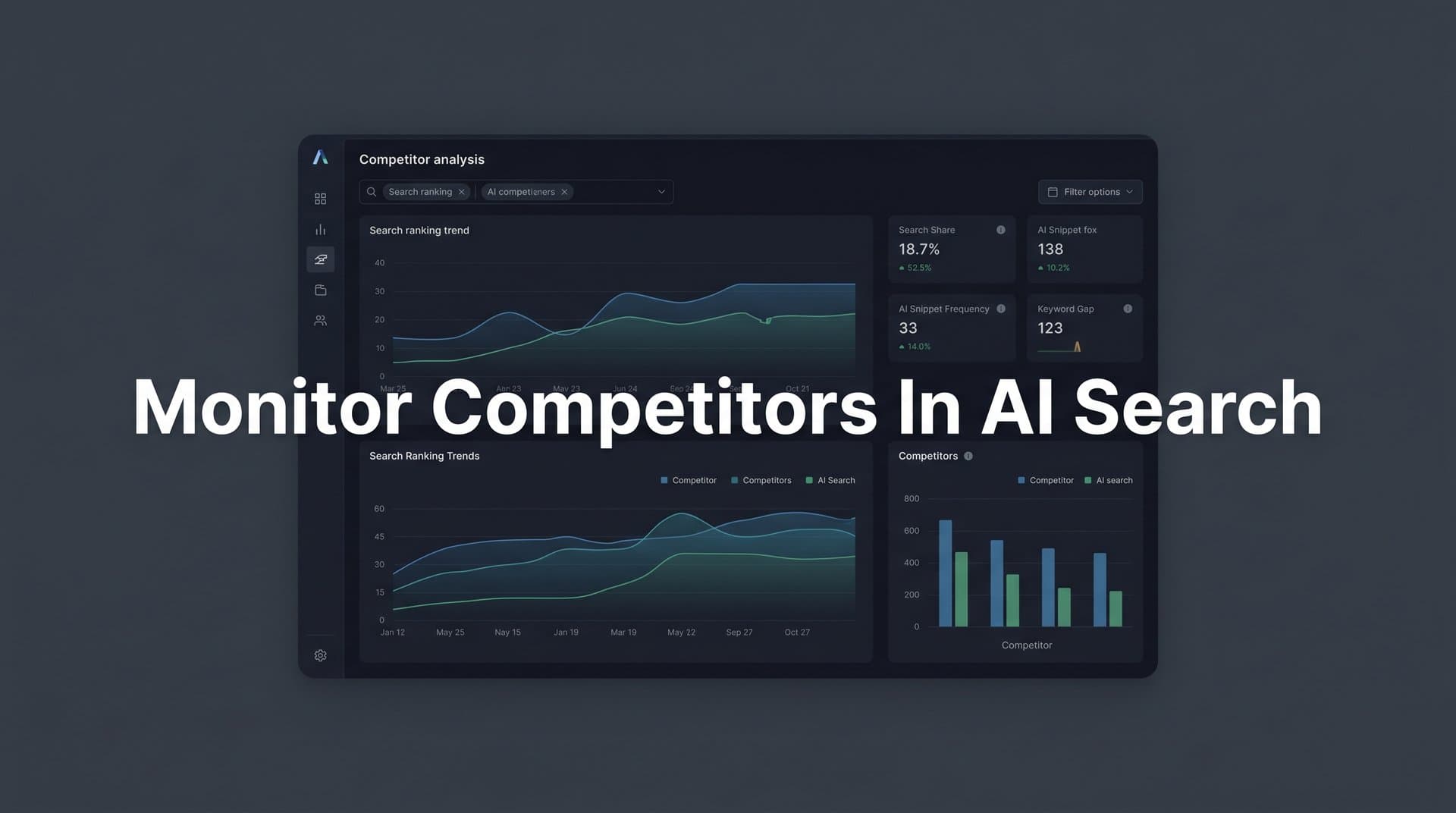
Manual tracking works well when you're starting out or running a focused audit. Run each prompt across your target AI platforms, then log the response in a structured format. For each response, record: which competitors were mentioned, how prominently (first recommendation vs. fifth in a list), the sentiment of each mention (positive, neutral, or with caveats), and the context that triggered the mention. A simple spreadsheet with one row per prompt-platform combination works fine at this stage.
Automated tracking becomes essential as your prompt library grows and you want consistent, scalable data. Platforms like Sight AI monitor competitor mentions across multiple AI models simultaneously, with sentiment analysis and prompt tracking built in. Instead of manually running 40 prompts across five platforms every two weeks, you get structured data delivered automatically, making it far easier to spot trends and act on them.
Regardless of which approach you use, the key metrics to capture for each competitor mention are:
Mention frequency: How often does this competitor appear across your full prompt library? This is your baseline measure of their AI visibility.
Mention position: Are they the first recommendation or buried in a list? Position matters because AI users often act on the first one or two options surfaced.
Sentiment: Is the mention a positive endorsement, a neutral reference, or does it come with caveats? Caveats are particularly valuable intelligence because they reveal positioning vulnerabilities.
Context: What problem or use case triggered the mention? This tells you which content topics are driving their AI visibility.
Establish a tracking cadence before you start. AI models update their responses over time as they receive new training data, so a one-time audit gives you a snapshot, not a trend. Weekly or bi-weekly AI search visibility monitoring is more reliable for catching meaningful shifts in how competitors are being represented.
Before making any strategic changes, run your full prompt library once and document the results as your baseline. This is your benchmark. Every future measurement will be compared against it, so the quality of your baseline directly affects your ability to measure progress. Once you have a documented baseline showing how often each competitor appears, on which platforms, and in what context, you're ready to move to analysis.
Step 4: Analyze Competitor Mention Patterns and Content Gaps
Raw tracking data is just a log. Analysis is where it becomes competitive intelligence. Once you have baseline data from your prompt library, the goal is to find patterns that tell you why competitors are getting mentioned and where your brand has an opportunity to displace them.
Start by looking for clustering patterns. Are certain competitors recommended consistently for specific use cases but not others? Do they appear more frequently on particular AI platforms? Are they mentioned alongside specific keywords or problem types? These clusters reveal the content and authority signals driving their visibility. Conducting thorough competitor SEO research alongside your AI tracking gives you a fuller picture of the content strategies fueling their mentions.
AI models tend to surface brands that have strong, well-structured content on specific topics. If a competitor consistently appears when someone asks about "email marketing for e-commerce," it's a strong signal that they've published authoritative, comprehensive content on that exact use case. Your job is to identify what content is likely driving each cluster of mentions.
Gap analysis is the most actionable output of this step. Go through your prompt library and map every prompt where a competitor appears but your brand does not. This list represents direct content opportunities. Each gap is a topic where AI models currently have no reason to recommend you, but could, if the right content existed.
Sentiment analysis adds another layer of intelligence. Pay close attention to how competitor mentions are framed. A mention that says "Competitor X is a solid choice for small teams, though it can feel limited as you scale" is very different from an unqualified recommendation. Those caveats are positioning opportunities. If AI models consistently describe a competitor as strong in one area but weak in another, that's a signal about unmet market needs your brand can address directly.
Look for recurring limitations in competitor mentions across multiple prompts and platforms. When AI models consistently surface the same caveat about a competitor, it reflects a pattern in how that brand is perceived across the content AI has been trained on. That's a durable signal, not a one-off observation.
The output of this step should be a prioritized list of content gaps and positioning opportunities. Rank them by two factors: how frequently the relevant prompts appear (high-frequency prompts represent more potential exposure) and how high the intent level is (decision-stage prompts are more valuable than awareness-stage ones). This prioritized list becomes your content roadmap for the next step.
Step 5: Create GEO-Optimized Content to Capture Competitor Gaps
Here's where intelligence turns into action. You now have a prioritized list of prompts where competitors appear and you don't. The next step is creating content specifically designed to fill those gaps in a way that AI models can discover, parse, and cite.
This is the practice of Generative Engine Optimization, or GEO. It differs from traditional SEO in meaningful ways. Traditional SEO optimizes for ranking signals like backlinks, page authority, and keyword density. GEO optimizes for clarity, authority signals, and direct answers to the specific questions your prompt library surfaces. The goal is to create content that AI models recognize as a reliable, citable source when a relevant query comes in. For a deeper look at how this approach works in practice, our guide on how to optimize for AI search engines covers the core principles in detail.
For each content gap in your prioritized list, create a dedicated piece of content that directly addresses the prompt topic. The formats that tend to perform well in AI-generated recommendations include:
Comparison pages: "X vs. Y: Which is better for [use case]?" These directly address comparison prompts and give AI models structured information to draw from when answering competitive questions.
Use-case guides: "How to accomplish [specific goal] with [your tool/approach]" — these target problem-solution prompts and position your brand as the answer to specific challenges.
"Best tool for X" articles: These directly mirror category and recommendation prompts and are among the formats most frequently cited in AI-generated responses.
Structure your content for AI readability. Use clear, descriptive headings that match the language of actual queries. Include concise definitions early in the piece. Use structured comparisons with clear criteria. Provide direct answers to the questions your prompts surface, not just general information about the topic.
Include authoritative signals throughout. Cite credible sources, include original perspectives or data where you have it, and demonstrate genuine subject matter depth. AI models favor content that signals expertise, not just content that mentions the right keywords.
For teams that need to produce this content at scale, Sight AI's AI Content Writer uses 13+ specialized agents to generate SEO and GEO-optimized articles structured for AI discovery. This makes it practical to systematically work through a long list of content gaps without the bottleneck of manual writing for every piece.
Once content is published, make sure it gets indexed quickly. Content that isn't indexed can't influence AI model responses. Understanding how to get indexed by search engines faster is critical so new content enters the ecosystem quickly and starts influencing AI model responses.
Finally, connect new content to existing high-authority pages through internal linking. This strengthens topical relevance signals and helps AI models understand the depth of your coverage on a given subject. For foundational on-page principles, our guide on how to optimize content for SEO covers the core elements that support both traditional and generative visibility.
Step 6: Track Your AI Visibility Score and Iterate
Publishing content is not the finish line. The value of this entire system comes from the feedback loop: tracking whether your new content is actually shifting how AI models talk about your brand relative to competitors.
After publishing new content, re-run your prompt library on your established cadence. Compare the results against your baseline. Are you appearing in prompts where you previously didn't? Has your mention position improved? Has the sentiment around your mentions shifted toward positive recommendations?
An AI Visibility Score gives you a single composite metric to track over time instead of managing dozens of individual data points. A well-constructed score captures mention frequency, sentiment, platform coverage, and prompt diversity, rolling them into one performance indicator that's easy to track month over month. Sight AI's platform calculates this automatically, making it straightforward to see whether you're gaining or losing ground relative to competitors. To understand how this differs from traditional rank tracking, the comparison of LLM monitoring vs traditional SEO is worth reviewing.
Use your score trajectory to answer the right competitive questions. Are you closing the gap on specific platforms? Are you winning on certain prompt categories while falling behind on others? These patterns tell you where to focus your next content cycle.
Identify what's working by looking for correlations between content you've published and improvements in your AI mention data. Which pieces correlate with new mentions on specific prompts? What formats or topics seem to be resonating? Double down on those patterns in your next content cycle.
Adjust your prompt library as AI platforms evolve. New AI tools emerge, user behavior shifts, and the questions your audience asks AI systems change over time. A prompt library that was comprehensive six months ago may be missing important new query patterns today. Build in a quarterly review of your prompt library to add new prompts, retire outdated ones, and ensure your tracking reflects current user behavior.
Set a monthly review rhythm as your operating cadence: update your competitor baseline, review content performance against AI mention data, identify new gaps that have emerged, and plan the next content cycle. This rhythm transforms competitor monitoring from a one-time project into a compounding intelligence practice that gets more valuable with every iteration.
The success indicator at this stage is straightforward: month-over-month improvement in AI mention frequency on your highest-priority prompts, with measurable shifts in sentiment toward positive, unqualified recommendations.
Putting It All Together
Monitoring competitors in AI search is not a one-time audit. It's an ongoing intelligence practice that compounds over time. The brands that will dominate AI-generated recommendations are those that systematically understand where they stand, where competitors are winning, and what content needs to exist to shift the balance.
To recap the process: define your competitive AI landscape, build a structured prompt library, set up systematic tracking, analyze patterns and gaps, create GEO-optimized content to fill those gaps, and iterate based on your AI Visibility Score. Each step builds on the last, creating a repeatable cycle of competitive intelligence and content execution.
The good news is that most brands haven't started this process yet. AI search visibility is still an early-mover opportunity, and the brands that build systematic tracking and content practices now will be significantly harder to displace as AI search becomes the dominant discovery channel.
If you're ready to accelerate this process, Sight AI brings together AI visibility tracking, content generation, and website indexing in a single platform. You can monitor how AI models talk about your brand and your competitors, then act on that intelligence with content that gets you mentioned. Start tracking your AI visibility today and see exactly where your brand appears across top AI platforms, so you can turn competitor insights into measurable organic growth.