AI models like ChatGPT, Claude, and Perplexity have quietly become one of the most influential discovery layers in modern buying decisions. When a potential customer asks an AI assistant to recommend the best project management tool or compare SaaS platforms in your category, the language that model uses about your brand directly shapes whether that person clicks through, converts, or moves on to a competitor.
Here is the uncomfortable reality: most brands are completely blind to this. They publish content, optimize for Google, run paid campaigns, and have no idea whether AI systems describe them as a market leader or barely mention them at all.
This guide changes that. You will learn exactly how to build a repeatable monitoring workflow that captures what AI models say about your brand, analyzes the sentiment of those responses, identifies gaps and inaccuracies, and feeds those insights back into your content strategy. This is not a one-time audit. By the end, you will have a structured system that runs consistently and compounds over time.
Why does this matter right now? Users increasingly trust AI-generated answers over scrolling through ten blue links. That shift means your brand's reputation inside AI outputs is becoming as strategically important as your traditional search ranking. The brands that move early to monitor and influence AI sentiment accumulate a meaningful advantage before their competitors even recognize the problem exists.
Let's walk through the exact steps to build that system.
Step 1: Define Your Brand Monitoring Scope
Before you track anything, you need to know precisely what you are tracking. This sounds obvious, but most teams skip this step and end up with a sprawling, unmanageable list of prompts that produces noise instead of insight.
Start by identifying your core brand terms: your company name, product names, key features, and any branded terminology unique to your positioning. Then expand to the category-level queries your target buyers actually use when researching solutions. Think about how a real buyer phrases a question to an AI assistant, not how your marketing team describes your product internally.
Organize your prompts into three intent categories:
Discovery prompts: These are open-ended category queries like "what is the best AI visibility tracking tool" or "how do I monitor my brand in AI search." These reveal whether AI models mention you at all when buyers are in early research mode.
Comparison prompts: These pit your brand against specific competitors, such as "Sight AI vs [competitor]" or "best alternatives to [competitor tool]." These are high-stakes because the sentiment here directly influences switching decisions.
Recommendation prompts: These ask AI models to suggest tools for a specific use case, like "recommend a platform for tracking AI brand mentions for a marketing agency." These reveal how well AI models understand your positioning and use-case fit.
Next, decide which AI platforms to monitor. ChatGPT, Claude, Perplexity, and Gemini each have different user bases and different tendencies in how they construct responses. The right platforms for your monitoring scope depend on where your audience actually spends time. A B2B SaaS audience, for example, skews heavily toward Perplexity and ChatGPT for research queries.
Keep your starting scope realistic. A library of 15 to 30 core prompts across three to four AI platforms is a manageable foundation for most teams. Casting too wide a net at the start creates data overload and abandoned workflows. Start focused, prove the system, then expand.
Document your prompt library in a shared spreadsheet or project management tool, tagged by intent category, buyer stage, and competitor context. This structure will pay dividends when you start analyzing results.
Step 2: Set Up Your AI Visibility Tracking System
With your prompt library defined, the next step is getting the right infrastructure in place to run those prompts consistently and capture results at scale. Manual checking across multiple AI platforms is not a sustainable approach. It is time-consuming, inconsistent, and impossible to maintain as your prompt library grows.
A dedicated AI visibility platform like Sight AI solves this by automating prompt tracking across multiple AI models simultaneously. Instead of manually querying ChatGPT, then Claude, then Perplexity, and trying to record and compare responses in a spreadsheet, the platform runs your tracked prompts on a schedule and captures structured response data you can actually analyze.
Here is how to configure your system properly:
Import your prompt library: Group prompts by the categories you defined in Step 1. Discovery, comparison, and recommendation prompts often produce different sentiment patterns, so keeping them organized allows for cleaner analysis later.
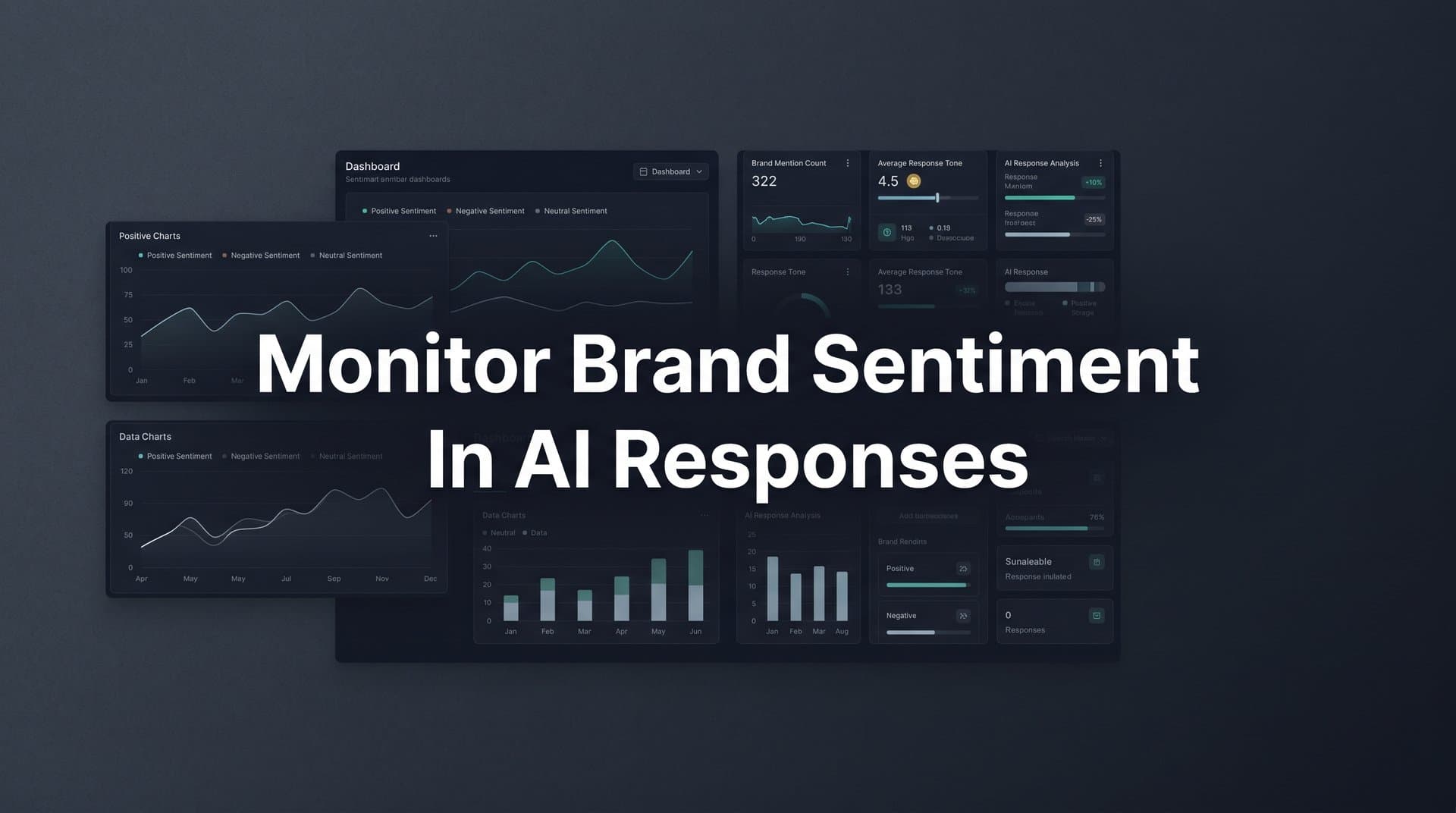
Enable sentiment analysis: Look for features that score responses as positive, neutral, or negative and flag specific language patterns associated with your brand. You want more than a simple score. You want to see the actual phrases AI models use when describing you versus competitors.
Establish your baseline: Before making any content changes, run your full prompt library and record the results. This baseline is your before state. Without it, you cannot attribute sentiment improvements to specific actions later. This is one of the most commonly skipped steps, and it makes future measurement nearly impossible.
Set your tracking cadence: Schedule automated prompt runs on a consistent schedule. Weekly is the minimum for most teams. If you are actively running content campaigns or have recently published new material targeting AI visibility, daily tracking lets you detect shifts faster.
Export and archive raw response data: AI models update their training and outputs over time. Historical snapshots of how AI described your brand in a given month become valuable reference points as you measure progress. Make sure your tracking setup preserves this data rather than overwriting it.
Verify platform coverage: Confirm the tool tracks across the specific AI platforms your audience uses most. Generic coverage of "the top AI models" may not align with where your buyers actually conduct research. Verify the platform list matches your monitoring scope from Step 1.
With your tracking system live and your baseline captured, you have the foundation for everything that follows. The system is now collecting data. The next step is making sense of what it tells you.
Step 3: Analyze Sentiment Patterns and Identify Gaps
Your first round of tracked responses will likely surface a mix of findings: some positive mentions, some neutral or absent coverage, and potentially some inaccurate or unfavorable descriptions. The goal of this step is to organize those findings into a prioritized action list.
Start by sorting responses into three buckets:
Positive mentions: AI models describe your brand accurately and favorably, using language aligned with your positioning. These are your wins. Note what content appears to be driving these responses so you can replicate the approach.
Neutral or absent mentions: Your brand is either mentioned without meaningful differentiation or not mentioned at all for certain query types. Absent mentions in discovery and recommendation prompts are particularly significant because they represent lost visibility at the top of the buyer journey.
Negative or inaccurate mentions: AI models describe your brand unfavorably, use outdated information, misattribute competitor features to your product, or position you incorrectly. These require immediate attention because they are actively working against you.
Once you have sorted your findings, dig into the language patterns. What specific adjectives and phrases do AI models use when describing your brand? How does that language compare to how they describe your top competitors? Sometimes the gap is not negative sentiment but rather vague or generic language that fails to differentiate you.
Map your sentiment findings to specific prompt types. A common pattern is strong positive sentiment for branded queries but weak or absent mentions for category-level discovery prompts. This tells you that AI models know who you are but do not yet associate you with the broader problem category strongly enough to surface you unprompted.
Pay close attention to competitor comparison prompts. If AI models consistently describe a competitor more favorably than your brand in head-to-head comparisons, or if your brand is absent from those comparisons entirely, those represent your highest-priority content opportunities.
Finally, try to identify which source content AI models appear to be drawing from when they mention your brand. If a particular page or article keeps surfacing in responses, that page has strong influence over your AI representation. Knowing this helps you decide which existing content to update and which gaps require entirely new content.
Document your findings in a prioritized gap list. Rank items by business impact: high-traffic query types with negative or absent brand visibility in LLMs should sit at the top of your content production queue.
Step 4: Create Targeted Content to Shape AI Responses
Now you have a clear picture of where AI models are misrepresenting, underrepresenting, or ignoring your brand. The next step is creating content specifically designed to close those gaps.
This is where GEO, or Generative Engine Optimization, becomes your framework. GEO principles focus on creating content that AI models can easily parse, trust, and cite. The core idea is straightforward: AI models favor content that is factual, clearly structured, and authoritative. Vague marketing language, superlative claims without substance, and poorly organized pages are less likely to influence how AI describes your brand.
For each high-priority gap on your list, plan a specific content asset. Match the content type to the gap:
For absent category-level mentions: Create authoritative explainer content that clearly connects your brand to the problem category. If you want AI models to mention you when someone asks about AI visibility tracking tools, you need published content that clearly, factually, and repeatedly establishes that connection.
For competitor comparison gaps: Publish honest, detailed comparison guides that lay out your differentiators clearly. AI models frequently pull from comparison content because it is structured, factual, and directly relevant to buyer decision queries. Do not shy away from naming competitors directly. Comparison content that avoids specifics is less useful to AI models and less trusted by readers.
For inaccurate or outdated descriptions: Update existing pages with current, accurate information and publish new content that corrects the record. If AI models are describing an old version of your product or misattributing a feature, the fix is authoritative published content that states the accurate information clearly.
For use-case and recommendation gaps: Create use-case articles that explicitly connect your product to specific buyer scenarios. If you want AI models to recommend your platform to marketing agencies tracking AI brand mentions, publish content that speaks directly to that use case with clear, specific language.
Sight AI's content generation tools can accelerate this process significantly. With 13+ specialized AI agents designed for SEO and GEO-optimized content production, you can generate well-structured comparison guides, feature explainers, and use-case articles at scale without sacrificing the quality and clarity that AI models respond to.
One practical tip: use the exact phrases and terminology you want AI models to associate with your brand. If your positioning is "the leading AI visibility platform for agencies," that language needs to exist clearly and repeatedly in your published content. AI models learn associations from the content they index. Give them the associations you want.
Connect new content to your existing high-authority pages through internal links. This strengthens topical authority signals and helps AI crawlers understand the relationship between your content assets.
Step 5: Ensure Your Content Gets Indexed and Discovered Quickly
Publishing great content is only half the equation. If that content sits unindexed for weeks, it cannot influence AI responses during that window. Fast indexing directly accelerates how quickly new content shapes AI model outputs.
The gap between publication and AI model awareness depends on how quickly search engines and AI crawlers discover and index your content. By default, that process can take days or weeks depending on your site's crawl frequency and authority. You can compress that timeline significantly with the right setup.
Use IndexNow integration: IndexNow is a protocol that notifies search engines immediately when new content is published, rather than waiting for organic crawl cycles. Sight AI's indexing tools include IndexNow integration, so new URLs are submitted the moment they go live. This is one of the most practical steps you can take to reduce indexing lag.
Keep your XML sitemap updated automatically: An accurate, current sitemap ensures crawlers always have a complete map of your content. If your sitemap is outdated or manually maintained, new pages may be missed or delayed. Automate sitemap updates so this never becomes a bottleneck.
Verify indexing status: Do not assume new pages are indexed promptly. Use indexing verification tools to confirm pages are being discovered within your expected timeframe. A page that sits unindexed for three weeks represents three weeks of missed AI brand monitoring opportunity.
Enable auto-publishing and auto-indexing workflows: For teams using a CMS, connecting your publishing workflow to automated indexing submission removes the manual step entirely. Content goes live, indexing is triggered automatically, and the gap between creation and discovery is minimized.
Resubmit updated pages: When you make significant edits to existing content, especially positioning updates or new feature information, trigger a recrawl. AI models need to see the current version of your content, not a cached version from months ago. If you updated a product page with new language after your sentiment analysis, make sure that update reaches crawlers promptly.
Technical health also matters here. Clean site architecture, fast load times, and proper canonical tags all support consistent crawling. These are not glamorous optimizations, but they create the foundation that makes everything else work reliably.
Step 6: Track Sentiment Changes and Iterate
With new content published and indexed, return to your tracking system and continue running your prompt library on schedule. This is where the system starts to show its value. You are now comparing results against the baseline you established in Step 2.
Look for directional shifts in your data. Are AI models now mentioning your brand in discovery prompts where you were previously absent? Is the language becoming more specific, more favorable, or more aligned with your intended positioning? Even small shifts in the right direction confirm the system is working and tell you which content types are having the most impact.
Use your AI Visibility Score trends to quantify progress over time. Sentiment improvement should correlate with increased brand mentions in relevant AI responses. If your score is moving in the right direction after publishing a particular type of content, that is a signal to prioritize similar content in your next production cycle.
Adjust your prompt library as your market evolves. New competitors enter your category. You launch new products or features. Industry terminology shifts. All of these changes require updates to your monitoring scope. A prompt library that made sense six months ago may miss important new query patterns today.
Share sentiment reports with your broader marketing team. Content writers benefit from knowing which topics and formats are influencing AI responses. Product marketers can use AI sentiment data to sharpen positioning. Demand generation teams can align campaigns with the language AI models are actually using to describe your category. The data has value beyond the SEO team.
Build a monthly review cadence as your operational rhythm: analyze sentiment trends, update your gap list, plan new content, verify indexing, and confirm baseline comparisons. This monthly loop keeps the system self-reinforcing rather than letting it drift into a one-time project that gets deprioritized. The brands that treat AI sentiment monitoring as an ongoing operational function, not a quarterly audit, are the ones that compound their advantage over time.
Putting It All Together: Your AI Sentiment Monitoring Checklist
Here is the complete six-step system as a repeatable operational checklist you can run every month:
1. Define your scope: Maintain a library of 15 to 30 core prompts organized by discovery, comparison, and recommendation intent. Review and update quarterly.
2. Track across AI platforms: Run your full prompt library across ChatGPT, Claude, Perplexity, Gemini, and any other platforms your audience uses. Capture and store raw response data.
3. Analyze sentiment gaps: Sort findings into positive, neutral/absent, and negative/inaccurate buckets. Prioritize gaps by business impact and update your content queue accordingly.
4. Create targeted content: Produce GEO-optimized comparison guides, use-case articles, and feature explainers that directly address your highest-priority gaps. Use precise positioning language you want AI models to adopt.
5. Ensure fast indexing: Submit new and updated URLs via IndexNow, keep your sitemap current, and verify indexing status for all new content before moving on.
6. Measure and iterate: Compare new results against your baseline, identify which content drove the most measurable improvement, and plan your next production cycle accordingly.
The most important thing to understand about this system is that it compounds. Brands that build this workflow early accumulate months of baseline data and content influence before competitors recognize the opportunity. Every month of consistent monitoring adds another layer of insight. Every piece of targeted content strengthens your AI representation incrementally.
AI model outputs are not static. Training updates, web crawl refreshes, and shifts in the content landscape mean your brand's AI sentiment can change over time in either direction. The brands that win are the ones treating this as an ongoing operational priority rather than a periodic project.
Start tracking your AI visibility today with Sight AI to run your first AI visibility scan, establish your baseline sentiment score, and identify the exact content opportunities that will move your brand in the right direction across ChatGPT, Claude, Perplexity, and beyond. The system is ready. Your first baseline is one step away.