AI models like ChatGPT, Claude, and Perplexity are rapidly becoming the first stop for consumers researching products, comparing services, and making purchasing decisions. Unlike traditional search engines, these models synthesize information and present brand recommendations directly, without showing a list of links for users to evaluate themselves. If your brand isn't being mentioned accurately, or at all, in AI-generated responses, you're losing visibility to competitors who are.
This guide walks you through exactly how to monitor your brand in AI models: from setting up tracking infrastructure to interpreting sentiment, identifying content gaps, and taking action to improve how AI systems represent your business. Whether you're a marketer, founder, or agency managing multiple clients, you'll leave with a repeatable system for staying on top of your AI presence.
By the end of this tutorial, you'll know how to identify which AI platforms matter most for your brand, set up structured prompt tracking to surface brand mentions, interpret AI Visibility Scores and sentiment signals, uncover content gaps that are suppressing your mentions, and publish SEO/GEO-optimized content that increases AI citation frequency.
This is not a passive monitoring exercise. It's an active strategy for owning your brand narrative across the AI search landscape. Let's get into it.
Step 1: Identify the AI Platforms and Prompts That Matter to Your Brand
Before you can monitor anything, you need to know where to look and what to look for. Not all AI platforms attract the same users. ChatGPT dominates general-purpose queries and creative tasks. Perplexity has carved out a strong position for research and real-time information retrieval. Claude tends to attract users who want nuanced, longer-form analysis. Gemini is deeply integrated into Google's ecosystem, making it particularly relevant for product discovery tied to Google services.
Start by asking: where does my target audience spend their time online, and which AI tools are they most likely to use when researching solutions like mine? For B2B SaaS marketers, ChatGPT and Perplexity are typically the highest-priority platforms. For consumer brands, Gemini and ChatGPT may carry more weight. You don't need to monitor every platform equally, but you do need to cover the ones your customers actually use.
Next, map out the types of queries your customers are likely asking AI models. These fall into a few predictable categories:
Product comparison queries: "What's the best AI SEO tool for agencies?" or "ChatGPT vs. Claude for content marketing?" These are high-intent prompts where brands either appear or don't, with direct purchasing implications.
Category recommendation queries: "What tools do marketers use to track AI visibility?" or "Best platforms for GEO optimization." These surface category leaders and often reflect how AI models choose brands to recommend in your space.
Brand-specific queries: "What does Sight AI do?" or "Is [your brand] good for enterprise teams?" These reveal how AI models describe your brand directly.
How-to and use-case queries: "How do I monitor my brand mentions in AI models?" These surface educational content and the brands associated with solving specific problems.
From these categories, build a seed list of 10 to 20 high-intent prompts relevant to your niche. Be specific. Vague prompts produce vague data. A prompt like "What is the best AI visibility monitoring tool?" is more actionable than "Tell me about AI tools."
Prioritize your seed list by commercial intent and relevance to your core offerings. A prompt that maps directly to your product category and signals purchase intent should sit at the top of your tracking list. These become your monitoring foundation for everything that follows.
One common pitfall: brands that only monitor queries containing their own name. This misses the broader competitive landscape entirely. Category-level and comparison prompts are where you'll discover who AI models recommend when your brand isn't in the frame, and that's often the most valuable intelligence you can collect.
Step 2: Set Up a Structured AI Visibility Tracking System
Once you have your seed prompt list, the next step is building the infrastructure to monitor those prompts consistently across multiple AI platforms. This is where most brands fall short. Manual spot-checking, where someone opens ChatGPT, types a query, and notes the result, is inconsistent, time-consuming, and impossible to scale. It also produces no trend data, which means you can't measure improvement over time.
A dedicated AI visibility monitoring platform solves all of this. Tools like Sight AI are purpose-built to run your tracked prompts across multiple AI models on a recurring schedule, aggregate the results, and surface actionable data in a single dashboard. The difference between manual checks and automated tracking is the difference between a snapshot and a movie: one shows you a moment, the other shows you a story.
Here's how to configure your tracking system properly:
Connect your brand profile: Input your brand name, key product names, and the branded terms you want to track. Include common variations and misspellings if relevant. The more precise your entity inputs, the more accurate your mention detection will be.
Add competitor tracking: Include the competitors you want to benchmark against. Seeing that a competitor appears in 80% of tracked prompts while you appear in 20% is the kind of gap that drives strategy. Reviewing the best LLM brand monitoring tools can help you identify which platforms offer the most robust competitor benchmarking for your niche.
Configure your seed prompts: Import the 10 to 20 prompts you built in Step 1. Set the platform to run these prompts across your priority AI models on a recurring schedule, ideally weekly at minimum. Consistency in query execution is what makes trend analysis possible.
Establish your AI Visibility Score baseline: This is your benchmark before any optimization work begins. Your initial score reflects the current state of your brand's presence in AI-generated responses. Document it. Every improvement you make going forward will be measured against this number.
Enable sentiment tracking: Mention frequency is only half the picture. How your brand is described matters just as much. Sentiment analysis flags whether your brand is being characterized positively, neutrally, negatively, or inaccurately. A brand mentioned in AI responses as "an older tool that's been largely replaced" is worse off than a brand not mentioned at all. Negative brand sentiment in AI models catches these issues so you can address them before they cost you customers.
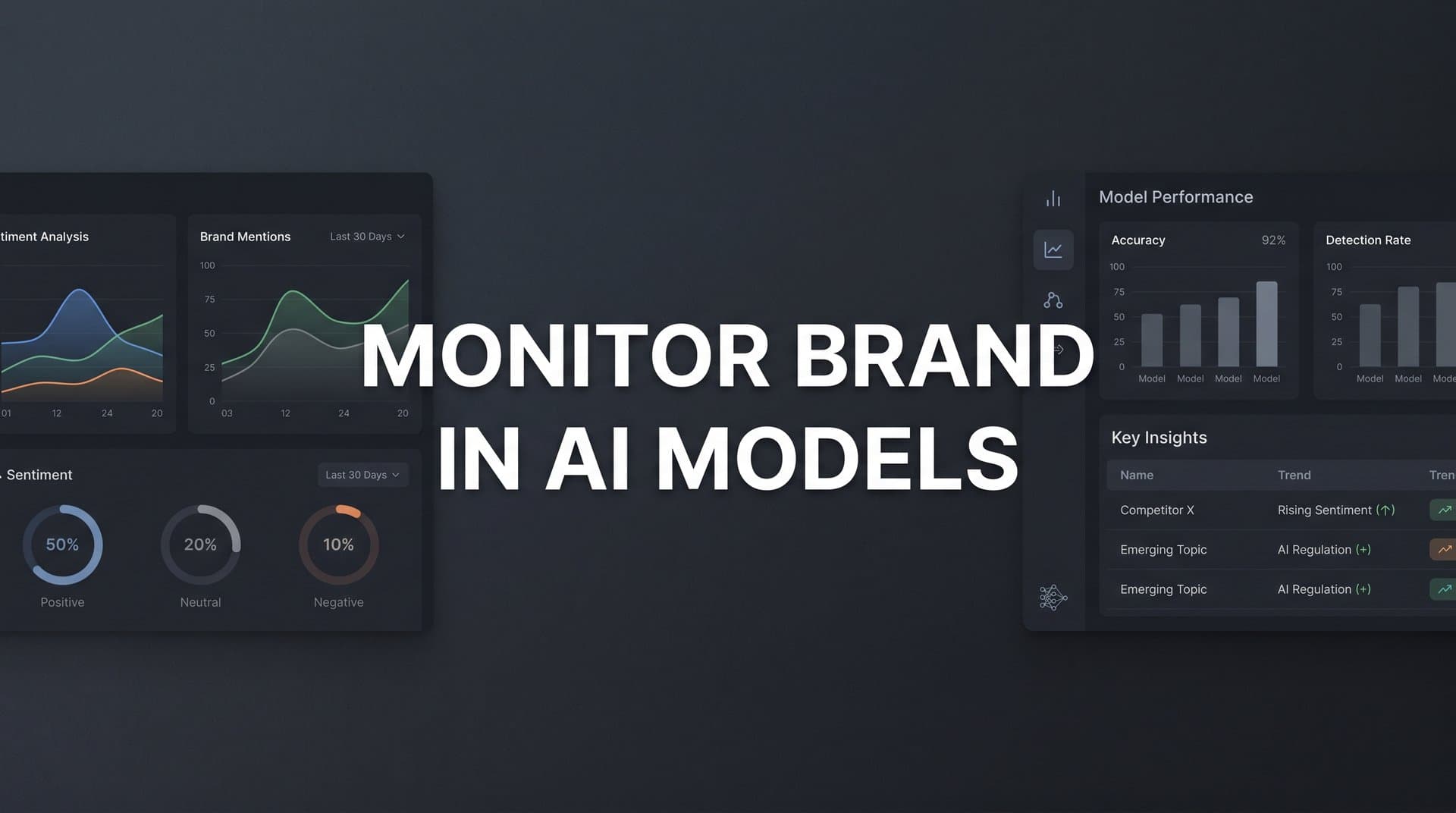
The success indicator for this step is straightforward: you should be able to open a single dashboard and see, at a glance, how often your brand appears across multiple AI platforms, which prompts trigger mentions, what competitors appear alongside or instead of you, and how your brand is being described. If your setup gives you that view, you're ready to analyze.
Step 3: Analyze Your Brand Mention Data and Identify Gaps
With your tracking system running and initial data coming in, it's time to move from setup to strategy. This step is where monitoring becomes intelligence. You're not just looking at whether your brand appears; you're building a clear picture of where you stand in the AI search landscape and where the highest-leverage opportunities are.
Start by reviewing which prompts trigger brand mentions and which do not. This binary view is your first filter. For every prompt that returns no brand mention, ask: who does appear? If a competitor consistently surfaces for high-intent prompts where you're absent, that's a mention gap with direct business implications.
Mention gaps are the core output of this analysis. A mention gap exists when a high-intent prompt is relevant to your brand but your brand doesn't appear in the AI response. These gaps represent potential customers who are getting recommendations that don't include you. Prioritize gaps by commercial intent: a missing mention on "best AI visibility monitoring tool" is more critical than a missing mention on an obscure niche query with low search volume.
Next, examine your sentiment signals. Even when your brand is mentioned, the quality of that mention matters enormously. Look for:
Accuracy issues: Is the AI describing your product correctly? Outdated information, incorrect feature descriptions, or vague characterizations can actively mislead potential customers who trust AI-generated responses.
Tone and framing: Is your brand positioned as a leader, an alternative, or an afterthought? There's a significant difference between "Sight AI is a leading platform for AI visibility tracking" and "Sight AI is one option you might consider."
Contextual relevance: Is your brand being mentioned in the right context? A brand mentioned in response to an irrelevant query may not be generating useful visibility.
Look for patterns across your data. Are you missing from specific AI platforms? Are you absent from comparison queries but present in how-to queries? Are there topic clusters, such as "agency use cases" or "enterprise features," where you consistently don't appear? If you find that AI models aren't mentioning your brand in key categories, those patterns point directly to content gaps you'll address in the next steps.
Document your findings in a structured gap analysis. For each tracked prompt, record: whether your brand was mentioned, the sentiment of that mention, which competitors appeared, and your priority level for addressing the gap. This table becomes your content roadmap. It transforms raw monitoring data into a prioritized action list.
Step 4: Audit Your Existing Content for AI Citability
Before creating new content, it's worth understanding why your existing content isn't generating AI mentions. AI models don't cite content arbitrarily. They favor sources that are authoritative, clearly structured, and directly answer the questions being asked. If your current content doesn't meet those criteria, publishing more of the same won't move the needle.
Start by cross-referencing your tracked prompts against your existing content. For each high-priority prompt in your gap analysis, ask: does your website have a page, article, or resource that directly and comprehensively answers this question? Not tangentially, not partially, but directly. If the answer is no, that's your first content gap. If the answer is yes but you're still not appearing in AI responses, the issue is likely structure or depth.
Evaluate your content structure against what AI models prefer. Content that gets cited by AI systems tends to share several characteristics:
Clear, descriptive headings: AI models parse heading structures to understand what a page covers. Vague headings like "Our Approach" are far less citable than specific ones like "How Sight AI Tracks Brand Mentions Across AI Platforms."
Concise definitions and direct answers: Content that opens a section with a clear, quotable definition or direct answer to a question is much more likely to be excerpted by AI models. Think of how featured snippets work in traditional search, and then go further.
Factual specificity: Thin, generic content rarely gets cited. AI models favor content that includes specific, verifiable claims, concrete examples, and expert-level detail. Surface-level overviews are the enemy of AI citability.
Comparison and structured data: Comparison tables, feature lists, and structured breakdowns are highly citable because they answer multiple questions in a compact, organized format. Understanding how AI models select content sources can help you prioritize which structural improvements will have the greatest impact on your citability.
Identify pages that rank in traditional search but aren't generating AI mentions. These are your highest-priority optimization targets because they already have some authority signals; they just need structural improvements to become AI-citable.
Finally, cross-reference your content with indexing status. Content that isn't indexed promptly can't be discovered by AI training pipelines or real-time retrieval systems like those used by Perplexity. If you publish a new article and it takes weeks to get indexed, you're delaying your path to AI visibility. Ensuring fast, reliable indexing is a prerequisite for everything else in this process. Tools with IndexNow integration can dramatically accelerate this step by notifying search engines of new content immediately upon publication.
Step 5: Create and Publish GEO-Optimized Content Targeting Your Gaps
GEO, or Generative Engine Optimization, is the practice of structuring content so AI models are more likely to surface and cite it. It goes beyond traditional SEO in important ways. Where SEO focuses on keyword density, backlinks, and technical signals, GEO focuses on answer quality, entity clarity, factual specificity, and structural accessibility for AI parsing.
For each high-priority gap you identified in Step 3, create a dedicated content asset that directly addresses the target prompt. The content format should match the query type:
Comparison guides for prompts like "What's the best tool for X?" These should include your brand alongside relevant alternatives, with clear, factual differentiators that position your strengths accurately.
Explainer articles for definition and concept queries. If AI models are asked "What is AI visibility monitoring?" and your brand isn't mentioned, you need a comprehensive, authoritative explainer that establishes your brand visibility in large language models as a leader in that category.
How-to guides for process queries. Like this article. Content that walks through a specific process step by step is highly citable because it directly answers action-oriented questions.
Listicles and roundups for "best of" and recommendation queries. These formats align naturally with how AI models present recommendations.
When writing GEO-optimized content, apply these core principles consistently:
Introduce your brand name in context early: Don't bury your brand mention 800 words in. Establish the entity association clearly and early in the content.
Use factual, specific language: Replace vague claims with precise ones. "Sight AI tracks brand mentions across 6+ AI platforms including ChatGPT, Claude, and Perplexity" is far more citable than "Sight AI monitors your AI presence."
Structure for excerptability: Write sections that can stand alone as answers. Each heading should introduce a self-contained answer block that makes sense even if an AI model pulls it out of context.
Mirror the language patterns AI users employ: Use the exact phrasing from your tracked prompts within your content. If users ask "best AI SEO tool for agencies," that phrase or close variants should appear naturally in your content.
Publish consistently. AI models update their knowledge through ongoing training and real-time retrieval. A single article is rarely sufficient to establish sustained AI visibility. Build a content calendar that continuously addresses new gaps as your monitoring data reveals them.
After publishing, ensure rapid indexing. Use platforms with IndexNow integration and automated sitemap updates to push new content into search and AI discovery pipelines as quickly as possible. Every day a piece of content sits unindexed is a day it can't generate AI mentions. Speed matters here more than most marketers realize.
Step 6: Track Changes, Iterate, and Scale Your Monitoring
Publishing content is not the finish line. It's the beginning of a measurement cycle. AI visibility improvement is a compounding process: each piece of optimized content, each indexing confirmation, and each monitoring insight builds on the last. The brands that win in AI search are those that treat this as an ongoing system, not a one-time project.
Return to your AI visibility dashboard two to four weeks after publishing new content to measure movement. Look at the specific prompts you targeted. Did new content generate brand mentions where there were none before? Did your AI Visibility Score improve? Did sentiment shift in a positive direction? These before-and-after comparisons are your proof of concept and your guide for what to do next.
For content that doesn't move the needle after four weeks, don't abandon it. Refine it. Common reasons content fails to generate AI mentions include:
Insufficient topical depth: The content exists but doesn't go deep enough for AI models to consider it authoritative. Add more specific detail, expert context, and comprehensive coverage of the topic.
Structural issues: The content answers the right questions but in a format that's hard for AI models to parse. Restructure with clearer headings, more direct answer blocks, and better use of lists and definitions.
Outdated information: AI models with real-time retrieval capabilities will deprioritize stale content. Update articles with current data, recent developments, and fresh examples.
Expand your prompt tracking list as your strategy matures. Your initial seed list of 10 to 20 prompts was a starting point. As your monitoring data reveals new query patterns, competitor movements, and emerging topic clusters, your tracking list should grow. A robust real-time brand monitoring across LLMs system might eventually track 50 to 100 prompts across multiple platforms, giving you a comprehensive view of your AI search landscape.
For agencies managing multiple client accounts, this workflow scales effectively with centralized reporting. A single dashboard that shows AI Visibility Scores across all clients makes it easy to demonstrate value, identify cross-client content opportunities, and prioritize effort where it generates the most impact. AI visibility metrics are becoming a reportable KPI alongside traditional SEO metrics, and agencies that can present this data clearly are ahead of the curve.
Build a monthly review cadence into your workflow. Each month: review your AI Visibility Score and trend direction, identify new mention gaps from fresh monitoring data, assign content creation tasks to address top-priority gaps, publish and verify indexing for new content, and schedule the next review. This rhythm transforms AI brand monitoring from a reactive scramble into a proactive, compounding growth system.
The success indicator for this step is a consistent upward trend in your AI Visibility Score and an increasing percentage of tracked prompts returning brand mentions. If both of those metrics are moving in the right direction, your system is working.
Your AI Brand Monitoring System: Putting It All Together
Monitoring your brand in AI models is no longer optional for businesses that depend on organic discovery. The brands that will win in AI search are those that treat AI visibility as a measurable, manageable channel, not a black box they hope works in their favor.
By following this six-step process, you build a compounding system that steadily improves how AI models represent your brand. Each step reinforces the next: better prompt tracking surfaces better gap data, better gap data drives better content decisions, and better content generates more AI mentions over time.
Use this quick-start checklist to confirm you've completed each phase before moving on:
✅ Seed prompt list created with 10 to 20 high-intent prompts
✅ AI visibility tracking platform configured with brand profile and competitor benchmarks
✅ Baseline AI Visibility Score documented
✅ Gap analysis completed with prompts prioritized by business impact
✅ Existing content audited for AI citability
✅ GEO-optimized content published for your top three priority gaps
✅ Indexing verified for all new content
✅ Monthly review cadence scheduled
The earlier you start monitoring, the more data you accumulate, and the faster you can act when AI models misrepresent or overlook your brand. Your competitors are either already doing this or they're about to start. The window for early-mover advantage is open now.
Stop guessing how AI models like ChatGPT and Claude talk about your brand. Start tracking your AI visibility today and see exactly where your brand appears across top AI platforms, what sentiment surrounds those mentions, and which content gaps are costing you the most ground.