AI-powered search has fundamentally changed how people discover brands. When someone asks ChatGPT, Claude, or Perplexity to recommend a tool, suggest a service provider, or explain an industry concept, the answers those models generate directly shape purchasing decisions — often without the user ever visiting a search results page.
For marketers, founders, and agencies, this creates a serious blind spot. Traditional SEO dashboards track Google rankings, but they tell you nothing about how AI models perceive and represent your brand. You could be ranking on page one and still be completely invisible when someone asks an AI assistant for a recommendation in your category.
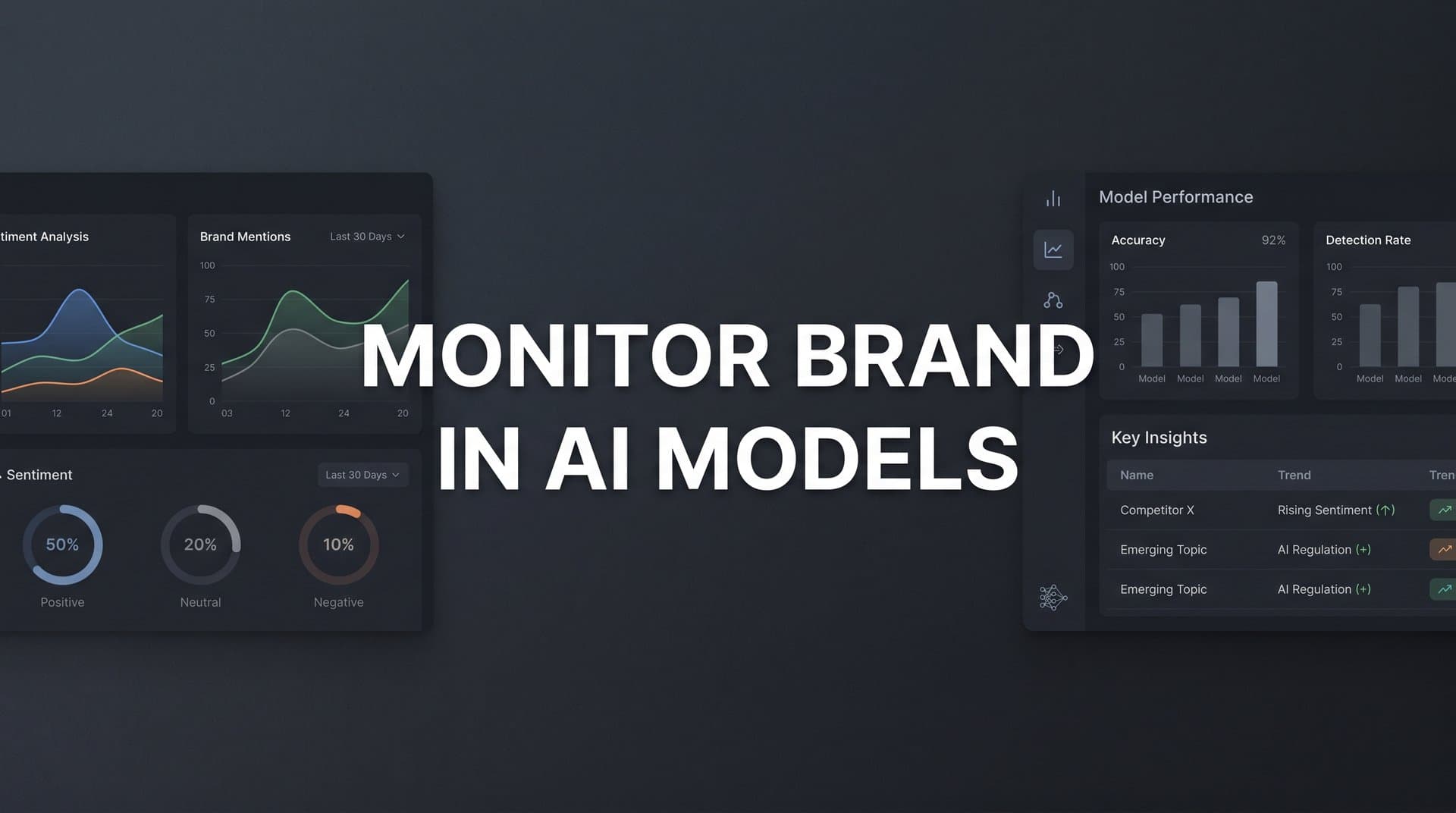
Monitoring your brand across AI models means understanding whether you're being mentioned at all, what context surrounds those mentions, whether the sentiment is positive or negative, and which competitors are capturing the AI-generated visibility you're missing. These are different questions than traditional SEO answers, and they require a different kind of tracking infrastructure.
This guide walks you through the exact process: from defining your monitoring scope to setting up tracking, auditing your baseline, building a content strategy, publishing optimized content, accelerating indexing, and establishing a review cadence that keeps your AI visibility growing over time.
By the end, you'll have a repeatable system for tracking AI brand mentions, identifying content gaps, and publishing content that increases your chances of being recommended by AI models. Whether you're just starting to think about AI visibility or you already have some tracking in place and want to systematize it, these steps apply directly to your workflow.
Step 1: Define Your Brand Monitoring Scope and Target AI Models
Before you set up any tracking tools, you need to be precise about what you're monitoring and where. Jumping straight into a dashboard without this clarity means you'll collect data that doesn't map to real business outcomes.
Start by listing your core brand terms: your company name, product names, key features, and any branded terminology your audience uses to describe what you do. Then expand outward to category keywords. If you sell project management software, you're not just monitoring your brand name — you're monitoring prompts like "best project management tool for remote teams" or "how to organize team workflows."
Prioritize the right AI platforms: Not every AI model is equally relevant to your audience. ChatGPT has broad consumer and professional adoption. Claude is widely used by technical and research-oriented users. Perplexity is increasingly popular for research queries and product discovery. Gemini has growing integration with Google's ecosystem. Start with the platforms where your target customers are most active, then expand.
Map your prompt categories: Think about the types of questions users actually ask that could surface your brand. These fall into a few distinct buckets worth tracking separately.
Recommendation prompts: "What is the best [tool/service] for [use case]?"
Comparison prompts: "[Your Brand] vs [Competitor]" or "[Category] alternatives"
How-to prompts: "How do I accomplish [task your product solves]?"
Problem-solution prompts: "I need help with [problem], what should I use?"
Category definition prompts: "What is [category or concept you operate in]?"
Define your mention benchmarks: What does success look like? A positive mention recommends your brand by name in a favorable context. A neutral mention names you without strong positioning. A missing mention is a prompt where AI models respond with competitor recommendations or generic advice, with no reference to your brand at all. Document these definitions before you start tracking so your team has consistent benchmarks from day one.
Common pitfall to avoid: Many teams track only their exact brand name. This misses the majority of AI visibility opportunities. Prompts about your product category, your use cases, and direct competitor comparisons are often higher-intent than branded queries — and they're where visibility gaps hurt most.
Step 2: Set Up an AI Visibility Tracking System
Once you know what you're monitoring, you need a system that queries AI models automatically and surfaces the results in a way you can act on. Doing this manually — opening ChatGPT, typing prompts, recording responses in a spreadsheet — is unsustainable at any meaningful scale.
The concept you're working toward is an AI Visibility Score: a consolidated metric that reflects how often and how favorably your brand appears across AI model responses. Think of it as the AI equivalent of a keyword ranking report, except instead of measuring your position on a search results page, it measures your presence in AI-generated answers.
Setting up Sight AI's AI Visibility tracking: Sight AI's platform monitors brand mentions across six or more AI platforms from a single dashboard. Rather than manually querying each model, the system runs your tracked prompts automatically and categorizes the results. Setup involves connecting your brand profile, entering your target prompts from Step 1, and configuring the AI models you want to monitor.
Configure prompt tracking precisely: The quality of your tracking depends entirely on the quality of your prompt library. Input the specific question types you identified in Step 1. Be specific about phrasing — "best AI SEO tool" and "top AI tools for content marketing" may surface different results from the same model. Include variations so you capture the full range of how users phrase queries in your category.
Enable sentiment analysis: Mention frequency alone doesn't tell the full story. A mention that describes your brand as "expensive compared to alternatives" carries very different implications than one that says "the leading solution for [use case]." Sentiment analysis lets you distinguish between mentions that actively recommend your brand, those that name it neutrally, and those that frame it in a context that could discourage consideration.
Understand what's happening under the hood: AI models like ChatGPT and Claude are trained on large corpora of web content. They also increasingly use retrieval-augmented generation (RAG) to pull real-time web content into responses. This means both historical training data and current indexed web content influence how AI models represent your brand. Your tracking system captures the output of this process — which is why the content you publish and how quickly it gets indexed both matter to your results.
Success indicator: Your dashboard is pulling live data from multiple AI models and categorizing mentions by sentiment and prompt type within 24 hours of setup. If you can see which prompts surface your brand and which surface competitors, you're ready for the next step.
Step 3: Audit Your Current AI Visibility Baseline
With tracking active, your first task is establishing a baseline. This is the snapshot you'll compare everything against as you execute your strategy. Don't skip this step — without a documented baseline, you won't be able to measure progress or demonstrate the impact of your content work.
Run your first full visibility report and document the results systematically. For each prompt category you're tracking, record: whether your brand was mentioned, how it was framed, which competitors were recommended instead, and whether the information in the AI's response was accurate and current.
Identify your visibility gaps: These are the high-intent prompts where AI models recommend alternatives but never mention your brand. Visibility gaps are your highest-priority content opportunities. A gap on a recommendation prompt means every user who asks that question gets directed toward a competitor. A gap on a comparison prompt means your brand isn't even part of the conversation when users are actively evaluating options.
Analyze competitor mentions: Note which competing brands appear frequently across your tracked prompts. Pay attention to the context of those mentions — what language do AI models use to describe them? What use cases or strengths do the models associate with each competitor? This tells you what content or positioning is earning those brands their AI visibility, and it gives you a roadmap for closing the gap.
Review sentiment patterns carefully: Are AI models describing your brand accurately? Are there outdated characterizations that don't reflect your current product? Are there negative framings that appear repeatedly? Inaccurate or outdated AI representations often trace back to old content on your own site or third-party coverage that's still influencing model outputs. Identifying these patterns early lets you address them through targeted content.
Document everything in a tracking spreadsheet: Create a simple table with columns for the prompt, current mention status (mentioned/not mentioned), sentiment if mentioned, competitor mentioned instead, and content gap identified. This becomes your working document for Step 4.
Pay special attention to comparison prompts: Queries like "[Your Category] vs alternatives" or "best [category] tools" are high-conversion queries. Users asking these questions are often in active evaluation mode. AI visibility on these prompts directly impacts purchase decisions, which makes them the highest-value gaps to close first.
Step 4: Build a Content Strategy Targeting AI Visibility Gaps
Your audit has given you a prioritized list of gaps. Now you need a content strategy that systematically closes them. This is where AI visibility work connects directly to content marketing execution.
Use your gap analysis to rank content topics by priority. Focus first on high-intent gaps where competitors are being recommended instead of you, particularly on recommendation and comparison prompts. These represent the clearest missed opportunities: users are asking exactly the right questions, and your brand isn't in the answer.
Understand GEO (Generative Engine Optimization): GEO is the practice of optimizing content so it's more likely to be cited, summarized, or recommended by large language models and AI-powered search engines. It's an emerging discipline, and the principles are meaningfully different from traditional keyword optimization. AI models favor content that is authoritative, well-structured, factually dense, and directly answers specific questions. Thin content that targets keywords without providing genuine depth doesn't perform well here — models are trained to surface comprehensive, trustworthy answers.
Plan content types that AI models tend to surface: Certain formats consistently earn AI citations across categories.
Definitive guides: Comprehensive, authoritative content that covers a topic end-to-end gives AI models a reliable source to reference when answering broad category questions.
Comparison articles: Content that directly addresses "[Your Brand] vs [Competitor]" or "[Category] alternatives" positions your brand in the exact conversations users are having.
Step-by-step tutorials: How-to content that answers specific procedural questions maps directly to how-to prompt categories in your tracking setup.
Clear explainer content: Articles that define category concepts and explain how they work establish your brand as an authoritative voice in the space.
Map each content piece to a tracked prompt: Every article you plan should connect back to a specific prompt category from your tracking setup. This is how you measure whether the content is working — after publishing, you check whether that prompt now surfaces your brand where it didn't before.
Critical pitfall to avoid: Creating content that targets the right topics but lacks depth. AI models are trained to surface authoritative, comprehensive answers. A 400-word article that skims the surface of a topic is unlikely to earn AI citations. Invest in genuine depth and factual specificity for every piece in your strategy.
Step 5: Create and Publish SEO/GEO-Optimized Content at Scale
Strategy without execution doesn't move your AI visibility score. This step is about turning your content plan into published articles efficiently and at a velocity that compounds over time.
AI visibility isn't a one-time achievement. Models are retrained periodically, and retrieval systems pull from current web content. Teams that publish consistently and keep their content library fresh maintain better visibility than those who publish in bursts and then go quiet. Velocity matters.
Using Sight AI's AI Content Writer: Sight AI's content generation system includes 13 or more specialized AI agents that produce articles optimized for both traditional search engines and AI model ingestion. Rather than generating generic content, the system is designed to produce the factually dense, well-structured articles that earn AI citations. You can generate listicles, step-by-step guides, explainer content, and comparison articles — the exact formats that perform well for AI visibility.
Structure each article for AI ingestion: Clear headings that directly answer target prompts. Opening paragraphs that state the core answer before elaborating. Factual depth that gives AI models citable information. Consistent brand positioning that reinforces what your brand does and for whom. These structural choices aren't just good writing practice — they're GEO principles that make your content more likely to be surfaced in AI responses.
Enable Autopilot Mode: Sight AI's Autopilot Mode maintains consistent publishing velocity without requiring manual intervention for every article. This is particularly valuable for teams managing multiple content tracks simultaneously. Consistent publishing is what builds the content library depth that AI models draw from.
Use CMS auto-publishing: Manual upload friction is a real bottleneck for content teams. CMS auto-publishing eliminates the gap between content creation and live publication, keeping your pipeline moving without requiring manual steps at each stage.
Submit for fast indexing immediately after publishing: Use IndexNow integration to notify search engines the moment new content goes live. The faster your content is indexed, the sooner it's available for retrieval-augmented AI systems to pull into responses. We'll cover this in more detail in the next step.
Success indicator: New articles are live, indexed, and beginning to appear in your AI visibility tracking dashboard within days of publication. If you're tracking the right prompts and your content directly addresses them, you should start seeing mention improvements within your next monitoring cycle.
Step 6: Accelerate Indexing So AI Models Discover Your Content
Publishing great content is only half the equation. If that content isn't indexed quickly, it contributes nothing to your AI visibility while it sits undiscovered. Indexing speed is a lever that many content teams overlook, and it's directly relevant to AI visibility.
Here's why it matters: AI models increasingly use retrieval-augmented generation (RAG), which means they pull real-time web content into their responses rather than relying solely on training data. Content that gets indexed faster is available sooner for these retrieval systems. Additionally, as models are periodically retrained on new web data, content that has been indexed and crawled regularly has a better chance of influencing future model updates.
Use IndexNow integration: IndexNow is an open protocol that allows website owners to instantly notify participating search engines when content is published or updated. Rather than waiting for search engine crawlers to discover your new content on their own schedule, IndexNow sends an immediate signal. Sight AI's Website Indexing tools include IndexNow integration, automating this notification process so every new article gets submitted the moment it goes live.
Keep your XML sitemap updated automatically: Your sitemap is the map that crawlers use to navigate your content. An outdated sitemap means crawlers may miss new pages or deprioritize them. Sight AI's indexing tools handle automatic sitemap updates, so your sitemap always reflects your current content library without requiring manual maintenance.
Monitor crawl activity: Confirm that your new content is actually being discovered. Unindexed content contributes nothing to your AI visibility regardless of how well it's written. Check your indexing status regularly and investigate any content that isn't being picked up within expected timeframes.
Pair fast indexing with smart internal linking: When you publish new content, add internal links from high-authority existing pages on your site to the new article. Crawlers follow internal links, so linking from established pages signals that the new content is worth prioritizing. This accelerates crawl prioritization and helps new content get discovered faster even before IndexNow signals have been processed.
The compounding effect: Each piece of content that gets indexed quickly and starts earning AI citations creates a stronger foundation for the next piece. Over time, a consistently indexed content library builds the kind of authoritative presence that AI models draw from regularly.
Step 7: Review, Iterate, and Expand Your AI Visibility Footprint
The first six steps build your monitoring and content infrastructure. This final step is what keeps it working and growing. AI visibility is a compounding asset — teams that review and iterate consistently pull further ahead over time.
Establish a monthly review cadence: Once per month, pull your AI Visibility Score and compare it to your documented baseline. Which prompt categories have improved? Which haven't moved? Which new prompts have surfaced that weren't in your original tracking setup? A monthly cadence gives you enough data to see trends without reacting to short-term noise.
Add new prompt categories as your product evolves: Your product changes. Your market changes. Users develop new ways of describing the problems you solve. As you discover new query patterns in your tracking data — or as your product expands into new use cases — add those prompts to your tracking setup. Your monitoring scope should grow with your business.
Monitor competitor visibility trends: If a competitor's mention rate is rising in your tracked prompts, don't ignore it. Look at what content they've published recently, what positioning they're using, and what use cases AI models are associating with them. This competitive intelligence should feed directly back into your content strategy.
Refine underperforming content: Not every article will move the needle on its target prompts. When content isn't improving AI mention rates after a reasonable period, investigate why. Common issues include insufficient depth, weak structure that makes it hard for AI models to extract clear answers, or factual claims that aren't specific enough to be citable. Update and strengthen underperforming articles rather than abandoning them.
Correlate AI visibility with organic traffic: Use your SEO performance data alongside your AI visibility tracking. AI visibility improvements and organic traffic growth tend to reinforce each other — content that earns AI citations often also ranks well in traditional search, and vice versa. Tracking both gives you a complete picture of your content's performance.
The long-term goal: Build a content library comprehensive enough that AI models consistently surface your brand across all major prompt categories in your niche. This doesn't happen in a month. It's the result of consistent tracking, systematic content production, fast indexing, and regular iteration. Teams that commit to this process build a durable competitive advantage that's genuinely difficult for competitors to replicate quickly.
Your AI Visibility System: Putting It All Together
Monitoring your brand across AI models is no longer optional for teams serious about organic growth. The brands that appear in AI-generated recommendations are the ones that have deliberately built their visibility through structured tracking, strategic content, and fast indexing.
Here's a quick checklist to confirm you've completed the core setup:
✅ Brand terms and target prompts defined across all relevant prompt categories
✅ AI visibility tracking active across multiple AI models with sentiment analysis enabled
✅ Baseline audit completed and visibility gaps documented in a tracking spreadsheet
✅ Content calendar built around high-priority visibility gaps, mapped to specific tracked prompts
✅ SEO/GEO-optimized content publishing on a consistent schedule using structured formats
✅ IndexNow integration active for fast content discovery immediately after publication
✅ Monthly review process in place to track progress, refine content, and expand prompt coverage
Sight AI brings all of these capabilities into one platform: tracking how ChatGPT, Claude, and Perplexity talk about your brand, generating optimized content that closes your visibility gaps, and ensuring that content gets indexed and discovered quickly. Start with your baseline audit, identify where competitors are being recommended instead of you, and build from there.
Stop guessing how AI models talk about your brand. Start tracking your AI visibility today and see exactly where your brand appears across top AI platforms — and where it doesn't yet.