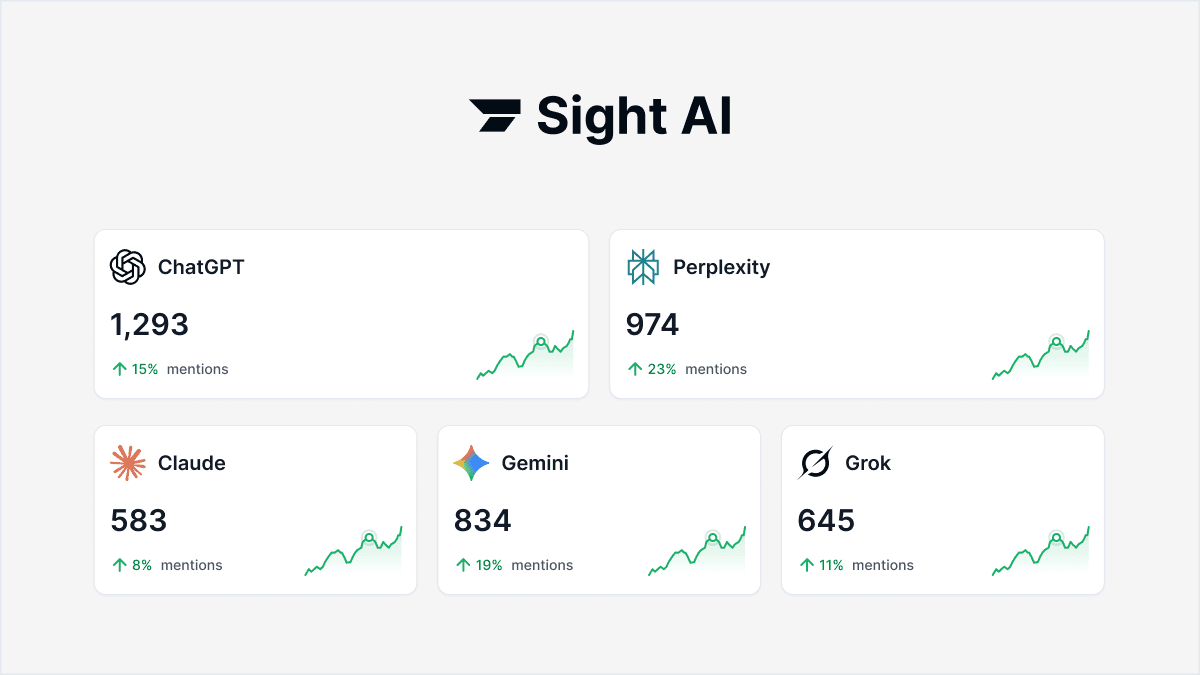
Your brand is being discussed in ChatGPT right now—but do you know what's being said? As AI chatbots become a primary source of information for millions of users, tracking how these models reference your brand has become essential for modern marketers.
Unlike traditional social media monitoring, ChatGPT mentions happen in private conversations, making them invisible to conventional tracking tools. When someone asks "What's the best project management software?" or "Which CRM should I use for my startup?", ChatGPT generates an answer that could include your brand—or completely ignore you in favor of competitors.
This guide walks you through the exact process of monitoring your brand's presence in ChatGPT and other AI models, from understanding why AI visibility matters to implementing automated tracking systems. By the end, you'll have a working system to monitor, analyze, and improve how AI chatbots talk about your brand.
Step 1: Understand Why AI Brand Monitoring Differs from Traditional Tracking
Think of traditional brand monitoring tools as security cameras pointed at public spaces. They capture what people post on Twitter, mention in blog comments, or share on Facebook. But ChatGPT conversations? Those happen behind closed doors.
ChatGPT generates responses using a combination of training data and retrieval-augmented generation (RAG). When a user asks a question, the model draws from patterns learned during training and, in some cases, retrieves current information to supplement its response. This means your brand might appear in thousands of daily conversations, and you'd have no way to know.
Here's what makes AI visibility fundamentally different from social listening. Traditional monitoring tools track public posts with your brand name already in them. AI visibility measures how often AI models proactively mention your brand when users ask relevant questions—even if they never typed your company name. Understanding how ChatGPT responds to brand queries is essential for grasping this distinction.
The business impact hits harder than you might expect. When someone asks ChatGPT for recommendations, they're often at the consideration or decision stage of their buyer journey. If your competitor appears in that response and you don't, you've lost a potential customer before they even knew you existed.
AI visibility means more than just getting mentioned. It encompasses how often you appear, in what context, with what sentiment, and how accurately the AI represents your offerings. A mention that describes your product incorrectly can be worse than no mention at all.
Traditional SEO focused on ranking in Google's top 10 results. AI visibility focuses on being the answer ChatGPT gives when users ask questions in your domain. The shift is profound: from competing for clicks to competing for recommendations.
Step 2: Identify Your Brand Monitoring Priorities and Keywords
Start by listing every variation of your brand name users might type or say. Include your company name, product names, common misspellings, and abbreviations. If you're "TechSolutions Inc." but everyone calls you "TechSol", both matter.
Next, step into your customer's shoes. What questions do they ask before buying your product? Create a list of prompts your target audience likely types into ChatGPT. These might include comparison queries like "Salesforce vs HubSpot for small business" or problem-focused questions like "how to automate email marketing workflows".
Document these in a tracking sheet with three columns: the prompt, why it matters to your business, and which stage of the buyer journey it represents. A prompt like "what is project management software" indicates early awareness, while "Asana vs Monday pricing comparison" signals late-stage consideration.
Build your competitor watchlist next. Identify 5-10 direct competitors whose mentions you want to track. Learning how to track competitor AI mentions helps you understand the competitive landscape. When ChatGPT recommends three tools and yours isn't among them, you need to know who is.
Industry-specific queries deserve special attention. If you sell accounting software, track prompts about tax season, bookkeeping challenges, and compliance requirements. These broader queries might not mention any brand names, but they represent opportunities to establish thought leadership.
Organize your prompts by priority. High-priority prompts directly relate to your core offering and represent significant search volume. Medium-priority prompts cover adjacent use cases or secondary features. Low-priority prompts might be tangentially related but still worth monitoring quarterly.
This foundation determines everything that follows. Spend time getting it right. The prompts you identify now become the basis for your entire AI visibility strategy.
Step 3: Set Up Manual Prompt Testing to Establish a Baseline
Before you automate anything, you need to understand your current AI visibility through hands-on testing. Open ChatGPT and start typing your priority prompts, one by one. Copy each response into a spreadsheet.
Create a tracking template with these columns: Date, Prompt, Brand Mentioned (Yes/No), Position (if listed with competitors), Sentiment (Positive/Neutral/Negative), Accuracy (Correct/Partially Correct/Incorrect), and Notes. This structure lets you spot patterns quickly.
Here's what to look for in each response. Was your brand mentioned at all? If yes, where did it appear—as the first recommendation, buried in a list, or mentioned as an alternative? What tone did the AI use when describing you? Reviewing brand mentions in ChatGPT responses helps you understand these patterns.
Test the same prompt multiple times. ChatGPT's responses vary based on conversation context and model randomness. Run each high-priority prompt at least three times and note whether your brand appears consistently or sporadically.
Switch between ChatGPT versions if you have access. Free tier users see one model, while Plus subscribers access more advanced versions. Test across both to understand how visibility differs. Some brands appear more frequently in newer models that have access to updated training data.
Document accuracy issues meticulously. If ChatGPT says your product costs $99/month but you actually charge $79/month, that's a critical data point. If it describes features you deprecated two years ago, note it. These inaccuracies tell you what outdated information the model learned during training.
Calculate your baseline AI visibility score. Count how many times your brand appeared across all tests, divide by total prompts tested, and multiply by 100. If you ran 20 prompts and appeared in 8 responses, your baseline visibility is 40%.
This manual testing phase typically takes 3-4 hours for a comprehensive baseline. It's tedious work, but the insights are invaluable. You'll discover which prompts trigger mentions, which competitors dominate recommendations, and where your biggest gaps exist.
Step 4: Implement Automated AI Visibility Tracking Tools
Manual testing revealed your baseline, but it's not sustainable. Testing 20 prompts took hours. Testing them weekly would consume your entire workday. Testing across ChatGPT, Claude, Perplexity, and other AI platforms? Impossible to manage manually.
This is where automated AI visibility tracking becomes essential. These platforms continuously monitor how AI models mention your brand across multiple platforms, tracking changes over time without manual effort. Implementing brand mentions tracking automation saves countless hours while improving accuracy.
AI visibility tracking software monitors brand mentions across AI models by running your defined prompts systematically and analyzing the responses. The best platforms track mentions across ChatGPT, Claude, Perplexity, and other emerging AI search tools, giving you a comprehensive view of your AI presence.
Start by selecting a platform that offers prompt tracking and sentiment analysis. Look for tools that let you input your priority prompts and automatically test them across multiple AI models. The platform should track whether your brand appears, in what context, and with what sentiment.
Configure your monitoring cadence based on your resources and how quickly your industry moves. Daily tracking makes sense for rapidly evolving markets or during active PR campaigns. Weekly tracking works for most brands. Monthly tracking suffices if you're just establishing a baseline.
Set up automated alerts for significant changes. Configure notifications when your mention frequency drops below a threshold, when competitor mentions spike, or when sentiment shifts from positive to negative. These alerts let you respond quickly to emerging issues.
The platform should provide an AI visibility score that aggregates your performance across all tracked prompts. This single metric helps you measure progress over time. Track how your score changes month-over-month as you implement optimization strategies.
Integration capabilities matter too. The best tools connect with your content management system, allowing you to publish optimized content directly from the platform. This creates a closed loop: track visibility, identify gaps, create content, publish, and measure impact.
Step 5: Analyze Your AI Visibility Data and Identify Gaps
Your tracking system is running. Now comes the strategic work: turning data into action. Start by reviewing your overall AI visibility score. A score above 60% indicates strong presence. Between 30-60% suggests room for improvement. Below 30% means you're largely invisible to AI recommendations.
Dig into the prompt-level data next. Sort your prompts by mention frequency and identify the bottom quartile—these are your biggest gaps. Ask yourself: why aren't AI models mentioning us here? Is it lack of content, weak brand authority, or outdated information in their training data?
Run a competitive gap analysis. For each prompt where competitors appear but you don't, document which brands the AI recommends instead. Look for patterns. Does one competitor dominate across multiple prompts? That suggests they've invested heavily in content optimization for AI visibility.
Pay special attention to inaccurate mentions. If ChatGPT describes your pricing incorrectly or references discontinued features, you've found training data problems. If your brand is not showing up in ChatGPT at all, that requires a different strategy than correcting misinformation.
Sentiment analysis reveals how AI models frame your brand. Positive sentiment like "highly rated" or "popular choice" strengthens recommendations. Neutral mentions are opportunities for improvement. Negative sentiment requires immediate investigation to understand the source. Learning to track brand sentiment online helps you monitor these shifts.
Create a prioritized action list based on your analysis. High-impact opportunities are prompts with high business value where you're currently invisible. Quick wins are prompts where you're mentioned inconsistently—small content improvements could boost visibility significantly.
Track trends over time, not just snapshots. A single week's data might show noise. Four weeks of data reveals patterns. If your visibility score drops consistently, investigate what changed. Did a competitor launch new content? Did an AI model update its training data?
Step 6: Create Content That Gets Your Brand Mentioned by AI
Understanding how AI models source information changes everything about content creation. These models don't crawl your website in real-time like Google does. They learn from content during training and, for some queries, retrieve current information from authoritative sources.
This is where Generative Engine Optimization (GEO) comes in. Unlike traditional SEO that optimizes for search engine rankings, GEO optimizes content to be cited by AI models when generating responses. The principles differ in important ways.
AI models favor content that directly answers questions with clear, structured information. Write comprehensive guides that cover topics thoroughly rather than superficial blog posts. Include specific details, examples, and step-by-step instructions that AI models can reference when responding to user queries.
Structure matters enormously. Use descriptive headings that mirror the questions users ask. If people ask "how to choose project management software", create a section with that exact heading. AI models often pull information from sections whose titles match user queries.
FAQ sections are particularly valuable for AI visibility. Create comprehensive FAQ pages that answer every question your target audience might ask. Format them with clear question headings followed by detailed answers. This structure makes it easy for AI models to extract relevant information.
Comparison content performs exceptionally well. When users ask ChatGPT to compare your product with competitors, detailed comparison guides give the AI factual information to reference. Include feature matrices, pricing comparisons, and use case recommendations.
Publishing frequency and volume matter more for AI visibility than traditional SEO. AI models learn from the breadth of information available about your brand. A single amazing article helps less than ten solid guides covering different aspects of your offering. Understanding how ChatGPT chooses brands to recommend can inform your content strategy.
This is where AI content tools become force multipliers. Platforms with specialized agents can generate GEO-optimized articles at scale—listicles, step-by-step guides, and explainer content structured specifically for AI citation. The key is maintaining quality while increasing volume.
Ensure your content gets indexed quickly. Use IndexNow integration to notify search engines immediately when you publish new content. Faster indexing means AI models can access your latest information sooner when they retrieve real-time data.
Step 7: Monitor Results and Iterate Your AI Visibility Strategy
Set up a regular review cadence before you publish your first piece of optimized content. Weekly reviews work well during active optimization campaigns. Monthly reviews suffice for ongoing monitoring once you've established strong visibility.
Track your AI visibility score as your primary success metric. Plot it on a chart with publication dates marked. You should see gradual improvement as AI models encounter and learn from your new content. Significant jumps often correlate with publishing comprehensive guides or comparison content.
Monitor mention frequency for specific prompts where you published targeted content. If you created a guide about "choosing email marketing software" and your brand still doesn't appear when users ask that question, investigate why. The content might need stronger optimization or more time to be incorporated into AI training data. Using a dedicated ChatGPT mentions tracking tool simplifies this process.
Sentiment tracking reveals whether your optimization efforts improve how AI models describe you. Publishing case studies and customer success stories often shifts sentiment from neutral to positive. Addressing outdated information corrects negative or inaccurate mentions.
Adjust your keyword and prompt tracking based on evolving user behavior. New competitors enter the market. Industry terminology shifts. User questions change as technology evolves. Quarterly prompt audits ensure you're tracking what matters now, not what mattered six months ago.
Success indicators go beyond raw visibility scores. Look for increased mention frequency after publishing new content. Watch for improved positioning when you are mentioned—moving from fourth in a list to first represents meaningful progress. You can also track brand mentions across AI platforms to get a complete picture of your visibility.
Document what works and what doesn't. If comparison guides consistently boost visibility while product announcements don't move the needle, adjust your content strategy accordingly. Build a playbook of tactics that drive results for your specific brand and industry.
Putting It All Together
Tracking brand mentions in ChatGPT requires a fundamentally different approach than traditional monitoring. You're not watching public conversations—you're measuring how AI models proactively recommend your brand when users ask relevant questions.
Here's your quick implementation checklist. First, define your brand keywords and target prompts based on questions your audience actually asks. Second, establish a manual testing baseline to understand your current AI visibility across key prompts. Third, implement automated AI visibility tracking to monitor mentions at scale across ChatGPT, Claude, Perplexity, and other platforms.
Fourth, analyze gaps and competitor positioning to identify high-impact optimization opportunities. Fifth, create GEO-optimized content structured specifically for AI citation—comprehensive guides, detailed FAQs, and comparison articles. Sixth, monitor results monthly and iterate your strategy based on what drives visibility improvements.
Start with manual testing today to understand your current AI visibility. Even a few hours of prompt testing reveals where you stand and which gaps matter most. Then scale with automated tools as you build your optimization strategy.
The brands that master AI visibility now will dominate the recommendations users receive for years to come. While your competitors wonder why their traffic is declining, you'll understand that the game has shifted. It's not about ranking in Google anymore—it's about being the answer ChatGPT gives.
Stop guessing how AI models like ChatGPT and Claude talk about your brand—get visibility into every mention, track content opportunities, and automate your path to organic traffic growth. Start tracking your AI visibility today and see exactly where your brand appears across top AI platforms.