Your biggest competitor just got recommended to your ideal customer. Again. And again. Twelve times this week, actually—across ChatGPT, Claude, and Perplexity. Meanwhile, your brand? Invisible. Not ranking poorly. Not mentioned unfavorably. Just... absent from the conversation entirely.
This isn't happening on Google where you can track it. It's not showing up in your social listening tools. Your traditional competitive intelligence dashboard has no idea this is even occurring.
Welcome to the new competitive battlefield: AI-powered search and recommendations. While you've been optimizing for traditional search rankings, your competitors have been dominating the AI platforms that are rapidly becoming the primary research tool for your target audience. When someone asks ChatGPT for software recommendations in your category, when they query Claude about solutions to their specific problem, when they use Perplexity to research vendors—AI models are serving up curated lists of 2-5 brands. And if you're not on those lists, you're losing deals you never even knew existed.
The stakes are higher than you might think. AI recommendations carry a different psychological weight than traditional search results. Users perceive them as personalized advice rather than algorithmic rankings. They trust them more. They act on them faster. And because AI responses typically mention only a handful of brands instead of showing 10+ search results, each mention becomes exponentially more valuable. Getting recommended means capturing market share directly from competitors. Being invisible means watching that market share disappear into a black box you can't even measure.
Here's the twist: your traditional competitors might not be your AI competitors. Some brands that barely register in search rankings are dominating AI recommendations. Meanwhile, established players with strong SEO are mysteriously absent from AI responses. The competitive landscape has fundamentally shifted, and most companies are still fighting yesterday's war.
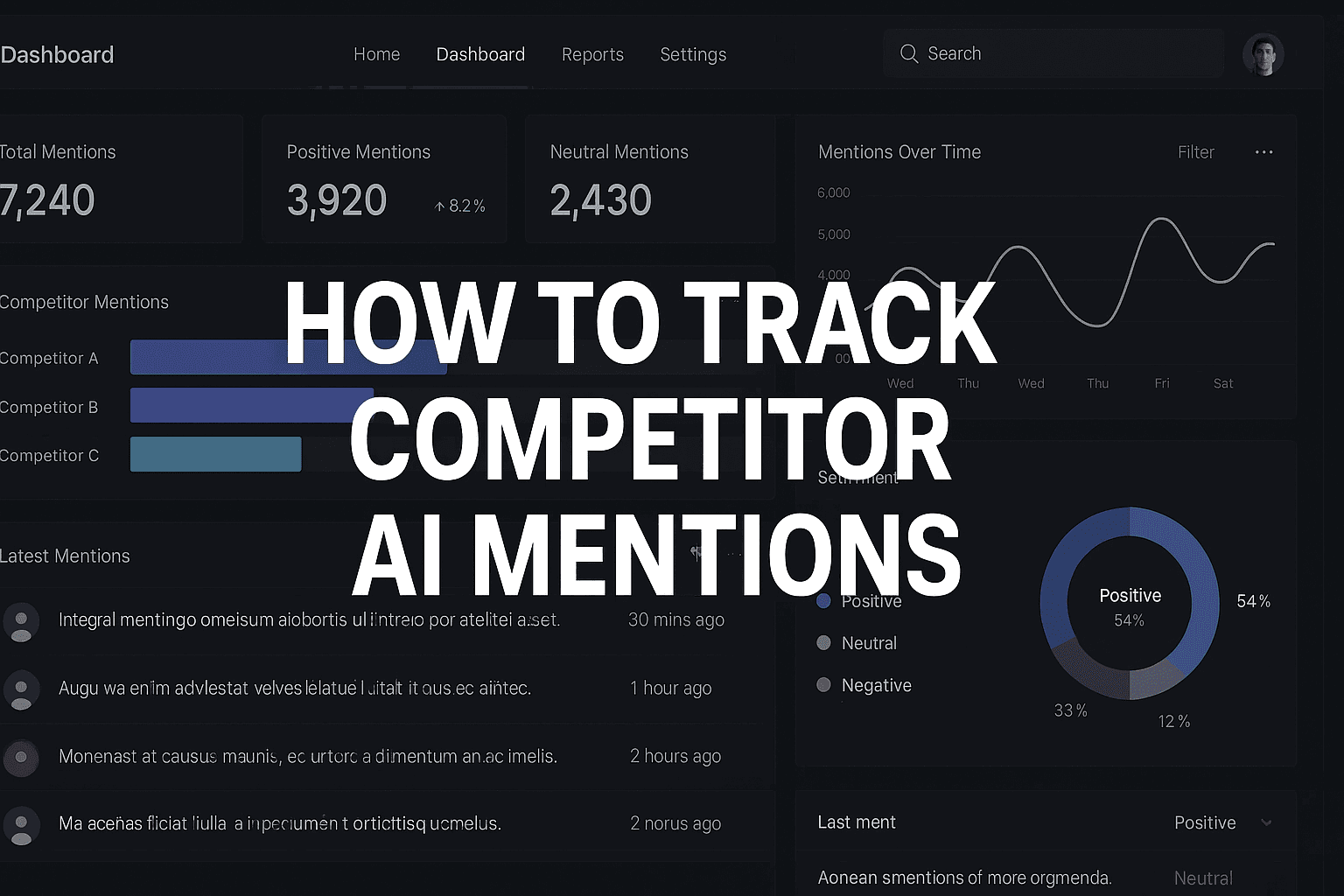
This guide walks you through exactly how to track competitor AI mentions across all major platforms—ChatGPT, Claude, Perplexity, and Gemini. You'll learn how to discover which competitors actually matter in AI search, build both manual and automated tracking systems, analyze what AI models really think about your competitors, and convert that intelligence into content strategies that shift mention patterns in your favor.
By the end, you'll have a complete competitive intelligence system that reveals the invisible battlefield where your next customers are making decisions right now. Let's start by identifying which competitors are actually winning the AI conversation.
Step 1: Identify Which Competitors Actually Matter in AI Search
Here's the uncomfortable truth: your traditional competitor list is probably wrong for AI search. The enterprise software giant dominating Google rankings might be invisible in ChatGPT recommendations. Meanwhile, that scrappy startup you barely noticed? They're getting mentioned in AI responses three times more often than you are.
AI platforms don't care about your market share or advertising budget. They care about content quality, topical authority, and how well your information matches user intent. This creates a completely different competitive landscape—one you need to map before you can monitor effectively.
Test Your Actual AI Competitive Landscape
Start by running systematic tests across the four major AI platforms: ChatGPT, Claude, Perplexity, and Gemini. Use identical prompts on each platform to see which competitors actually appear in recommendations.
Create 5-7 core prompts that represent how your target customers search for solutions. Include direct questions ("What's the best [your category] software?"), scenario-based queries ("I need [solution] for [specific use case]"), and comparison requests ("Compare [your category] options for [audience type]").
Document every competitor mentioned in each response. You'll quickly notice patterns—some competitors appear consistently across platforms, others only on specific models, and many traditional competitors never appear at all. The systematic approach to tracking these cross-platform patterns mirrors the methodology used in AI brand monitoring, but redirected toward competitor analysis rather than your own brand presence.
Pay special attention to unexpected players. That content-focused startup with lower search rankings but comprehensive guides? They might dominate AI mentions because their content better matches how AI models evaluate authority and relevance.
Prioritize Based on AI Mention Frequency and Context
Not all mentions are equal. A competitor mentioned as the "industry leader for enterprise security" carries more weight than one listed fifth in a generic roundup. As you test, note both frequency and context.
Create a simple scoring system: 3 points for positive recommendations, 2 points for neutral mentions, 1 point for negative examples or cautionary tales. Track this across all four platforms for each competitor. After a week of testing with your core prompts, you'll have a clear picture of who actually matters in AI search.
Focus your ongoing monitoring on the top 5-8 competitors who consistently appear in AI recommendations. These are your true AI competitors—the brands actively capturing mindshare in the channels where your customers are increasingly making decisions. Trying to track everyone dilutes your intelligence and wastes resources on competitors who aren't actually winning AI visibility.
This focused list becomes the foundation for everything that follows—your manual tracking system, automated monitoring setup, and competitive content strategy. Get this step right, and you're tracking the competitors who actually threaten your AI visibility. Get it wrong, and you're monitoring ghosts while real competitors dominate the conversation.
Step 2: Build Your Manual Intelligence Gathering System
Before investing in automated tools, you need to understand what you're actually tracking. Manual intelligence gathering reveals the nuances that automated systems miss—the context around mentions, the sentiment in AI responses, the specific positioning of competitors. This foundation shapes everything that comes after.
Think of this phase as your reconnaissance mission. You're not just counting mentions. You're discovering patterns, identifying opportunities, and building the strategic framework that will guide your entire competitive intelligence operation.
Creating Effective Monitoring Prompts
Your prompts determine what you discover. Generic queries like "best project management software" reveal surface-level competitive dynamics. Strategic prompts uncover positioning, weaknesses, and opportunities.
Start with direct comparison prompts: "Compare [Competitor A] and [Competitor B] for enterprise teams." These reveal how AI models position competitors against each other—which features get highlighted, which weaknesses get mentioned, how the models frame the decision.
Then add scenario-based prompts that mirror real customer situations: "I'm a marketing director at a 50-person company struggling with campaign tracking and team collaboration. What tools should I consider?" These prompts reveal which competitors AI models recommend for specific use cases and pain points.
The prompt engineering techniques you use here mirror the strategies outlined in our guide on how to monitor ChatGPT brand mentions—simply redirect the focus from your brand to competitor brands. Understanding how AI content strategy influences model responses helps you craft prompts that reveal deeper competitive insights beyond surface-level mentions.
Include negative prompts too: "What are the main complaints about [Competitor]?" or "Why do companies switch away from [Competitor]?" AI models often reveal weaknesses that competitors work hard to hide in their marketing.
Build a prompt library of 15-20 variations covering direct questions, scenario-based queries, comparison requests, and weakness exploration. Test each prompt across all major AI platforms—ChatGPT, Claude, Perplexity, and Gemini—because responses vary significantly by platform.
Establishing Tracking Schedules and Documentation
Consistency transforms random data points into competitive intelligence. Set up a weekly tracking schedule for your core competitors and primary keyword categories. Every Monday morning, run your top 10 prompts across all four platforms and document the results.
Create a simple spreadsheet with columns for date, platform, prompt, competitors mentioned, mention order, context, and sentiment. The mention order matters—being listed first versus fourth signals different levels of AI model preference.
Context is where manual tracking shines. Note whether competitors are mentioned as premium options, budget alternatives, niche specialists, or cautionary examples. Record the specific features or use cases that trigger each mention. This qualitative data reveals positioning patterns that frequency counts miss.
Add monthly comprehensive reviews where you test broader prompt variations and explore emerging topic areas. If "remote work" or "AI integration" starts trending in your industry, test how competitors appear in those contexts.
The discipline of manual tracking builds your intuition about competitive dynamics. After four weeks, you'll recognize patterns instantly—which competitors own which topics, how positioning shifts across platforms, where gaps exist in the competitive landscape.
Pattern Recognition and Insight Development
Raw tracking data becomes actionable intelligence through systematic analysis. Review your weekly documentation to identify recurring themes in how competitors are positioned. Look for consistency across platforms—when multiple AI models position a competitor similarly, that's a strong signal about their established market perception.
Pay attention to divergence too. If a competitor dominates ChatGPT recommendations but rarely appears in Claude responses, that reveals platform-specific content strategies you can learn from or exploit. The techniques that drive visibility in one model may not transfer to others, creating opportunities for strategic differentiation.
Step 3: Automate Your Competitive Intelligence with AI Visibility Tools
Manual tracking gives you the insights. Automation gives you the scale. Once you understand what patterns to look for, it's time to build a system that monitors competitor mentions 24/7 across every major AI platform—without you lifting a finger.
The shift from manual to automated tracking isn't about replacing your strategic insights. It's about multiplying them. While you were sleeping, your competitor just got mentioned in 47 ChatGPT conversations. While you were in meetings, they appeared in 23 Claude responses. Manual tracking catches the patterns. Automation catches everything.
Start by evaluating AI-specific monitoring platforms—not traditional brand monitoring tools. Here's the critical distinction: social listening tools track public mentions across Twitter and Reddit. AI monitoring tools track private recommendations happening inside ChatGPT, Claude, Perplexity, and Gemini conversations. Completely different data sources. Completely different technology requirements.
Look for platforms that offer multi-model coverage as their core feature. Your ideal tool should monitor at minimum ChatGPT, Claude, Perplexity, and Gemini simultaneously. Single-platform tools create blind spots. If you're only tracking ChatGPT while your competitor dominates Claude recommendations, you're missing half the battlefield.
Prioritize real-time detection capabilities over batch processing. When a competitor suddenly starts appearing in a new topic category, you need to know immediately—not in next week's report. Real-time alerts let you analyze their content strategy while it's fresh and respond before they establish dominance.
Once you've selected your platform, configure your tracking parameters strategically. Start with your core competitor list from Step 1—those 5-8 brands that actually appear in AI recommendations. Add every variation of their brand names: full company name, shortened versions, common misspellings, product names that users might reference instead of company names.
Layer in your industry keyword categories. If you're tracking project management competitors, configure monitoring for "project management software," "team collaboration tools," "workflow automation," "task management platforms"—every phrase your target audience might use when asking AI for recommendations. This reveals not just when competitors are mentioned, but in what context.
Here's where most teams make a critical mistake: they configure alerts for everything and drown in notifications within 48 hours. Instead, establish a tiered alert system. Set immediate notifications for high-priority scenarios: competitor mentioned in your top 3 strategic keyword categories, sudden spike in mention frequency, competitor appearing in new topic areas they haven't dominated before.
Configure daily digest emails for routine mentions—competitor appeared in standard queries you're already tracking. Weekly trend reports for pattern analysis—which competitors are gaining traction, which are declining, what new positioning themes are emerging.
The goal isn't to react to every single mention. It's to maintain continuous awareness while focusing your attention on significant competitive developments. When your competitor launches a new content strategy that's working, you'll know within hours instead of months. That's the automation advantage.
Step 4: Decode What AI Models Really Think About Your Competitors
Raw mention data tells you which competitors appear in AI responses. But that's only half the story. The real competitive intelligence lies in understanding how AI models position your competitors—and that context reveals everything about their perceived strengths, weaknesses, and market positioning.
Think about it: being mentioned as "the enterprise leader with robust security features" carries completely different strategic implications than being mentioned as "a budget-friendly option for small teams." Both are mentions. But one positions the competitor as a premium solution while the other relegates them to the low-end market segment.
This is where most competitive tracking efforts fail. They count mentions without analyzing what those mentions actually mean. You end up with frequency charts that miss the strategic insights hiding in plain sight.
Understanding Mention Context and Sentiment
Start by categorizing every competitor mention into one of three contexts: positive recommendation, neutral listing, or cautionary example. AI models don't just mention brands randomly—they position them within specific narratives based on patterns in their training data.
When a competitor appears in a positive recommendation context, the AI model is actively endorsing them as a solution. The language typically includes phrases like "excellent choice for," "particularly strong at," or "recommended for teams that need." These mentions carry the highest competitive value because they directly influence purchase decisions.
Neutral listings occur when AI models present multiple options without strong differentiation. Your competitor appears in a list alongside others with minimal context or positioning. These mentions provide visibility but less persuasive power. They're opportunities—if you can shift the context to positive recommendation, you gain significant competitive advantage.
Cautionary examples are the most revealing. When AI models mention competitors as examples of what not to do or highlight their limitations, you've discovered a critical weakness. Pay special attention to these. They reveal gaps in competitor positioning that you can exploit through strategic content.
Track sentiment trends over time, not just point-in-time snapshots. A competitor whose sentiment is improving month-over-month is executing an effective AI visibility strategy. A competitor whose positive mentions are declining is vulnerable to competitive displacement.
Identifying Competitive Advantages and Weaknesses
Map every competitor mention to specific product features, use cases, or customer segments. This creates a competitive positioning matrix that reveals exactly where each competitor dominates—and where they're conspicuously absent.
Here's what to look for: When a competitor consistently appears for "enterprise security features" but never gets mentioned for "ease of use" or "quick implementation," you've identified their positioning and their weakness. AI models have learned to associate them with one strength while implicitly excluding them from other categories.
The same principles that govern how you would build topical authority apply to understanding competitor strengths. Competitors who dominate specific topic categories have invested heavily in comprehensive content that establishes them as authorities. Implementing the strategies outlined in AI content generation tools can help you systematically create the depth of content needed to challenge their established positions.
Create a feature-mention matrix for your top competitors. List their key features down one axis and the frequency with which AI models mention each feature on the other. This visualization immediately reveals their content strategy priorities and the gaps where they're vulnerable.
Step 5: Convert Competitive Intelligence into Market-Winning Content Strategy
Raw competitive data means nothing until you transform it into content that shifts AI mention patterns in your favor. This is where most companies stumble—they collect intelligence but never act on it. The brands winning AI visibility treat competitive insights as a strategic roadmap for content creation.
Start by mapping competitor weaknesses to specific content opportunities. Review your tracking data and identify patterns where competitors consistently fail to appear or receive negative sentiment. If your analysis shows competitors mentioned for "enterprise features" but never for "ease of implementation," that's your opening. Create comprehensive content that directly addresses this gap—detailed implementation guides, step-by-step tutorials, or case studies showcasing simple deployment.
The key is specificity. Don't create generic content about topics where competitors are weak. Instead, craft resources that explicitly position your solution as the answer to their documented shortcomings. If competitor sentiment analysis reveals users complain about complex setup processes, publish "The 15-Minute Implementation Guide" that demonstrates your streamlined approach. AI models favor content that directly addresses user pain points with concrete solutions.
Once you've identified strategic content opportunities, focus on creating the depth and breadth of content that establishes topical authority. Competitors who dominate AI mentions have built comprehensive content libraries that cover every angle of their core topics. Your AI content workflow needs to support systematic production of interconnected content pieces that demonstrate expertise across your competitive positioning areas.
Stop guessing how AI models like ChatGPT and Claude talk about your brand—get visibility into every mention, track content opportunities, and automate your path to organic traffic growth. Start tracking your AI visibility today and see exactly where your brand appears across top AI platforms.