If you've ever asked an SEO consultant how many backlinks you need to rank, you've probably received some version of the same frustrating non-answer: "It depends." And while that response feels like a cop-out, the honest truth is that it's largely correct. The problem isn't the answer itself. It's that nobody follows it up with a useful explanation of what it actually depends on.
The idea that there's a magic number, say 50 backlinks or 200 referring domains, that unlocks first-page rankings is one of the most persistent myths in SEO. It leads marketers to chase arbitrary targets, buy low-quality links in bulk, and wonder why their rankings still haven't moved six months later. The question "how many backlinks do you need?" deserves a more nuanced, strategic answer than a single number can provide.
This guide is designed to give you exactly that. We'll break down the factors that actually determine your backlink requirements, explain how to set realistic goals based on your specific competitive landscape, and explore how the backlink equation is shifting in an era where AI models like ChatGPT, Claude, and Perplexity are increasingly how people discover brands and answers. Whether you're a marketer, founder, or agency professional, the goal here isn't to hand you a number. It's to help you think about backlinks more strategically.
The Myth of the Universal Backlink Count
Let's start with the most important concept to internalize: backlink requirements are entirely relative to your competitive environment. A local bakery trying to rank for "best sourdough bread in Austin" and a fintech SaaS company targeting "automated accounts payable software" are operating in completely different universes when it comes to link building. The local bakery might rank with a handful of citations and a few local directory links. The fintech company might be competing against pages with hundreds of high-authority referring domains.
This is why any conversation about how many backlinks you need has to start with your specific target keyword, not some industry average or rule of thumb.
Before we go further, it's worth clarifying a distinction that trips up a lot of people: the difference between total backlinks and referring domains. Backlinks are the raw count of all links pointing to a page or site. Referring domains are the number of unique websites those links come from. A single website could link to you 100 times across different pages, but that still counts as one referring domain.
From a ranking signal perspective, referring domains are generally considered more meaningful. A page with links from 50 different websites typically signals broader authority and trustworthiness than a page with 500 links from just five domains. Diversity matters because it suggests that multiple independent sources have found your content valuable enough to reference. When you're benchmarking your link profile, referring domains should be your primary metric.
The most practical tool for figuring out your own backlink target is a backlink gap analysis. The process is straightforward: identify the top 10 pages currently ranking for your target keyword, pull the number of referring domains pointing to each of those pages, and compare that against your own current profile. The gap between where you are and where your competitors sit gives you a directional benchmark, not a guarantee, but a realistic starting point for your link-building goals.
This competitor-based approach is far more useful than any generic benchmark because it accounts for the actual competitive landscape of your specific keyword. The top 10 results are the ground truth of what Google currently rewards in your niche.
The Variables That Shape Your Backlink Requirements
Once you've run a backlink gap analysis, you'll have raw numbers to work with. But interpreting those numbers requires understanding the factors that influence how many links you actually need to close the gap and compete effectively.
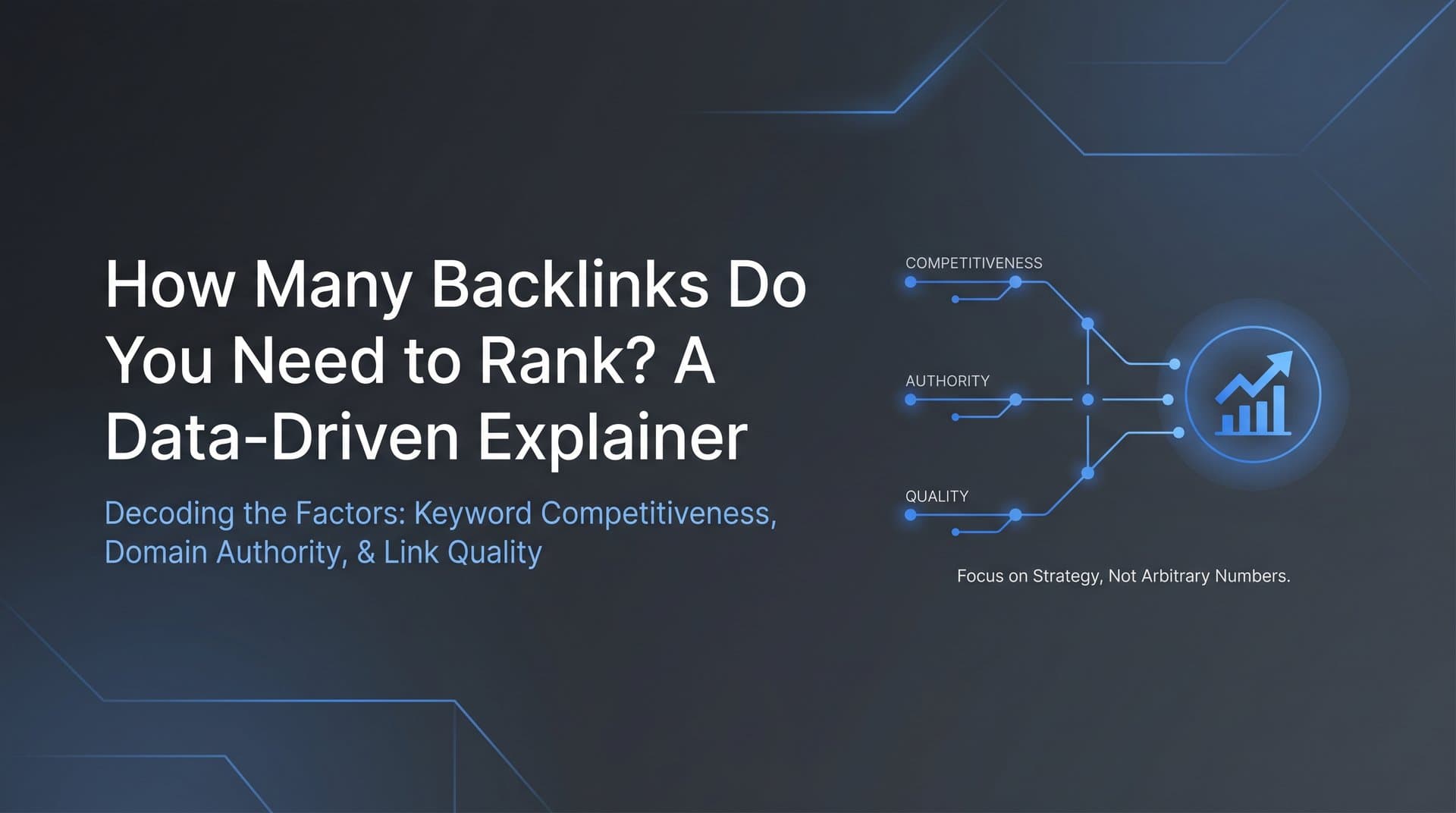
Keyword Difficulty Scores: Tools like Ahrefs and Moz calculate keyword difficulty (KD) scores that factor in the referring domain profiles of top-ranking pages. Ahrefs' documentation, for example, explains that low-difficulty keywords (roughly KD 0-10) may require few or no backlinks to rank, while high-difficulty keywords (KD 70 and above) typically require links from many high-authority domains. These scores are estimates and should be treated as directional guidance rather than precise targets, but they're useful for prioritizing which keywords are realistically achievable given your current domain strength.
Domain Authority and Existing Link Equity: A well-established site with a strong overall backlink profile has a significant advantage over a brand-new domain. That existing authority acts as a rising tide, meaning individual pages on a high-authority domain often need fewer new links to rank than equivalent pages on a newer site. If you're building a new domain from scratch, factor this into your timeline expectations. You're not just building links to a single page; you're building the foundational authority that makes every page on your site more competitive.
Content Quality and Search Intent Alignment: This is the factor that pure link-count thinking tends to undervalue. Google's systems are increasingly sophisticated at evaluating whether a page genuinely satisfies the search intent behind a query. A page that perfectly matches what users are looking for, answers their questions thoroughly, and keeps them engaged can outperform pages with more backlinks. This doesn't mean links don't matter; they absolutely do. But it does mean that pouring resources into link acquisition while neglecting content quality is a losing strategy. The two work together, and a content gap can limit how much your links actually move the needle.
Diminishing Returns: Many experienced SEO practitioners observe a pattern of diminishing returns with backlinks. The first 10 to 20 referring domains pointing to a page often have a disproportionately large impact on rankings, with each additional referring domain providing progressively smaller boosts. This isn't an officially quantified relationship, but it's a widely observed pattern that has practical implications: you don't necessarily need to match your competitors link-for-link. Closing a significant portion of the gap, especially with higher-quality links, can often be enough to compete.
Quality vs. Quantity: What Actually Moves the Needle
Here's the thing about link building that bulk-link vendors don't want you to know: not all backlinks carry equal weight, and the gap between a great link and a mediocre one is enormous.
A single link from a high-authority, topically relevant publication can deliver more ranking impact than dozens of links from low-quality directories or unrelated blogs. Why? Because Google's evaluation of a link isn't just about the linking site's overall authority. It's about relevance, trust, and editorial context. A link from a respected industry publication that editorially chose to reference your content is a genuine vote of confidence. A link from a site that exists primarily to sell links is a signal that Google's spam detection systems are specifically designed to discount or penalize.
Google's spam policies are explicit on this point. Link schemes, paid links without proper disclosure, and large-scale automated link building are all violations that can result in manual penalties or algorithmic devaluation. The risk isn't just that these links won't help you. It's that they can actively harm rankings that took months or years to build. Ranking gains from manipulative link building can disappear overnight when algorithm updates roll out.
So how do you evaluate link quality before pursuing it? A practical framework includes several dimensions:
Domain Relevance: Is the linking site topically related to your industry or content? A backlink from a cybersecurity blog to a cybersecurity SaaS product carries more weight than the same link from a recipe website.
Traffic to the Linking Page: A link from a page that actually receives organic traffic suggests that the page itself has earned some level of authority and visibility. Tools like Ahrefs and Semrush can show you estimated traffic to specific pages.
Editorial Placement: Links embedded naturally within the body content of an article carry more weight than links placed in footers, sidebars, or author bios. Editorial placement signals that the link was included because it genuinely adds value to readers.
Anchor Text Diversity: A healthy backlink profile contains a natural mix of branded anchors, generic anchors ("click here," "learn more"), and keyword-rich anchors. A profile dominated by exact-match keyword anchors is a red flag that can trigger spam filters. You can also apply this principle to your internal links to maintain a natural-looking site structure.
When you're evaluating link opportunities, run through these dimensions. A smaller number of links that score well across all four will consistently outperform a larger volume of links that fail most of them.
A Practical Framework for Setting Your Backlink Goals
Knowing the theory is useful. Having a repeatable process to apply it is what actually drives results. Here's a step-by-step approach to setting realistic, data-informed backlink targets for any keyword you're pursuing.
1. Identify your target keywords. Start with the specific keywords you want to rank for. Be precise. "Project management software" and "project management software for remote teams" are different keywords with different competitive landscapes and different backlink requirements.
2. Analyze the top 10 competitors' referring domains. Use a tool like Ahrefs, Moz, or Semrush to pull the referring domain count for each of the pages currently ranking in the top 10 for your target keyword. Focus on the specific page ranking, not the entire domain.
3. Calculate the median and your gap. Find the median referring domain count across the top 10 results. This is your competitive benchmark. Subtract your current referring domain count from that median to get your gap. This gives you a target range to aim for, keeping in mind that content quality and domain authority can reduce the number of links you actually need to close that gap.
4. Set monthly acquisition targets. Divide your gap by a realistic timeframe, typically 6 to 12 months for competitive keywords, to arrive at a monthly link-building goal. For most sites, acquiring anywhere from a few to a couple dozen high-quality referring domains per month is a realistic and sustainable pace.
On the subject of timelines: link building is a long-term investment. Google has acknowledged that it takes time for new links to be discovered, crawled, and incorporated into ranking calculations. Expecting significant ranking movement within 30 days of acquiring new links is unrealistic. A more grounded expectation is 3 to 6 months before new links meaningfully influence rankings, with compounding gains over time as your overall authority grows.
One more critical point: backlinks are one ranking factor among many. Treating link building as the only lever worth pulling is a mistake. Pair your link-building efforts with strong on-page SEO, solid technical health (site speed, crawlability, Core Web Vitals), and content that genuinely satisfies search intent. You can learn more about how to measure SEO success holistically rather than focusing on a single metric. These elements compound. A technically sound site with great content earns links more easily and converts that link equity into rankings more efficiently than a site with content or technical problems.
Backlinks in the Age of AI Search and GEO
The conversation about how many backlinks you need can't happen in 2026 without acknowledging a significant shift in how people find information and discover brands. AI-powered search tools like ChatGPT, Claude, and Perplexity are increasingly being used to answer questions that previously led users directly to Google. And the way these models decide which brands and sources to reference is influenced, at least in part, by the same authority signals that traditional search engines rely on.
Sites with strong backlink profiles and established authority tend to be cited more frequently by AI models when generating answers. This isn't a perfectly understood or documented relationship, but the underlying logic is consistent: AI models are trained on web content and tend to surface sources that the broader web has treated as credible and authoritative. Understanding how to get AI to recommend your brand is becoming an essential part of modern SEO strategy. Backlinks, as a proxy for authority and credibility, contribute to that signal.
This is where Generative Engine Optimization (GEO) enters the picture. GEO is the practice of creating content that earns visibility not just in traditional search results but in AI-generated answers. The strategies overlap significantly with traditional SEO: create authoritative, well-sourced, comprehensive content that earns backlinks from relevant sites. But GEO also involves thinking about how your content is structured and positioned to be referenced by AI systems, including clear entity definitions, structured data, and content that directly answers the kinds of questions AI models are asked.
The practical implication is that your link-building efforts now serve a dual purpose. Strong backlinks improve your traditional search rankings and contribute to the authority signals that influence whether AI models recommend your brand when users ask relevant questions. Tracking your brand's presence across AI platforms, including which prompts surface your brand and what sentiment those mentions carry, can reveal whether your link-building and content investments are translating into AI-powered recommendations.
This is an emerging area of SEO practice, and the research is still developing. But the directional insight is clear: building genuine authority through quality backlinks and strong content is the strategy that pays dividends in both traditional and AI-driven search.
Smarter Link Building Starts with Better Content
The most sustainable link-building strategy isn't outreach-first. It's content-first. When you create something genuinely worth linking to, you shift from chasing links to attracting them.
Certain types of content consistently earn organic backlinks at higher rates than standard blog posts or product pages. Original research and data studies give other writers and journalists something to cite. Comprehensive guides that become the definitive resource on a topic earn links over time as people discover and reference them. Data visualizations and infographics make complex information shareable. Free tools and calculators attract links because they provide ongoing utility.
These linkable asset types work because they serve the same editorial judgment that makes any high-quality link valuable: someone chose to reference your content because it genuinely adds value to their audience. Learning how to write a blog post for SEO can help you create the kind of content that naturally attracts these editorial links. That's the kind of link that moves rankings and builds lasting authority.
AI-powered content creation is increasingly useful for producing this kind of high-quality, SEO and GEO-optimized content at scale. Rather than spending weeks producing a single comprehensive guide, platforms with specialized AI agents can help generate well-structured, thoroughly researched articles across multiple formats, from explainers to listicles to data-driven guides, that are optimized for both search engines and AI visibility. The goal isn't to replace editorial judgment but to accelerate the production of content that earns links organically rather than requiring manual outreach for every single placement.
The full loop looks like this: create optimized, authoritative content that addresses real search intent. That content earns organic backlinks from relevant sites. Those backlinks improve your domain authority and page-level rankings. Higher rankings and stronger authority increase the likelihood that AI models surface your brand in generated answers. Greater AI visibility drives additional organic traffic and brand recognition, which in turn makes your content more likely to earn future links. Each element reinforces the others, and the compound effect over time is significantly greater than any single tactic pursued in isolation.
Putting It All Together
The right number of backlinks is always a moving target, defined by your competition, your domain's existing authority, and the quality of what you're linking to. There is no universal answer, and anyone who gives you one without first analyzing your competitive landscape is guessing.
The more useful questions to ask are: How does my link profile compare to the pages currently ranking for my target keyword? Are the links I'm acquiring genuinely authoritative and relevant? Am I pairing link building with content and technical SEO that maximizes the value of every link I earn?
Shift from asking "how many backlinks do I need?" to asking "how good are my backlinks?" and "how strategic is my approach?" That reframe leads to better decisions, more sustainable results, and a link profile that builds real authority rather than gaming short-term signals.
Modern SEO success, especially in a world where AI models are becoming a primary discovery channel, comes from combining quality backlinks with optimized content and active AI visibility tracking. Knowing that you rank on page one is valuable. Knowing that ChatGPT and Claude are recommending your brand when users ask relevant questions is increasingly just as important.
Stop guessing how AI models like ChatGPT and Claude talk about your brand. Start tracking your AI visibility today and see exactly where your brand appears across top AI platforms, uncover content opportunities, and automate your path to organic traffic growth with Sight AI.