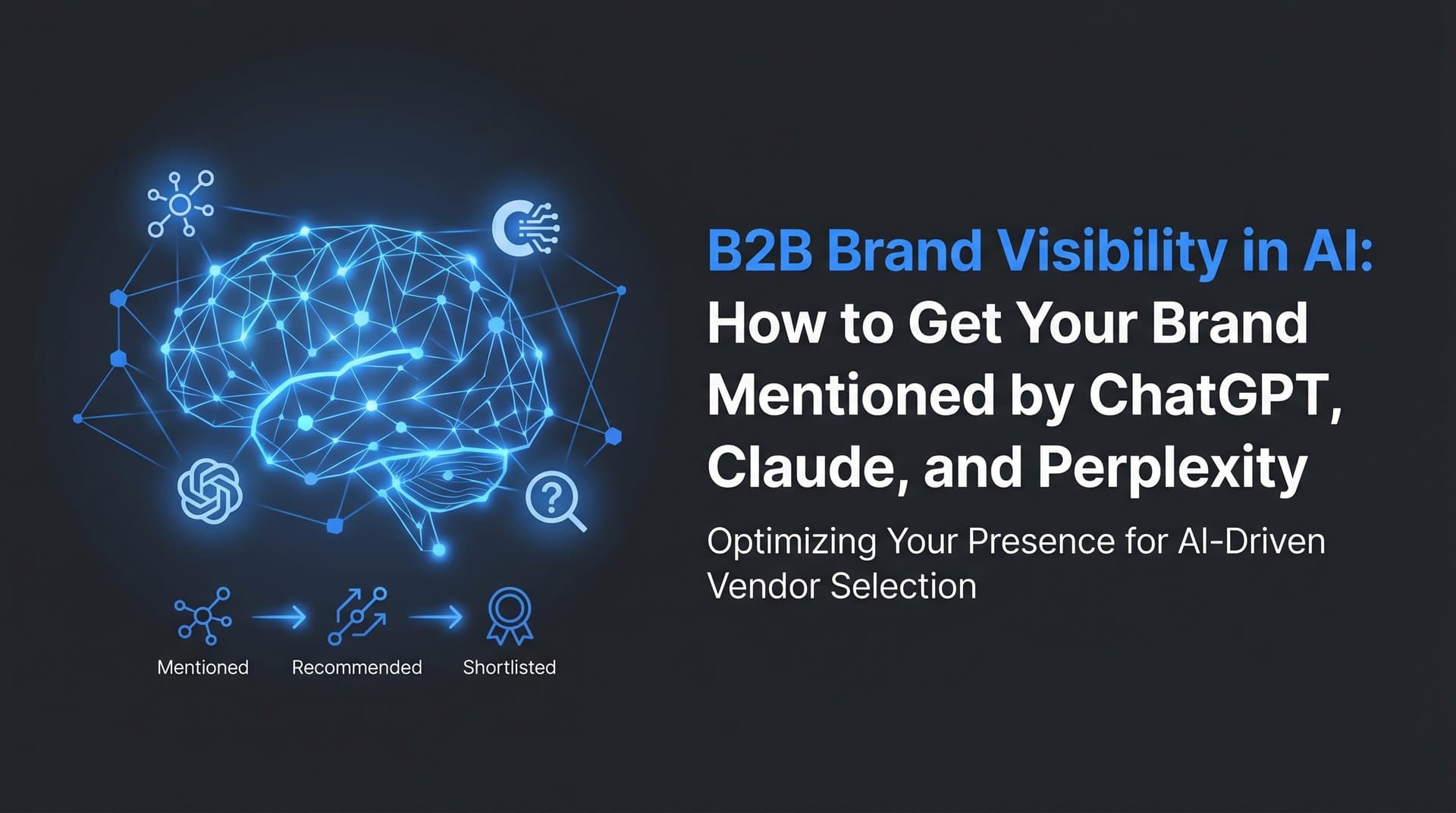
Picture this: A potential customer opens ChatGPT and types, "What's the best project management tool for remote teams?" In seconds, they receive a confident, synthesized answer recommending three specific brands. Your competitor is mentioned. You're not.
This scenario is playing out millions of times daily as users increasingly bypass traditional search engines in favor of AI assistants for product research, recommendations, and purchase decisions. The paradigm shift is profound: instead of typing keywords into Google and scrolling through blue links, users are having conversations with AI models that deliver direct, authoritative-sounding answers.
Here's the uncomfortable truth: Your brand's hard-won position on page one of Google search results doesn't guarantee you'll be mentioned when someone asks an AI assistant about your product category. These AI models operate on entirely different principles, synthesizing information from vast training datasets and real-time web retrieval to make editorial decisions about which brands deserve mention.
Brand visibility in generative AI has emerged as a critical new frontier in marketing, one that requires understanding how AI models think, what influences their recommendations, and how to optimize your digital presence for this fundamentally different discovery layer. This article will explain exactly what brand visibility in generative AI means, why it matters more than most marketers realize, and the concrete strategies you can implement to ensure your brand appears when it counts.
The New Discovery Layer: How AI Models Decide What Brands to Mention
When you ask ChatGPT, Claude, or Perplexity about product recommendations, you're not searching a database of indexed web pages. You're triggering a complex decision-making process where the AI model synthesizes information from multiple sources to formulate what appears to be a thoughtful, personalized response.
Understanding this process is crucial because it operates fundamentally differently from traditional search engines.
Large language models draw from three primary information sources when generating responses. First, their training data: massive datasets of text from books, websites, articles, and other sources that the model learned from during its initial training. This training data has a knowledge cutoff date, meaning the model's baseline knowledge stops at a specific point in time. Second, real-time web retrieval: many AI models now supplement their training data by searching the web in real-time to incorporate current information. Third, retrieval-augmented generation (RAG): sophisticated systems that pull relevant context from specialized databases or knowledge bases to inform responses.
The critical difference from traditional search becomes apparent here. Google shows you a ranked list of links and lets you decide which to click. AI assistants make the decision for you, selecting which brands to mention based on what the model determines is most relevant, authoritative, and helpful for the specific query.
Think of it like this: Traditional search is a librarian pointing you to the shelf where relevant books live. AI assistants are more like a trusted colleague who's read all those books and is now telling you specifically which ones you should pay attention to, often mentioning only two or three options from dozens of possibilities.
Several key factors influence whether your brand makes the cut. Authority signals matter enormously: Is your brand frequently mentioned in authoritative publications? Do industry experts reference you? Does your brand appear in contexts that establish credibility and expertise? Content structure plays a crucial role as well. AI models favor information that's clearly organized, with explicit entity definitions, unambiguous claims, and logical information hierarchies that make it easy to extract and synthesize key points.
Brand associations in training data create powerful influence. If your brand consistently appears alongside specific problems, use cases, or industry terms in the model's training data, those associations strengthen the likelihood of mention when relevant queries arise. Understanding brand visibility in large language models helps you grasp how these associations form and persist.
This creates a winner-take-all dynamic that's fundamentally different from traditional search. In Google, being ranked #4 instead of #1 might cost you traffic, but you're still visible. In AI responses, you're either mentioned or you're not. There's no page two.
Why Traditional SEO Falls Short in the AI Era
If you've spent years mastering SEO, you might assume those same principles will carry over to AI visibility. Unfortunately, the relationship isn't that straightforward.
Here's the fundamental problem: Ranking on page one of Google doesn't guarantee AI mentions because these systems prioritize completely different signals. Traditional SEO focuses heavily on keywords, backlinks, domain authority, and technical optimization. These factors help search engines index and rank your pages. But AI models care more about contextual relevance, entity recognition, and the strength of brand-topic associations in their knowledge base.
Consider how information compression differs between the two systems. Search engines index your content relatively comprehensively, storing information about individual pages and their relationship to specific queries. AI models compress information drastically, synthesizing thousands of data points into generalized knowledge about brands, products, and their associations. Your carefully optimized 2,000-word article about "best project management software" might contribute to the AI's general knowledge that your brand exists in that category, but it doesn't guarantee mention when someone asks about project management tools.
The shift required in content strategy is significant. Traditional SEO content often targets specific keyword phrases, optimizing for exact-match queries and related variations. This approach creates pages designed to rank for particular searches. AI visibility requires a different approach: building comprehensive topical authority that establishes your brand as intrinsically linked to specific problems, use cases, or categories.
This is where Generative Engine Optimization (GEO) enters the picture as the evolution of SEO for the AI era. While SEO asks "How do I rank for this keyword?", GEO asks "How do I become the brand AI models associate with this problem or category?" Understanding how AI affects brand visibility is essential for making this strategic shift.
Traditional SEO might have you create separate pages targeting "project management software for startups," "project management tools for agencies," and "best project management apps for small teams." GEO encourages building authoritative content that establishes your brand's expertise across the entire project management category, with clear entity definitions that help AI models understand exactly what you do, who you serve, and why you're relevant.
The technical optimization focus shifts as well. Where SEO emphasizes page speed, mobile-friendliness, and crawlability for search engine bots, GEO adds concerns about content structure for AI comprehension, semantic richness that helps models understand context, and entity clarity that makes your brand easy to extract and reference.
This doesn't mean abandoning traditional SEO. The two approaches complement each other, creating a comprehensive organic discovery strategy that covers both traditional search and AI-assisted discovery. But it does mean recognizing that the rules have changed, and optimization strategies must evolve accordingly.
Measuring Your Brand's AI Visibility: What to Track and How
You can't improve what you don't measure. The challenge with AI visibility is that unlike traditional search rankings, you can't simply check your position for specific keywords. AI responses are dynamic, contextual, and vary based on how questions are phrased.
This is where AI Visibility Score becomes crucial as a metric. Think of it as your brand's equivalent of search visibility, but for AI platforms. It measures how frequently your brand appears when AI models are asked relevant questions about your industry, product category, or the problems you solve. A comprehensive AI Visibility Score tracks mentions across multiple dimensions: frequency of appearance, prominence in responses (are you mentioned first or fifth?), and the breadth of queries that trigger your brand.
Sentiment analysis adds critical context to raw visibility numbers. Being mentioned frequently doesn't help if those mentions are negative or misleading. Sentiment tracking analyzes how AI models characterize your brand when they mention it. Are you described positively? Neutrally? Are the associations accurate? Does the AI attribute correct features and benefits to your product? This qualitative dimension often matters more than pure mention frequency.
Prompt tracking reveals which specific queries trigger your brand mentions and, equally important, which don't. This creates a roadmap for content strategy. If AI models mention your brand when asked about "email marketing automation" but not when asked about "marketing automation platforms," you've identified a content gap. Your brand isn't sufficiently associated with the broader category in the AI's knowledge base.
The importance of tracking across multiple AI platforms cannot be overstated. Each major AI model—ChatGPT, Claude, Perplexity, Gemini—has different training data, knowledge cutoffs, and retrieval methods. Perplexity performs real-time web searches for most queries, making it more responsive to fresh content. ChatGPT has knowledge cutoffs but supplements with browsing capabilities when needed. Claude relies more heavily on its training data with specific cutoff dates.
This means your brand might be highly visible in Perplexity responses because you have fresh, well-indexed content, while being absent from Claude responses because you lacked strong presence in its training data. Comprehensive brand visibility tracking in AI must account for these platform differences.
Competitive benchmarking adds strategic value to your visibility metrics. Which competitor brands appear for your target queries? How frequently? In what context? This competitive intelligence reveals both threats (competitors dominating AI mentions in your category) and opportunities (queries where no brands are being mentioned, suggesting room for your brand to claim that territory).
The monitoring cadence matters as well. AI models update regularly, training data refreshes, and retrieval algorithms evolve. What worked last month might not work today. Continuous monitoring—weekly or even daily for critical queries—ensures you catch changes before they impact your business. When a competitor suddenly starts appearing in AI responses for your core category, you need to know immediately, not three months later when you've lost significant market share.
Content Strategies That Earn AI Mentions
Creating content that earns AI mentions requires understanding how these models process and synthesize information. The good news? Many of the principles align with creating genuinely helpful content. The challenge lies in the execution details that make your content AI-comprehensible.
Start with clear entity definitions. AI models excel at extracting structured information about entities: who you are, what you do, who you serve, and how you're different. Your content should make these definitions explicit rather than implied. Instead of assuming the AI will infer that you're a "marketing automation platform for e-commerce businesses," state it directly in your About page, product descriptions, and category content.
Authoritative claims carry more weight than hedged statements. AI models synthesizing information from multiple sources tend to favor confident, clear assertions backed by evidence. Compare "We might be able to help improve your email deliverability" with "Our platform improves email deliverability through authenticated sending infrastructure and real-time reputation monitoring." The second statement is specific, authoritative, and easy for an AI to extract and reference.
Information hierarchies matter enormously for AI comprehension. Well-organized content with clear headings, logical flow, and explicit relationships between concepts makes it easier for AI models to understand and synthesize your key points. Learning how to improve brand visibility in AI responses starts with mastering these structural elements.
Semantic richness improves AI understanding of context and relevance. This doesn't mean keyword stuffing, it means using the full vocabulary of your domain naturally. If you're a project management tool, your content should naturally incorporate related concepts: task management, team collaboration, workflow automation, project planning, resource allocation. These semantic connections help AI models understand the full scope of your relevance.
Topical authority requires comprehensive coverage of your domain. A single article about "project management best practices" contributes minimally to AI visibility. A content library covering project management methodologies, common challenges, use cases, integration considerations, and industry-specific applications builds the kind of topical authority that makes AI models recognize your brand as a genuine expert in the space.
Fresh, indexed content improves your chances of appearing in AI retrieval results. Many AI models supplement their training data with real-time web searches. Having recently published, well-indexed content increases the likelihood of being retrieved when the AI searches for current information. This is where faster indexing through protocols like IndexNow becomes strategically valuable. The faster search engines discover your new content, the faster it becomes available for AI retrieval.
Practical implementation means creating content types that serve both human readers and AI comprehension. Comprehensive guides that thoroughly cover specific topics, comparison content that clearly positions your brand against alternatives, use case documentation that establishes your relevance for specific scenarios, and thought leadership that builds authority in your domain all contribute to AI visibility while providing genuine value to readers.
Handling Negative or Missing Brand Mentions in AI Responses
Sometimes the problem isn't just lack of visibility. It's actively harmful visibility: your brand appearing in negative contexts, being mischaracterized, or being omitted from categories where you clearly belong.
Understanding why brands appear negatively or don't appear at all starts with diagnostic analysis. Common causes include insufficient presence in training data (your brand simply wasn't prominent enough in the sources the AI learned from), negative content at authoritative sources that the AI learned from or retrieves, incorrect brand associations in the AI's knowledge base, or weak topical authority that fails to establish your relevance for specific queries. Identifying brand visibility problems in AI requires systematic investigation of these factors.
When your brand appears in negative contexts, the root cause often lies in authoritative negative content that the AI either learned from during training or retrieves during real-time searches. A critical review in a major publication, a viral complaint thread, or prominent negative coverage can create lasting negative associations in AI responses.
Addressing this requires a multi-pronged approach. First, address the negative content at its source when possible. If criticism is valid, acknowledge it publicly and demonstrate concrete improvements. If it's inaccurate, pursue corrections through appropriate channels. Second, create substantial positive content that establishes alternative narratives and associations. This doesn't mean spin, it means comprehensive, authoritative content that presents your brand accurately and thoroughly.
Building positive associations requires strategic content creation focused on the contexts where you want to appear. If you want AI models to mention your brand when asked about "enterprise marketing automation," you need substantial, authoritative content that explicitly establishes your enterprise capabilities, case studies, and relevant features.
The proactive approach to AI visibility problems centers on continuous monitoring that catches issues before they scale. Discovering that AI models have started characterizing your brand negatively after three months of degraded visibility is far more costly than catching it in the first week. Regular prompt testing, sentiment analysis, and competitive comparison create an early warning system for visibility problems. Implementing AI visibility monitoring for brands ensures you stay ahead of potential issues.
When you're missing from AI responses where you should appear, the diagnostic process examines several factors. Do you have content that explicitly establishes your relevance for those queries? Is that content well-indexed and discoverable? Do authoritative sources mention your brand in those contexts? Are your competitors dominating the AI's knowledge base for that category?
The solution often involves a combination of content creation to fill gaps, technical optimization to improve discoverability, and strategic relationship building to earn mentions in authoritative sources that AI models learn from or retrieve. This is long-term work, but it's essential for building sustainable AI visibility in competitive categories.
Your AI Visibility Action Plan: Putting the Pieces Together
Understanding AI visibility concepts is one thing. Implementing a systematic strategy is another. The key is integrating AI visibility into your existing marketing workflows rather than treating it as a separate initiative.
Start with a baseline assessment of your current AI visibility. Test relevant prompts across major AI platforms: ChatGPT, Claude, Perplexity, and Gemini. Document when your brand appears, when it doesn't, and how it's characterized when mentioned. Using the right AI brand visibility tools makes this baseline assessment far more efficient and comprehensive.
The strategic framework follows a continuous feedback loop. Track mentions to understand your current state. Identify gaps where you should appear but don't. Create optimized content specifically designed to fill those gaps. Index that content quickly so it becomes available for AI retrieval. Measure the impact on your visibility metrics. Then repeat the cycle, continuously refining your approach based on results.
Content creation priorities should focus on high-impact opportunities: queries where no brands currently dominate AI responses, categories where you have genuine expertise but lack AI visibility, and competitive vulnerabilities where you can displace competitor mentions through superior content.
Technical implementation matters for execution speed. Automating content indexing through IndexNow integration ensures your new content becomes discoverable quickly. Structured data markup helps AI models understand your content's context and relevance. Clear site architecture makes it easy for both search engines and AI retrieval systems to understand your brand's scope and expertise.
AI visibility complements rather than replaces traditional SEO, creating a comprehensive organic discovery strategy. Your traditional SEO efforts drive traffic from search engines. Your AI visibility efforts ensure your brand appears when potential customers ask AI assistants for recommendations. Together, they cover the full spectrum of organic discovery channels.
The integration works both ways. Content created for AI visibility often performs well in traditional search because it's comprehensive, authoritative, and well-structured. Technical optimizations that improve search engine crawling also benefit AI retrieval. The strategies reinforce each other.
The Future of Brand Discovery Starts Now
Brand visibility in generative AI represents more than a new marketing channel. It's a fundamental shift in how customers discover and evaluate brands. When users trust AI assistants to synthesize information and make recommendations, being mentioned becomes the new page one ranking.
The key actions are clear: Understand how AI models make mention decisions by learning the factors that influence their responses. Measure your current visibility across platforms using systematic prompt testing and sentiment analysis. Create GEO-optimized content that establishes topical authority and clear brand associations. Establish continuous monitoring to catch changes and opportunities early.
The competitive landscape is still forming. AI search continues to grow as users increasingly prefer conversational interfaces over traditional search. Early adopters who build strong AI visibility now will enjoy sustained advantages as these platforms become primary discovery channels. Brands that wait risk becoming invisible in the most influential discovery layer of the next decade.
Stop guessing how AI models like ChatGPT and Claude talk about your brand. Get visibility into every mention, track content opportunities, and automate your path to organic traffic growth. Start tracking your AI visibility today and see exactly where your brand appears across top AI platforms.